Robinhood Chain officially entered the public mainnet on July 1, 2026, ready to tokenize assets for trading, lending, custody, and developer infrastructure, alongside its cross-chain functionality. That makes the best Robinhood Chain projects a compelling area of focus for investors who want to get ahead of the curve.
The list below is not necessarily a list of things to buy. The likes of UNI▲$6.32, LINK▼$11.38, ZRO, MORPHO▲$2.22, and ARB▼$0.1362 are tokens being traded for the purposes of the ecosystem. Pleiades, Arcus, BitGo, and Alchemy are protocols or companies not necessarily advertising a Robinhood-specific coin. This is a list of Robinhood Chain crypto projects that should serve as research, not an indication that nine new Robinhood Chain tokens will appear.
Related: Best Memecoins to Buy in June 2026: Data-Driven Look at the Most Traded and Trending Tokens
Contents
- What Is Robinhood Chain?
- How We Chose the Best Robinhood Chain Projects
- Best Robinhood Chain Projects to Watch in 2026
- Why Robinhood Chain Could Become One of Crypto's Fastest-Growing Ecosystems
- Risks Investors Should Know Before Buying Robinhood Chain Projects
- Which Robinhood Chain Project Has the Biggest Upside?
- Robinhood Chain Projects Comparison Table
- FAQ
What Is Robinhood Chain?
Robinhood Chain is a permissionless EVM-compatible layer 2, secured by Arbitrum and Ethereum blobs for scalability. It utilizes ETH▲$2,518.27 as transaction fees settle to Ethereum and focuses on financial applications and tokenized real-world assets. It is separate from the Robinhood brokerage and crypto wallet experience.
For those wondering what Robinhood Chain crypto is, an alternative phrasing could be permissionless programmable financial infrastructure. DeFi applications, custodians, trading platforms, bridges, and even AI agents can build on the same set of generalized on-chain tools.
Why Robinhood Built Its Own Layer-2 Blockchain
The rationale behind Robinhood’s Layer 2 lies in the balance between developer freedom and direct control over performance, partnerships, and cost structures. Similar to other custodial exchanges, Robinhood retains authority over the movement of user funds on its own infrastructure.
Robinhood Chain’s Focus on Tokenized Real-World Assets (RWAs)
As for the question of what the Robinhood Chain is used for, the focus is on tokenized real-world assets. Robinhood Stock Tokens are one example of a product aiming to onboard users to on-chain finance while letting them retain their economic exposure to traditional markets.
Robinhood’s tokenized stocks are not direct ownership of shares, but rather a form of debt security that provides economic exposure without delivering legal or beneficial ownership of the underlying securities. Securities laws limit availability in any given jurisdiction, which makes Robinhood’s RWA products both compelling and restricted.
Why Developers Are Flocking to the Ecosystem
Robinhood’s EVM is developer-friendly, with wallet support, consumer distribution channels, and production-grade infrastructure partnerships. Robinhood claims the exchange serves nearly 28 million customers across 38 countries, though not all services are available everywhere.
The early ecosystem map shows liquidity, lending, oracles, custody, messaging, compliance, and node operators, alongside a $1 million grant from its leadership to the Arbitrum 2026 Open House program.
Read more: What Is CashCat Crypto? Why Robinhood’s Memecoin Is Exploding
How We Chose the Best Robinhood Chain Projects
We approached this list as a ranking of Robinhood blockchain initiatives and the most promising ventures on the Robinhood Chain, with an emphasis on established, reliable integrations that tackle critical challenges.
Ecosystem Importance
We prioritized liquidity, data, credit, custody, interoperability, and developer infrastructure.
Live or Confirmed Robinhood Chain Integration
Only initiatives with documented or confirmed onboarding are included, not just speculation or industry gossip.
Product-Market Fit
The projects had to align with the main priorities of the chain, such as tokenized finance.
Long-Term Adoption Potential
Preference was given to sustainable adoption rather than short-term experimentation.
Best Robinhood Chain Projects to Watch in 2026
1. Uniswap — The Flagship DEX for Robinhood Chain
Uniswap’s versions 2, 3, and 4, plus the Uniswap X spot trading layer, are all live on Robinhood Chain within the web application, wallet, and API. Robinhood cites Uniswap as a key public liquidity protocol, which makes it one of the best Robinhood crypto projects in terms of immediate adoption.
Within the context of Robinhood Chain DeFi, Uniswap’s liquidity is crucial for enabling trading of Stock Tokens alongside algorithmic and fiat-backed stablecoins, as well as other crypto assets. However, the same cannot be said about UNI’s potential yield, despite the token’s overall viability.
Related: Best Crypto Presales to Buy Now: 7 Early-Stage Tokens That Could Explode in June 2026
2. Pleiades — Native Liquidity Layer for RWAs
Pleiades is launching its own AMM as a primary venue for institutional trading of tokenized real-world assets. Unlike Uniswap, which is more geared toward public market-makers, Pleiades has the potential to facilitate inventory financing in a post-settlement setting.
In terms of what Robinhood Chain is good for, this one is a critical liquidity layer for RWAs, which is why the project is considered one of the best Robinhood crypto projects to keep an eye on in 2026. At the same time, professional trading venues rarely scale into public adoption, and there is no known Pleiades coin confirmed in the Robinhood launch notes.
3. Chainlink — Powering Stock
Chainlink’s Data Feeds are live on Robinhood’s EVM, with price data being used in trading, lending, liquidations, and tokenized securities. Reliable price information is particularly important for on-chain derivatives and tokenized assets that rely on settlement of underlying instruments.
LINK holds potential as one of the best Robinhood Chain tokens, but it has indirect utility, at least for now. The same could be said for any of the other infrastructure-related assets further down the list.
4. LayerZero — Connecting Robinhood Chain to the Multichain Economy
LayerZero lists Robinhood Chain as a supported network, which means that developers can use its messaging system to build cross-chain applications and liquidity markets. LayerZero’s relays are critical in a world where stablecoins and other assets will originate on multiple chains, including Ethereum, Arbitrum, and others.
With that in mind, ZRO represents an interesting Robinhood Chain token buy, but it competes directly with other multichain messaging systems.
5. Arcus — Decentralized Trading for Stocks, Commodities and Crypto
Built in partnership with Robinhood, Arcus is a decentralized exchange with a spot market beta for eligible users and perpetuals in development. In addition to self-custodied trading of tokenized stocks, crypto, and commodities, Arcus perpetuals are expected to introduce cross-margining of equities, crypto, indices, and more.
This one has the potential to become one of the largest Robinhood Chain applications, but it is unclear how many users will be able to access it at any given time due to regulatory restrictions. Leverage is dangerous, and none of the Robinhood Chain projects have a publicly traded token.
6. Morpho — Lending Infrastructure for Tokenized Assets
Morpho is the force behind the Robinhood Earn product, which is available to users with self-custodied USDG▲$0.9999 wallets. Morpho’s contracts live on Robinhood Chain, which is the settlement layer for tokenized assets, including those issued by Morpho itself.
MORPHO would arguably be the easiest Robinhood Chain crypto token to pick up and use, but it has limited exposure to the broader ecosystem.
7. BitGo — Institutional Custody Infrastructure
Hot and cold wallet custodianship, multi-tenancy, ERC-20 support, and ETH gas management for institutional accounts are among BitGo’s services for Robinhood Chain. Robinhood’s institutional custody products will benefit from trusted third-party oversight, particularly in the early years.
This makes BitGo one of the most important Robinhood Chain projects from an infrastructure standpoint, but again, it does not have a public token.
8. Alchemy — Developer Backbone of Robinhood Chain
Alchemy is the recommended infrastructure provider for Robinhood, offering RPC and WebSocket access, webhook alerts, analytics dashboards, gas sponsorship, and account abstraction tools for developers. Smart contract wallets can be deployed without having to manage every node and indexing application individually.
In other words, Alchemy is critical for anyone looking to build on Robinhood Chain. Its connection to the Robinhood ecosystem gives it exposure to future adoption, but it lacks a public token the same way many other infrastructure providers do not have tokens.
9. Arbitrum — The Technology Powering Robinhood Chain
Arbitrum provides the settlement and rollup infrastructure for Robinhood’s EVM, including customization and bridging support. Off-chain Labs worked closely with Robinhood to build the chain, but there is no direct utility beyond the inherent value of holding ARB tokens.
As one of the Robinhood Chain coins to watch, ARB represents a strong hedge for anyone looking to participate in the ecosystem’s early development, but it has limited utility beyond that.
Why Robinhood Chain Could Become One of Crypto’s Fastest-Growing Ecosystems
Millions of Existing Robinhood Users
Firstly, Robinhood has an established brand, wallet, and trading habits of almost 28 million users. Therefore, even a small number of conversions will bring considerable profits to the company and lead to the rapid adoption of Robinhood Chain crypto.
Tokenized Stocks Could Bring New Capital Into DeFi
The tokenization of stocks opens the door to traditional finance for DeFi and offers users a new asset class. Users eligible for them can be expected to engage in trading, liquidity provision, or a combination of both. This would enable Robinhood Chain investment products to diversify and build upon their existing yield-generating channels, such as stablecoins and lending, significantly contributing to their growth.
Related: Best Ethereum Tokens and Projects to Invest in 2026
AI-Native Design Creates Additional Growth Opportunities
Robinhood declares that its chain is AI-native, and account abstraction, sponsored gas, batching, and session keys will allow agents to perform trades or give out loans on certain terms. It will create substantial growth opportunities for the early-stage projects within the Robinhood ecosystem.
Risks Investors Should Know Before Buying Robinhood Chain Projects
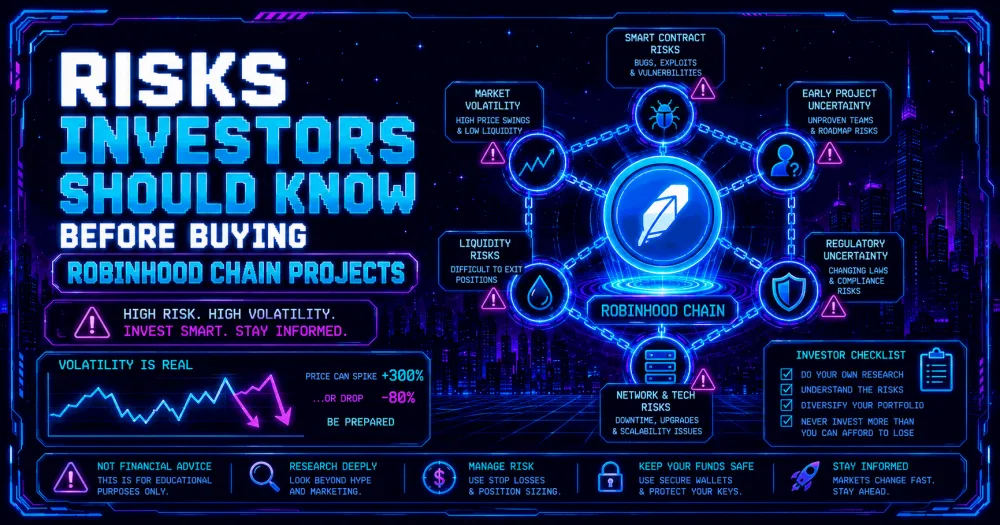
Early Ecosystem Risk
The mainnet is newly launched; therefore, it could face temporary liquidity restrictions, incentives influencing utilization, and smart contract, bridge, or application failures. Early development does not ensure ongoing product-market fit for the ecosystem.
Regulatory Uncertainty Around RWAs
Stock Tokens are not permitted in the United States or a number of other jurisdictions, and offer potentially materially different rights and exposure to underlying assets than traditional stock ownership. Regulation of RWAs is likely to evolve, potentially restricting trading or distribution of RWAs or tokens, collateralization of other crypto assets, or interaction with Robinhood Chain RWAs.
Infrastructure Projects Don’t Always Translate Into Token Performance
Inclusion of infrastructure project tokens does not indicate that the price of those tokens will increase or that investors in the Trust will benefit from value captured by the infrastructure projects.
Certain offerings lack an associated token. The value capture mechanisms for UNI, LINK, ZRO, MORPHO, and ARB differ from one another.
Which Robinhood Chain Project Has the Biggest Upside?
Uniswap, Chainlink, and Arbitrum provide much-needed foundational services, but Morpho appears to be the best Robinhood Chain token in terms of asymmetric potential. It has immediate utility in the form of the Robinhood Earn product while also potentially benefiting from wider adoption of tokenized assets for cross-margin lending.
Pleiades and Arcus each have the potential to disrupt trading of conventional financial instruments, but neither is associated with a publicly traded token. That leaves the best Robinhood crypto projects as ecosystem infrastructure plays.
Robinhood Chain is best approached as a research-intensive long-term opportunity where investors are advised to take advantage of price dips after the initial hype surrounding the launch subsides.
Robinhood Chain Projects Comparison Table
| Project | Primary Role | Public Token | Main Opportunity | Main Risk |
|---|---|---|---|---|
| Uniswap | Decentralized liquidity | UNI | Trading tokenized stocks and other assets | Limited direct token value capture |
| Pleiades | Proprietary RWA liquidity | None verified | Professional tokenized asset markets | Limited public information |
| Chainlink | Price data and interoperability | LINK | Essential infrastructure for financial applications | Indirect effect on token demand |
| LayerZero | Cross-chain messaging | ZRO | Multichain asset transfers and liquidity | Strong interoperability competition |
| Arcus | Spot and perpetual trading | None verified | Native markets for stocks, commodities, and crypto | Leverage and regional restrictions |
| Morpho | Lending and yield infrastructure | MORPHO | Credit markets for tokenized assets | Smart-contract and collateral risk |
| BitGo | Institutional custody | No ecosystem token | Institutional access and asset security | No direct token exposure |
| Alchemy | Developer infrastructure | None verified | Growth of Robinhood Chain apps | Private company without a public token |
| Arbitrum | Layer 2 technology | ARB | Expansion of Robinhood Chain and other custom networks | Weak direct value capture for ARB |
FAQ
Does Robinhood Chain Have Its Own Token?
Robinhood has not announced a token for its own chain. Their official documentation lists ETH as the gas token for transactions and does not mention any other asset. Exercise caution when considering any other purportedly official Robinhood coin, as they are likely to be scams.
What Are the Best Robinhood Chain Tokens?
The best Robinhood Chain crypto projects include UNI, LINK, ZRO, MORPHO, and ARB, among others. Each plays a critical role in the broader ecosystem, but they do not have identical risk/reward profiles. Conduct additional research before buying any of the tokens associated with Robinhood Chain projects.
Are Pleiades and Arcus Coins Available to Buy?
There is currently no known publicly traded token associated with either Pleiades or Arcus. The former is a confirmed AMM partner, while the latter is launching a decentralized trading platform with a self-custody beta. Neither officially has a coin, although the companies are each associated with Robinhood.
Is Robinhood Chain the Same as Arbitrum?
While both utilize the same core technology, Robinhood and Arbitrum are separate layer-2 blockchains. Robinhood has its own unique chain ID, applications, and ecosystem.
Can US Investors Trade Robinhood Stock Tokens?
US residents are explicitly prohibited from using Robinhood Stock Tokens. The same restriction applies to persons within the United States, including those using foreign brokerage accounts.
What Should Investors Track Next?
Track developments in decentralized exchange trading volume, lending, stablecoins, active addresses, new RWA projects on Robinhood Chain, regulatory changes, and activity beyond the initial launch incentives.