This guide helps you select the right provider under real production load — covering TON, Celestia, and multichain environments — with comparisons of latency, RPS, pricing, SLA, and network coverage. All figures should be independently verified before deployment. RPC node providers differ significantly in what they promise versus what they deliver under sustained load.

Contents
- Top web3 RPC node services
- Why RPC Choice Matters for Production Web3 Applications
- What Are RPC Node Providers and Why Web3 Applications Need Them
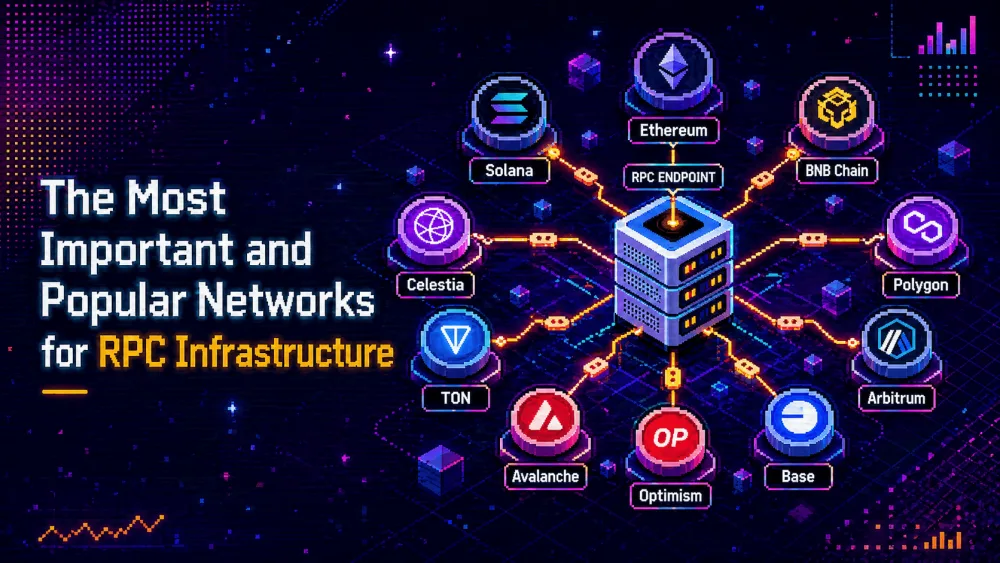
- The Most Important and Popular Networks for RPC Infrastructure
- Affiliate and Testing Disclaimer
- How We Test Recommended RPC Node Providers Before Ranking
- Detailed Reviews of Best RPC Providers for Web3 Teams
- How Blockchain Node Providers Differ from Blockchain Node Service
- Web3 Infrastructure Services for TON and Celestia Workloads
- Pricing Snapshot for Recommended RPC Providers
- Risk Matrix for leading blockchain RPC node providers
- Not Recommended: Popular RPC node providers to Avoid in Production
- Conclusion: How to Choose Blockchain Node Service Without Blindly Following Rankings
- FAQ
Top web3 RPC node services

GetBlock
40,000 free requests/day — no credit card
- Free tier: 40k req/day
- Uptime SLA: 99.9%
- Pricing: from ~$299/mo (Starter), CU-based

NOWNodes
100K free requests + 99.95% uptime
- Free tier: 100K requests, 15 RPS, 5 networks, available for 1 month
- Coverage: 120+ blockchain networks, shared and dedicated nodes
- Pricing: Pro plan from €20/mo with 1M requests; no preset RPS limits on paid plans

Tatum
100+ networks with a developer-friendly free tier
- Free tier: yes (dev)
- Pricing: Free → ~$999/mo, credit-based
- Coverage: 100+ networks

Chainstack
3M free request units/mo + 99.99% uptime
- Free tier: 3M RU/mo, 25 RPS
- Uptime SLA: 99.9%–99.99%
- Pricing: request-based, Developer plan $0
Why RPC Choice Matters for Production Web3 Applications
RPC infrastructure determines availability, latency, cost, and security posture for every dApp. The best RPC node providers serve DeFi protocols, wallets, indexers, game backends, and trading bots — each with different tolerance thresholds for downtime. Two warnings: free and shared-tier endpoints impose hard rate limits with no SLA, and vendor lock-in from proprietary extensions makes migration expensive. Regional performance varies by origin and method. The most reliable RPC nodes for crypto usually combine low p95 latency, documented failover, transparent incident history, and method-level consistency across chains.
What Are RPC Node Providers and Why Web3 Applications Need Them
RPC node providers act as a managed gateway to a blockchain network. Instead of running your own full node, you submit JSON-RPC requests to the provider’s endpoint, which routes them to synchronized nodes.
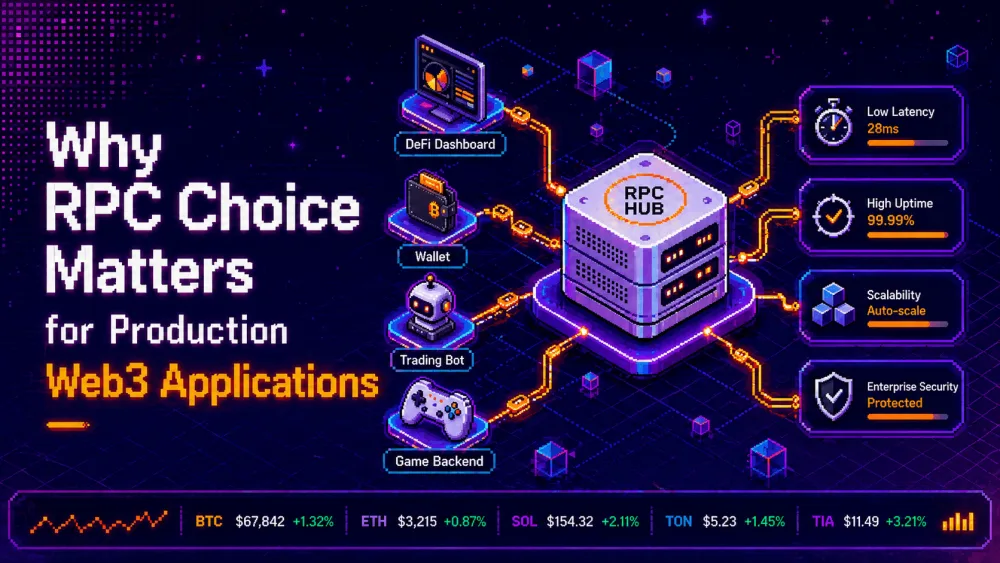
Example: a DeFi frontend calls eth_call to simulate a swap; a wallet calls eth_getBalance thousands of times per minute — on a shared endpoint, all compete for the same pool.
The top RPC node services are not always the biggest brands; they are the ones that stay stable when real users, indexers, bots, and wallets hit the same endpoint at once.
Endpoint types break into four categories:
- Public RPC — open access, no key required, heavy throttling, no SLA
- Shared endpoint — authenticated but multi-tenant; rate-limited by plan
- Private endpoint — dedicated subdomain, isolated rate limits, billed per plan
- Dedicated endpoint — single-tenant node, highest isolation, enterprise pricing
Confirm the SLA in writing before going live — shared plans produce 429 errors and data inconsistency under congestion.
The Most Important and Popular Networks for RPC Infrastructure
| Network | Role | RPC Specifics | Typical Shared Limits | Notes |
|---|---|---|---|---|
| Ethereum | L1 anchor | eth_call, getLogs, archive | 300–500 RPS (paid) | Archive adds cost |
| Solana | High-throughput L1 | getTransaction, websocket | 100–200 RPS | Method coverage varies |
| BNB▲$572.56 Chain | EVM-compatible L1 | Full EVM + BSC debug | 200–400 RPS | NodeReal specializes |
| Polygon | EVM L2 | PoS + zkEVM | 200–300 RPS | zkEVM coverage limited |
| Arbitrum | Optimistic L2 | EVM + Nitro trace | 150–300 RPS | trace_* on paid plans |
| Base | Optimistic L2 (Coinbase) | Standard EVM | 100–200 RPS | Growing coverage |
| Optimism | Optimistic L2 | EVM + op_trace | 100–200 RPS | debug_* varies |
| Avalanche | Multi-chain L1 | C-Chain, X-Chain | 150–250 RPS | X/P-chain support scarce |
| TON | Non-EVM L1 | ADNL, TonCenter API | 50–150 RPS | Verify per provider |
| Celestia | DA layer | Blob submission, namespaces | Low; verify | Few providers support |
Bitcoin and TRON appear as extra coverage on several platforms but are not primary use cases for most Web3 teams. An Optimism RPC provider should be tested separately for op_trace, debug methods, log retrieval, and L2-specific congestion behavior.
Ethereum remains the top pick for many teams, which is why in this article we intended to answer the questions like “Which Ethereum RPC provider is recommended?” and “What Ethereum RPC provider is best?”
Affiliate and Testing Disclaimer
This article may contain affiliate relationships with some listed providers. Ranking order is determined by methodology — latency benchmarks, published pricing, documentation depth, SLA terms, and observed limitations. This is not financial advice.
How We Test Recommended RPC Node Providers Before Ranking
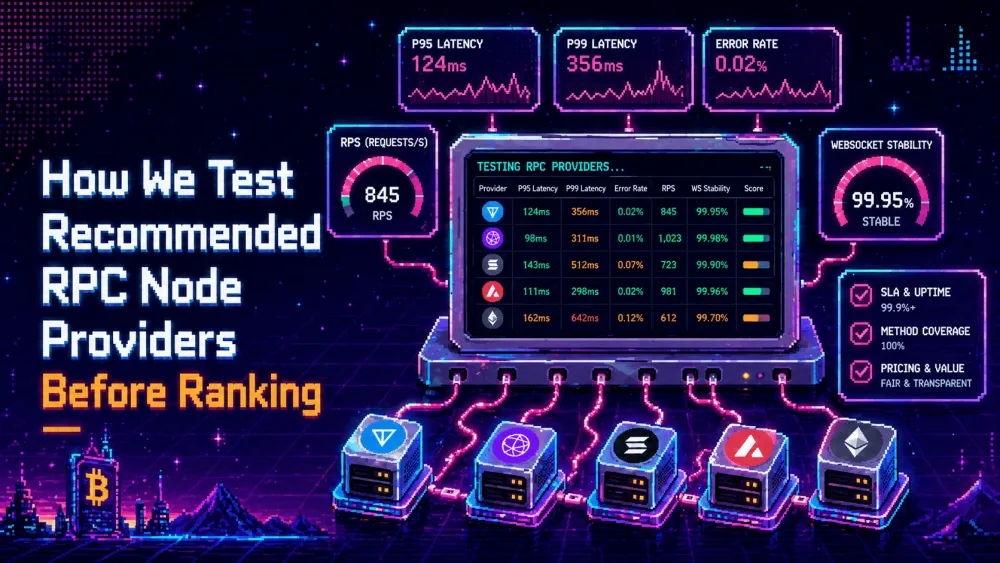
Our evaluation of recommended RPC node providers covered endpoint provisioning, read/write testing, WebSocket persistence, and archive/trace verification. Scoring ran over two weeks in February 2026 on p95 latency, error rate, method coverage, SLA transparency, and pricing clarity. Tests ran from US East and EU West; Asia-Pacific results may differ.
Performance analyst note: Mean latency is misleading — a provider with 80ms mean but 900ms p95 is a liability. Always demand p95 and p99 figures.
RPC Providers Test Bench: Latency, RPS, Error Rate, and Method Coverage
All figures are “in our test.” 429 errors and method gaps appeared on shared tiers at burst across most providers.
Evaluation Criteria for High-Performance RPC Node Providers
Scores run 6.5–9.5; p95 latency and method coverage carry the most weight for high-performance RPC node providers. For production teams, high-performance RPC node providers should be judged by sustained throughput, not by a single clean benchmark screenshot. A top-rated Ethereum RPC service should show stable p95 and p99 latency during congestion, not just high uptime on a public status page.
| Criterion | Weight | Source | Example Failure |
|---|---|---|---|
| Performance (p95/p99) | 25% | Load test | p95 > 500ms on burst |
| Reliability (uptime SLA) | 20% | SLA docs + status page | No documented SLA |
| Network coverage | 20% | Docs + endpoint test | TON/Celestia missing |
| Pricing transparency | 15% | Pricing page | CU/credits not explained |
| Tooling & dashboard | 10% | Manual review | No usage analytics |
| Support quality | 10% | Ticket + response time | >24h first response |
Why mean latency is not enough: Good averages can mask p99 spikes during congestion. Uptime SLA without latency SLA is an incomplete guarantee.
Where provider data is unavailable, this guide notes “not stated publicly.” All SLA and pricing figures reflect documentation as of April 2026; verify before signing contracts.
Detailed Reviews of Best RPC Providers for Web3 Teams
Each review covers a brief overview, a parameter table, and two strengths alongside two limitations. This section evaluates fit for specific tasks — not universal superiority. The best RPC providers match your workload, not your marketing preferences.
The best RPC providers for blockchain apps should also support the exact chains, methods, rate limits, and WebSocket behavior your product needs before launch. Leading Ethereum RPC solutions usually include Alchemy, Infura, QuickNode, Chainstack, and other providers with mature archive, WebSocket, and analytics support.
GetBlock — Ultra-Fast Solana RPC Node, Region-Specific Endpoints, Advanced Support
GetBlock supports 130+ blockchains with tiered pricing and MEV-protection for all plans. For dedicated node customers, accelerated Solana access with fastest transaction landing is available while TON RPC node comes with v4 support.
| Parameter | Detail |
|---|---|
| Supported networks | 130+ chains |
| Endpoint types | Shared, dedicated |
| Free tier | Yes |
| Entry pricing | ~$49/month |
| RPS (tested) | ~1000+ |
| Archive access | Paid plans only |
| SLA | Claimed (verify) |
Strengths: Wide chain coverage; regional endpoint selection, fast Solana and BSC RPC access.
Limitations: Debug/trace restricted on entry-level shared plans; archival access for paid plans only.
Chainstack — RPC Node Providers with Global Routing and Archive Access
Chainstack offers managed RPC node providers across 30+ networks with shared, dedicated, and archive endpoints; global routing suits latency-sensitive multi-region deployments.
| Parameter | Detail |
|---|---|
| Supported networks | 30+ including ETH▲$1,761.17, SOL▲$82.41, BNB, Polygon, TON |
| Endpoint types | Shared, dedicated, archive |
| Free tier | Yes (limited RPS) |
| Entry pricing | ~$49/month |
| RPS (tested) | ~300 on paid |
| Archive access | Yes (paid plans) |
| SLA | 99.9% claimed |
Strengths: Broad network coverage including TON; stable WebSocket in testing. Limitations: Free tier RPS is restrictive; archive pricing is buried in documentation.
Alchemy — Developer Tooling, APIs, and Fast Web3 Onboarding
Alchemy combines RPC access with developer tooling — the Notify API, transaction simulation, and analytics — using a compute unit (CU) model that charges per method.
| Parameter | Detail |
|---|---|
| Supported networks | ETH, Polygon, Arbitrum, Base, Optimism, Solana (beta) |
| Endpoint types | Shared, archive, WebSocket |
| Free tier | Yes (300M CU/month) |
| Entry pricing | $49/month and up |
| RPS (tested) | ~330 |
| Archive access | Yes (paid) |
| SLA | 99.9% (enterprise tier) |
Strengths: Superior developer tooling; stable p95 in EU/US. Limitations: CU model obscures cost for heavy workloads; SLA is enterprise-only.
QuickNode — High-Performance Routing for Trading and DeFi Workloads
QuickNode targets throughput-intensive workloads with its Streams product for real-time data delivery, broad network support, and archive access across major chains.
| Parameter | Detail |
|---|---|
| Supported networks | ETH, SOL, BNB, Avalanche, Polygon + more |
| Endpoint types | Shared, dedicated, archive, Streams |
| Free tier | Yes (limited) |
| Entry pricing | $9/month and up |
| RPS (tested) | ~350 |
| Archive access | Yes |
| SLA | 99.95% claimed |
Strengths: Best-in-test throughput; Streams is strong for event-driven use. Limitations: Credit model is hard to forecast; enterprise support requires higher-tier plans.
dRPC — Decentralized Routing and Public/Private Endpoint Models
dRPC routes requests through distributed node operators, offering free public endpoints and authenticated private access, though latency variability is a known trade-off.
| Parameter | Detail |
|---|---|
| Supported networks | ETH, SOL, Polygon, Arbitrum + more |
| Endpoint types | Public, private |
| Free tier | Yes (public) |
| Entry pricing | Pay-as-you-go |
| RPS (tested) | ~200 |
| Archive access | Selective |
| SLA | Partial |
Strengths: Cost-effective for moderate workloads; frictionless onboarding via public endpoints. Limitations: Latency predictability varies by node; SLA coverage is incomplete.
Infura — Ethereum-First Infrastructure with MetaMask Ecosystem and Archive Access
Infura is Ethereum-first infrastructure powering MetaMask and many DeFi protocols, with stable archive and WebSocket access on paid tiers for Ethereum and primary L2 networks.
| Parameter | Detail |
|---|---|
| Supported networks | ETH, Arbitrum, Optimism, Polygon, Linea + limited others |
| Endpoint types | Shared, dedicated, archive |
| Free tier | Yes |
| Entry pricing | $50/month and up |
| RPS (tested) | ~280 |
| Archive access | Yes (paid) |
| SLA | 99.9% stated |
Strengths: Proven Ethereum reliability; archive access is well-documented. Limitations: Non-EVM support is minimal; Ethereum reputation does not transfer to all chains.
Ankr — Multichain Access, Public RPC, and Enterprise API for Web3
Ankr covers 45+ chains including TON with free public RPC endpoints and paid private or dedicated plans; enterprise API access adds rate-limit isolation and dedicated support.
| Parameter | Detail |
|---|---|
| Supported networks | 45+ chains including TON |
| Endpoint types | Public, private, dedicated |
| Free tier | Yes (public) |
| Entry pricing | $99+/month (paid private) |
| RPS (tested) | ~220 |
| Archive access | Paid plans |
| SLA | Enterprise only |
Strengths: Wide chain coverage including TON; public endpoints aid initial testing. Limitations: Public endpoints carry no SLA and throttle aggressively; paid entry pricing is higher than competitors for comparable RPS.
NOWNodes — Broad Network Coverage and Simple API Access Model
NOWNodes covers 110+ networks via a simple API key model with a free tier for onboarding; breadth is its primary differentiator, though method depth is shallower than focused providers.
| Parameter | Detail |
|---|---|
| Supported networks | 110+ chains including TON |
| Endpoint types | Shared, WebSocket |
| Free tier | Yes |
| Entry pricing | $20+/month |
| RPS (tested) | ~150 |
| Archive access | Selective |
| SLA | Not stated publicly |
Strengths: Largest chain coverage tested; accessible pricing. Limitations: RPS ceiling is lower than competitors; verify blog claims against official documentation.
Blockdaemon — Enterprise Infrastructure for Compliance, Support, and Institutional Teams
Blockdaemon serves institutional clients with SOC 2-documented, dedicated managed node infrastructure across 70+ chains and enterprise-grade SLAs; custom pricing requires a sales conversation.
| Parameter | Detail |
|---|---|
| Supported networks | 70+ chains |
| Endpoint types | Dedicated, managed |
| Free tier | No |
| Entry pricing | Custom (sales required) |
| RPS (tested) | 300+ |
| Archive access | Yes |
| SLA | Enterprise SLA |
Strengths: Best compliance posture tested; genuine enterprise SLA guarantees. Limitations: Custom pricing makes direct comparison unreliable; onboarding is prohibitive for small teams.
NodeReal — BNB Chain Focus, Low Latency, and High-Throughput Scenarios
NodeReal is optimized for BNB Chain workloads, posting the lowest tested p95 latency on that network; archive, debug, and trace access are available on paid plans.
| Parameter | Detail |
|---|---|
| Supported networks | BNB Chain, opBNB, Ethereum, Polygon |
| Endpoint types | Shared, dedicated |
| Free tier | Yes |
| Entry pricing | $49+/month |
| RPS (tested) | ~400 (BNB Chain) |
| Archive access | Yes |
| SLA | 99.9% stated |
Strengths: Fastest tested p95 on BNB Chain; full trace API on paid plans. Limitations: Performance advantage diminishes on non-BNB chains; separate testing required for non-BNB workloads.
How Blockchain Node Providers Differ from Blockchain Node Service
The terms blockchain node providers and blockchain node service are often used interchangeably. A blockchain node service manages a single node for you; a blockchain node provider layers authentication, load balancing, rate limiting, and a node pool on top. A wallet backend needs a blockchain node service with uptime guarantees; a DeFi indexer needs archive access and high RPS; a trading bot needs low p95 latency and WebSocket streaming; a multi-chain backend needs a blockchain node service abstracting chain-specific provisioning. Always confirm what “managed node” means in the provider’s documentation.
Endpoint Models: Public, Shared, Private, and Dedicated
| Model | Access | Isolation | Rate Limit | Auth | SLA | Cost | Production-Ready? |
|---|---|---|---|---|---|---|---|
| Public RPC | Open | None | Very low | No | No | Free | No — testing only |
| Shared endpoint | Keyed | Low | Plan-based | API key | Partial | Low–mid | With caution |
| Private endpoint | Keyed | Medium | Plan-based | API key | Partial | Mid | Yes, with monitoring |
| Dedicated endpoint | Keyed | Full | Custom | API key + IP | Yes | High | Yes |
Infra architect note: A single dedicated endpoint with no failover is a single point of failure — route critical traffic through at least two providers.
Requirements for Archive, Debug, Trace, WebSocket, and gRPC Access
Method availability depends on plan tier and network:
- Archive — for historical queries beyond ~128 blocks; paid-only on most providers
- Debug — required for internal transaction tracing; restricted to dedicated plans
- Trace — needed for DeFi analytics and MEV tooling; throttled on shared plans
- WebSocket — required for event subscriptions; available on paid tiers
- gRPC — available on fewer providers; lower overhead for high-frequency feeds
The best Ethereum RPC API for Web3 use should support eth_call, eth_getLogs, WebSockets, archive reads, transaction simulation, and predictable pricing under burst traffic.
Throttling on heavy methods is common; verify method-by-method for each target network — never assume Ethereum coverage applies elsewhere.
Story Protocol RPC Endpoint: What to Verify Before Integration
A story protocol RPC endpoint should be evaluated like any other production blockchain access layer: method availability, rate limits, latency under sustained load, WebSocket stability, and provider documentation all matter more than headline network support.
Teams building around Story Protocol should confirm:
- Whether the provider supports the exact RPC methods their application needs
- Whether archive or indexing functionality is available
- Whether the endpoint is covered by the same SLA and status-page reporting as larger EVM networks
Web3 Infrastructure Services for TON and Celestia Workloads
TON and Celestia require separate evaluation from EVM chains. Web3 infrastructure services that handle Ethereum well may offer limited, underdocumented support for these networks. TON operates on a unique architecture (ADNL, TonCenter API) with different finalization behavior; a TON RPC node exposes different methods from an Ethereum node. Accessing Celestia RPC correctly requires blob submission support and namespace-based data retrieval. When evaluating any provider for TON or Celestia, verify method support (not just network listing), request limits, and whether the status page covers TON/Celestia incidents.
When Dedicated TON RPC Node Is Safer Than Shared Access
A dedicated TON RPC node reduces rate-limit collisions and improves log visibility; shared TON RPC node access can work for an MVP, but rate limits compound at scale. Use dedicated access when:
- Your application sends more than 50 TON RPC requests per second
- You need guaranteed method availability (e.g.,
getTransactions,getMasterchainInfo) - SLA is required contractually for payments, custody, or regulated services
- Failover and audit logs are required for compliance
Two limitations: dedicated TON access is offered by only a subset of providers, and costs exceed EVM-equivalent tiers. Verify method support separately from marketing materials.
How to Test Reliability of Celestia RPC and Celestia RPC Node
A complete evaluation of any Celestia RPC node goes well beyond a single status request:
- Endpoint availability — confirm the endpoint responds to namespace queries across at least three test periods
- Blob submission — test actual blob submission on testnet; confirm the method is not silently rejected
- Namespace retrieval — retrieve data from a known namespace to verify complete read access
- Request limits — measure when throttling begins; Celestia RPC workloads generate high request counts
- Status history — check the provider’s status page for Celestia-specific incidents over at least 30 days
Common failures: Celestia support limited to light node access only, and WebSocket instability during high blob-submission periods.
Pricing Snapshot for Recommended RPC Providers
Pricing differs significantly between RPC providers — request-based, CU-based, RPS-based, and dedicated flat-fee models each produce different effective costs. Top web3 RPC node services increasingly compete on price, as well as on analytics dashboards, multi-region routing, archive access, and predictable overage policies.
| Provider | Model | Free Tier | ~20M req/mo cost | ~50 RPS burst | Archive add-on | Overage policy |
|---|---|---|---|---|---|---|
| Chainstack | Requests | Yes | ~$49 | Included | Yes (higher plan) | Throttle or upgrade |
| Alchemy | CU | Yes (300M CU) | ~$49–$199 | Method-dependent | Included (paid) | Throttle |
| QuickNode | Credits | Yes | ~$49–$99 | Credit-limited | Included (paid) | Throttle or overage |
| GetBlock | CU | Yes | ~$49 | Plan-limited | Paid only | Throttle |
| dRPC | Requests | Yes | Pay-as-you-go | Flexible | Selective | Per-request |
| Infura | Requests | Yes | ~$50 | Plan-limited | Yes (paid) | Throttle |
| Ankr | Requests | Yes | ~$99+ | Private plan | Paid | Throttle |
| NOWNodes | Requests | Yes | ~$20–$50 | Plan-limited | Selective | Throttle |
| Blockdaemon | Custom | No | Custom | Custom | Yes | Custom |
| NodeReal | Requests/CU | Yes | ~$49 | Plan-limited | Yes (paid) | Throttle |
FinOps note: Hidden costs come from method weight multipliers, undisclosed archive add-ons, and support tier upgrades required for SLA. Model your exact call mix before committing.
Credits, CU, RPS, Overages, and SLA Cost Math
Understanding what leading blockchain RPC node providers charge requires translating plan limits into production equivalents. A “30M requests/month” plan may deliver only 15M effective calls if eth_getLogs consumes 2–5 CU each.
| Scenario | Volume | Method Mix | Estimated Cost | Risk |
|---|---|---|---|---|
| Light DeFi frontend | 5M req/mo | 80% eth_call, 20% getLogs | $20–$49 | Low |
| Active wallet backend | 20M req/mo | Mixed reads + sends | $49–$199 | Medium |
| DeFi indexer (archive) | 50M req/mo | Heavy getLogs, archive | $200–$800+ | High (method weights) |
| Trading bot (burst 50 RPS) | Variable | sendRawTransaction heavy | $100–$500+ | High (credit burn) |
All figures are approximations; custom-priced plans require a detailed quote.
Budget Traps of popular RPC node providers in web3
Popular RPC node providers in web3 advertise entry prices that obscure true production costs. Five common traps:
- Method weight multipliers — CU platforms charge 5–10× more for archive or trace calls than basic reads
- Low free-tier RPS — free plans may allow millions of requests per month but throttle at 5–10 RPS
- Archive as an add-on — several popular RPC node providers charge a separate archive premium not shown in headline pricing
- Enterprise-only support — SLA guarantees are often gated behind enterprise contracts
- Regional throttling — stricter rate limits outside primary data centers, undisclosed in standard documentation
Verify before migrating: request a cost estimate for your actual call mix, test archive access on a trial account, and read support policy documentation carefully.
Risk Matrix for leading blockchain RPC node providers
A risk matrix is more useful than a ranking for evaluating leading blockchain RPC node providers:
| Risk | Severity | Detection Method | Mitigation |
|---|---|---|---|
| Vendor lock-in | High | Proprietary API extensions in use | Use standard JSON-RPC; test with fallback provider |
| Failover gap | High | Single endpoint, no redundancy | Multi-provider routing with health checks |
| Regional coverage | Medium | Latency test from target region | Select providers with PoPs near your users |
| Data consistency | Medium | Compare responses across providers | Cross-validate archive queries periodically |
| Compliance | Medium–High | No SOC 2 or audit docs | Request compliance documentation in writing |
| Support speed | Medium | Measure first-response time on trial | Upgrade support tier before go-live |
Three warnings: a status page is not an SLA. SOC 2 badges are not the same as a current audit report. Provider incidents often affect multiple chains simultaneously — test failover logic under simulated failure. Popular RPC node providers can still fail production tests if archive methods throttle, WebSockets disconnect, or support response time slips during incidents.
Vendor Lock-In, Failover, Compliance, and Support Risks
Four concrete risks for Web3 infrastructure services: vendor lock-in from proprietary APIs (use standard JSON-RPC for critical paths); failover absence from single-endpoint dependency; compliance gaps if the provider cannot produce a current audit report; and slow support response causing incident revenue loss. Multi-provider routing is also a negotiating lever — providers offer better SLA terms when they know you have a fallback.
The best RPC services make migration easier by supporting standard JSON-RPC methods, clear documentation, fallback routing, and exportable usage data.
Not Recommended: Popular RPC node providers to Avoid in Production
Rather than naming specific companies, this section describes risk profiles. Avoid any popular RPC node providers that match these patterns:
- No SLA documentation — if a provider cannot produce an uptime SLA or a status page with historical data, they are not production-ready
- Weak documentation — popular RPC node providers in web3 with incomplete API references create debugging burdens that outweigh cost savings
- Unknown resellers — aggregators that do not disclose their upstream node operator introduce a hidden dependency
- Single-region endpoints — any provider with a single data center and no failover path is a liability for latency-sensitive applications
Always require a published SLA, a documented upstream, and two active PoP locations before provisioning any production endpoint.
Free Public Endpoints Without SLA or Status Proof
Free public endpoints are appropriate for prototyping, not production. Known limitations: rate limits as low as 5 RPS per IP, no SLA, no support channel, and data inconsistency during congestion. Use a paid shared plan with a status page, or a community-maintained fallback paired with a primary paid provider, once any real user funds or time-sensitive reads are involved.
Unknown Resellers Without Documentation, Limits, or Support Proof
Five questions before purchasing from any reseller: Who is your upstream node operator? What is your rate-limit policy? Do you have a status page with 90 days of uptime history? What is your first-response SLA? Can you provide a sample SLA agreement? Walk away if questions 1 and 3 cannot be answered, or if answers reference internal systems that cannot be independently verified.
Single-Region Endpoints for Latency-Sensitive Applications
| Application Type | Risk | p95 Impact | Failover Consequence |
|---|---|---|---|
| Trading bot | High | +200–500ms on regional event | Missed execution windows |
| Wallet | High | Slow balance/tx confirmation | User-facing error |
| Game backend | Medium | Visible lag on chain reads | Degraded experience |
| Internal monitoring | Low | Acceptable delay | Alert latency only |
Single-region endpoints are acceptable for internal dashboards and MVPs with no real-asset exposure. Multi-region coverage is a baseline for production applications.
Conclusion: How to Choose Blockchain Node Service Without Blindly Following Rankings
Choosing a blockchain node service requires matching provider capabilities to your workload — not following a static ranking. The results here reflect testing from February 2026 and are not universal across geographies or networks. The best RPC node providers should be tested with your own call mix, because generic rankings rarely reflect real method cost, burst behavior, or regional latency.
Identify your target networks, define your p95 latency threshold, calculate monthly request volume by method type, determine whether archive or trace access is required, and confirm SLA terms in writing. Test two or three RPC node providers with production-representative traffic before committing. The best RPC node providers are the ones that hold up under your specific load — provision trial endpoints, run your RPC method mix for 72 hours, and compare p95 latency and error rates.
Author: Infrastructure and DevRel editorial team, reviewed April 2026. Verify all figures against provider documentation before deployment. Report errors via the Bitcoin Foundation contact form.
Sources: Provider pricing pages (Chainstack, Alchemy, QuickNode, GetBlock, dRPC, Infura, Ankr, NOWNodes, Blockdaemon, NodeReal); docs.celestia.org; docs.ton.org; provider status pages; CompareNodes. All accessed April 2026.
FAQ
How do RPC node providers differ from public RPC endpoints?
RPC node providers are managed services that offer authenticated access, defined rate limits, SLA guarantees, support channels, and billing — everything a public RPC endpoint omits. A public endpoint is an open, shared channel with no guarantees, no support, and no isolation. Endpoint types range from shared to private to dedicated, each with a different risk profile. Public endpoints are not a managed service replacement; treat them as temporary infrastructure only.
How to choose best RPC node providers for Web3?
Evaluate on five criteria: network coverage for your target chains, p95 latency under your expected RPS, pricing model and method cost transparency, support tier and SLA terms, and archive/trace access if required. Test actual RPC methods from your codebase — not just a ping. The best RPC node providers for your project are determined by your load profile, not industry reputation. Recommended RPC node providers for blockchain projects should be filtered by network support first, then tested for latency, uptime, archive access, and support quality.
Are best RPC providers always paid?
Free tiers are appropriate for prototyping and light development. Production applications that handle real assets, require consistent availability, or exceed 10 RPS typically need paid plans with SLA coverage, private endpoint isolation, and support access. Two cases where paid plans still fall short: providers that gate SLA behind enterprise contracts, and plans where archive access is an undisclosed add-on.
Which companies are the best free RPC providers?
For development, Alchemy, Infura, QuickNode, Chainstack, Ankr, dRPC, and NOWNodes are common starting points, but free tiers should not be treated as production infrastructure.
Which Ethereum RPC is recommended for Web3?
The practical answer depends on whether the workload is a wallet, DeFi frontend, indexer, trading bot, or analytics backend. The best Ethereum RPC provider for one team may be poor for another if archive access, trace calls, or CU pricing do not match the application’s real usage.
What’s the top Ethereum RPC provider?
For most teams, the shortlist starts with Alchemy, Infura, QuickNode, and Chainstack, then narrows after latency, cost, and method testing. Alchemy often fits tooling-heavy teams, Infura fits Ethereum-first reliability needs, QuickNode fits throughput-heavy workloads, and Chainstack fits multi-region infrastructure.
When do you need a TON RPC node?
A TON RPC node is required for any production application built on the TON blockchain — wallets, payment processors, indexers, and bots. Key metrics to verify: response latency for TON-specific methods, availability of getTransactions and getMasterchainInfo, rate limits under sustained load, failover options, and whether the provider’s documentation explicitly lists TON support with method-level detail.
What is the difference between Celestia RPC and Celestia RPC node?
A Celestia RPC node is a full infrastructure deployment — a running Celestia node that processes and stores data availability information. A Celestia RPC endpoint is the access point through which your application submits queries or blob transactions to that node. Confirm: namespace retrieval works for your use case, blob submission is available, and the provider’s status history includes Celestia-specific data. Ask which node type runs behind the endpoint and what rate limits apply to blob submission.
Should you use a dedicated TON RPC node for production?
A dedicated TON RPC node is the right choice when your application requires stable, isolated throughput — especially for payment processing, custody, or high-frequency indexing. Shared access may suffice for an MVP. Two limitations: cost is significantly higher than shared tiers, and dependency on a single provider increases vendor concentration risk. Always provision a fallback before relying on any dedicated endpoint in production.
Which blockchain node providers support archive, debug, and trace?
Most major blockchain node providers offer archive access on paid plans for Ethereum and primary EVM chains. Debug and trace availability is narrower — often restricted to dedicated or premium plans, and not uniformly available across all supported networks. Verify method support by chain and plan tier before provisioning. Even large providers may throttle heavy methods on shared infrastructure.
How to benchmark Web3 infrastructure services?
A meaningful benchmark of Web3 infrastructure services requires at least three geographic origins, six representative RPC methods (including one archive and one write method), two load levels (sustained and burst), p95 and p99 latency measurement, error rate tracking over at least 24 hours, and WebSocket reconnection testing. Repeat the benchmark after any plan upgrade or provider incident. A single-session test is not sufficient to evaluate production reliability.