
Contents
- What Are Crypto Liquidity Providers and Pools?
- Why Liquidity Is Critical in Crypto Trading in 2026
- Top 5 Crypto Liquidity Providers & Pools in 2026
- How to Choose the Best Liquidity Pool
- Risks of Providing Liquidity in 2026
- How to Earn Passive Income with Liquidity Pools
- DeFi Trends Shaping Liquidity in 2026
- Centralized vs Decentralized Liquidity Providers
- Future of Crypto Liquidity and Market Depth
- FAQ – Crypto Liquidity Providers and Pools 2026
What Are Crypto Liquidity Providers and Pools?
Definition of Liquidity in Cryptocurrency Markets
Liquidity in cryptocurrency markets means being able to buy and sell assets quickly, at reasonable prices, and with low impact on the prices of those assets. Liquidity is an important factor in determining the spreads (the difference between buying/selling) for an asset, as well as the amount of slippage (how much the spread widens when you execute a trade), which are both important factors that contribute to the liquidity depth and trading efficiency of the crypto markets.
Traditional markets provide liquidity from central entities such as exchanges or crypto market makers. Decentralized finance, however, provides liquidity through supplied capital from users. Crypto liquidity pools provide liquidity through a different mechanism than order books. They are computer-based algorithms created to continuously provide trading opportunities.
For centralized venues, the best crypto exchange liquidity provider is usually the firm or market-making desk that can maintain deep order books, narrow spreads, and reliable execution across volatile market conditions. A crypto exchange liquidity provider helps centralized venues keep spreads tight, order books deep, and large trades executable without major price distortion.
How Liquidity Providers (LPs) Work
DeFi’s core mechanisms rely on understanding how crypto liquidity providers work. As the name suggests, liquidity providers are either individual users or organizations that place asset pairs into smart contracts — normally in equal amounts.
For this action, LPs receive an LP token that represents their stake within that pool and will also receive a percentage of the trading fees generated from those swaps. The incentive alignment for this model exists as follows: Traders can execute trades quickly, and LPs can be paid passively for providing liquidity.
Retail individuals and institutional investors make up modern crypto liquidity providers in 2026. With more firms using automated strategies and new types of liquidity aggregation crypto tools, institutional investors are increasingly optimizing where they deploy their capital across many different exchanges.
This process relies upon Automated Market Makers (AMM). AMMs utilize algorithms rather than order books to calculate the prices of all assets dynamically.
Role of Liquidity Pools in DeFi Ecosystem
DeFi liquidity pools serve as the core base upon which DeFi operates – facilitating the ability to engage in a wide variety of activities, including, but not limited to, swapping tokens, engaging in lending, and generating yields.
Uniswap — and other similar types of DeFi platforms — do not support direct matches of buyer and seller. Instead, these platforms utilize pre-defined pools of assets, which can be traded by the user using smart contract functionality to allow for continuous 24/7 trading capability without an intermediary.
Read Also: Major Ethereum Updates 2026: Overview, Protocol Upgrades and Strategic Roadmap
The emergence of leading DeFi liquidity pools in 2026 is indicative of a larger trend toward developing automated, open-source financial systems. In addition to supporting exchange activity, the liquidity pools provide the basic structural basis for more sophisticated applications of DeFi technology — such as derivative products, synthetic assets, and cross-asset/chain-based liquidity.
Therefore, liquidity pools are now an essential element of modern cryptocurrency markets and represent a new type of structured system (replacing intermediaries) capable of providing programmability and greater efficiency when compared to capital-intensive systems.
Why Liquidity Is Critical in Crypto Trading in 2026

Impact on Price Stability and Slippage
Liquidity is the major determinant of market stability in 2026. A high level of liquidity enables very large trades to occur without substantially impacting prices; conversely, a low level of liquidity produces volatile price movements and increases the risks associated with the execution of trades.
The effect of a lack of sufficient liquidity on traders is clearly seen through slippage. Slippage refers to the difference between what was anticipated when initiating an order for execution and the ultimate price at which that trade ultimately executes. This happens because either there are inadequate numbers of other orders existing within the order book from which the executing firm can draw as it attempts to complete its trade, or because the size of the orders being submitted is so large that they consume all available liquidity. The best crypto exchange liquidity provider is usually the one that can maintain reliable execution across Bitcoin, Ethereum, stablecoins, and major altcoin pairs during volatile market periods.
A deep market that is backed by crypto liquidity providers in 2026 will have tighter bid/ask spreads and provide a greater degree of predictability regarding the execution process of trades. Both factors help reduce trading costs and stabilize price movements. On the other hand, a weakly liquid environment could potentially make even modest-sized trades become events capable of producing significant price movement; this would be particularly likely to be true in the case of smaller tokens or illiquid marketplaces.
Therefore, since confidence in price discovery is critical to the participation of both retail and institutional investors, liquidity is an essential element in encouraging such confidence.
Current market structure also makes current crypto market liquidity conditions 2026 a key factor for traders, since thinner liquidity can magnify slippage, widen spreads, and make even strong assets harder to trade efficiently.
Liquidity and Market Efficiency
Liquidity plays a major role in the overall market efficiency because, with institutionalization in the crypto space, there will be more reliance on it. In 2026, efficient markets will have two main characteristics: speed, fairness, and low friction for the execution of trades. The speed, fairness, and frictionless nature of executing trades depend directly on the liquidity depth and trading execution effectiveness.
“Market making in crypto involves continuously quoting buy and purchase orders to provide liquidity, price stability, and smoother trading experiences.” — Industry research report, 2026
Having well-supplied markets permits continuous price discovery instead of discrete trade-by-trade fluctuations. Continuous price discovery is also vital to a 24/7 environment that has continuous trading activity, and therefore, requires constant liquidity levels across global time zones.
The increasing use of liquidity aggregation crypto solutions will provide additional efficiencies in the form of routing orders across several venues. A crypto liquidity aggregator helps traders reduce slippage by routing orders across several pools, exchanges, and market makers instead of relying on one venue, thus giving traders the most favorable execution regardless of whether they are operating in a fragmented or consolidated marketplace. Therefore, liquidity is now an active participant in the development of a trading platform’s infrastructure, as opposed to being a passive statistic.
Role in Decentralized Exchanges (DEXs)
Decentralized trading’s primary foundation is the concept of liquidity. In contrast to the use of centralized exchanges as well as order books, DEX’s are based solely upon their own DeFi liquidity pools to operate.
These liquidity pools replace the AMM’s (automated market makers) that have traditionally been used to continuously provide trading options by using the user’s inputted asset(s) and then swapping them against the liquidity pool. This reduces the requirement for counterparties. As stated previously, there are limitations to the model. Primarily, it relies upon the quality of the liquidity provided to both the quantity and distribution of liquidity within a given pool.
The number of top DeFi liquidity pools in 2026 increased enough to improve the overall dex experience through lower levels of slippage and increased trade size. Competition among these pools will continue to be competitive and will permit dynamic fees. Dynamic fees additionally improve pricing and attract additional capital.
The best liquidity pools usually combine deep TVL, consistent trading volume, audited smart contracts, and realistic fee income rather than temporary reward spikes.
Top 5 Crypto Liquidity Providers & Pools in 2026
The best crypto liquidity providers in 2026 include both DeFi protocols and professional market makers, depending on whether the priority is self-custody, execution depth, or institutional support. A practical crypto liquidity providers list should separate AMM protocols, centralized exchanges, OTC desks, market makers, and aggregation tools because they solve different liquidity problems.
1. Uniswap – Leading Decentralized Liquidity Protocol
The Uniswap liquidity pool is still the gold standard for decentralized liquidity through 2026. The largest AMM-based exchange with the highest volume, Uniswap, offers very deep liquidity across over a thousand different ERC-20 pairs, due to its concentrated liquidity model, and it now operates on multiple chains.
This model has positioned Uniswap as one of the best crypto liquidity providers for trading efficiency, particularly for blue-chip assets and stablecoin pairs.
2. Curve Finance – Stablecoin Liquidity Specialist
Curve Finance liquidity pools continue dominating stablecoin trading due to a low slippage design focused on the price of assets. This brand has made a name for itself through offering a low-slippage design in order to provide liquidity pool designs for stablecoin (USDT▼$0.9997) and other asset pairs that are priced similarly. This has enabled Curve to offer one of the best stablecoin liquidity pools available with the lowest amount of slippage in the marketplace.
Curve Finance’s algorithm lowers the price impact even for large trades and, as such, is a preferred venue for institutional-sized stablecoin swaps.
3. Balancer – Multi-Token Liquidity Pools
The best crypto liquidity provider for a protocol is not always the largest firm, but the one that can support launch depth, stable spreads, and long-term market health.
Balancer’s ability to have flexible pool designs allows users to have multiple token pools with customized weights. This is different from your average two-asset pool as it provides the user with the ability to diversify their exposure to many assets with one pool. By doing so, the user is able to provide liquidity and also manage their portfolios all at once.
As such, this style of configuration will appeal to more advanced DeFi users who are looking for ways to dynamically allocate their tokens and earn some form of fee. As an example, Balancer continues to be ranked in the top DeFi liquidity pools in 2026 for its use of complex asset baskets and also for use by DAO treasuries.
4. Binance Liquidity Pools – Centralized Exchange Liquidity
On the centralized side, Binance has the highest liquidity levels available within the global markets, due to high volumes of trades being executed and a large number of orders on its books. The pool-based products also provide users with additional yield opportunities that are still supported by Binance’s liquidity depth.
Binance’s hybrid model combines centralized matching engine technology with decentralized pool-based incentivization models; therefore, making certain that all trades have high-quality executions with minimal slippage, enabling Binance to be a major player in both retail and institutional-level trade environments.
5. PancakeSwap – High-Yield Liquidity on BNB Chain
PancakeSwap is still one of the leading protocols that support liquidity in the BNB▼$724.53 chain. The main reasons why it’s well-known are its low costs, fast speeds, and large number of retail participants.
PancakeSwap v4 stablecoin pools features 2026 include swap efficiency, hook design, stable-pair pricing, fee customization, and BNB Chain execution costs.
The AMM model from PancakeSwap allows a huge variety of BEP-20 tokens to be added, which makes it easier for many new LPs (Liquidity Providers) to enter the space at an accessible price point where they can earn higher returns.
This ecosystem is one of the most vibrant DeFi spaces because it offers so many different ways to earn rewards through yield farming, staking, and gamified incentivization.
It will continue to be one of the best crypto liquidity providers for people who prioritize generating revenue or saving money with lower costs than institutional-grade liquidity.
The expected PancakeSwap v4 stablecoin pools features 2026 also matter because better hooks, custom pool logic, and more efficient stablecoin swaps could make PancakeSwap more competitive against larger Ethereum-based liquidity venues.
How to Choose the Best Liquidity Pool

Top crypto liquidity providers should be compared by execution quality, supported assets, transparency, counterparty risk, and ability to handle stress during market spikes. A best liquidity provider crypto shortlist should include providers that can prove uptime, depth, reporting quality, and execution consistency before capital is committed.
Users researching how to add liquidity to PancakeSwap v4 stablecoin pools 2026 should first verify supported pairs, pool parameters, fee tiers, smart contract risks, and withdrawal rules.
Key Metrics: TVL, Volume, APY
Identifying the top crypto liquidity pools of 2026 will be based on essential Performance Indicators (PIs). The most commonly utilized indicator is Total Value Locked (TVL), which measures the total amount of capital committed to a protocol and represents a measure of both the level of trust within a community and the overall depth of liquidity.
A higher TVL typically represents greater levels of confidence from participants in the marketplace and also creates better trading conditions, such as lower slippage. However, while TVL provides insight into trust and liquidity, it is just one piece of the puzzle. The other important factor is trading volume; this is the key determinant of how much revenue is being generated through fees for providing liquidity.
Read Also: Crypto Market Maker Disclosure Near Zero Across Top Tokens: Data
Finally, APY (Annual Percentage Yield) completes the three-dimensional picture representing expected or projected returns. A high APY may attract large amounts of capital; however, it also increases risk, especially if the APY is artificially inflated due to token incentives instead of being derived from natural/organic trading activity. The best crypto liquidity pools are usually safer when their returns come from durable trading activity rather than short-term incentive emissions.
Taken together, these three metrics represent the factors that are used to determine which platforms are ranked as the best crypto liquidity providers and provide guidance to investors regarding pools that maximize profit whilst maintaining sustainability. For many users, the best crypto liquidity pools are not the ones with the highest APY, but the ones with durable volume, deep TVL, audited contracts, and manageable volatility.
Risk vs Reward in Liquidity Provision
Liquidity provision represents an opportunity cost between providing returns and taking on risk. The main mechanism through which yields are produced is via trading fees that grow directly with volume and user participation. Higher yields may be associated with greater volatility or less liquid/less stable token pairs.
Capital efficiency — how much a protocol produces in terms of revenue relative to its base amount of liquidity — is one of the most important factors in determining how sustainable the returns will be from a given pool.
Users have to balance their desire for income with their tolerance for risk, including impermanent loss and token volatility. Users who participated in DeFi protocols in 2026 were considering liquidity aggregation crypto across multiple pools to maximize returns, as opposed to solely using a single liquidity pool.
Which crypto swap service has the best liquidity and low slippage depends on the asset pair, trade size, chain, routing engine, and whether the swap crosses centralized or decentralized venues. In order to choose between top DeFi liquidity pools in 2026 you need to find a way to consistently provide income while exposing yourself to reasonable amounts of risk.
Platform Security and Reputation
Due to the fact that any liquidity platform’s security and reputation will be important in assessing them, there is always an inherent danger associated with DeFi liquidity pools’ smart contract-based functionality. When vulnerabilities or exploits occur with DeFi liquidity pools, losses will occur immediately. Even top liquidity pools should be checked for real volume, fee generation, audit history, impermanent loss exposure, and whether liquidity is concentrated in useful price ranges
Proven protocols with long operating histories, regularly audited by third-party firms, and actively maintained by the developer community generally provide better safety than other options. Although high TVL may indicate to some extent that a particular protocol is trustworthy, higher TVLs also create larger target opportunities for attackers, which reinforces the importance of performing your own research on each platform.
With increased institutional investment into DeFi liquidity platforms as early as 2026, leading participants have elevated their stress on transparency, auditability of code bases, and creating solid risk management processes to increase confidence in bringing in both institutional and retail capital.
For users evaluating the best crypto liquidity providers for trading efficiency, security is no not optional—it is a defining factor in long-term capital preservation.
Risks of Providing Liquidity in 2026
Impermanent Loss Explained
DeFi’s impermanent loss represents the single greatest risk associated with providing liquidity in pools. Liquidity pool participants experience losses due to their deposits becoming unbalanced through a change in the price of two or more assets.
This happens because the automated market makers (AMMs) that are intended to maintain token maintain balance through changing prices will either have too many tokens of the falling asset on hand after the price falls, and/or too few tokens of the rising asset.
When an AMM has unbalanced amounts of two different tokens, they lose money relative to the total amount of tokens held, even though it has no direct exposure to losing or gaining money based on asset value appreciation or depreciation.
Smart Contract Vulnerabilities
A major threat to liquidity providers in 2026 will be smart contract risks. Because a DeFi pool is controlled solely through code, if there is a bug or vulnerability in that code, the result could be instant loss of funds.
Historically common bugs/attacks include Logic Errors (the most obvious), Reentrancy Attacks, and Oracle Manipulation, resulting in Billions of dollars lost within the DeFi Ecosystem.
An audited protocol does not automatically mean it is secure. The Openness and Composability of DeFi result in multiple possible areas for an attacker to strike, and as such, even with improved auditing and monitoring tools, security continues to be a major challenge.
Market Volatility and Token Risk
Volatility of a cryptocurrency’s value adds extra risk to providing liquidity. Unpredictable price movements are also inherent characteristics of traditional markets; however, they occur at a faster rate within crypto asset markets. This contributes toward variability in pool compositions and returns.
As such, liquidity providers engaged in trading pairs will be subject to both price movement (and/or divergence) and broader sentiments of the overall market. These two variables combined amplify potential losses. Low-liquidity tokens present a greater degree of downside risk because demand is typically lower, and there is less volume of trade in these types of tokens.
Therefore, it is important that liquidity providers assess their own risk when engaging in lending or borrowing from crypto-based platforms, and those looking for stable yields should focus on this aspect, particularly in today’s competitive and increasingly complex DeFi environment.
How to Earn Passive Income with Liquidity Pools

Yield Farming Strategies
Yield Farming continues as a leading way for individuals to earn money through crypto liquidity pools in 2026. Capital can be allocated to several pools at once to maximize the returns associated with trading fees and reward incentives provided by each pool.
The new advanced methods are dynamic allocation models that allow capital to move between pools as needed based upon APY, volume, and risks involved. Many times, this type of model is assisted through various types of liquidity aggregation crypto tools that provide an optimal amount of yield across multiple protocols.
Ultimately, the best method focuses on long-term viability (returns) versus short-term incentives, and pools that consistently have high levels of trading activity and deep levels of liquidity will typically produce the greatest returns.
Staking vs Liquidity Providing
As Decentralized Finance (DeFi) continues to grow and mature, the difference between offering liquidity and staking will be of increasing importance. Typically, staking is about securing a decentralized network by “locking” assets; thereby enabling relatively predictable returns while limiting exposure to financial volatility.
However, liquidity provision allows for much greater potential reward through fees and incentives; however, it also bears notable risk, including impermanent loss and price divergence, thus making it an active form of investing versus staking.
By 2026, users are expected to have begun combining these two strategies together – using a balance of the consistent yields that can be provided by staking with the high return opportunities presented by DeFi’s liquidity pools – to maximize their investment portfolios.
Maximizing Returns with Low Risk
The need to be cautious in selecting which pools to include in an investment portfolio, as well as diversifying those selected pools, is necessary to maximize returns and minimize possible risks. The use of stablecoin pairs continues to be one of the most favorable options for investors looking for lower volatility, and therefore may provide the highest amount of best stablecoin liquidity pools with low slippage and the greatest stability in their income stream.
Diversifying across multiple pools and platforms lowers exposure to single-point failures, while concentrating on high-liquidity markets improves crypto liquidity depth and trading execution effectiveness.
Read Also: Bitcoin Price Repeats 2018 Signal as Bear Phase Enters Month Three
Since 2026, there have been changes that are now modifying how investors make decisions regarding which strategies will perform better. More institutions and individual investors are now placing greater importance on the need for risk-adjusted returns over the need for aggressive yield chasing. Therefore, many successful strategies are being developed based upon investor requirements for consistent and secure capital allocation, versus maximizing APY.
DeFi Trends Shaping Liquidity in 2026
Growth of Automated Market Makers (AMMs)
Automated Market Makers (AMMs) have become the most commonly used liquidity models for DeFi applications. They replaced traditional Order Books through the use of algorithms to provide pricing. In 2026, there will be an increase in how efficient capital is in AMMs; as a result, it will allow liquidity providers to focus their fund resources into a particular price range to enhance profits.
Besides, this advancement has resulted in improvements to crypto liquidity pools, resulting in deeper markets requiring less capital. Therefore, advanced AMM designs currently exist that include: dynamic fees, enhanced routing, and improved management of volatility; all of which add to how crypto liquidity providers work in modern DeFi.
Therefore, the automated market maker is no longer simply a DeFi primitive but instead a core part of the global on-chain trading infrastructure.
Cross-Chain Liquidity Solutions
Cross-chain liquidity is emerging as a key trend that will address the fragmentation across multiple blockchains. By 2026, cross-chain liquidity will allow asset transfers to take place on each network with ease, thus enabling a better use of capital within an ecosystem.
This shift is critical for improving crypto liquidity depth and trading performance, as liquidity is no longer confined to a single chain. Instead, it can be aggregated across ecosystems, decreasing slippage and improving pricing consistency.
Cross-chain infrastructure also enables the emergence of liquidity aggregation crypto, which optimizes trade paths in real-time across multiple blockchains and liquidity.
Institutional Liquidity
Beginning in 2026, we will see institutional participation impact liquidity trends in cryptocurrencies. As a result of this shift, leading firms such as Wintermute market maker are increasingly shaping liquidity across both centralized and decentralized marketsб thereby increasing the liquidity in these markets, and providing better and more sophisticated trading options.
Institutional players, including Cumberland OTC crypto, continue to provide deep off-exchange liquidity for large-volume trades.
What are best liquidity pools for institutions? Usually, they are deep stablecoin, blue-chip, and permissioned or compliance-aware pools with strong reporting, low slippage, and audited infrastructure.
In addition to boosting liquidity in the crypto space, stablecoins have grown to over $300 billion in market size and have enabled on-chain liquidity to be used as a reliable clearing platform for global transactions.
As a result of the above trends, we will begin to see the development of an institutional crypto liquidity providers list in 2026. The engagement of these entities will increase liquidity in each market segment, decrease volatility associated with each cryptocurrency, and provide more productive trading capabilities.
Centralized vs Decentralized Liquidity Providers
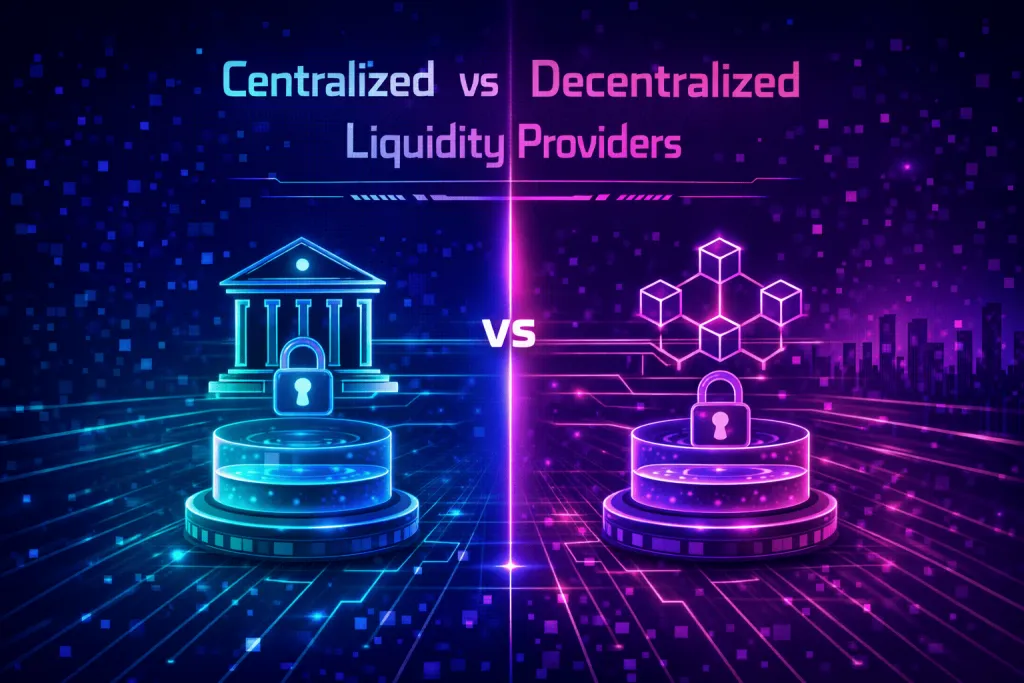
Crypto liquidity providers for protocols, centralized and decentralized alike, can support token launches, treasury execution, DEX depth, market-making agreements, and cross-chain liquidity routing.
Key Differences Between CEX and DEX Liquidity
The core distinction in centralized vs decentralized liquidity comparison lies in how liquidity is created and managed. CEXs generate liquidity through a combination of order books that facilitate price discovery and institutional crypto market makers that continuously quote both the best bid and the best ask prices with minimal slippage.
On the other hand, DEXs utilize Automated Market Maker (AMM)-driven crypto liquidity pools. This solution enables users to supply liquidity into these pools without reliance upon an intermediary. As such, liquidity provided via DEXs is generated directly from user contributions rather than as an intermediary.
CEXs typically offer superior crypto liquidity depth and trading order execution efficiency, especially for large orders, while DEXs stress transparency, accessibility, and permissionless participation.
Advantages and Disadvantages
Centralized exchanges have advantages (in terms of) liquidity, speed, and usability. The decentralized exchange is an alternative to centralized exchanges that allow users to maintain their own private keys.
Thus, DEX’s do not need to follow the same regulatory requirements (such as AML/KYC, therefore allowing the user a greater degree of anonymity. However, this also means that there are fewer resources available when trying to buy/sell certain cryptocurrencies.
On the other hand, DEX’s give the users complete control of their cryptocurrency. Therefore, it gives users a lot more flexibility.
Which Option Is Better for Investors
There isn’t a “right” or universally preferred model, as that will depend on what your goal is for trading (i.e., how you want to trade), what level of risk you’re willing to take, and how much money you have available. Crypto exchanges with deep liquidity for large orders matter most when traders need tight spreads, predictable fills, and minimal price impact on institutional-sized execution.
Centralized Exchanges (CEXs) continue to be the most popular among larger traders and institutional investors because they provide better executions and superior liquidity. Despite their growing popularity, CEXs still account for the majority of global spot trading volume. “Find me crypto exchange options with top liquidity” means looking first at Binance, Coinbase, OKX, Bybit, Kraken, and other venues with deep books across major pairs.
DEXs, however, appear to be becoming increasingly attractive to users who want greater control over their assets (i.e., self-custody), initial exposure to new tokens, and an ability to engage within the wider DeFi community. Between 2024 and 2026, the percentage of spot trading volume accounted for by DEXs increased by more than two times, indicating increasing adoption.
For protocols launching new markets, crypto liquidity providers for protocols can include AMMs, market-making firms, liquidity mining programs, treasury-backed pools, and cross-chain routing partners.
Future of Crypto Liquidity and Market Depth
AI and Algorithmic Liquidity Provision
By 2026, artificial intelligence will be changing how liquidity is provided in the marketplace. Increasingly, AI-based platforms will be utilized for instant risk assessment and capital allocation by all types of cryptocurrency (crypto) liquidity providers as of 2026. Utilized simultaneously to offer real-time risk assessments are on-chain data analysis, trader sentiment, and order flow. The AI-based platforms can perform decision-making at a much faster rate than classic algorithms.
AI-powered agents can dynamically rebalance positions, optimize spreads, and route orders across venues, greatly boosting crypto liquidity depth and trading execution effectiveness. This shift denotes a transition from static liquidity models to autonomous, data-driven systems that continuously adjust to market conditions.
This represents a paradigmatic shift away from the use of fixed liquidity models toward an environment where dynamic, data-driven AI systems continually respond to changing market conditions.
Regulatory Impact on Liquidity Pools
Regulation has had an increasing impact on how liquidity is established in 2026. Improved regulatory clarity(frameworks) will attract large amounts of institutional capital to markets, which will improve transparency, especially in the areas of custody, reporting, and compliance.
DeFi liquidity pools present an opportunity or constraint when it comes to regulation. Compliance can establish credibility with institutions that want to participate, but strict regulations can also limit the use of permissionless access models and make it difficult for decentralized applications to operate efficiently.
Overall, there is a more mature market and a more regulated process for establishing liquidity with a focus on regulated financial processes rather than being independent from them.
Evolution of DeFi Infrastructure
Evolutionary changes in DeFi infrastructure will create novel routes for generating and distributing liquidity. By 2026, DeFi’s liquidity generation architecture will likely be comprised of hybridized, multi-tiered architectures combining institutional trading platforms, cross-chain (interoperable) protocols, and Automated Market Maker (AMM) technologies.
With cross-chain interoperability comes the ability to move liquidity throughout the DeFi network, decreasing the amount of fragmented liquidity pools and increasing overall capital efficiency. Also, through integrating off-chain assets with DeFi’s on-chain liquidity pool creation capabilities, we’re seeing the DeFi space begin to transform from a purely decentralized crypto-asset-focused system into a wider financial settlement platform.
As this maturation process occurs within DeFi’s underlying infrastructure, liquidity levels are increasing in depth, functional efficiencies are increasing, and liquidity is becoming much progressively interconnected throughout all digital assets.
FAQ – Crypto Liquidity Providers and Pools 2026
What is a crypto liquidity provider?
A crypto liquidity provider is an individual or institution that supplies assets to markets to enable trading. In DeFi, this usually involves depositing funds into crypto liquidity pools, while in centralized markets it includes professional crypto market makers guaranteeing continuous buy and purchase orders.
The best crypto liquidity provider is usually the one that combines deep capital, reliable execution, strong risk controls, transparent operations, and experience across both centralized and decentralized venues.
How do liquidity pools generate profit?
Liquidity pools generate earnings chiefly through trading fees paid by users who swap assets. These fees are distributed proportionally among liquidity providers based on their share of the pool.
Additional income can come from incentive programs such as yield farming, where protocols reward participants with tokens to boost liquidity in DeFi liquidity pools.
What is impermanent loss in crypto?
Impermanent loss occurs when the value of assets deposited in a pool diverges due to price changes, resulting in lower returns compared to holding the assets separately.
This risk is inherent to AMM-based systems and is especially relevant in volatile markets where price fluctuations are more pronounced.
Are liquidity pools safe in 2026?
Liquidity pools are generally safer than in earlier stages of DeFi due to audits, improved smart contract design, and institutional participation. However, risks still exist, including exploits, market swings, and protocol failures.
As a result, users should prioritize well-established platforms when selecting among the best crypto liquidity providers.
Which liquidity pool is the most profitable?
There is no single most profitable pool, as returns depend on trading volume, asset volatility, and incentive structures. Stablecoin pools often provide lower but more consistent returns, while volatile pairs may offer higher yields with increased risk.
In 2026, the most effective approach is diversification across top DeFi liquidity pools in 2026, balancing yield potential with risk exposure.
Who are the top crypto liquidity providers in 2026?
The top crypto liquidity providers in 2026 include a mix of decentralized protocols, centralized exchanges, and institutional market makers. Uniswap, Curve, Balancer, Binance, PancakeSwap, Wintermute, and Cumberland all play different roles depending on whether the user needs DeFi pool access, centralized exchange depth, or institutional execution.