RWA crypto projects are no longer a niche side story in DeFi. They have become one of the clearest bridges between crypto and traditional finance, turning Treasuries, private credit, invoices, funds, and other real-world assets into blockchain-based instruments. The market more than tripled since 2025, reaching $19 billion.

That does not mean every RWA token is useful. Some are just old finance with a crypto wrapper and a press release. But the strongest RWA crypto projects are trying to solve a real problem: how to make off-chain assets more liquid, programmable, transparent, and usable inside digital markets.
In 2026, three names still stand out: Ondo, Maple, and Centrifuge. They do not do the same thing. Ondo focuses heavily on tokenized Treasuries and institutional-grade products. Maple leans into on-chain credit and lending. Centrifuge builds infrastructure for tokenizing a broader range of real-world assets.
Together, they show where the RWA sector is going: not toward one giant winner, but toward specialized platforms handling different parts of the financial stack.
Related: What Is XRPL Update: Is It Finally Ready to Beat Ethereum in RWA and DeFi?
Contents
- What Are RWA Crypto Projects?
- Why RWA Crypto Projects Matter in 2026
- Ondo Finance: Tokenized Treasuries for the Institutional Crowd
- Maple Finance: On-Chain Credit for Institutions
- Centrifuge: Infrastructure for Tokenizing Real Assets
- Ondo vs. Maple vs. Centrifuge
- Why Tokenized Treasuries Became the First Big RWA Winner
- Why Private Credit Could Be More Profitable — and More Dangerous
- What Makes a Strong RWA Crypto Project?
- Risks Behind RWA Crypto Projects
- RWA Crypto Projects 2026: Market Outlook
- Final Takeaway
- FAQ
What Are RWA Crypto Projects?
RWA crypto projects bring real-world assets on-chain. RWA stands for real-world assets, meaning assets that exist outside crypto but can be represented, financed, traded, or managed using blockchain infrastructure.
Examples include:
- U.S. Treasuries.
- Private credit.
- Real estate.
- Invoices.
- Money market funds.
- Commodities.
- Tokenized stocks.
- Fund shares.
The basic promise is simple. Traditional finance has trillions of dollars in assets, but much of that capital moves slowly. Settlement takes time. Access is limited. Intermediaries sit everywhere. Tokenization tries to make those assets more programmable and easier to move across digital systems.
That is the clean pitch. The harder part is legal enforcement, custody, regulation, liquidity, and trust. A token representing a Treasury bill is only useful if holders can trust the issuer, the custodian, the legal structure, and the redemption process.
So, the best RWA crypto projects are not just tech projects. They are legal, financial, compliance, and infrastructure projects wearing crypto clothes. Nice outfit, complicated tailoring.
Why RWA Crypto Projects Matter in 2026
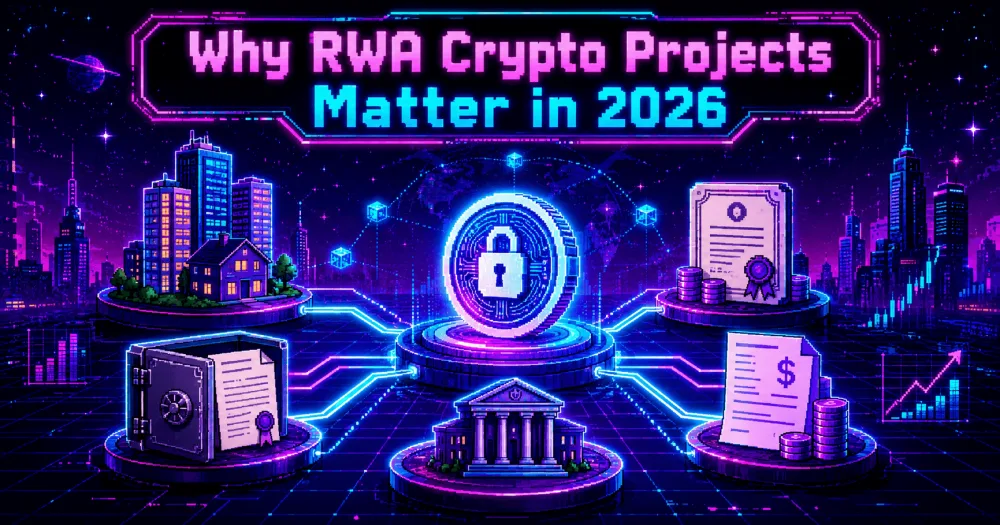
The RWA sector matters because crypto has been looking for sustainable yield and real adoption beyond speculation. Tokenized assets offer something the industry badly needs: a connection to real cash flows.
In early DeFi, yield often came from emissions, leverage, or circular incentives. That worked until it did not. RWA products are different because the yield may come from external sources: Treasury bills, credit agreements, loan repayments, or institutional financial products.
That makes RWA crypto projects attractive to several groups at once.
Crypto users want yield that is not purely dependent on token inflation.
Institutions want faster settlement, better transparency, and programmable financial rails.
DeFi protocols want new collateral.
Asset managers want distribution into digital markets.
Traders want narratives with numbers behind them.
This is why RWAs keep returning as a major crypto theme. They offer a serious answer to a brutal question: what does blockchain do besides help people gamble faster?
Ondo Finance: Tokenized Treasuries for the Institutional Crowd
Ondo is one of the most visible RWA crypto projects because it focuses on a category investors already understand: tokenized U.S. Treasuries and yield-bearing cash-like products.
Its core appeal is straightforward. Treasury yield is familiar. Institutional demand is real. Stablecoin users already sit in dollar-denominated assets. Ondo tries to connect those worlds by making Treasury-backed exposure usable in crypto markets.
Products like OUSG and USDY▼$1.13 helped Ondo become one of the best-known names in tokenized finance. OUSG targets short-term U.S. government bond exposure for qualified investors, while USDY offers tokenized yield exposure in a more crypto-native format.
Ondo’s biggest advantage is positioning. It does not need to persuade the market that Treasuries exist, that yield matters, or that institutions care about cash management. Those points are already settled. Ondo’s job is to make the wrapper credible, accessible, and useful across chains.
The risk is also clear. Treasury-tokenization is increasingly competitive. BlackRock, Franklin Templeton, JPMorgan-linked initiatives, and other traditional finance players are moving into the same territory. Ondo has crypto-native speed, but Wall Street has balance sheets, relationships, and regulatory muscle.
That makes Ondo powerful, but not untouchable.
Related: Best Prediction Markets 2026: Regulated Access, Crypto Liquidity and Risk Filters
Maple Finance: On-Chain Credit for Institutions
Maple is different from Ondo. It is less about tokenized Treasuries and more about credit. Maple builds infrastructure for institutional lending, allowing capital providers to fund borrowers through on-chain pools.
That makes it one of the more important RWA crypto projects for private credit exposure. Instead of simply tokenizing low-risk government debt, Maple deals with lending markets, borrower underwriting, pool management, and credit risk.
The appeal is obvious. Credit markets are massive. Borrowers need capital. Lenders want yield. Blockchain can make parts of the process more transparent and efficient. Maple sits right at that intersection.
But credit is not magic. Lending always comes with default risk. The more attractive the yield looks, the more carefully investors should ask where it comes from. Tokenization does not make weak borrowers stronger. It just makes the lending structure more visible and composable.
Maple’s strength is that it focuses on a real financial category with real demand. Its challenge is that credit requires discipline. Bad underwriting can hurt fast. Crypto users love yield but often hate reading risk documents, which is awkward because risk documents are where the bodies are usually buried.
In 2026, Maple remains interesting because private credit is one of the few RWA categories that can actually be used actively in DeFi. Treasuries are good for safety and cash management. Credit can be more dynamic, but it is also more dangerous.
Centrifuge: Infrastructure for Tokenizing Real Assets
Centrifuge has been around the RWA conversation for years, and its role is broader than either Ondo or Maple. It focuses on infrastructure for tokenizing real-world assets and connecting them to DeFi.
That makes Centrifuge one of the more foundational RWA crypto projects. Instead of being only a Treasury product or only a credit marketplace, it helps bring different kinds of assets on-chain, including invoices, credit pools, real estate-related assets, and other off-chain financial instruments. In 2025, it collaborated with S&P Dow Jones Indices to tokenize the famous S&P 500 Index.
Centrifuge’s thesis is that businesses should be able to access liquidity directly through blockchain-based capital markets. Asset originators can tokenize pools, investors can fund them, and the system can track ownership, repayments, and performance more transparently.
The strength of Centrifuge is flexibility. The weakness is the same thing. Broader infrastructure can be harder to explain than a simple Treasury product. Ondo can say “tokenized Treasuries.” Maple can say “on-chain institutional credit.” Centrifuge has a wider story, which is useful for builders but sometimes harder for traders to price.
Still, Centrifuge matters because the RWA sector needs more than tokenized money market products. If tokenization is going to reach invoices, receivables, funds, real estate, and structured credit, infrastructure like Centrifuge remains important.
Ondo vs. Maple vs. Centrifuge
| Project | Main Focus | Best Use Case | Main Strength | Main Risk |
|---|---|---|---|---|
| Ondo | Tokenized Treasuries and yield products | On-chain cash management and Treasury exposure | Clear institutional narrative | Competition from major TradFi players |
| Maple | Institutional lending and private credit | On-chain credit pools and borrower financing | Real yield from lending markets | Credit/default risk |
| Centrifuge | Asset tokenization infrastructure | Tokenizing varied real-world assets | Broad RWA framework | Harder narrative and adoption complexity |
These three RWA crypto projects show that RWA is not one market. It is several markets stacked together: tokenized Treasuries, private credit, invoices, tokenized stocks and real estate.
So, when people say “RWA,” the first response should be: which asset, which legal structure, which issuer, and who can redeem it?
Why Tokenized Treasuries Became the First Big RWA Winner
Tokenized Treasuries became the easiest RWA category to understand because they solve a simple problem. Crypto markets sit heavily in dollar assets, and users want yield on idle capital.
Treasuries offer a clean narrative: low-risk government debt, familiar yield, and institutional legitimacy. Put that exposure on-chain, and suddenly stablecoin holders have a more productive place to park capital.
This is why Ondo’s rise makes sense. It stands close to the strongest early RWA category. Tokenized Treasuries are not exotic. They are boring in the best possible way. Crypto could use more boring sometimes. The industry has had enough “revolutionary” tokens that collapse faster than a lawn chair in a hurricane.
But Treasuries also have limits. They are useful, but not automatically composable. Many products have restrictions, KYC requirements, transfer limits, or jurisdictional constraints. That means the token may exist on-chain but still behave more like a regulated financial product than a free-floating DeFi asset.
Related: Crypto Exchange Battle 2026: Binance vs Bybit — Where Do Traders Prefer to Trade?
Why Private Credit Could Be More Profitable — and More Dangerous
Private credit is where things get more interesting. It can offer higher yields than Treasuries, but it carries higher risk.
Maple sits here. So do parts of the broader RWA lending market. The idea is to connect lenders and institutional borrowers through on-chain infrastructure, creating more transparent credit markets.
The bullish case is strong. Private credit is huge in traditional finance. If even a small part of it moves on-chain, the opportunity for RWA crypto projects could be meaningful.
But higher yield comes from somewhere. Usually, that somewhere is risk:
- Borrowers can default.
- Markets can freeze.
- Underwriting can fail.
- Collateral can be mispriced.
- Liquidity can disappear.
This is why credit-focused RWA platforms need stronger risk controls than simple tokenized Treasury products. Tokenizing a loan does not make it safe. It just makes the loan easier to package, track, and potentially move around.
That is useful. It is not a force field.
What Makes a Strong RWA Crypto Project?

The best RWA crypto projects share several traits:
- Clear asset backing: Users should know what sits behind the token or pool.
- Credible legal structures: On-chain ownership needs to connect to off-chain rights.
- Transparent reporting: Investors need data on assets, yield, risk, and performance.
- Real liquidity: A token that cannot be sold or redeemed easily is not very useful.
- Serious compliance: RWAs touch regulated markets, and pretending otherwise is amateur hour.
- Actual demand: Tokenizing something nobody wants does not create value. It just creates a shinier database entry.
This is where the RWA sector separates serious builders from brochure merchants. The winners will not be the projects with the biggest slogans. They will be the ones that make off-chain value work reliably on-chain.
Risks Behind RWA Crypto Projects
The RWA narrative sounds mature, but risks remain.
First, regulation is unavoidable. Real-world assets sit inside legal systems. If a project ignores securities rules, custody rules, investor restrictions, or jurisdictional limits, trouble eventually finds it.
Second, redemption matters. A tokenized asset is only as strong as the user’s ability to redeem or enforce rights. If holders cannot access the underlying claim, the token is just financial cosplay.
Third, liquidity can be overstated. Some RWA tokens look liquid on dashboards but remain difficult to trade in size.
Fourth, smart contracts still matter. Even if the underlying asset is real, the token infrastructure can break.
Fifth, oracle and reporting risk remain. Off-chain asset values need to be reflected on-chain accurately. That requires trusted data flows.
Finally, there is concentration risk. If most assets sit with a few issuers, custodians, or managers, the RWA sector may recreate old finance’s bottlenecks.
Related: What Is SAOS Crypto? Why Analysts Are Watching This New Token Closely
RWA Crypto Projects 2026: Market Outlook
The 2026 outlook for RWA crypto projects is strong, but uneven.
Ondo is well positioned if tokenized Treasuries and institutional yield products keep growing.
Maple is well positioned if on-chain private credit expands and investors accept the risk.
Centrifuge is well positioned if broader asset tokenization moves beyond Treasuries into more diverse financial instruments.
The biggest tailwind is institutional adoption. Major asset managers, banks, and payment companies are taking tokenization seriously. That validates the sector and brings attention to crypto-native platforms that moved early.
The biggest headwind is also institutional adoption. Once Wall Street enters a market, it does not politely leave room for smaller players out of kindness. Crypto-native RWA platforms need to prove they offer something incumbents cannot easily copy: open infrastructure, faster composability, better distribution, or access to DeFi liquidity.
The next phase will not be about proving tokenization can exist. That part is already obvious. The next phase is proving tokenized assets can be useful, liquid, compliant, and worth integrating at scale.
Final Takeaway
RWA crypto projects are one of the most serious narratives in crypto because they connect blockchain infrastructure to real financial assets. Unlike many speculative sectors, RWA has a clear purpose: move real value on-chain and make it more programmable.
Ondo, Maple, and Centrifuge represent three different paths.
Ondo is the clean tokenized Treasury and institutional-yield story.
Maple is the on-chain credit and private-lending story.
Centrifuge is the broader asset-tokenization infrastructure story.
None of them is risk-free. RWAs depend on legal structures, custodians, compliance, liquidity, reporting, and real-world enforcement. That makes them more complicated than pure crypto assets, not less.
Still, the direction is hard to ignore. If crypto keeps merging with traditional finance, RWA crypto projects will not be a side theme. They will be one of the main places where that merger happens.
FAQ
What are RWA crypto projects?
RWA crypto projects are blockchain platforms that bring real-world assets on-chain. These assets can include Treasuries, private credit, invoices, real estate, commodities, money market funds, or other financial instruments.
Why are RWA crypto projects important in 2026?
They matter because they connect crypto to real financial assets and real yield sources. In 2026, institutions are paying more attention to tokenization, while DeFi users are looking for yield that does not rely only on token emissions.
Is Ondo one of the top RWA crypto projects?
Yes. Ondo is one of the top RWA crypto projects because it focuses on tokenized Treasuries and institutional-grade yield products, two of the strongest early categories in the RWA sector.
How is Maple different from Ondo?
Maple focuses more on institutional lending and private credit, while Ondo focuses more on tokenized Treasuries and yield-bearing cash-like products. Maple may offer higher-yield opportunities, but it also carries more credit risk.
What does Centrifuge do?
Centrifuge builds infrastructure for tokenizing and financing real-world assets. It supports broader asset tokenization beyond simple Treasury products, including credit pools and other off-chain financial instruments.