Hidden fees hide inside DeFi trades. When someone exchanges coins on a decentralized exchange, they see what happens once it’s done. Before that moment, automated programs might have scanned pending activity, guessed price shifts, then slipped their moves in nearby. The user notices nothing until the deal finishes.
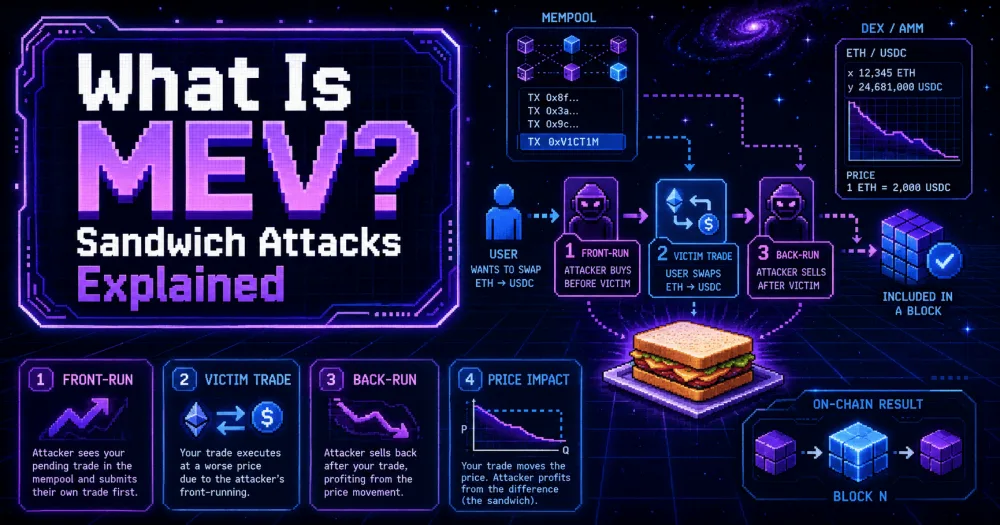
Anyone touching Ethereum, Solana, BNB▲$724.25 Chain, or Layer-2s feels the ripple of MEV. Though often painted as stealing, not every move drains value – some actually sharpen market efficiency. Yet plenty still prey on regular users. Take the sandwich attack: a blunt case where harm hits without disguise.
Contents
- What Is MEV in Crypto?
- How Transactions Are Processed on Ethereum
- What Is a Sandwich Attack?
- Real Example of a Sandwich Attack
- Types of MEV Strategies
- Why Sandwich Attacks Are Harmful
- Which Blockchains Are Most Affected by MEV
- How MEV Bots Work
- How to Protect Yourself From Sandwich Attacks
- Flashbots and the Fight Against Harmful MEV
- Is MEV Good or Bad for Crypto?
- FAQ
What Is MEV in Crypto?
MEV Meaning: From Miner Extractable Value to Maximal Extractable Value
Profit hides in how trades line up. Once called miner extractable value, the name shifted when Ethereum changed systems. Validators took over where miners left off. Order matters more than timing now. What began as a mining perk evolved into broader gains. Maximal extractable value reflects that wider reach. Control of sequence opens doors to advantage.
Related: Can Bitcoin Crash to $20K in 2026? What Could Trigger a Historic Crypto Market Collapse
How MEV Works on Blockchain Networks
Block space runs short, so when trades pile up, sequence shapes results. One swap shifts rates before the next even starts. Price moves depend on who gets in front. Influence timing, gain advantage – simple as that.
Why MEV Exists on Ethereum and Other Chains
Out in the open, DeFi lets everyone peek at what’s coming. Swaps waiting for their turn, loans about to trigger, who gets liquidated – it’s all visible ahead of time. That visibility feeds Ethereum’s MEV problem. When other blockchains offer clear transaction paths, paired with decentralized exchanges and speed-hungry bots, the pattern repeats itself. Transparency pulls back the curtain – then opportunists step in.
The Role of Validators, Searchers, and Builders
Out there, MEV searchers spot openings. Block by block, builders piece them together. When validators step in to suggest a block, payouts follow. Running bots isn’t required for validators – still, a share finds its way to them.
How Transactions Are Processed on Ethereum
What Is the Mempool?
Inside the network, unconfirmed deals hang out like people in a lobby. Once someone starts a trade, it usually lands here first. Machines keep an eye on this space – it gives clues about upcoming moves.
Why Pending Transactions Are Visible Before Confirmation
Out in the open, networks spread control – yet that exposure draws attention. Before a big trade even goes through, bots might notice it, guess how prices will shift, then weigh if squeezing it front and back pays off.
Related: Top AI Crypto Tokens June 2026: FET, RNDR, TAO, NEAR, AGIX
Gas Fees and Transaction Prioritization
Most of the time, what you pay depends on network traffic. When things get crowded, transactions with bigger fees move faster. Bots step in when they see a chance to earn more than their bid. Sneaky trades jump ahead because someone pays extra just before a big shift.
How Block Builders Select Transactions
Most of the time, block creators skip random picks. Instead, they pack deals that boost their cut – especially those hiding extra profit. Bids come in as packages, often shaped by traders hunting value. The assembler weighs options, fitting together what earns the most. What fits best lands inside.
What Is a Sandwich Attack?
Sandwich Attack Definition

Built around sneaky timing, this move slips a buy just ahead of someone else’s order. Following that up, a second trade trails behind theirs. Their action ends up boxed between two others. Trapped like that, prices shift without them noticing.
How a Sandwich Attack Works Step by Step
Out of nowhere, someone initiates a trade with wide slippage. Right after that, a program spots the move. Then, without delay, the software purchases ahead of them. As a result, the buyer’s own action lifts the price up. After the victim places their trade, that is when the bot jumps in to sell. That move – right there – is what people call a sandwich attack.
Front-Running vs Back-Running Explained
Someone jumps ahead of a trade to profit first. After that deal finishes, another person acts fast behind it. One trick combines those moves like layers. Price shifts because of the early step, then the last push locks in the gain.
Why DEX Traders Are Vulnerable
Most DEX users face risk since pricing shifts when trades alter liquidity levels. Pool ratios tilt after big transactions go through. Loose slippage controls let deals push forward, even at worse rates. Price movement ties directly to how much is swapped.
Real Example of a Sandwich Attack
Example of a Large Swap Being Exploited
Picture this: someone trades one hundred thousand USDC▼$0.9998 into a tiny token on a low-liquidity exchange. They accept three percent slippage. Right then, an automated program spots it. Instead of waiting, the bot jumps ahead – buying that same coin fast. That move pushes the cost up just before the person’s trade goes through.
How the Attacker Profits
Once the victim buys and lifts the token’s value, out goes the bot – dumping shares right back into the market. Profit lands clean: what it grabbed low for earlier slips away at a steeper rate later.
How Much the Victim Loses
Most times, the person won’t notice exactly what got taken. Instead, they just get less than promised. Say the display said 10,000 tokens – what arrives could be only 9,750. Hidden gaps like that? A big part of the MEV danger.
Why Slippage Makes Attacks Possible
Trades still go through even if prices shift slightly. Yet too much leeway opens doors for automated programs to twist outcomes. When controls are too relaxed, an ordinary token exchange might get caught between predatory moves on a decentralized market.
Related: What Is Crypto Market Sentiment? Beginner to Advanced Investor Guide
Types of MEV Strategies
Arbitrage Opportunities
Nowhere else does price difference spark opportunity like in arbitrage. When one market values an item lower than another, a chance opens up. Instead of waiting, automated systems step in fast. They purchase at the low point, then shift to sell higher elsewhere. Movement happens across platforms almost instantly. The gap closes as trades fill it. Profit hides in the split second between prices. Machines act before humans notice.
Liquidation Hunting
When collateral drops too far, DeFi loans get cleared out. Watching closely, bots sprint to be first in line to pull that trigger. Solvency stays intact because of this rush, yet being fast is what pays off.
Back-Running Strategies
After big trades, some bots step in to help prices settle across markets. That move might seem fairer compared to trapping orders on both sides. Yet profit only appears because someone else moved first. Gains here depend entirely on that earlier decision.
Time-Bandit Attacks
Blocks get shuffled around when time-bandit attacks happen, reaching back for missed chances. Because of this, MEV might threaten how safe the whole network is.
NFT and Token Mint Sniping
When a new NFT drop offers quick gains, automated programs often sweep up stock moments after launch. Instead of waiting, these systems race ahead – snatching spots meant for regular participants during whitelist events or fresh releases. Profitable openings attract such tools fast, leaving little behind for everyday buyers.
Why Sandwich Attacks Are Harmful
Increased Trading Costs
Trading becomes pricier because of sandwich attacks. Gas costs hit the user, along with fees set by the platform, and then poor trade outcomes pile on top. One single swap might show a tiny loss, yet over time those dents grow deeper.
Hidden Losses for Retail Investors
Most people buying online never check if they got the price shown earlier. A shift in market levels distracts them instead of the algorithm’s behavior. Harm slips by unseen because of that.
Reduced Market Efficiency
Most of the time, a bit of MEV helps things run more smoothly. Yet sandwich trades bring nothing useful in return. These moves take value straight out of users’ pockets. Poor pricing sticks around because of it. When markets jump wildly, some traders just leave instead.
Impact on DeFi Adoption
Most people won’t stick around if DeFi seems rigged. Clear rules help – yet too much openness can backfire when safeguards are missing. Protection against hidden manipulation has quietly become essential.
Which Blockchains Are Most Affected by MEV

Ethereum
Most of the MEV activity shows up on Ethereum because liquidity runs deep in its DeFi spaces. Built-up tools and systems around profit extraction have grown further there than anywhere else.
BNB Chain
Bot activity spikes on the BNB Chain when traders swarm decentralized exchanges. Volatile tokens pull in automated plays, especially where liquidity runs low. Cheap transactions let those systems operate more freely. Retail movement feeds the pattern, layer by layer. Thin pools become targets, quietly.
Solana
Block speeds on Solana might be quick, yet MEV finds its way in. Around new coin drops, bots scramble when validators tweak order. Fee races show up where users bid higher just to go first. Instead of slow chains, the pressure shifts – still present, just reshaped by design.
Arbitrum and Other Layer-2 Networks
Fees drop on Layer-2s, yet MEV lingers. Networks like Arbitrum or Optimism still juggle DEX traffic, sequencing power, and order control. Change the setup however you want – the core tension stays put.
Related: What Is RSI in Crypto Trading? How Relative Strength Index Signals Buy & Sell Moves
How MEV Bots Work
What Is an MEV Bot?
A sneaky bit of code watches every move on the chain, slipping in trades when it spots an opening. Who runs these? Traders deploy programs that hunt mismatches – sudden drops, weak pools, forced exits, fresh tokens appearing out of nowhere.
How Searchers Detect Profitable Transactions
Out front, searchers operate nodes alongside tools tracking pending transactions. Not far behind, they simulate scenarios using price forecasts. When the numbers suggest that gain outweighs cost and danger, execution follows. Bundles fly only if margins clear hurdles. Watching closely comes before any move.
The Role of Flashbots
Hidden bidding channels now handle what used to be chaotic price fights in open view. That shift redefined the mechanics behind profit chasing on the network. Suddenly, speed wasn’t everything. Behind closed doors, deals reshaped the game. Efficiency replaced noise. This quiet switch altered incentives across the chain.
Are MEV Bots Legal?
Most MEV bots fall into a gray area when it comes to legality. While arbitrage and liquidation strategies follow the system’s code, some actions push boundaries. Exploiting user transactions through sandwich tactics raises ethical questions. Laws may treat these cases differently depending on the location.
How to Protect Yourself From Sandwich Attacks
Use Private Transaction Relays
Out of sight, swaps move through private channels first. Before hitting open ledgers, they skip the crowded waiting area. Because hidden trades aren’t visible right away, guesswork thwarts automated front-runners. Without early signals, trap setups lose their edge.
Reduce Slippage Settings
Slippage shrinks, leaving less room to twist things unfairly. Trades might drop more frequently, yet the person sidesteps far uglier rates. That’s how basic MEV defense works.
Split Large Orders Into Smaller Trades
Big trades shake prices harder than little ones. When you break up a deal, less movement shows on screen. Higher gas fees might come along for the ride – weigh what slips versus what spends.
Trade During Higher Liquidity Periods
Liquidity tends to soften how much prices swing when trades happen. Pools filled with more capital resist shifts better than shallow ones. When trading volume picks up, slippage often shrinks. What matters is shown in movement during busy hours.
Use MEV-Protected Wallets and DEXs
Most wallets plus some DEX tools now guard against MEV tricks. Private paths, smart order handling, or split trades might be built in. Look at your options first thing when setting up a trade. Settings can change how orders move through the network.
Related: Top 5 Altcoins for the Next 10-100x Crypto Bull Run in 2026: High-Potential Crypto Picks
Flashbots and the Fight Against Harmful MEV
What Are Flashbots?
Hidden bids shape trades behind the scenes. Flashbots looks into these shifts without removing them. One aim: clearer views of profit grabs. Less chaos in open bidding happens when signals flow differently. Steps toward openness replace old race conditions.
MEV-Boost Explained
Blocks come to Ethereum validators through MEV-Boost, pulled in from outside builders. Competition pushes those builders to craft the richest possible block. More rewards become available for validators this way. Meanwhile, searchers, along with builders, sort out how MEV moves around.
How Private Order Flow Reduces Attacks
Hidden trade paths keep automated programs from spotting deals early. Because of that, scams like deal-squeezing become harder to pull off. Less exposure means fewer bidding fights over transactions, too. Some sneaky trading ahead of others gets blocked as a result.
Criticism of Flashbots
Folks point out that Flashbots could push too much power into a few hands when putting blocks together. Some fear certain transactions might get blocked quietly, while others stress how backdoor channels give some players unfair edges.
Is MEV Good or Bad for Crypto?
Arguments Supporting MEV
Prices sometimes drift between exchanges. Yet arbitrage steps in to fix that gap. Lending systems face risk when loans go bad. However, liquidation tools step up to limit damage. Certain trades follow others on purpose. These often help rebalance shared funds. Value shows up where effort makes a difference. Rewards tend to flow there naturally.
Criticisms of MEV Extraction
Hidden costs hit traders through MEV. Worse outcomes come when sandwich attacks twist prices. Rising gas happens as bots race endlessly. Many see it not as tech – it acts like a quiet charge.
Can MEV Ever Be Eliminated?
Stopping MEV entirely is unlikely to happen. When sequence shapes outcomes, someone will find a way to profit. Aiming lower makes more sense – cutting down the damaging kind instead.
The Future of MEV Mitigation
One day could bring sealed bid pools online. Auctions might group trades instead. Swaps guided by user goals may appear. Block creators are possibly splitting from builders more cleanly. Default settings in wallets are tending toward stronger safeguards. Protection against value extraction is likely to become standard.
FAQ
What Does MEV Stand For?
Maximal Extractable Value. Value shows up when someone changes how trades are lined up inside a single batch. That benefit goes to whoever controls the sequence – like moving deals forward, adding new ones, or leaving some out completely.
What Is a Sandwich Attack in Crypto?
Out of nowhere, someone sneaks a trade right before you on a decentralized exchange. Right after yours goes through, another one slips in behind. Your order gets caught in the middle without asking. Prices shift just enough to tilt things sideways. That gap between what should have been and what happened? Someone else pockets it. Smoothly, quietly, automatically.
How Do MEV Bots Make Money?
Profits come from arbitrage when price gaps show up across exchanges. Speed matters most the moment a trade hits the network. Liquidations pay out when loans collapse under market swings. Bots step in right after big moves to capture value. Snatching tokens early gives an edge if new projects pump fast. Hidden in the flow, some deals get restructured just before confirmation. Watching every detail lets them predict what happens next. Order within blocks decides who wins each round.
Can You Prevent a Sandwich Attack?
Start with private relays – they help cut exposure. Slippage drops when settings are adjusted carefully. Big trades work better when broken apart slowly. Protection hides in certain wallet types, built to block front-running tricks. Some trading tools bundle safeguards right into routing paths.
Which Wallets Offer MEV Protection?
Not every app includes features like private routing or shields against MEV tricks. Since support shifts now and then, it pays to peek at your wallet’s menu and how a decentralized exchange directs trades – especially when moving big amounts.
Is MEV Illegal?
Just because MEV occurs does not mean it breaks the law. Certain moves fit right into regular trading behavior. When tactics turn damaging, authorities might step in. Legal risks arise mainly when users are injured.