Each shift in value within digital currency markets carries dual narratives: facts shaped by numbers, yet also colored by feelings. Crypto market sentiment is the study of that second story — not merely statistics, but shared mindsets shaping these shifts — moods, leanings, unspoken assumptions held among traders at critical points in time.

During surges or sudden steep drops, crypto market sentiment has consistently proven a powerful indicator. This guide covers what is crypto market sentiment, how it is measured, how it can be used at every level of experience, and which tools offer the clearest read on the market’s emotional state in 2026.
Why Crypto Market Sentiment Matters for Investors
Digital currency values respond readily to stories circulating online. One message posted by an influential figure or altered discussion tones across internet forums might shift vast sums rapidly. This makes understanding investor sentiment crypto not just useful but essential. Sharp drops may follow widespread unease, dragging down even tokens backed by solid project metrics. Occasionally, extreme optimism lifts even weak ventures quickly. Investors aware of emotional shifts tend to spot such patterns earlier than others.
Related: What Is a Crypto Faucet? How Free Bitcoin and Crypto Rewards Work in 2026
How Market Sentiment Influences Crypto Prices
How sentiment affects crypto prices operates through a straightforward mechanism: sentiment drives behavior, and behavior moves markets. From optimism comes increased demand, which drains available supply on exchanges, pushing valuations upward. Once dread takes hold, withdrawal of buy interest accelerates declines — moves often steeper than data alone might suggest. Such cycles intensify within digital asset spaces due to:
- Limited overall volume
- 24/7 trading cycle that never allows sentiment to reset
- The outsized role of retail participants whose decisions are more emotion-driven than those of institutional managers.
Understanding crypto market psychology is therefore not a soft skill — it is a core analytical discipline.
Contents
- Understanding the Basics of Crypto Market Sentiment
- How Crypto Market Sentiment Is Measured
- Types of Crypto Market Sentiment
- How Beginners Can Use Market Sentiment in Crypto Trading
- Advanced Strategies for Using Crypto Market Sentiment
- Limitations of Crypto Market Sentiment Analysis
- Best Tools to Track Crypto Market Sentiment in 2026
- Frequently Asked Questions (FAQ)
Understanding the Basics of Crypto Market Sentiment
Definition of Market Sentiment in Cryptocurrency
Crypto market sentiment refers to the overall attitude and emotional disposition of market participants toward a cryptocurrency or the broader market at a given point in time. It is sometimes described as the market’s “mood” — a composite reading of whether investors collectively feel optimistic, pessimistic, or uncertain.
Sentiment is distinct from price in that it describes the psychological state preceding price action. What is crypto market sentiment in practical terms? It is the aggregated signal from social media chatter, trading volume patterns, derivatives positioning, whale wallet movements, and survey data. It answers the question: what does the crowd currently believe is going to happen next?
Fear, Greed, and Neutral Market Conditions Explained
Among emotional drivers in cryptocurrency trading, fear, greed, and neutral outlook stand most prominent. When fear takes hold, consistent selling emerges. Volume tends to drop gradually while public discussion turns pessimistic; buyers remain absent even as values decrease. Such phases typically align with low points in price cycles.
In contrast, periods ruled by greed see aggressive purchasing alongside upbeat online narratives and confidence that upward movement will persist. Neutral stance lacks intense emotion, balancing caution with moderate interest. Recognition of such conditions begins any assessment of crypto sentiment analysis in digital assets.
Difference Between Market Sentiment and Market Fundamentals
What lies beneath defines a blockchain project: code strength, people behind it, economic structure, income streams, coding updates, real-world purpose. Emotion shapes perception — sometimes aligned with reality, more often drifting apart from facts entirely. Digital assets differ from mature markets; belief and truth may stay disconnected for months, even years. This mismatch breeds extreme highs where nothing justifies cost, also rare lows where value hides in plain sight. The clearest insight from crypto market behavior analysis emerges by pairing logic with mood.
Related: What Is RSI in Crypto Trading? How Relative Strength Index Signals Buy & Sell Moves
How Crypto Market Sentiment Is Measured
Social Media Activity and Community Trends
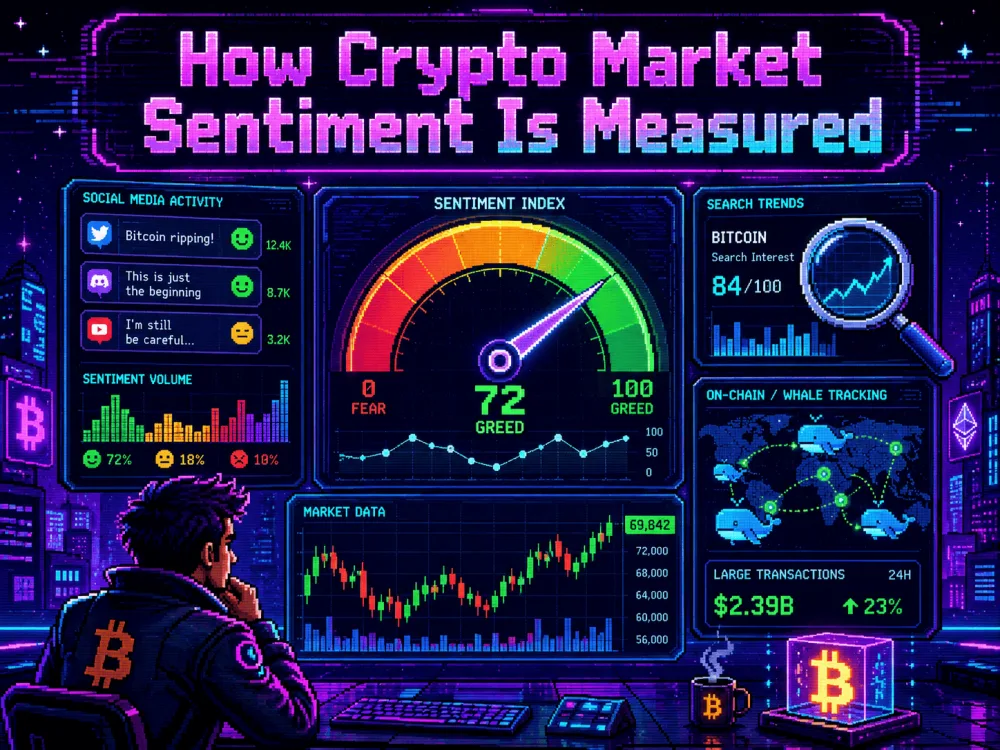
Social media crypto sentiment is one of the earliest and most real-time signals traders can access. Platforms like X (formerly Twitter), Reddit, Telegram, and Discord are where ideas gain shape. When a particular coin suddenly appears more often in discussions, patterns begin to show.
AI tools sort vast numbers of messages into favorable, unfavorable, or indifferent categories and produce overall readings. Noticeable swings in activity levels or emotional tone often happen before prices react, making social media crypto sentiment one of the strongest forward-looking measures accessible today.
Trading Volume and Price Momentum Signals
Volume stands first among signs revealing market mood. When prices climb alongside growing turnover, it shows strong commitment — a pattern long tied to upward pressure. Yet when gains unfold with shrinking activity, enthusiasm appears thin, hinting the advance could stall without deeper support. Crypto trading sentiment indicators derived from price momentumreflect how firmly direction aligns with underlying momentum.
Crypto Fear and Greed Index Overview
The crypto fear and greed index is the most widely cited single-number sentiment gauge in the market, producing a daily score from 0 to 100. Scores below 25 indicate extreme fear; scores above 75 indicate extreme greed. The crypto fear and greed index is calculated using a blend of movement in pricing along with other signals:
- Trade intensity
- Public chatter on online platforms
- Bitcoin’s share of total market value
- Search interest tracked via one major engine
- Price stability shifts
When fear reaches extremes, prices often find their lowest point; near peaks, excessive confidence tends to appear instead. Pairing it with additional methods brings clearer context.
On-Chain Data and Whale Activity Indicators
On-chain sentiment analysis draws directly from blockchain transaction data. This layer of signal is immune to the distortions seen on social platforms. Rising counts of engaged wallets often point to expanding involvement, hinting at favorable outlooks within the network.
Movement of tokens away from trading venues implies confidence, possibly indicating long-hold strategies taking shape; surges toward these venues may reflect intent to exit positions. Observations of major holders via tools such as Nansen or Arkham add depth when their behavior shifts silently amid widespread caution.
When large wallets accumulate quietly during a period of fear, that divergence between on-chain sentiment analysis data and prevailing mood is one of the most powerful signals in the entire toolkit.
Types of Crypto Market Sentiment
Bullish Sentiment and Market Uptrends
Bullish sentiment — the dominant emotional state of bullish vs bearish sentiment crypto analysis — is characterized by widespread optimism, a general expectation that prices will rise, and increasing market participation. In a bullish phase, positive news is amplified while negative news is discounted. Social media discussions focus on price targets and new all-time highs, while derivatives markets show elevated long positioning. Markets can remain in bullish states far longer than skeptics expect, which is why fighting strong sentiment trends with premature short positions is one of the most common and costly mistakes in crypto trading.
Bearish Sentiment and Market Downtrends
Bearish sentiment reflects a prevailing expectation that prices will fall, driving selling behavior, declining participation, and a retreat from risk. In a bearish phase, negative news dominates the narrative while positive developments are ignored. Bullish vs bearish sentiment crypto analysis reveals that bearish periods are often self-reinforcing — falling prices generate fear, which generates selling, which generates lower prices. The depth of a bearish phase is frequently measured by how long sentiment stays suppressed rather than how far prices have fallen.
Neutral Sentiment and Market Consolidation
Neutral sentiment phases are often the most challenging for traders because they lack the clear directional conviction that makes entry and exit decisions straightforward. In a consolidation, the crypto market behavior analysis picture shows balanced buying and selling pressure, shrinking volatility, and declining social media engagement. These phases typically precede a significant directional move in either direction. Monitoring sentiment during consolidation for early signs of tipping toward fear or greed — through volume patterns, social media shifts, or on-chain accumulation signals — is how experienced traders position themselves before the breakout occurs.
How Beginners Can Use Market Sentiment in Crypto Trading
Identifying Entry Points Using Sentiment Signals
For beginners learning how to read crypto sentiment, the most actionable application is using extreme fear readings as potential entry signals. When the crypto fear and greed index drops into extreme fear territory and social media is dominated by pessimistic narratives, markets are often near or at a bottom. That situation never suggests automatic purchases — instead, chart patterns must align before any move makes sense — yet sentiment extremes can sharpen timing for better odds. On the opposite end, intense optimism hints it might be wise to scale back exposure, lock in gains, or guard capital more closely.
Avoiding Emotional Trading Decisions
What harms new investors most is not missing data — it is copying the mood of others. During upswings, excitement spreads; people step in without pause. As declines begin, worry takes hold; stepping out feels necessary. One leads to entering too late, the other to leaving too soon. Learning to read crypto market sentiment externally — as data to be analyzed rather than emotion to be felt — is the foundational discipline that separates consistently profitable traders from the majority. Treating sentiment as a contrary signal, rather than a confirmation of your own feelings, is the key cognitive shift.
Combining Sentiment with Basic Technical Analysis
Sentiment works best when combined with technical analysis rather than used in isolation. A beginner’s framework for how to read crypto sentiment in practice: use the fear and greed index and social media sentiment to identify the macro emotional state of the market; use support and resistance levels, moving averages, and volume analysis to identify price levels where a sentiment-driven move is likely to stall or reverse. When sentiment is extremely fearful and price is testing a major support level with declining sell volume, the alignment of both signals creates a higher-probability setup than either signal would provide alone. Crypto trading sentiment indicators are a complement to technical tools, not a replacement for them.
Advanced Strategies for Using Crypto Market Sentiment

Contrarian Investing: Buying Fear and Selling Greed
The contrarian approach to crypto sentiment analysis is among the most historically reliable strategies in the asset class. The core thesis — buy when fear is extreme, sell when greed is extreme — is well-supported by data. Every major Bitcoin bottom since 2017 has coincided with prolonged extreme fear readings; every major top has coincided with extreme greed.
Advanced practitioners use a tiered accumulation approach: beginning to build positions when fear enters extreme territory, adding incrementally as sentiment deteriorates further, and setting predefined exit targets tied to greed readings rather than price targets alone.
Related: What Is Crypto Arbitrage Trading and How Does It Work? Complete Beginner’s Guide (2026)
Sentiment Divergence vs Price Action
Sentiment divergence — when crypto price prediction signals derived from sentiment data conflict with the direction of price action — is one of the most powerful setups in advanced sentiment analysis. Bullish divergence occurs when price makes a new low but sentiment indicators do not deteriorate further; bearish divergence occurs when price makes a new high but sentiment readings begin to plateau or decline, indicating the rally is running out of genuine conviction.
Monitoring crypto market trends prediction through the lens of sentiment divergence adds a dimension that pure technical traders frequently miss, particularly near major turning points in market cycles.
Using Multi-Source Sentiment Analysis Tools
Noise often clouds isolated sentiment readings — a viral post can spike social metrics without reflecting any genuine shift in investor thinking. Instead of relying on one channel, skilled analysts combine inputs from several places at once: online discussions, blockchain transaction patterns, futures market positions, news article tones. As these separate streams begin pointing the same way, their alignment strengthens confidence where lone metrics fail. Such layered evaluation defines professional crypto sentiment analysis today, now within reach via up-to-date analytical tools available by 2026.
Limitations of Crypto Market Sentiment Analysis
Why Sentiment Can Be Misleading in Volatile Markets
Even powerful tools carry constraints worth noting. Sentiment may stretch beyond normal limits, lasting much longer than logic suggests — irrationality tends to persist over extended periods, complicating entry or exit points regardless of eventual accuracy.
External shocks such as policy shifts, economic data surprises, or security breaches disrupt established emotional patterns without warning, making signals once trusted lose value rapidly. Crypto sentiment analysis and crypto market trends prediction built only on mood lean toward fragility when surprises strike — probability shapes what feelings suggest; certainty does not live there.
Social Media Manipulation and Fake Signals
Social media crypto sentiment is particularly vulnerable to manipulation. Project groups work together, using hired promoters or automated accounts to push attention toward weak projects, making them seem more promising than they are.
Tools designed to measure public mood now look deeper, focusing less on how much people post and more on what those posts actually mean — cross-referencing social data with on-chain activity and watching for sudden surges in talk that lack proof of actual investment behind them. Even so, gaps remain; treating any single sentiment spike with skepticism until corroborated by independent signals remains the safest approach.
Best Tools to Track Crypto Market Sentiment in 2026
Crypto Fear and Greed Index Tools
The original crypto fear and greed index, published by Alternative.me and widely cited across the industry, remains the most accessible entry point for sentiment monitoring. CoinMarketCap has developed its own proprietary version, incorporating data from the top ten cryptocurrencies and a five-factor model covering price momentum, social media activity, market volatility, Bitcoin dominance, and Google Trends data — tested against past conditions thoroughly, and appearing regularly in outlets like Bloomberg, Reuters, and CNBC when describing mood shifts. Both tools update each day without cost, serving well as broad lenses before deeper analysis.
Sentiment Analytics Platforms and Dashboards
When deeper insight into crypto sentiment analysis is needed, specialized services deliver detailed views per digital asset. In 2026, LunarCrush analyzes vast numbers of public messages every day drawn from X, Reddit, YouTube, TikTok, and media outlets, weighing signals using its Galaxy Score and AltRank tools that reflect momentum, interaction depth, and influence presence.
Santiment merges feelings expressed online with actual blockchain behaviors within one screen, linking conversation spikes to coding updates, large fund moves, or exchange transfers. CryptoScores measures how steady emotion stays around a coin — sustained strong interest backed by active participation may hint at favorable conditions, whereas fading enthusiasm might appear just before prices drop sharply.
On-Chain Analytics Tools for Investors
Pure on-chain sentiment analysis is best served by platforms specializing in blockchain data interpretation. Rather than guessing intentions, Nansen reveals patterns by tagging wallets and tracing capital shifts tied to seasoned market participants.
Glassnode stands apart by offering an extensive collection of on-chain measurements, such as SOPR — which reflects whether coins sold were profitable — alongside NUPL, indicating broader market phases, in addition to tracking exchange netflow data.
Arkham Intelligence adds clarity to significant transactions by connecting anonymous addresses to real-world organizations like trading desks or development groups. Together, these tools give advanced practitioners a read on investor sentiment crypto grounded in verifiable blockchain data rather than the noisier signals from social channels.
Frequently Asked Questions (FAQ)
What is crypto market sentiment and why does it matter?
Crypto market sentiment is the collective emotional state of cryptocurrency market participants at a given point in time — whether investors are predominantly optimistic, fearful, or neutral. It matters because sentiment drives buying and selling behavior, which directly moves prices. In a market as narrative-driven as crypto, understanding sentiment often provides more predictive value about near-term price direction than fundamental analysis alone.
How is crypto market sentiment measured?
Crypto market sentiment is measured through a combination of data sources: the Fear and Greed Index (a composite score from 0–100 reflecting overall market emotion), social media sentiment tools that scan X, Reddit, and Telegram for tone and volume, trading volume and price momentum indicators, and on-chain data tracking wallet activity, exchange flows, and whale behavior. Advanced practitioners combine multiple sources to filter out noise and identify genuine sentiment shifts.
What is the crypto Fear and Greed Index?
The crypto fear and greed index is a daily composite score ranging from 0 (extreme fear) to 100 (extreme greed) that measures the overall emotional temperature of the cryptocurrency market. It is calculated using price momentum, trading volume, social media activity, market volatility, Bitcoin dominance, and Google Trends data. Historically, extreme fear readings have coincided with market bottoms and extreme greed readings with market tops, making it a widely used contrarian indicator.
Can sentiment analysis predict crypto prices?
Crypto price prediction signals derived from sentiment analysis are probabilistic, not deterministic. Sentiment extremes — particularly extreme fear — have historically preceded price recoveries, and sentiment divergences (where sentiment and price action conflict) have preceded significant reversals. However, sentiment analysis cannot predict the exact timing or magnitude of price moves, and exogenous events such as regulatory actions or major security breaches can override existing sentiment trends rapidly.
What are the best tools for tracking crypto sentiment in 2026?
The leading tools for crypto sentiment analysis in 2026 include: the CoinMarketCap Fear and Greed Index for macro emotional temperature; LunarCrush for social intelligence and token-level social momentum scoring; Santiment for combined social and on-chain signal analysis; Glassnode for deep on-chain metrics including SOPR and NUPL; Nansen for smart money wallet tracking; and CryptoScores for sentiment stability and exhaustion signals. The most effective approach uses a combination of these tools rather than relying on any single platform.