Nowhere near mere test projects anymore, Layer 2 networks dominate Ethereum’s path forward by 2026. Central to expansion efforts, these systems support DeFi evolution, digital game economies, and enterprise-grade ledgers. Investors focused on opportunities outside Bitcoin and primary blockchains find strong potential within the top Layer 2 coins. Growth signals here stand out amid broader market offerings.

Most leading initiatives go beyond offering lower-cost alternatives to Ethereum. Ecosystems take shape when developer resources appear alongside specialized blockchains for apps. Gaming platforms emerge at the same time as financial frameworks settle into place. Because of these developments, certain Layer 2 cryptocurrencies increasingly attract investor focus. These assets now fit within extended timelines tied to upcoming market phases, making them some of the Layer 2 coins with highest potential.
Contents
- What Are Layer 2 Coins and Why Are They Exploding in 2026?
- Why Layer 2 Coins Could Deliver Massive Returns in the Next Bull Run
- Arbitrum (ARB) – The Leading Layer 2 Ecosystem
- Optimism (OP) – The Superchain Infrastructure Play
- Starknet (STRK) – The High-Upside ZK Rollup Bet
- zkSync – One of the Most Promising zkEVM Projects
- Mantle (MNT) – The Treasury-Backed Layer 2 With Strong Fundamentals
- Base Ecosystem Tokens – The Coinbase Narrative
- Best Layer 2 Coins by Use Case
- Risks Investors Should Know Before Buying Layer 2 Coins
- How to Find the Next Explosive Layer 2 Crypto
- FAQ
What Are Layer 2 Coins and Why Are They Exploding in 2026?
Connected to scaling solutions, Layer 2 coins operate through off-chain transaction handling before returning proof or transaction data to Ethereum’s base layer. While maintaining core network safety, these Ethereum Layer 2 coins enable faster transfers at lower expense than mainnet execution.
Speed improves because activity happens away from congested primary chains initially. Security stays tied to Ethereum even though processing shifts elsewhere temporarily. Cost reduction occurs when bulk operations avoid direct use of expensive base-layer space. Scalability emerges not from redesigning Ethereum itself but from extending its reach externally first.
Ethereum’s Scalability Problem Explained
Still dominant in smart contracts, Ethereum faces a structural issue: mainnet limits are regularly surpassed by user demand. As usage grows, so do costs, while speed declines. Network congestion emerges under load, revealing scalability constraints inherent in its design.
Related: Ethereum Updates 2026: Upcoming Changes That Could Transform the Network
When users attempt trading, minting NFTs, engaging in blockchain gaming, or accessing DeFi, such congestion leads to frustration. Although the primary network remains responsible for finality, secondary frameworks handle the bulk of operations separately.
How Layer 2 Networks Reduce Fees and Increase Speed
With Layer 2 solutions, groups of transactions move off the main chain. Instead of recording each one separately, summarized information reaches Ethereum later. Costs drop when work is shared across users. Speed improves because processing happens elsewhere first.
Two main models stand out:
- Optimistic rollups, such as Arbitrum and Optimism
- Zero-knowledge rollups, such as Starknet, zkSync, Linea, and Scroll
Both approaches support the same goal: cheaper, faster Ethereum usage.
Why Investors Are Rotating Into Layer 2 Tokens
Right now, movement toward Layer 2 tokens shows focus on networks with the greatest upside. These systems already see actual activity while supporting expanding stories. Because Ethereum depends on expansion, avoiding scalability solutions becomes impractical. Should Ethereum continue holding relevance, then systems built beneath it probably stay essential as well.
Value may rise within leading L2 ecosystems as user numbers grow, app availability expands, liquidity increases, and transaction volume strengthens. This is why many investors now track the best Layer 2 crypto projects as a separate market category.
Read more: Best Bitcoin Layer 2 Projects to Watch in 2026
Key Metrics That Matter for L2 Crypto Projects
Some Layer 2 solutions lack lasting value. Worth depends on actual activity rather than excitement around them.
TVL Growth
Total value locked shows the amount of capital currently engaged within DeFi protocols across the network. A higher level often points toward increased liquidity availability and improved stability in the ecosystem.
Daily Transactions
A surge in transactions often points to actual usage. Yet attention must remain on whether such movement stems from authentic applications rather than temporary reward chasing.
Ecosystem Expansion
Among emerging blockchains, top-tier Layer 2 solutions draw decentralized finance systems. Infrastructure partners follow where user activity grows. Gaming applications appear alongside digital asset marketplaces. Wallet services integrate as bridge protocols multiply.
Developer Activity
What counts is developer engagement. It reveals if creators stick with the platform. Lasting worth tends to arrive after genuine work begins, not slogans. Builders shape outcomes more than campaigns ever do.
Revenue and Fee Generation
A system generating income through user fees stands on firmer ground compared to one fueled solely by token rewards. While both models attract participation, sustained earnings introduce a layer of economic stability absent in incentive-driven networks.
Why Layer 2 Coins Could Deliver Massive Returns in the Next Bull Run
Among future cryptocurrency phases, systems with active user bases could see stronger outcomes. This positions leading Layer 2 initiatives ahead due to existing adoption.
The Rollup-Centric Future of Ethereum
Future plans for Ethereum focus on rollups. Rather than requiring everyone to operate directly on the base layer, activity shifts to secondary frameworks where processing happens separately yet remains anchored to Ethereum for verification and protection.
Long-term potential of Layer 2 blockchain projects gains strength here. Progress in these networks shows signs of lasting value, and foundations for future growth appear increasingly stable.
Institutional Interest in Layer 2 Infrastructure
Should institutions prioritize long-term systems, their focus often shifts toward durability rather than temporary market moves. When costs matter, second-layer solutions offer space for transactions, digital property, financial protocols, and corporate tools while bypassing expensive primary chain rates.
With such advantages, top-tier Layer 2 initiatives carry more weight than standard alternative coins.
AI, Gaming, and DeFi Are Fueling L2 Adoption
For swift, low-cost transfers, AI-driven systems rely on efficient infrastructure. High fees on Ethereum’s primary chain create obstacles repeatedly. Frequent interactions find smoother operation through secondary frameworks.
For this reason, acceptance of L2 grows stronger within areas such as gaming, artificial intelligence, forecasting platforms, on-chain trading, and consumer crypto.
Why Layer 2 Tokens Often Outperform During Bull Markets
When prices rise steadily, attention turns toward areas that tell a coherent story. Among them, Layer 2 tokens stand out because they align with tangible shifts: Ethereum throughput, broader access to decentralized finance, dedicated app networks, interactive digital environments, machine learning integration, and systems built for large-scale adoption.
Should sentiment shift toward risk, the best L2 crypto projects may draw strong attention again.
Arbitrum (ARB) – The Leading Layer 2 Ecosystem
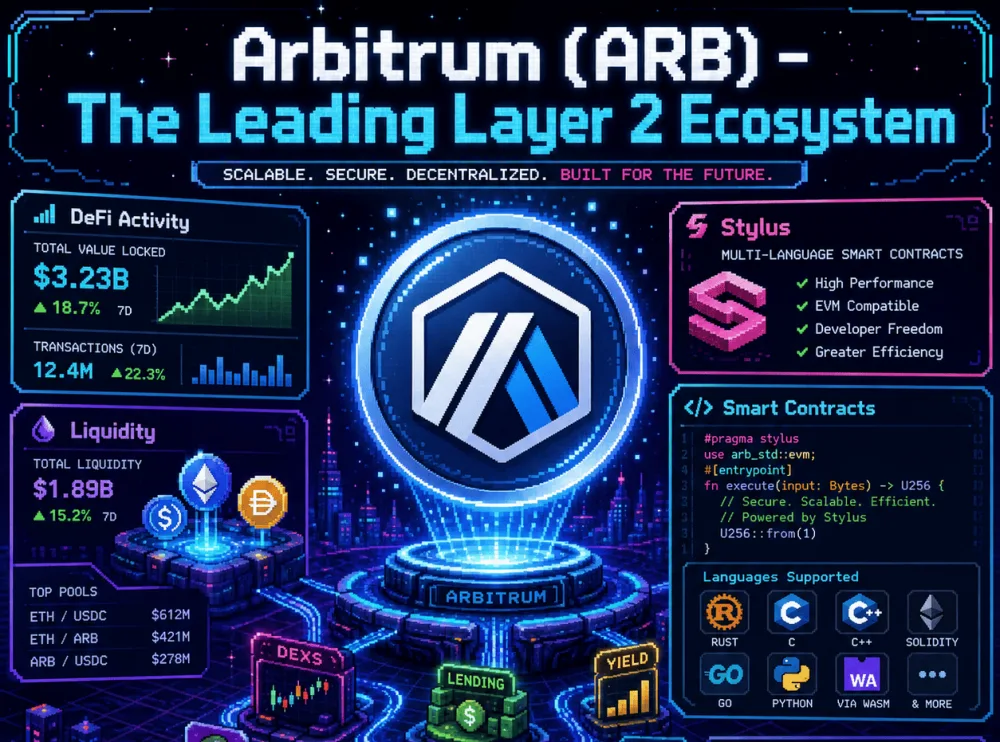
Still prominent within scaling solutions, Arbitrum holds steady among leading Layer 2 platforms. Its position persists, recognized widely when evaluating major Layer 2 tokens.
Why Arbitrum Dominates DeFi Activity
Among Ethereum’s Layer 2 networks, Arbitrum hosts a notably rich DeFi environment. Major decentralized exchanges operate there, alongside established lending systems. Perpetual futures platforms are present, while diverse pools support asset liquidity.
Because of its established position, ARB▲$0.0808 holds an advantage over more recent tokens. Trading, borrowing, and lending take place regularly on Arbitrum. Builders choose it for development, adding to its stability. Activity volume supports continued presence in varied market phases.
Read more: Arbitrum Price Prediction 2026: Is ARB the Next 10x Crypto?
Arbitrum Stylus and Multi-Language Smart Contracts
Among recent enhancements, Arbitrum Stylus stands out through broader programming access. Code execution now supports Rust, C, and C++ — not just Solidity — for contract development. This shift expands options available to builders working on the network.
Should adoption grow, Arbitrum might draw developers interested in building advanced applications, including artificial intelligence tools, intensive computational frameworks, and interactive simulations.
Key Catalysts That Could Push ARB Higher
A rise in Arbitrum’s value may follow expanding DeFi activity, paired with broader use of Stylus. Progress comes through Orbit chain development, improvements in DAO decision-making, and rising focus on Ethereum scalability. Each element builds momentum without relying on the last.
The bullish Arbitrum price prediction case depends on liquidity continuing to flow into Arbitrum. With ongoing developer activity, ARB may remain one of the strongest Layer 2 tokens over time.
Risks and Competition Facing Arbitrum
Despite its strengths, Arbitrum faces pressure from Base, Optimism, Mantle, Starknet, and zkSync. Token unlocks emerge as another influence on value trends. Governance questions also linger without clear resolution paths.
Although ARB shows solid underlying qualities, competition exists within its space. It does not capture attention alone.
Optimism (OP) – The Superchain Infrastructure Play
What stands out in Optimism crypto is its focus shifting away from individual networks toward foundational systems. Tied closely to the OP token is the OP Stack, a structure designed for rolling out Ethereum-aligned chains with greater capacity.
What Makes the OP Stack Important in 2026
From foundational tools within the OP Stack, creation of independent chains emerges through unified systems. This approach shifts Optimism beyond typical L2 status. A web of interconnected layers begins to form, linked by common design.
For this cause, OP continues to stand among top-tier Layer 2 digital assets worth attention.
How Base Strengthens the Optimism Ecosystem
What began as an experimental rollup soon demonstrated strong traction among users. Growth unfolded rapidly on Base, pointing to broader potential within the ecosystem. Technical direction shifted independently over time, yet initial momentum remained clear evidence that OP-based infrastructure could support real-world demand.
For this reason, Base carried Coinbase’s user base, reputation, and development network into the Layer 2 space.
Superchain Vision and Cross-Chain Expansion
The Superchain vision is built around a network of blockchains following shared rules, pooling resources, and using unified systems. Should that approach hold, coordination across Ethereum expansion may center partly on Optimism.
Can OP Become Ethereum’s Main Infrastructure Layer?
Should the Superchain attract widespread use, OP might evolve into a core component of Ethereum’s structure. Its potential hinges on whether rival frameworks, bespoke rollups, or Base pursuing its own path limit Optimism’s future value.
Read more: Best Ethereum Tokens and Projects to Invest in 2026
Starknet (STRK) – The High-Upside ZK Rollup Bet
Among Layer 2 solutions, Starknet crypto stands out due to its focus on zero-knowledge proofs. Though intricate in design, it offers notable potential gains because of that depth.
How Starknet Uses Zero-Knowledge Technology
Validity proofs enable Starknet to extend Ethereum’s capacity. Rather than accept transactions as valid by default, zero-knowledge methods confirm accuracy through computation. Mathematical verification replaces trust-based validation.
For this reason, Starknet ranks among leading top zk rollup coins in expert assessments.
Cairo Language and Scalability Advantages
Beginning with code structure, Starknet relies on Cairo, a programming language built around verifiable processes. Flexibility emerges in scenarios demanding growth across many users, yet new programmers face unfamiliar patterns when adapting.
The system allows expansion, though understanding its logic takes time due to unique design choices embedded within it.
Why STRK Is Considered a Long-Term Growth Asset
Should Starknet enhance how users interact with its platform, wider adoption of applications might follow. Growth in Ethereum’s scalability efforts may elevate the importance of zero-knowledge systems over time.
STRK tends to be viewed through a prolonged investment lens due to such potential. A substantial Layer 2 environment could emerge, provided network activity increases gradually.
Starknet’s Potential in Gaming and AI
Computation must be affordable, expandable, and provable, especially within gaming powered by artificial intelligence. Starknet’s architecture aligns well with such demands. Turning advanced systems into widespread usage remains difficult, however.
zkSync – One of the Most Promising zkEVM Projects
A prominent player among zero-knowledge initiatives, zkSync stands out as a closely observed zkEVM platform. Ownership of the zkSync token offers alignment with efforts toward scalable solutions compatible with Ethereum’s ecosystem. Enhanced usability shapes part of its core direction.
Native Account Abstraction and Better User Experience
Among zkSync’s notable qualities stands native account abstraction. Wallets may become simpler to operate due to capabilities such as smart accounts and improved gas handling. Onboarding improves at the same time because interactions grow more seamless.
For many people, cryptocurrency remains difficult to grasp. A refined user experience addresses more than appearance. Such improvements form the foundation for wider acceptance.
zkSync’s Growing DeFi Ecosystem
A handful of lending protocols now operate within zkSync, alongside emerging trading venues and cross-chain transfer systems. Despite limited user retention so far, signs of structure appear clearly. While total funds remain modest, expansion continues through incremental integration.
Adoption Trends and Major Partnerships
What keeps zkSync moving forward is ongoing support from developers, funding for new tools, and partnerships across platforms. Whether activity continues relies heavily on whether teams remain active once rewards are no longer available.
Challenges zkSync Must Solve to Compete
Among those vying for position, zkSync finds itself alongside Arbitrum, Base, Starknet, Linea, Scroll, and Optimism. For progress, deeper liquidity becomes necessary. Clarity in application purpose matters just as much. Momentum among builders, once gained, requires consistency over time.
Mantle (MNT) – The Treasury-Backed Layer 2 With Strong Fundamentals
Among recent developments, Mantle stands out due to its integration of second-layer technology alongside an extensive reserve of ecosystem funds. Its position is further shaped by solid monetary support from established sources.
Few projects have managed such alignment between network function and asset foundation. Stability does not come solely from code but also from balance sheet clarity.
What Makes Mantle Different From Other L2s
What sets Mantle apart goes beyond how fast transactions are processed. Backed by reserves, its approach to expansion stands out. Rewards within the network guide participant behavior over time. Links to liquid staking options add another layer of function. Efficiency in handling assets remains a central theme throughout.
The Role of Mantle Treasury in Ecosystem Growth
Mantle’s treasury holds funds meant for supporting applications, ensuring market liquidity, forming alliances, and guiding extended progress. Within cryptocurrency spaces, substantial reserves may offer meaningful leverage, provided management remains thoughtful.
MNT Staking, Governance, and Yield Opportunities
MNT▲$0.4454 serves governance along with involvement across the ecosystem. To gain interest beyond mere value shifts, yield options combined with staking may appeal to certain investors.
Why Analysts Watch Mantle Closely in 2026
Should Mantle’s backing matter, consider its developed framework alongside planned expansion. Not quite matching Arbitrum or Base in attention, Mantle still has structural strength that resists dismissal. What stands out is sustained progress without loud announcements.
Base Ecosystem Tokens – The Coinbase Narrative
Without a native coin, Base stands apart. Yet interest grows as ecosystem assets signal momentum within the Layer 2 landscape.
Why Base Became One of the Fastest-Growing Layer 2 Networks
Fast growth of Base stems from merging Ethereum’s scalability with Coinbase’s reach. This connection creates immediate access to everyday users, developers, and compliant trading systems.
Top Tokens Building Inside the Base Ecosystem
Base ecosystem tokens include those centered on DeFi, social platforms, gaming, and meme-based projects. While potential gains may be substantial, so too is uncertainty due to their early stage, price swings, and reliance on trends.
How Coinbase Could Accelerate Mass Adoption
Should Coinbase promote Base across its wallet services, trading platform, fiat gateways, software resources, and user-facing programs, widespread integration may follow. With vast numbers joining decentralized systems through that gateway, sizeable growth for Base appears possible.
Risks Around Base-Centered Investments
The primary concern lies in Base lacking a built-in token. Rather than investing in such an asset, individuals frequently choose tokens tied to its ecosystem. Yet these may fail to reflect the actual growth of Base’s network. Ownership here does not guarantee alignment with platform success.
Best Layer 2 Coins by Use Case
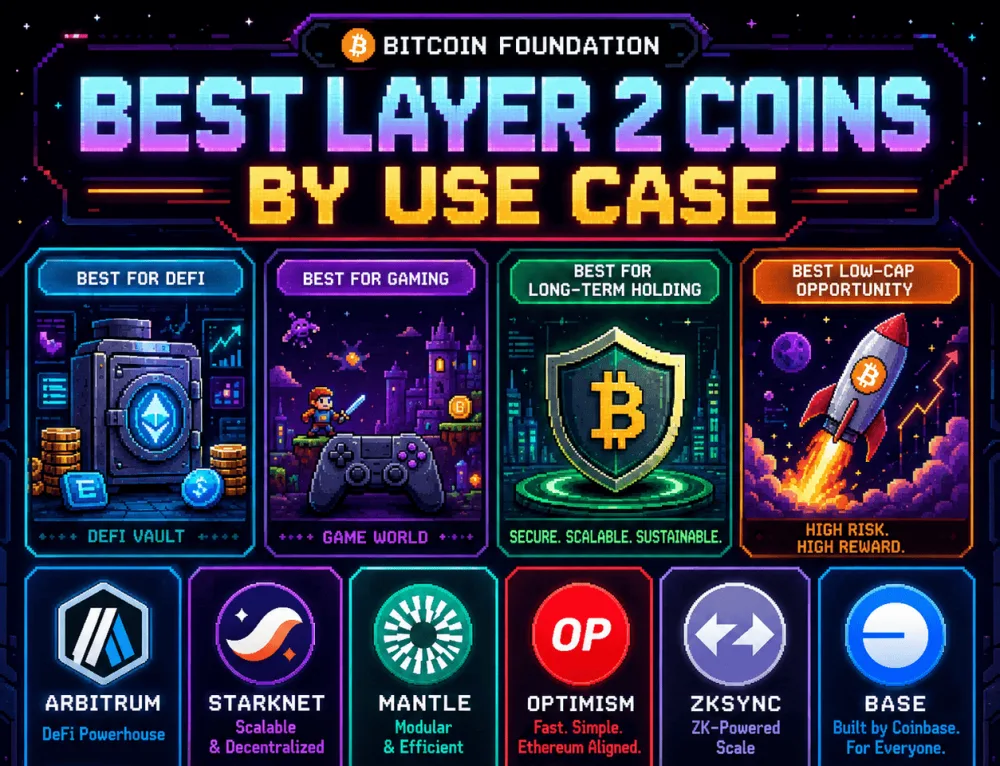
Not every investor fits one mold. Depending on goals, choices shift. Risk level shapes what makes sense by 2026. Time frame matters just as much. Purpose behind ownership plays a role too. That is why the best crypto to buy 2026 depends on use case, not just hype.
Best Layer 2 Coin for DeFi
When it comes to DeFi, Arbitrum stands out due to deep liquidity pools. Its position grows stronger through long-standing protocols already in place. Activity within its trading environment remains consistently high.
Best Layer 2 Coin for Gaming
Among emerging platforms, Starknet stands out due to its zero-knowledge proof foundation. Efficiency in handling intricate computations may also come through Arbitrum’s Stylus feature. Gaming applications benefit where performance meets throughput.
Best Layer 2 Coin for Long-Term Holding
Mantle stands out through its robust treasury position. Despite DeFi market shifts, Arbitrum maintains a leading role in decentralized finance activity. The path forward for Optimism ties closely to adoption of its broader Superchain framework.
Best Low-Cap Layer 2 Crypto With High Risk/Reward
Higher gains might come from smaller ZK and Base ecosystem tokens. However, the risks increase sharply. Most investors would find limited allocation more suitable than central placement within holdings.
Risks Investors Should Know Before Buying Layer 2 Coins
Though Layer 2 tokens may offer notable gains, risk remains present within this segment. Unexpected shifts often follow periods of upward movement. A cautious outlook fits well when reviewing such assets.
Token Unlocks and Inflation Risks
With many Layer 2 tokens set to release holdings over time, price dips may follow. Investors should review how much supply is already circulating, what comes next, and the rate at which new tokens enter the market.
Centralization Concerns Around Sequencers
Centralized sequencers remain common among numerous L2 networks. Risks may arise, including potential censorship, service interruptions, and influence on how transactions are arranged. Though designed for efficiency, such setups might limit autonomy when processing activity.
Competition Between Optimistic and ZK Rollups
Right now, many favor optimistic rollups. Still, ZK variants could hold greater promise over time. Which approach leads remains unclear.
Regulatory Risks for Ethereum Scaling Projects
Attention from regulators could center on tokens and how decisions are made within systems. Governance models might draw scrutiny similar to staking setups. Revenue distribution methods may also come under review, just as mechanisms controlling networks. Legal challenges can affect Layer 2 initiatives despite their technical layer.
How to Find the Next Explosive Layer 2 Crypto
Finding the next breakout L2 means looking beyond price charts.
Early Ecosystem Growth Signals
Real expansion tends to show up ahead of full price movement. Observe wallet growth alongside stablecoin liquidity levels. App rollouts connect with bridge inflows in meaningful ways. Transaction numbers often follow TVL shifts. Price changes tend to lag behind these indicators.
Tracking Smart Money and Whale Activity
Even though whale buying, institutional moves, and shifts in available supply may point to rising attention, informed investors sometimes misjudge direction. Exit patterns show large holders frequently leave positions long before smaller traders become aware.
Why Developer Activity Matters More Than Hype
What counts most is what happens behind screens, not viral posts. Though attention shifts fast online, real momentum builds quietly through code. Applications emerge where effort is steady. When tools work well, people stay. Their continued use shapes durable systems over time.
Indicators That Often Predict L2 Breakouts
Among the clearest signals are increases in total value locked, rising daily user counts, more flagship applications, steady developer engagement, higher fee revenue, major integrations, and stronger token usefulness. These indicators often separate real growth from temporary attention. For investors comparing the top Layer 2 coins, the strongest candidates are usually the networks where TVL, users, developers, and real revenue grow together.
FAQ
Which Layer 2 cryptocurrencies lead in 2026?
In 2026, leading Layer 2 cryptocurrencies consist of Arbitrum, Optimism, Starknet, zkSync, and Mantle. Despite lacking its own native token, the Base network still holds significance through associated ecosystem assets.
Which second-layer crypto option holds the strongest potential?
One size fits none when it comes to Layer 2 crypto investments. While Arbitrum shows depth in DeFi activity, Optimism opens access through its evolving Superchain framework. Starknet and zkSync offer exposure rooted in ZK rollup potential, while Mantle stands on measurable financial footing.
Could Layer 2 tokens hold value over extended periods?
A future rise in user numbers might support Layer 2 tokens, provided growth continues across usage and development fronts. Still, upcoming supply releases could pressure prices, especially where earnings do not match market interest.
Which cryptocurrencies lead in ZK rollup technology?
Among leading ZK rollup tokens, Starknet stands alongside zkSync, while initiatives like Linea and Scroll gain notice. Validity proofs serve as the core mechanism through which ZK rollups enhance Ethereum’s capacity.
Which Layer 2 cryptocurrency could see the largest increase in value?
Among emerging options, those showing early signs of user engagement could lead in expansion. Projects like Starknet, zkSync, Mantle, along with certain Base-linked assets might rise further despite modest present value. In contrast, networks such as Arbitrum and Optimism already hold firmer positions.
Why are Layer 2 blockchain projects important?
Layer 2 solutions make Ethereum more usable under heavy demand by reducing transaction costs and improving speed. With capacity expanded, applications ranging from digital games to automated software agents can function more smoothly. As usage grows steadily, scalable structures become a quiet necessity beneath daily crypto interactions.