As we look at the trajectory of Ethereum updates 2026, it can be seen as progress towards a modular, scalability-first architecture.
From a monolithic blockchain system, Ethereum has evolved into a settlement and data availability layer. This allows for upgrades to directly affect the throughput, fees, and security on Ethereum.

Contents
- Introduction to Ethereum Updates in 2026
- Key Ethereum Upgrades Coming in 2026
- Ethereum Scalability Improvements
- Gas Fees in 2026 – Will Costs Go Down?
- Security and Network Stability Enhancements
- Ethereum vs Solana and Other Blockchains in 2026
- Impact of Ethereum Updates on Users and Investors
- Potential Risks and Challenges
- FAQ
Introduction to Ethereum Updates in 2026
Why Ethereum Upgrades Matter
The core changes, such as the introduction of EIP-4844, for example, allowed for “blob transactions”, which are temporary data storage. These allow significant reductions in cost associated with rollups because they separate the execution of the transaction from the data available.
Therefore, due to the potential of reducing costs in addition to increasing speed, Ethereum upgrades have become important for both performance and relevance within an increasingly competitive Layer-1 environment.
Overview of Ethereum’s Long-Term Roadmap
The Ethereum roadmap 2026 will be a rollup-centric version. It will be focused on having the L1 perform security functions and store data, while the rollups perform all the actual execution. Most see this as the best way to achieve global scalability.
One major component will be danksharding, explained as a core evolution of the network’s scaling model. A new process has been started with proto-danksharding through EIP-4844 (cheaper data for rollups), and it will help pave the way for full danksharding.
Full danksharding will allow Ethereum to execute tens of thousands of transactions per second. This structure clearly defines what is Ethereum roadmap and future in practical, infrastructure-level terms.
What to Expect from Ethereum in 2026
The most recent proposed wave of upcoming Ethereum upgrades 2026, is expected to improve existing mechanisms rather than introduce entirely new ones. It is also supposed to continue to expand the blob capability and strengthen the rollups Ethereum ecosystem, helping to lower costs and boost overall efficiency.
In addition, Ethereum Layer-2 has become the de facto user interface, with the base layer providing a secure transaction settlement engine. All of these developments show how Ethereum is planned to grow and solidify itself as a basic layer for Decentralized Applications.
Key Ethereum Upgrades Coming in 2026
The Next Phase of Danksharding
Full danksharding represents the final step in scaling up Ethereum’s use of shard-based computing. It is a definitive solution that will enable massive growth in the amount of data that can be made available to rollups. Proto-danksharding created a sampling technique to create blobs and distribute them around the network.
In full danksharding, we are able to scale this model to the point where we have large portions of our data being distributed through sampling.
Full danksharding will allow us to get to tens of thousands of transactions per second, while at the same time limiting the load placed upon each node. As such, it will help to continue to build out Ethereum’s rollup-focused architecture and lead toward an era with much greater usability.
Proto-Danksharding Improvements (EIP-4844 Evolution)
A key step was achieved with the EIP-4844 rollout. However, as we move toward 2026, there is still an opportunity to improve blob capacities and the fee markets. Blob transactions, temporary data structures that were created during the Dencun hard fork, have already decreased layer two costs by as much as 90% in many scenarios.
As blob utilization increases, subsequent enhancements ought to provide more stable blob pricing and greater efficiency on the network. In addition, to make blobs more predictable and reliable for users, adjustments to the data gas market are going to need to occur quickly so that fees remain relatively low.
Verkle Trees and State Optimization
A number of the upgrades that are being eagerly awaited include the adoption of Verkle Trees in place of the current state structures on Ethereum, using a more efficient cryptographic model. The use of a stateless client will allow “clients” to process and store less data, which reduces node processing time.
Read Also Bitwise Says Ethereum Price Behaves More Like Oil Than Stock
In addition, from an infrastructure perspective, this represents one of the biggest leaps forward for ETH▲$1,761.17 network upgrades as it decreases the cost of hardware needed for operation, increases sync speed, and has increased decentralization as it makes it easier for additional people to operate their own nodes.
Account Abstraction Developments
Account abstraction will evolve from an incremental advance beyond existing applications and become one of the major usability upgrades for smart accounts. Users are no longer required to rely upon the use of “externally-owned” account types; they can instead choose to utilize programmable wallets, which offer new features such as social recovery and multi-signature control options.
Ethereum Layer-2 interaction will continue to improve through ease-of-use by 2026. The ability to pay fees in tokens other than ETH, and to simplify user onboarding, are two aspects of this transition that most people see as critical to achieving extensive adoption.
Other Proposed EIPs to Watch
Beyond headline upgrades, several smaller proposals are shaping upcoming Ethereum upgrades 2026, explained. For example, there are upgrades to improve how validators operate on the blockchain, reduce the time it takes for transactions to reach finality, and improve the ability to allow different blockchains to communicate with each other through rollups.
The next generation of Ethereum development is planning to implement new release cycles that will be more consistent and less risky than previous release cycles (e.g., expected 2026 upgrades known as “Glamsterdam” and “Hegota”), which should enable developers to innovate and deliver updates to users more quickly.
Ethereum Scalability Improvements
How Sharding Enhances Throughput
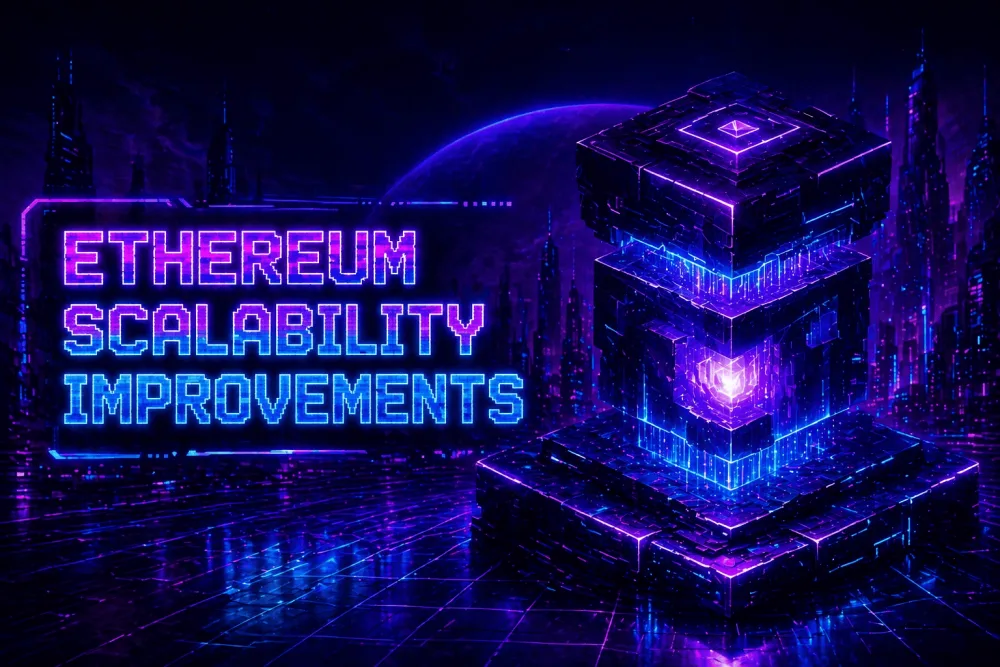
Sharding increases a network’s ability to scale as it has the capability to distribute the workload of data processing throughout the network rather than having all nodes process all information. In terms of scalability, Ethereum sharding enables the network to handle larger amounts of data while maintaining a decentralized and secure nature.
Long term, dankshardng will be used in Ethereum sharding. Danksharding involves taking large quantities of data and breaking them up into smaller portions that can then be verified using sampling methods. This method increases data availability for rollups and reduces congestion on the base layer, enabling much greater throughput.
Layer-2 Solutions and Rollups Growth
Ethereum Layer-2 is currently the main route forward to achieve scalability. L2 solutions use rollups as a method to process transactions off-chain and post the processed data in a compressed format back on-chain to inherit the same security properties that Ethereum has, but at significantly higher capacities.
EIP-4844 was an upgrade that introduced blob transactions, enabling lower-cost data storage with rollup solutions, resulting in an order-of-magnitude reduction in costs. As such, this will continue to accelerate adoption within DeFi and other application areas, further solidifying the ecosystem’s focus on using rollup-centric approaches.
Impact on Transaction Speed
Ethereum’s scaling roadmap has always focused on both how many transactions are processed as well as perceived speed at the end-user level.
Congestion in Layer-1 historically created slowdowns for confirmations and added delays due to a lack of processing space at times of high demand.
The use of rollup-based systems for carrying out transactions and blob-based systems that improve transaction data flow allows users to see faster confirmation time at the application layer.
Will Ethereum Finally Scale Globally?
The architecture of Ethereum has become increasingly modular. It has separate execution, settlement, and data availability. Modular architectures allow a larger volume of transactions on the network than was previously possible with a single monolithic architecture.
This shift toward modular scaling is widely supported by researchers and core contributors within the Ethereum ecosystem.
“Danksharding is how Ethereum becomes a truly scalable blockchain.” — Ethereum Foundation.
While Ethereum speed improvements are already visible, full global scalability continues an ongoing process. There are still many challenges that need to be solved before achieving interoperability among all types of rollups. Nevertheless, the way forward for how Ethereum will scale in the future is becoming clearer with each upgrade.
Gas Fees in 2026 – Will Costs Go Down?
Current Gas Fee Challenges
Gas fees on Ethereum remain dependent upon “demand shocks” despite improvements made recently. Demand increases(such as those experienced by DeFi/NFT markets) create increases in cost due to both the limited available block space on the Layer-1 and the auction mechanism.
The base layer is simply not built to be used at high frequency; even though averages of about $0.16-$0.22 were seen for early-2026, complex transactions can be quite costly during periods of congestion. Thus, there are major limitations of the Ethereum gas fees 2026 structure.
How Upcoming Upgrades Reduce Fees
The biggest cost savings come from EIP-4844’s introduction of blob transactions as an alternate method to access calldata that is significantly less expensive. This will allow for much greater efficiency in posting data through rollups, reducing the cost associated with these actions by 90–99%, depending on the operation, and altering the economics of the entire network.
This has resulted in a decrease in total gas pressure across all users on the mainnet. Average gas prices have been shown to drop more than 50%, creating “cheap gas” conditions more often.
Role of Layer-2 in Fee Optimization
The adoption of Layer-2 rollup solutions by Ethereum has been the primary driver for decreasing fees. As it currently stands, Layer-2 solutions handle nearly all of the transaction volume that occurs on the Ethereum blockchain, with an estimated 95% or higher. This offloads much of the pressure from Layer-1.
This translates into the fact that for many users, there are very few situations where one would need to pay the current gas fees for trading, transferring funds, or participating in games.
Thus, when asking will Ethereum gas fees go down 2026, while the prices may fluctuate as they always do on Layer-1, there is evidence of structural decreases in fees across the larger Ethereum community.
Security and Network Stability Enhancements
Improvements in Smart Contract Security
Improving security on the smart contract level is a primary focus area for many ETH network upgrades. The growth in DeFi and tokenization is creating an increasing need for secure ways that allow contracts to be updated and allow patches to be made to vulnerabilities so as to maintain the assumptions of users.
Protocol-level improvements through account abstraction and better developer tools will reduce the number of common attack vectors, which include incorrect signature handling and wasteful gas usage. All these improvements are part of a larger effort to improve the reliability of the execution layer of the Ethereum network as it continues to scale.
Validator Network Upgrades
Validators have been growing rapidly; the total number is now greater than one million. Additionally, over 30% of ETH is being staked.
Read Also: Top 5 Wild Ethereum Price Predictions for 2026: From Realistic to Moonshot Scenarios
Pectra, an upgrade, made several enhancements to validator operation, which include increased staking limits and a faster process to onboard new validators. Therefore, these upgrades improved both performance and resiliency. The consensus layer will continue to be operational as the network continues to scale.
Reducing Risks and Attack Vectors
The Ethereum roadmap 2026 emphasizes “Layer-1 Hardening”, which focuses on reducing system-wide vulnerability/risks, and increasing fault-tolerance through the improvement of agreement protocols, development of diverse clients, and hardening defense mechanisms at the network level.
At the same time, the community will be working on new risks, including the emergence of vulnerabilities associated with zk- based systems and developing plans to lessen longer-term risks associated with quantum computing. This active strategy constitutes a paradigm shift from simply repairing vulnerabilities to ongoing and continuing risk management.
Ethereum vs Bitcoin and Other Competitors in Security
Although alternative blockchain systems continue to place an emphasis on speed and cost savings compared to Ethereum, the latter has continued to focus on upholding both the decentralization and economic security of its network.
In addition to the layering of validation by a Proof of Stake (PoS) mechanism, the use of multiple validators that are required to validate each new block provides such a high level of resistance to potential attacks on the system.
In terms of scalability versus security, while there are many alternatives that provide greater throughput than Ethereum at this time, the architectural design of Ethereum, along with its long-term plans for upgrading the security of the platform, will likely result in one of the most secure platforms available.
As a result, the trade-off between scalability and security will likely remain a key point of discussion when comparing Ethereum vs other blockchains in 2026.
Ethereum vs Solana and Other Blockchains in 2026
Ethereum vs Solana
The contrast between Solana and Ethereum represents a dichotomy in how they are structured as blockchain systems. Solana has focused on the scalability of high-volume transactional throughput with lower costs. In contrast, Ethereum’s focus is on the decentralized security of transactions.
Ethereum makes up for this through its ability to scale using modular strategies and an established ecosystem. AlthoughSolana is well-suited for fast-paced, high-volume activities such as payments, Ethereum continues to dominate in DeFi complexity and institutional use-cases. This illustrates the main competitive dynamic between Ethereum vs other blockchains 2026.
Ethereum vs BNB Chain
Millions of daily users on the BNB▲$572.56 Chain have allowed for performance and cost efficiency. On the other hand, Ethereum’s market is more liquid, and its infrastructure is better developed than that of the BNB Chain.
The higher value transaction volume and composability of the applications within Ethereum’s ecosystem are key reasons why ETH continues to be superior to BNB for many complex fiscal applications.
Ethereum vs Layer-2 Ecosystem
A better current example is to compare Ethereum to the layering systems that it uses for scaling. The rapid proliferation of Ethereum’s Layer-2 networks has caused most of Ethereum’s network usage to move from the main chain to the secondary layer.
At the same time, some core developers have recently questioned how this model should evolve.
“The original vision of L2s and their role in Ethereum no longer makes sense.” — Vitalik Buterin.
This shift in use has significantly improved transaction speeds and lowered transaction fees while maintaining the level of security that users have come to expect.
Will Ethereum Maintain Dominance?
Ethereum’s place by 2026 will be based on how well it can find the balance between being decentralized and scalable. Although competitors such as Solana are getting better at faster transactions for specific use cases, and Binance Smart Chain is gaining users and lower costs for use.
Ethereum has a lot going for it. It has many established users and a strong reputation in the industry. This could give ETHa a greater advantage over time than Solana or other new blockchain platforms..
Impact of Ethereum Updates on Users and Investors
What It Means for Developers
At the same time, advancements such as improved developer tools and account abstraction have created an environment of less friction to onboard users and interact with smart contracts.
This has led to a simpler path to develop applications that allow developers to create dApps that will be able to use more flexible application logic. This is creating an ecosystem where developers are able to create dApps that will run primarily on Ethereum.
The combination of these changes has enabled Ethereum to become a platform for developing applications, in addition to providing a place for users to send value and secure those transactions.
Opportunities for DeFi and NFTs
The evolution of Ethereum scalability will provide new opportunities for both DeFi and NFTs. Rollup technologies, along with blob transactions, have enabled lower transaction costs that were unattainable previously. Many previously cost-prohibitive use-cases, for example, micro-transactions, quantitative trading, etc., can now be used.
NFT applications will also benefit from the improved technology, which has made it easier for developers to create applications such as gaming assets and dynamic tokens. As rollups Ethereum ecosystems mature, liquidity and user activity are expected to grow, strengthening Ethereum’s dominance in these sectors.
How Upgrades Affect ETH Price
The relationship of price to upgrades is still somewhat indirect; it has an important bearing. As improvements are made to scalability and usability, they typically lead to greater usage or “network activity,” which will typically enhance demand for ETH both through transaction fees and through staking participation.
In addition to actual upgrades themselves, there is also a market expectation. Optimism surrounding future upgrades has contributed to price momentum (ETH traded at $2,300), and as noted by analysts, additional institutional buying interest and enthusiasm for future upgrades could support further upward movement.
Although ETH predictions 2026 appear uncertain, most estimates have been in the range of $2,200 to $3,700 based on the market environment.
Long-Term Investment Outlook
The long-term view of Ethereum’s investment thesis will be more and more linked to its function as underlying/infrastructure. As scalability is improved through technical progress and increased usage, ETH has multiple uses for increasing demand, such as staking, DeFi applications, and data availability fees.
However, there are also continuing risks. There may be increased regulation and competition, which may hamper growth. Analysts have shown a wide variation in price projections, ranging from moderate increases to possibly reaching new highs.
Potential Risks and Challenges

Delays in Ethereum Roadmap
Execution delays are a continuing risk for Ethereum upgrades. The road map is extremely aggressive, with numerous interdependent upgrades (i.e., Glamsterdam and Hegotá) scheduled at the same time.
Even if there is a move towards releasing new versions more frequently than in the past, coordinating across clients and developers can slow down the release of each version.
Even though delays are purely technical, they can also affect how investors perceive Ethereum’s progress toward meeting its objectives — particularly when it comes to scalability features that are critical to improving roll-up efficiency and data access, as stated in the Ethereum roadmap 2026.
Technical Complexity of Upgrades
The technical challenges associated with advancing the Ethereum platform are significant when considering innovations such as danksharding, Verkle Trees, and proposer-builder separation.
All three have the capacity to substantially modify the underlying protocol and will need to be executed in an environment that does not compromise network integrity.
The level of difficulty as well as potential for errors associated with these types of innovations increases the likelihood of discovering new bugs or unintended vulnerabilities. The recent concerns regarding upgrade-related exploits highlight that even well-tested upgrades can produce temporary instability. This reinforces how hard it is to scale a live, high-value network.
Competition from Other Networks
The competition in this space will remain one of the key drivers of Ethereum’s ability to grow over time. There are many high-performance blockchains (such as Solana) and new Layer-1 networks that are attracting development talent due to their quicker execution times and lower fees.
Read Also: Major Ethereum Updates 2026: Overview, Protocol Upgrades and Strategic Roadmap
Although Ethereum has very strong network effects, there is an opportunity for other blockchain alternatives to capture some of ETH’s market share if its current plans for scaling do not meet expectations.
Regulatory Uncertainty
Regulation remains one of the primary external factors that could limit the future of Ethereum’s potential for development. The governments around the world have begun to take greater control over digital asset regulation with a focus on regulating several areas, including but not limited to: consumer protection, financial stability, and anti-money laundering compliance.
ETH has been referred to as a commodity by various governmental agencies in certain jurisdictions; however, there currently exists no uniform global scheme governing the regulation of digital assets.
Regulatory ambiguity may affect participation from institutions, which will negatively impact adoption, thereby creating a significant unknown variable in forecasting the Ethereum future.
FAQ
What are the most important Ethereum upgrades in 2026?
The major updates include continued improvements to proto-danksharding, expansion of Layer-2 infrastructure, and upcoming upgrades like Glamsterdam. These changes focus on scale, lower costs, and better integration between layers.
Are gas fees on Ethereum really lower now?
Yes, average mainnet fees have dropped to roughly $0.10-$0.20, while Layer-2 transactions can cost just fractions of a cent. This is largely due to blob transactions introduced by EIP-4844.
Is Ethereum fully scalable in 2026?
Ethereum is significantly more scalable than before, but not infinitely so. Most scalability gains come from Layer-2 networks, which now process a large share of transactions.
Why do developers still choose Ethereum?
Ethereum remains the leading platform due to its security, large developer ecosystem, and dominance in DeFi and stablecoins. Most new projects still launch on Ethereum or its Layer-2 networks.
Is Ethereum still a good long-term investment?
Ethereum’s long-term value depends on adoption, staking, and ecosystem growth. While it offers strong fundamentals, price volatility and competition remain important risks for investors.