Bitcoin and Ethereum currently dominate the crypto market by a wide margin. However, when it comes to payments, they face performance and scalability challenges. Bitcoin has value as money but has limitations as a high-speed rail. Ethereum has value as a settlement and application layer but remains fragmented in its own space. The question for 2026 is: can Solana become the main global payments network?
Solana has advantages in lower fees, faster settlement, stablecoin liquidity, consumer wallet adoption, and merchant tools. However, there are also non-technical challenges for payments: regulation, distribution, liquidity, uptime, and compliance. That last part is what makes empires, though few want to admit it.
Read more: Bitcoin Crashed to $58K: What Happens Next to BTC and Altcoins in July 2026?
Contents
- Why Bitcoin and Ethereum Face a Payments Crisis
- Why Solana Is Built for Payments
- Why Solana Can Beat Bitcoin in Payments
- Why Solana Can Challenge Ethereum in Payments
- The Importance of Mobile Wallets
- Can Solana Handle Global Scale?
- Solana’s Biggest Weakness: Trust and Reliability
- Regulation Will Determine the Winner
- The Competition: Tron, Base, Stellar, and More
- Can Solana Become the Main Global Payments Network in 2026?
- Final Thoughts
- FAQ
Why Bitcoin and Ethereum Face a Payments Crisis
Bitcoin and Ethereum are global assets that have strengthened their reputation in recent years. Bitcoin is money, and Ethereum is the settlement and application layer. Their challenge in payments is their ability to facilitate transactions at scale: fast, cheap, and programmable.
Their design is not inherently opposed to being a payments protocol, but neither is it optimized for it. That creates room for other smart contract chains to specialize in payments and displace Bitcoin and Ethereum in this role.
Solana’s design is focused on fast transactions and low fees, which are necessary (though not sufficient) for a payments network.
Bitcoin as Money: Strong Asset, Weak Payment Rail
Bitcoin’s value proposition as a payments protocol is undermined by its own success. The BTC▲$62,630.00 ecosystem has an incentive to favor its role as digital gold and weaken its role as digital cash. For most BTC holders, the opportunity cost of spending is too high, and they prefer to hold, long, or collateralize their BTC.
Moreover, BTC transactions can be slow and expensive for small payments. While the Lightning Network is a clever solution, it has not yet achieved critical mass to displace cash in global commerce.
Bitcoin’s value proposition as a payment asset is its role in large-value settlement, cross-border payments, savings in local currencies, and censorship-resistant value transfer. These are all important functions, but they do not make it the first choice for a main global payments network.
Ethereum’s Payment Problem: Costs, Fragmentation, and UX
Ethereum’s challenge is the opposite: the protocol can support a variety of applications, from stablecoins to DeFi to NFTs to payments. However, Ethereum mainnet is too slow and expensive to serve as a settlement layer for mass-market payments.
The solution is Layer 2 scaling, which has seen remarkable adoption in recent years. Base, Arbitrum, Optimism, zkSync, and other L2 chains offer cheaper and faster transactions than Ethereum mainnet.
The challenge for Ethereum as a payments network is that it requires users to adopt a multi-chain UX. To send funds on L2, a user must know which chain their recipient is on and have assets bridged there. This friction point that makes Ethereum less appealing as a payments protocol.
In the long term, Ethereum’s future as a payments network is not obvious. Transaction fees on L2s are falling and the UX will improve, but until account abstraction becomes widespread, the multi-chain UX will remain a barrier to mass adoption. Ethereum is more likely to remain a payments ecosystem than a payments network.
Why Solana Is Built for Payments
Solana has advantages over its rivals in its value proposition for payments: fast transactions and low fees. It also does not have the multi-chain UX challenge of Ethereum. These factors contribute to Solana’s appeal as a payments infrastructure. The value proposition for Solana is straightforward: facilitate high-throughput value transfers, particularly stablecoins. It also offers developer tools for companies to launch their own stablecoins and other financial products on the Solana blockchain.
Solana is well-positioned to displace other smart contract chains in the payments space. It does not need to replace Bitcoin and Ethereum to dominate the payments market. To do so, it must be better at what crypto payments are likely to be in 2026: faster settlement, lower fees, and a better UX.
Read more: What Is Solana? Complete Beginner’s Guide 2026
Solana Pay and the Merchant Use Case
Solana Pay is positioned to disrupt the payments industry by enabling direct payments from consumer wallets to merchant wallets, bypassing some of the infrastructure and settlement costs of traditional banking.
For merchants, this is an attractive proposition, as it reduces costs and settlement times while eliminating chargebacks. Merchants can also receive stablecoins directly on-chain, which is beneficial for treasury management. Consumers are also likely to favor the speed and simplicity of Solana Pay, as well as its potential to enable cheaper transactions using stablecoins.
The critical question is whether the end-user experience is simple enough for mainstream adoption. If Solana Pay requires too many steps, it will fail to disrupt the payments market. If it can be as simple as scanning a QR code and confirming a transaction, it has a chance to disrupt the payments industry.
Stablecoins Are the Real Payment Product
When most people think about payments on Solana, they think about stablecoins. Few want to pay rent, salaries, or invoices in volatile assets. As a result, stablecoins are likely to dominate the value transfer space on Solana. This is critical to understand when it comes to competition between smart contract chains.
Chains compete in the total value transferred, but stablecoins are the real differentiator. The availability of USDC▲$0.9999, USDT▲$0.9991, PYUSD▲$1.00, and other stablecoins will determine which chain is best positioned to disrupt the payments market.
The ideal scenario for Solana is to enable frictionless regulated stablecoin settlement. That would facilitate a main global payments network where users could send and receive digital dollars with ease.
Read more: Solana Staking 2026: Crouton Digital’s Institutional-Grade Solutions for Maximizing SOL Yield
Why Solana Can Beat Bitcoin in Payments
Solana can beat Bitcoin in payments because the two chains are designed for different purposes. Bitcoin is likely to maintain its status as digital gold, while Solana can carve out a niche as the fastest and cheapest blockchain for stablecoin payments.
Why Solana Can Challenge Ethereum in Payments
Both chains support programmable money. However, Ethereum faces a multi-chain UX challenge that Solana does not have. Solana’s value proposition is straightforward: a single fast and cheap chain, which is critical for payments. For most users and merchants, the speed and simplicity of a single blockchain outweigh the technical advantages of Ethereum’s ecosystem.
Ethereum is likely to dominate institutional settlement, while Solana can focus on the consumer payments market. This is a realistic scenario, but not guaranteed as Ethereum has a first-mover advantage and stronger institutional support.
The Importance of Mobile Wallets
Global payments are a mobile-first industry, and Solana is well-positioned to capitalize on this trend. The chain has seen increased adoption in mobile wallets, which is critical for disrupting the payments market. The payments UX is also crucial: users must be able to send stablecoins as easily as they can send money with a traditional mobile wallet.
This is the real competition between crypto wallets and traditional payment processors. The winner will be the one that offers the best combination of speed, simplicity, and cost.
Can Solana Handle Global Scale?
Solana is a high-performance blockchain that can handle enormous transaction volumes, but there are practical limits to how much a crypto network can scale in payments. Traditional card networks and banks have achieved global scale by providing compliance, customer support, fraud detection, and refunds, which are challenging for crypto networks to provide at scale. Settlement is only part of the equation; the other part is the user experience.
To disrupt the payments market and compete for the role of main global payments network, Solana must have the infrastructure that users and merchants care about: stablecoin liquidity, merchant tools, consumer protections, compliance, on- and off-ramps, fraud detection, tax reporting, and wallet infrastructure.
Solana’s Biggest Weakness: Trust and Reliability
Solana’s biggest weakness is its reputation. The chain has had several high-profile outages, which has hurt its credibility as a reliable payments network. Bitcoin’s advantage is security and censorship resistance, and Ethereum’s advantage is institutional adoption and composability. Solana’s advantage is speed and lower fees, but those are irrelevant if the chain is unavailable when it is needed.
To disrupt the payments market, Solana must overcome its reputation problem and demonstrate that it can provide the reliability and uptime required for mission-critical applications.
Regulation Will Determine the Winner
Crypto payments are highly regulated, and stablecoins, merchants, wallets, and processors must comply with financial regulations. Regulation will be a significant challenge for any payments network that wants to achieve mainstream adoption. Solana cannot rely on its technical advantages to dominate the payments market; it must build a compliant and trustworthy ecosystem that can attract merchants, stablecoins, processors, and users.
This could be an advantage for Solana, as its performance characteristics are well suited to regulated stablecoin settlement. If payment processors and stablecoin issuers adopt Solana, it will be much harder to displace them.
The Competition: Tron, Base, Stellar, and More
Solana is not the only smart contract chain that can challenge Bitcoin and Ethereum in payments. Tron has a large user base and is popular for stablecoin transfers. Base has the distribution advantage from Coinbase and has seen increased adoption in the L2 space. Stellar has had institutional adoption in the payments space, and Polygon, Arbitrum, and other chains are also vying for market share.
This means that Solana’s dominance in crypto payments is not guaranteed, and the market is likely to be multi-chain.
Can Solana Become the Main Global Payments Network in 2026?
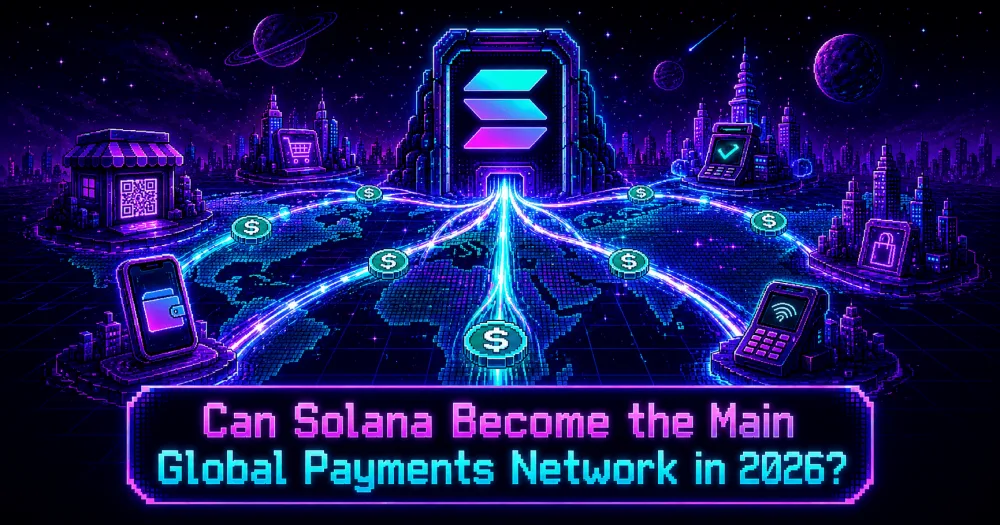
Solana can become one of the main crypto payment networks in 2026, but it is unlikely to dominate traditional payment rails in the near term. The most realistic scenario is that Solana will lead the market in crypto-native payments: fast, low-cost settlement of stablecoins. It will be one of the most important payment networks in the world but will not replace traditional banks, card networks, or national payment systems.
A more accurate description of Solana’s potential in 2026 is that it will be one of the most important rails for stablecoin payments. That is a huge market opportunity, but it is not the same as being the main global payments network.
Bull Case for Solana Payments
The bull case for Solana payments is that it has the potential to become one of the most important payment networks in the world. With its low fees, fast settlement, and growing stablecoin liquidity, Solana can facilitate a new era of crypto-native payments and disrupt the payments industry.
If stablecoins become a significant medium of exchange, Solana can benefit from the demand for fast and cheap transactions. This could propel Solana to mainstream adoption and make it one of the most important rails for value transfer in the world.
Bear Case for Solana Payments
The bear case is that Solana will fail to achieve mainstream adoption and disruption of the payments industry. While Solana has advantages over its rivals, it must overcome challenges in reputation, UX, regulation, and competition to achieve critical mass in payments. It is not obvious that any crypto network will dominate the payments market. Solana’s advantages may be outweighed by the scale and security of traditional payment rails.
Final Thoughts
Bitcoin and Ethereum are not dying, but both have weaknesses as payments protocols. Bitcoin is best suited for its role as digital gold, while Ethereum is a settlement and application layer for DeFi and tokenized assets. Solana is a high-performance smart contract chain that can facilitate fast and cheap payments.
Can Solana become the main global payments network in 2026? Possibly in the crypto-native sense but not easily in the traditional sense.
FAQ
Can Solana become the main global payments network in 2026?
Solana can become one of the main blockchain payment networks in 2026 but is unlikely to dominate traditional payment rails anytime soon.
Is Solana better than Bitcoin for payments?
Solana is better than Bitcoin for fast, low-cost payments, but Bitcoin has advantages as a settlement, savings, and censorship-resistant asset.
Is Solana better than Ethereum for stablecoin payments?
Solana has better performance characteristics than Ethereum mainnet and does not have the multi-chain UX challenge, but Ethereum has deeper liquidity and institutional support.
Why are stablecoins important for Solana payments?
Stablecoins are the real payment product, and Solana can facilitate their settlement with low fees, fast confirmation, and simple wallet UX.
What could stop Solana from becoming a major payment network?
Reputation, regulation, merchant adoption, distribution, liquidity, wallet UX, reliability, and competition from other blockchains and traditional rails could hurt Solana’s payments prospects.