Bitcoin price collapsed back towards the $58K area, which was expected to be relatively safe for risk-taking before. Contrary to expectations, the current crypto market environment is dominated by ETF selling, decreased liquidity, increased dollar dominance, and weak risk appetite. Thus, a correction has evolved into a broader crypto market crash, with the BTC▲$62,630.00 price near $58,691 and ETH▲$1,761.17 near $1,577 on July 1, 2026.

This does not necessarily indicate the end of the crypto bull market, but rather a need for the price to consolidate around $58K as a critical support. As such, every Bitcoin price prediction for July will be based on whether the buying interest can absorb large-scale selling pressures without undermining confidence in the asset class.
Contents
- Why Did Bitcoin Crash to $58K?
- Is the $58K Level Strong Support or the Beginning of Another Crash?
- What Could Happen to Bitcoin in July 2026?
- What Will Happen to Ethereum and Other Altcoins?
- Key Indicators Every Crypto Investor Should Watch in July
- Expert Predictions for Bitcoin in July 2026
- Should Investors Buy Bitcoin After the Crash?
- FAQ
Why Did Bitcoin Crash to $58K?
Bitcoin price is crashing due to multiple factors, and not just one particular news cycle. The Bitcoin crash of 2026 began as a result of ETF inflows/drawdowns, increased interest rates, a stronger dollar, weaker spot demand, and leveraged short selling. Thus, a confluence of macro-level, liquidity-related, and speculative selling pressures has triggered an extended drawdown.
Related: Can Bitcoin Crash to $20K in 2026? What Could Trigger a Historic Crypto Market Collapse
The Biggest Reasons Behind Bitcoin’s Latest Sell-Off
The most apparent explanation for the sudden drop in Bitcoin price is the rapid reduction in demand from buyers. The same market setup applies to different asset classes, but with varying degrees of severity. As such, the combination of profit-taking, mining-related selling pressures, derivative liquidations, and weak buyer demand has put extreme selling pressure on the asset.
ETF Outflows Continue to Pressure BTC
Intraday BTC price action is defined by rising bearish on-chain activity and heightened fears of a prolonged bear market. With that said, recent reports indicated the presence of significant redemption pressures across US spot Bitcoin ETFs, with a particularly large five-day selling window and an extended downtrend. As such, negative ETF-related flows are the most important factor in any Bitcoin price prediction for this week.
Fed Policy, High Interest Rates, and Strong Dollar
The overall macroeconomic environment is also a critical contributor to the bearish trend. The consensus amongst analysts is that the Federal Reserve will keep the federal funds rate between 3.50% and 3.75% through mid-2026. As such, tight liquidity conditions for risk assets will continue to put pressure on crypto prices, making Fed interest rates one of the most important topics for discussion in July.
Why Altcoins Are Falling Even Harder Than Bitcoin
Altcoins are generally more volatile than Bitcoin, with smaller-cap assets possessing larger beta exposure to macroeconomic headwinds. As such, the rapid Bitcoin price drop has resulted in an even sharper decline in the prices of alternative cryptocurrencies. Reduced liquidity and widened bid-ask spreads have created an immediate risk for forced unwindings, particularly when leveraged long positions are liquidated in response to unfavorable news.
Is the $58K Level Strong Support or the Beginning of Another Crash?
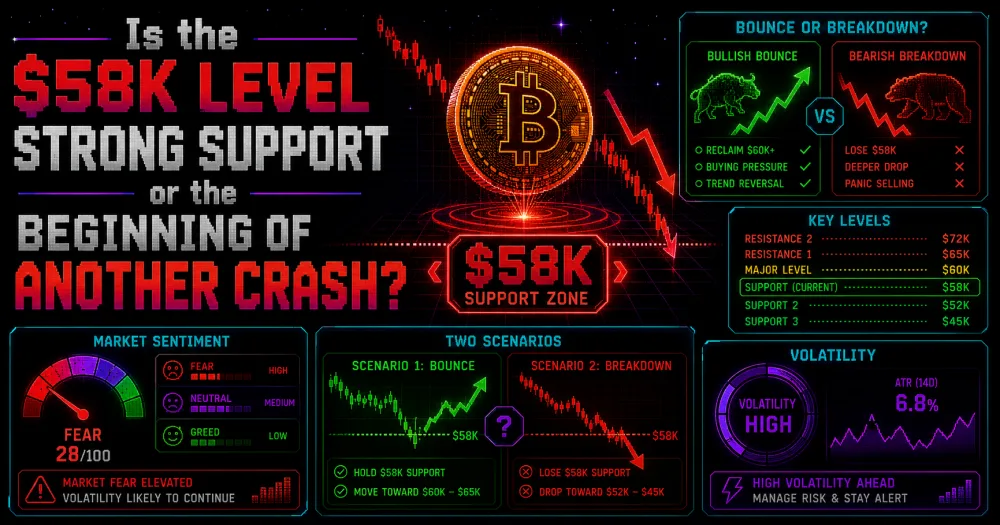
The importance of the $58K level is difficult to overestimate, although its impact on the Bitcoin price action will ultimately depend on market structure. The lowest Bitcoin support is between $ 57 K and $ 58 K, and a close below this level would suggest bears are in control of price action. With that said, the bulls will do their best to defend this level and possibly trigger a rally back towards $62K and higher.
Key Bitcoin Support and Resistance Levels
It’s worth repeating: the most important BTC support is between $58K and $57K. A close below this level would strongly indicate a resumption of the bearish trend. The next support level is estimated at $55K, whereas the first Bitcoin resistance is located at $62K. The bulls will need to clear this barrier to attempt a broader rebound.
What Technical Indicators Are Saying Right Now
Bitcoin technical analysis is mixed at the moment, with bears and bulls locked in an intense battle for control. While momentum indicators remain bearish and price action is rejected by ascending moving averages, the bears are challenged by increasing volumes on bullish candles. Oversold conditions are also present, which will enable the bulls to stage a convincing rally if buyers can clear the nearest resistance level.
Related: Why Is Crypto Crashing in Q2 2026? Top 3 Brutal Reasons the Market Is Falling Now
On-Chain Signals: Are Whales Buying or Selling?
On-chain analysis is one of the most important tools for understanding the Bitcoin price action. The distribution of large-volume transactions between exchanges will provide an indication of whether institutional investors will attempt to accumulate BTC, sell it for fiat, or remain inactive. Particular attention should be paid to whale wallets, exchange inflows, realized profits and losses, stablecoin-related flows, and other relevant factors.
What Could Happen to Bitcoin in July 2026?
Bitcoin prediction for July 2026 can be divided into three distinct scenarios, which include a bullish rebound, bearish crash, and sideways consolidation.
Bullish Scenario: BTC Recovers Above Key Resistance
The bullish scenario incorporates the possibility of a broad rebound, which is partially supported by recent observations. The bears are currently in control of the price action, but their grip on the market may loosen if ETF inflows begin to reverse. This would enable the bulls to rally the price back towards $62K and potentially trigger a broader rebound.
Bearish Scenario: Bitcoin Drops Below $55K
The bearish scenario suggests that the sell-off will intensify, with Bitcoin potentially falling below $55K. Such a development would strongly confirm the bears’ dominance and the likelihood of a broad crash later this year. As such, the bears will attempt to accelerate the decline so that short sellers can realize greater profits.
Sideways Scenario: Extended Accumulation Before the Next Move
The most realistic scenario, in this case, incorporates the possibility of a prolonged period of sideways consolidation. Bitcoin will remain trapped between $55K and $65K for most of July as leveraged longs unwind their positions and investors wait for a clear signal. Sideways price action is generally uneventful but can often lead to a sudden reversal if accumulation efforts gain traction.
What Will Happen to Ethereum and Other Altcoins?
Ethereum and other altcoins are generally expected to follow the direction of Bitcoin, although their response to macroeconomic headwinds can be different. With that said, the value of ETH is likely to depend on whether institutional investors will perceive it as a viable investment vehicle.
Related: Ethereum to $100K? Tom Lee’s Bullish ETH Forecast Sparks Massive Debate: Genius Call or Pure Hype?
Will Ethereum Follow Bitcoin or Outperform?
The Ethereum price forecast for July 2026 will depend on whether institutional investors will adopt it as a hedging instrument against systemic bank exposure. At this point, ETH can either closely follow the direction of BTC or outperform it in case of a broad bullish rebound. Any Ethereum price prediction will be based on the relative value of ETH against BTC, as well as broader market conditions.
Which Altcoin Sectors Could Recover First?
The first altcoins to recover from the ongoing downturn are likely to be those that possess superior liquidity, user base, and value proposition. As such, layer-1 networks, liquid staking derivatives, tokenized assets, DeFi protocols, and selected AI-related or DePIN tokens will be the first to benefit from renewed investment demand.
Why Altcoin Season Usually Starts After Bitcoin Stabilizes
Altcoin season typically begins after Bitcoin achieves a new ATH, improves its liquidity position, and provides favorable risk/reward for other crypto assets. A gradual downtrend in Bitcoin dominance will enable institutional investors to rotate funds into alternative assets, with improved stablecoin liquidity facilitating the process and reducing volatility.
Key Indicators Every Crypto Investor Should Watch in July
Crypto price forecasts for July 2026 will be based on crucial metrics, including macroeconomic developments, spot Bitcoin ETF inflows/outflows, stablecoin liquidity trends, exchange inflows/outflows, Bitcoin dominance, and others.
Spot Bitcoin ETF Flows
The flows within spot Bitcoin ETFs will be the most critical metric for assessing short-term price action. Large-scale inflows or outflows indicate institutional investors’ risk appetite and will strongly influence the Bitcoin price forecast for the week.
Stablecoin Liquidity Growth
The liquidity environment within the stablecoin ecosystem is another critical consideration. Increased supply of stablecoins and higher exchange balances will generally facilitate a rebound, whereas rapidly contracting balances will intensify selling pressures. As such, stablecoin liquidity should be one of the most important metrics in any crypto price prediction.
Exchange Inflows and Outflows
Exchange inflows can be used as an indicator of imminent selling pressures, whereas outflows suggest that investors are accumulating long positions. Inflows of BTC into exchanges will pressure the price if the inflows are substantial enough, while outflows will provide bullish momentum if they occur when the price is near a critical support level.
Bitcoin Dominance
Bitcoin dominance is a useful metric that reflects risk appetite among institutional investors. Rising dominance indicates that institutional investors are rotating funds into Bitcoin, whereas a declining trend suggests that they are diversifying their portfolios. As such, BTC dominance will be a critical consideration in any BTC price prediction for July.
Macroeconomic Events That Could Move Crypto Markets
Macro developments, such as changes in interest rates, inflation trends, employment data, dollar index movements, and bond yields, will influence crypto prices. A shift in the general economic environment will ultimately dictate the Bitcoin price forecast for the year.
Expert Predictions for Bitcoin in July 2026

Bitcoin predictions for July 2026 vary significantly, as analysts attempt to reconcile seemingly contradictory market fundamentals. While some experts believe that Bitcoin is nearing a turnaround point, others are much more pessimistic about the short-term prospects.
Bullish Forecasts
Many bulls believe that Bitcoin is close to completing its bearish cycle, with multiple factors contributing to this assessment. The bears have depleted their short-selling potential, leveraged longs have been largely unwound, and a broad institutional investment boom is projected to commence soon. Thus, most bullish forecasts predict that Bitcoin will begin climbing, following the stabilization around $58K. Some analysts even speculate that BTC will exceed $65K and potentially reach $70K by mid-July.
Bearish Forecasts
The bearish projections for Bitcoin are primarily based on the rapid decline in price and the weak response from buyers. The bears will attempt to push the price below $55K and potentially $50K in subsequent weeks, with any prediction for July incorporating these scenarios. As such, if the bears manage to overcome the critical $55K level, the Bitcoin price forecast for the year will be significantly lower. Moreover, the bears will also attempt to exacerbate the liquidity crunch and trigger a broader market crash.
What Analysts Agree On
Although bulls and bears have very different price predictions for July 2026, there is one consensus. Both sides agree that July is the critical month for Bitcoin, as the price will either stabilize around the $58K level or fall below $55K. Furthermore, many analysts suggest that any Bitcoin price forecast would benefit from considering the flows within spot Bitcoin ETFs.
Should Investors Buy Bitcoin After the Crash?
While a lower Bitcoin price is generally associated with better buying opportunities, investors should not purchase BTC without developing a suitable strategy.
Risks of Buying Too Early
Investors should be especially careful if they intend to buy Bitcoin at a local bottom, as there is always a possibility that the price will continue declining. Bitcoin is notoriously difficult to time, and even the most experienced traders can find themselves buying at a much higher price than anticipated. Thus, leveraged investors might experience margin calls in the event of a rapid price drop.
Dollar-Cost Averaging vs Waiting for Confirmation
Dollar-cost averaging is generally much safer for long-term investors, as it enables them to avoid buying at the local top. With that said, this approach is not particularly useful for short-term traders, who should wait for confirmation before opening a long position.
What History Says About Similar Bitcoin Corrections
Bitcoin is famously volatile, and many investors have been burned by rapid price drops. The Bitcoin crash of 2026 is not particularly different from many bear markets that occurred throughout history. During sharp corrections, headlines tend to turn bearish, bulls are quick to give up, and short-term traders are often liquidated.
FAQ
Why Did Bitcoin Crash to $58K?
Bitcoin price dropped due to multiple factors, including ETF-related selling pressures, higher interest rates, a stronger dollar, weaker liquidity, and derivative-related liquidations. Thus, several forces combined to drive the price downwards, with weakened demand from buyers playing the biggest role.
Will Bitcoin Recover in July 2026?
Bitcoin has a realistic chance of recovering in July if it manages to stabilize around $58K. This will require reduced selling pressures from ETF bears, followed by a gradual increase in price towards $62K or $65K. This development would strongly suggest a broader bullish trend, fueled by rising volumes on green candles and reduced exchange inflows.
Can Bitcoin Fall Below $50K?
The bears are likely to attempt to push the price below $50K, but this development is unlikely to occur in July. If Bitcoin falls below $55K and macroeconomic challenges persist, further losses are possible, although they will not be immediate.
Is Now a Good Time to Buy Bitcoin?
It is always advisable to have a strategy when buying Bitcoin, as the asset is exceptionally difficult to time. Long-term investors can utilize the dollar-cost averaging method, whereas short-term traders should wait for more confirmation before buying.
Which Altcoins Could Outperform if BTC Rebounds?
Ethereum, major altcoins such as Solana, on-chain infrastructure developers, DeFi protocols, tokenized asset providers, and selected AI-related or DePIN tokens have the potential to lead the rebound. These assets are likely to recover first in the event of a broad bullish trend.
Will There Be an Altcoin Season in 2026?
There is a possibility of an altcoin season in 2026, but it will depend on Bitcoin’s ability to stabilize. The likelihood will be further influenced by Bitcoin dominance, stablecoin liquidity trends, and the value of Ethereum in relation to Bitcoin.