Some crypto projects arrive with noise. Others arrive with a problem worth taking seriously. IRYS belongs closer to the second group. At a time when blockchains are still arguing about speed, fees, and execution, Irys is asking a more uncomfortable question: what happens when on-chain data itself becomes programmable?
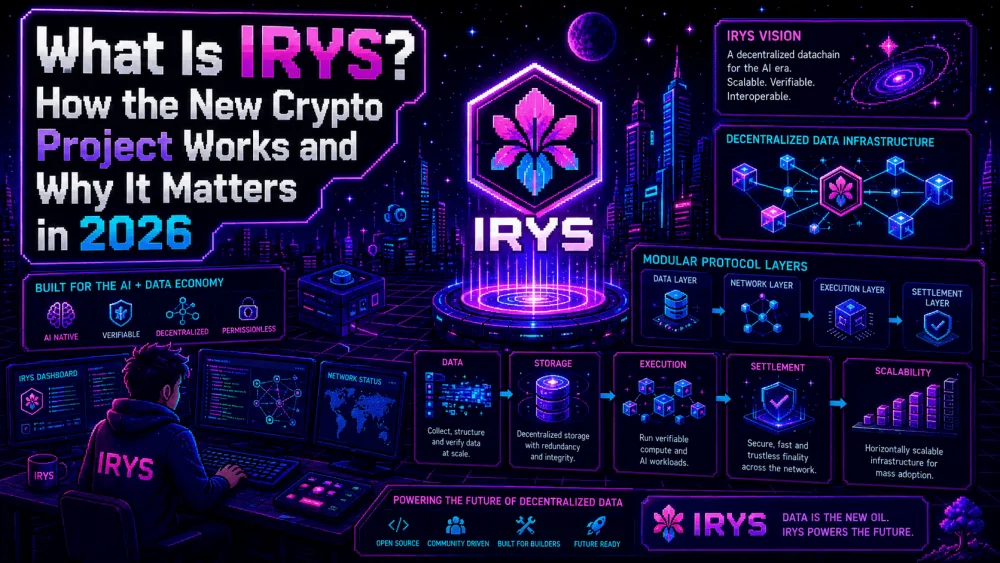
For investors tracking new crypto projects in 2026, IRYS has become one of the more interesting infrastructure names. Not because it promises another faster casino for speculation, but because it tries to merge storage, execution, and verification into one data-focused blockchain. The idea sounds technical. The market story is simple: if AI, DeFi, gaming, identity, and real-world apps need verifiable data, someone has to build the rails.
Related: How to Build a Profitable Crypto Portfolio. Recommended crypto portfolio allocation 2026
What Is IRYS?
IRYS Definition and Core Idea
So, what is IRYS? It is a programmable datachain: a blockchain designed to store large volumes of data on-chain, let smart contracts use that data directly, and prove over time that the data is still available. The project describes itself as “the data layer,” meaning data is not treated as a side effect of transactions, but as the core asset of the network.
That makes the Irys crypto project different from a typical execution-focused chain. Ethereum and Solana are mainly built around computation. Irys starts from data, then adds execution around it.
Why IRYS Is Gaining Attention in 2026
IRYS is gaining attention because crypto has moved into a more data-heavy phase. AI agents, zero-knowledge proofs, gaming assets, DePIN devices, creator IP, and compliance tools all need reliable data layers. The old model — store data somewhere else and connect it through bridges or APIs — is increasingly messy.
IRYS offers a cleaner pitch: put verifiable data and smart-contract logic in the same environment. That is why IRYS discussions in 2026 often sit beside AI, decentralized storage, and next-generation app infrastructure.
Read more: Top 5 Altcoins That Could Surge 10x–100x Bull Run in 2026: High-Potential Crypto Picks
IRYS Blockchain Overview and Position in the Crypto Market
The IRYS blockchain positions itself as a Layer-1 datachain with EVM-compatible execution through IrysVM. Developers can use familiar Ethereum-style tooling while building apps that rely on permanent or term-based on-chain data. Binance Academy describes Irys as a data-first base layer where storage, execution, and verifiability are designed as one system.
Among layer 1 blockchain projects, this is a focused lane. IRYS is not trying to be everything. It is trying to be the chain where data does more than sit in an archive.
Key Problems IRYS Aims to Solve
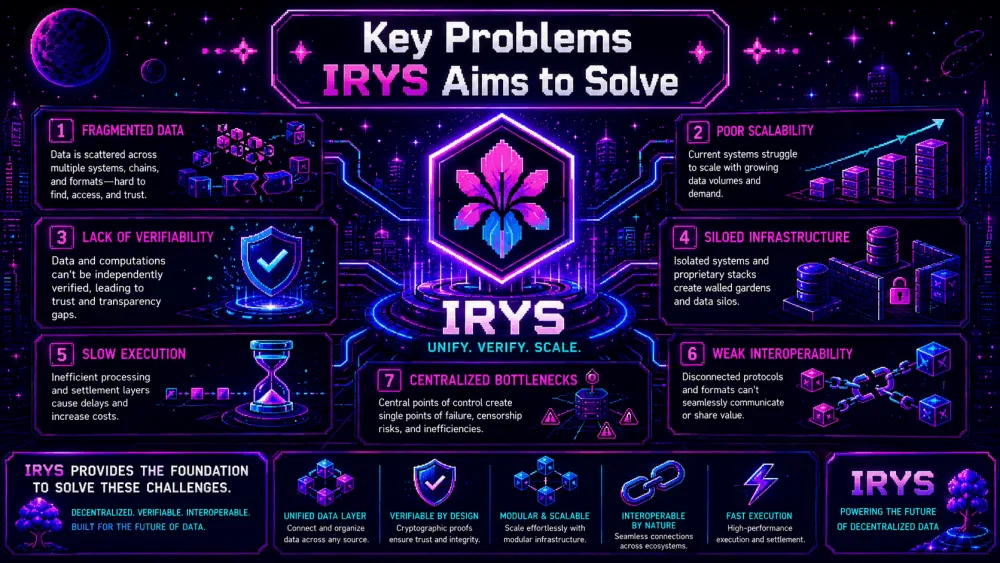
The biggest problem IRYS targets is the split between storage and execution. Traditional smart-contract chains make large-scale storage expensive. Older storage networks can preserve data, but that data is often passive and not easily usable inside live applications.
That gap matters. If a DeFi protocol, AI system, or game needs data that can be owned, referenced, verified, and acted upon, external databases weaken the Web3 promise. This is where IRYS becomes useful: it wants to make data active, not decorative.
Contents
How IRYS Works
IRYS Technology Explained (Architecture & Protocol)
The simplest way to explain how IRYS works is to think of three layers working together: storage, execution, and proof. Data enters the network, gets validated, can be stored for different time periods, and can then be used by smart contracts on IrysVM.
Irys says data first enters a Submit Ledger for validation before being promoted to a Publish Ledger for long-term, verifiable storage. The project also plans additional term-based ledgers for custom storage durations.
Token Model and IRYS Token Utility
The IRYS token is the native asset of the network. It is used to pay for data storage, smart-contract execution, validator staking, and governance. The official tokenomics states that all network fees are paid in IRYS, with pricing pegged to USD bands and reviewed annually to keep costs predictable.
Traders may search for an IRYS coin, but technically, the asset is the native token of the Irys network. Its value case depends on real network usage, not just exchange speculation.
Consensus Mechanism and Network Design
Irys uses a hybrid model called Useful Proof of Work and Stake, or uPoW/S. Miners and validators must stake IRYS and continuously prove that they maintain assigned data partitions. Misbehavior or data loss can trigger slashing, which gives the network an economic way to punish unreliable storage.
This design links security to usefulness. The network is not only burning energy to win blocks. It is meant to prove that stored data still exists.
Scalability, Speed, and Performance Features
Irys belongs to the broader category of blockchain scalability solutions, but its angle is not only transactions per second. The real performance question is whether apps can store, retrieve, verify, and use large datasets without breaking the user experience.
The project separates storage costs from execution costs. That matters because a spike in smart-contract demand should not automatically make data storage unpredictable. For builders, predictable pricing can be as important as raw speed.
How Transactions Work in the IRYS Ecosystem
In the IRYS ecosystem, transactions are tied to actions such as storing data, executing smart contracts, or validating network state. A user or app pays in IRYS. Part of the fee supports validators and network operations. The other part may be burned, depending on the fee type.
This creates a loop: more application activity creates more fee demand, while burns remove tokens from circulation. That is the core economic engine behind the IRYS tokenomics.
IRYS Use Cases and Ecosystem
Real-World Applications of IRYS Blockchain
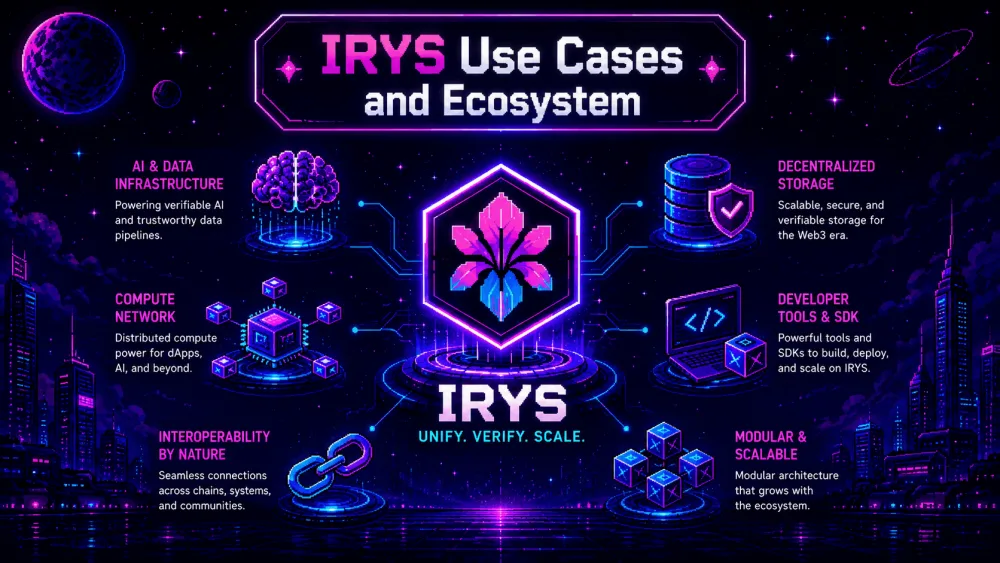
The most important IRYS use cases are data-heavy. Think AI model provenance, digital content licensing, verified datasets, decentralized identity records, gaming assets, and audit trails. Binance Academy also highlights AI model provenance, zero-knowledge proof use cases, decentralized AI agents, and scalable data oracles as possible applications.
In plain English, Irys is useful where data needs to be stored, trusted, and acted upon.
DeFi Integration and IRYS in Decentralized Finance
DeFi does not only need liquidity. It needs data. Lending markets need collateral records. Derivatives need pricing feeds. Real-world asset protocols need documents, audits, and ownership proofs. A programmable data layer could help these systems avoid relying too heavily on centralized backends.
This is where the IRYS crypto becomes more than another infrastructure ticker. If DeFi moves toward verified off-chain and on-chain data, Irys has a relevant story.
Developer Ecosystem and dApp Potential
The phrase “decentralized applications on IRYS” may sound awkward, but it captures the project’s developer pitch. IrysVM is EVM-compatible, so builders can use familiar Solidity tools while experimenting with programmable data.
That lowers the adoption barrier. Developers do not want to learn a new language every cycle. They want infrastructure that makes new app categories possible without forcing them to abandon known workflows.
Institutional and Enterprise Use Cases
Enterprise blockchain adoption has always struggled with one question: where does the data live? Companies may want transparency, but they also need auditability, permissions, retention policies, and predictable costs.
Irys could be relevant for enterprise records, AI governance, IP tracking, supply-chain documentation, and compliance archives. The opportunity is large, but enterprise adoption is slow. No infrastructure project wins that market on narrative alone.
Why IRYS Matters in the 2026 Crypto Market
IRYS vs Other Blockchain Projects
Irys competes indirectly with storage networks like Arweave and Filecoin, and more broadly with general-purpose chains that want to host data-intensive applications. The difference is that Irys combines storage with native execution. Binance Academy notes that Arweave and Filecoin are mainly archival, while Irys lets contracts read and act on stored data during execution.
That distinction is important. It means Irys is not just asking where data is kept. It asks what data can do.
Market Demand for New Layer-1 / Layer-2 Solutions
The market is tired of generic chains, but not tired of useful infrastructure. In 2026, new L1 and L2 projects need sharper reasons to exist. “Faster and cheaper” is no longer enough.
This is why Irys has a credible narrative. AI, DePIN, gaming, and real-world assets all need better data systems. If those sectors grow, programmable data could become a real category.
Related: Best Ethereum Tokens and Projects to Invest in 2026
Competitive Advantages of IRYS
Irys has three obvious advantages. First, its positioning is clear. Second, EVM compatibility makes onboarding easier. Third, the token model ties usage to fees, staking, and burns.
The project also has visible venture backing. Irys lists CoinFund, Lemniscap, Hypersphere, Framework, and Primitive among its backers on its website. Other market trackers report roughly $20 million raised across funding rounds, including a $10 million Series A led by CoinFund in 2025.
Adoption Trends and Market Positioning
Irys is still early. That is both the opportunity and the danger. Early-stage infrastructure projects often look brilliant in theory before developers arrive, and ordinary in practice if they fail to build network effects.
The better question is not whether Irys has a good idea. It does. The harder question is whether enough builders will choose Irys instead of stitching together storage, execution, and data availability elsewhere.
IRYS Tokenomics in Spotlight
IRYS Supply and Distribution Model
The official IRYS tokenomics states that IRYS has a 10 billion token supply cap. At launch, 20% of supply was circulating, while team and investor allocations were locked for the first year. Binance Academy lists allocations including 30% for ecosystem, 25.3% for investors, 18.8% for core team and advisors, 9.9% for foundation, 8% for airdrops and future incentives, and 8% for liquidity and launch partners.
That is a fairly typical infrastructure-token split. The market will care most about unlocks, usage, and whether demand grows faster than emissions.
Token Utility and Value Drivers
The IRYS token has four core demand drivers: storage payments, execution fees, staking, and governance. The strongest long-term driver is usage. If developers store data and execute contracts on Irys, the token becomes part of the network’s operating system.
That is also why when doing an IRYS price analysis, one should not only look at charts. For this type of asset, network revenue and developer activity matter more than short-term social hype.
Inflation, Incentives, and Staking Mechanisms
Irys uses validator and miner rewards equal to 2% annual issuance, with the rate halving every four years. At the same time, 50% of execution fees and over 95% of term-storage fees are burned. Permanent-storage fees flow to a non-circulating Storage Endowment.
This creates a push-pull model. Issuance rewards security. Burns reward usage. If usage becomes large enough, the network could move toward net deflationary pressure.
Economic Sustainability of IRYS Network
The sustainability question is simple: can real fees become meaningful? Many crypto projects design beautiful burn models that do not matter because nobody uses the chain.
Irys has a more plausible path than meme-only tokens, because storage and execution are real services. But economics will only work if developers, AI apps, and data-heavy protocols produce recurring demand.
IRYS Price Outlook and Market Interest
Early Market Performance of IRYS Token
As of early May 2026, CoinMarketCap showed IRYS trading around $0.0365, with 24-hour volume near $7.5 million, a market cap around $93.7 million, and more than 2.56 billion IRYS in circulating supply.
That puts IRYS in the small-to-mid cap infrastructure zone. The upside can be meaningful, but volatility is part of the package.
Factors Influencing IRYS Price Movement
Several factors will shape the IRYS price: exchange liquidity, token unlocks, developer adoption, broader market sentiment, and demand for data-focused infrastructure. A stronger AI-crypto narrative could help. Weak market liquidity could hurt.
Short-term price action may also be speculative. CoinMarketCap’s AI market update recently noted a sharp IRYS rebound from $0.02426 to $0.03927 within 24 hours, alongside a large jump in volume.
Investor Sentiment Around IRYS Crypto Project
Investor sentiment is curious but cautious. The project has a real technical thesis, respected backers, and a narrative that fits 2026. At the same time, it is still young, and the market has seen many infrastructure tokens fail to convert attention into durable usage.
For crypto investment in 2026, IRYS is the kind of name that belongs on a research list, not in a blind buy basket.
Risks and Challenges for IRYS
Market Competition in the Blockchain Sector
The biggest risk is competition. Irys is not the only project chasing data, storage, AI, or scalable infrastructure. Arweave, Filecoin, Celestia-style modular stacks, Ethereum L2s, and high-performance L1s all overlap with parts of the opportunity.
The market will not reward Irys simply for being technically interesting. It must prove that its integrated model is easier, cheaper, or more useful than the alternatives.
FAQ
What is IRYS?
IRYS is a programmable datachain designed to store data on-chain, let smart contracts use that data directly, and verify that the data remains available over time. It combines storage, execution, and verification in one blockchain environment.
Is IRYS a Layer-1 blockchain?
Yes. Irys is generally described as a Layer-1 datachain. Unlike standard Layer-1 chains that focus mainly on execution, Irys focuses on programmable data and native smart-contract access to stored information.
What Is the IRYS Token Used for?
The IRYS token is used to pay for storage, smart-contract execution, staking, and governance. Validators also use IRYS as collateral to secure the network and prove data integrity.
What Are the Main IRYS Use Cases?
Main IRYS use cases include AI model provenance, verified datasets, decentralized storage, data marketplaces, DeFi records, gaming assets, identity, creator IP, and applications that need reliable on-chain data.
What Makes IRYS Different From Filecoin or Arweave?
Filecoin and Arweave are primarily known for decentralized storage and archival use cases. Irys aims to go further by combining data storage with EVM-compatible execution, enabling smart contracts to directly use stored data.
What Could Drive IRYS Price Higher?
IRYS price could benefit from stronger developer adoption, higher network fees, more storage demand, exchange expansion, AI-related partnerships, and broader interest in data-focused blockchain infrastructure.
What Are the Biggest Risks for IRYS?
The biggest risks are low adoption, intense competition, token unlock pressure, speculative volatility, and the possibility that developers choose other infrastructure stacks over Irys.