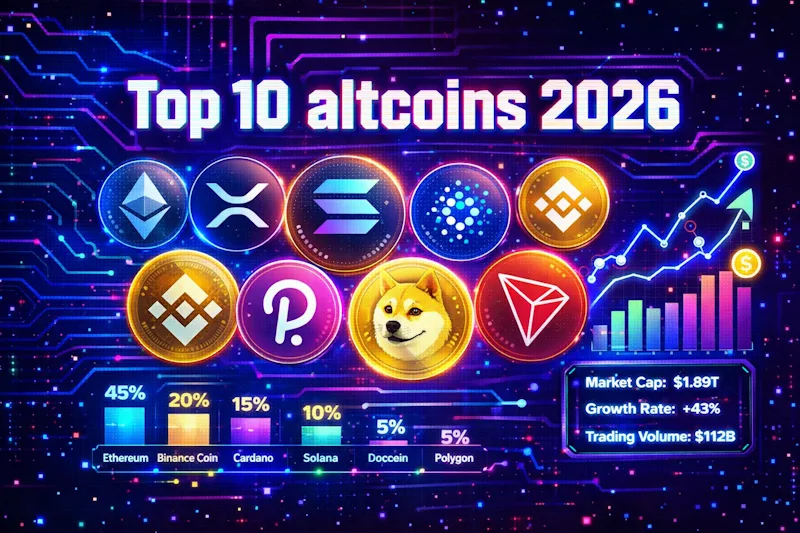
This article is following the ten largest altcoins by market value as of June 2026. The following is not a “buy list” but rather a list by market value. I’m also including the stablecoins because the market value list will include them if they’re among the largest.
A brief explanation is necessary to put the entire article into perspective. There are many pages that discuss the “top 10 altcoins,” but they often mix and match price action, stories, and personal opinions. The following list is very strict and only follows the circulating market capitalization as of the date. For readers comparing top cryptocurrencies by market cap June 2026, the key point is that this ranking follows size first, not hype, short-term returns, or personal preference.
Disclaimer: This ranking is a point-in-time snapshot for June 1, 2026. Market caps, circulating supply, and rank order can change within hours, so the table should be read as a dated market view rather than a permanent hierarchy. This also matters for searches like current total crypto market cap June 2026, because the total market number changes constantly.
Contents
Top 10 Cryptocurrencies by Market Cap June 2026
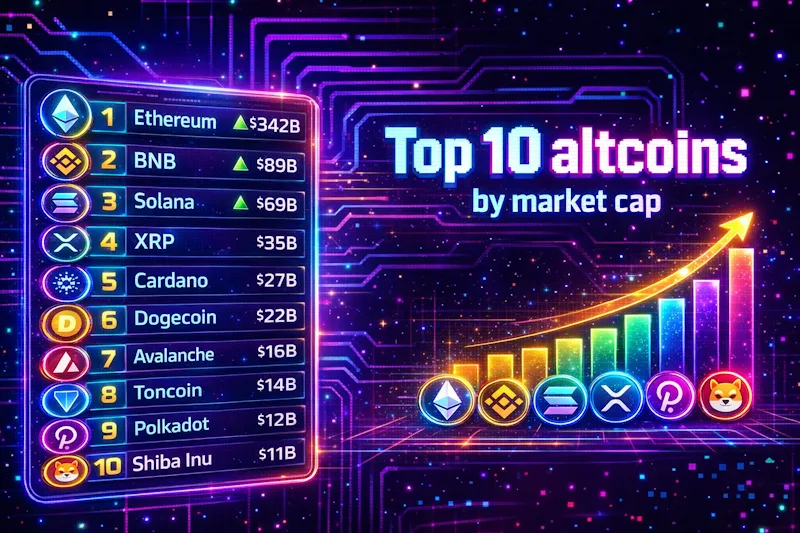
The entire ranking is shown below in one table. The market capitalizations are based on a snapshot taken on June 1, 2026, on CoinMarketCap. Hyperliquid is already ranking higher than Cardano as of the update date. This is one of the clearest indications that a lot of old top 10 altcoin pages are no longer up to date. For broader comparisons, readers may also search top cryptocurrencies by market cap 2026, but this article focuses only on altcoins.
| Rank | Altcoin | Ticker | Category | Key function | Market cap | Short comment |
|---|---|---|---|---|---|---|
| 1 | Ethereum | ETH▲$1,761.17 | Smart contract platform | Base layer for apps, DeFi, NFTs, token issuance, staking | $239.34B | |
| 2 | Tether | USDT▲$0.9991 | Stablecoin | Dollar liquidity for trading, transfers, settlement | $187.98B | Rank comes from use, not price appreciation |
| 3 | BNB▲$572.56 | BNB | Exchange and ecosystem token | Fees, gas, governance, ecosystem utility | $93.15B | Demand links to Binance and BNB Chain activity |
| 4 | XRP▲$1.13 | XRP | Payment asset | Fast value transfer on XRP Ledger | $80.84B | Large legacy footprint and deep liquidity |
| 5 | USDC▲$0.9999 | USDC | Stablecoin | Dollar liquidity for trading, treasury, payments | $75.85B | Stable-dollar role keeps it near the top |
| 6 | Solana | SOL▲$82.41 | Smart contract platform | High-throughput apps, DeFi, meme trading, consumer apps | $46.91B | Strong activity keeps it in the first tier after ETH |
| 7 | TRON | TRX▲$0.3220 | Payment and settlement network | Cheap transfers, major rail for USDT movement | $33.31B | Practical use matters more than branding here |
| 8 | Hyperliquid | HYPE▲$70.78 | Ecosystem and trading token | Native token of Hyperliquid and HyperEVM gas asset | $18.47B | Newest name in the current top ten |
| 9 | Dogecoin | DOGE▲$0.0778 | Memecoin | Peer-to-peer coin with strong brand and liquidity | $15.41B | Community and exchange liquidity keep it relevant |
| 10 | Cardano | ADA▲$0.1791 | Smart contract platform | Proof-of-stake chain with research-first design | $8.36B | Still large, though less dominant than before |
Source for ranks, prices, and market caps: CoinMarketCap snapshot on June 1, 2026. Project roles are summarized from official documentation.
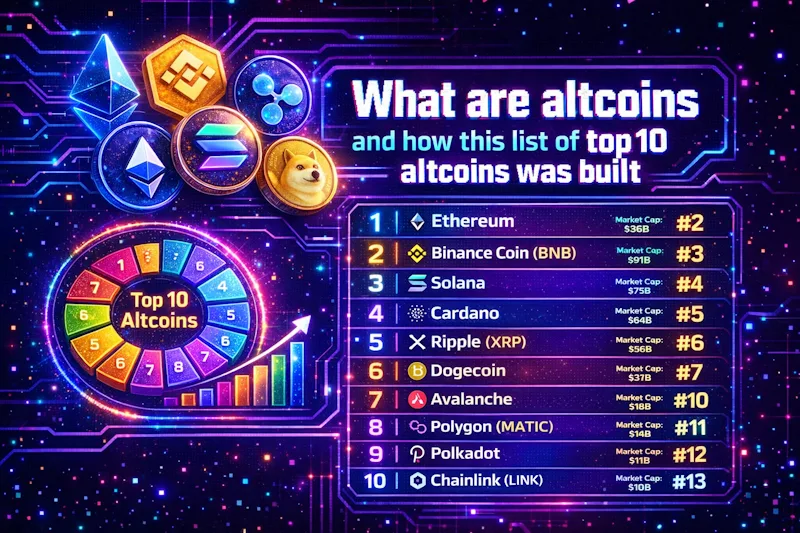
What Are Altcoins and How This List of Top 10 Altcoins Was Built
Altcoins are all the other coins apart from Bitcoin. They are further classified into smart contract coins, exchange coins, payment coins, meme coins, and stablecoins. Therefore, the inclusion of USDT and USDC means they are part of the list alongside other platform coins like ETH and SOL. This is why the list of the top 10 altcoins cannot simply exclude stablecoins by default.
The method is very simple and easy to understand.
- Market Cap is the product of Price and Circulating Supply.
- Circulating Supply is the amount that is already publicly available and in circulation.
- FDV (Fully Diluted Value) is an estimate of the value if the total amount was in circulation.
- Hype, previous all-time highs, and personal beliefs are irrelevant to the actual rank.
- This is an actual list of the top 10 altcoins as they stood on a particular day.
This method is important because readers might be interested in different types of coins. The method also maintains the list of the top 10 altcoins consistent. A stablecoin might have a higher rank than an upcoming network coin because more value is in circulation. Similarly, the coin might not be excluded from the list because its value is very low, as its supply is large.
How to Read Altcoins Top 10 Rating
Price indicates how much one coin is worth. Market cap indicates how much value is represented by the circulating market for an asset. Circulating supply indicates how much of an asset is currently circulating. FDV indicates how much value would be represented if all supply was circulating. That is why a less valuable coin can be above a more valuable coin in the altcoins top 10.
This metric is useful but can be problematic. Market cap can be useful for comparing. It cannot be used to determine product quality, token quality, or future potential. An asset can be high because it has a large supply, because it has high dollar demand, or because it has high exchange liquidity. That still does not mean it is one of the best altcoins for all investors.
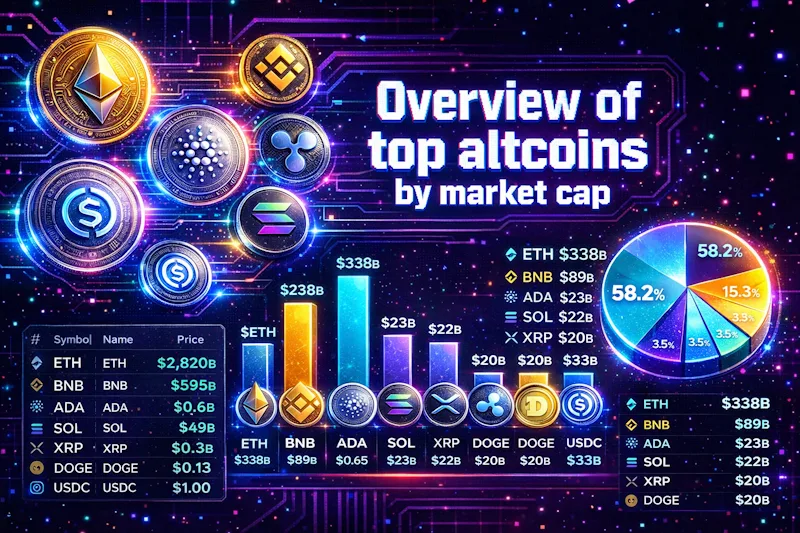
Overview of Top Altcoins by Market Cap June 2026
The next sections use one structure for every asset. First, what the project is. Second, why it belongs in the top tier today. Third, what the token does inside that system. Last, what risk or limit matters most. That makes the top 10 altcoins easier to compare without turning the article into a prediction piece.
Top 5 cryptocurrencies by market cap June 2026 searches may show Bitcoin and stablecoins alongside major altcoins, which is why the methodology needs to be clear. Readers checking top 10 cryptocurrencies by market cap June 2026 or top 20 cryptocurrencies by market cap June 2026 should remember that those lists are broader than an altcoin-only ranking.
1. Ethereum (ETH)
Ethereum remains the largest altcoin due to its position as the primary smart contract base layer. According to the docs, smart contracts are the building blocks of the app layer on Ethereum. Its ecosystem includes DeFi, NFTs, tokens, and more. It’s secured by staking ETH as well. One interesting fact is that the activation of solo validator mode still requires 32 ETH. This threshold defines who can operate a validator directly.
| Metric | Value |
|---|---|
| Ticker | ETH |
| Category | Smart contract platform |
| Market cap | $239.34B |
| Main role | Gas, settlement asset, staking asset |
| Main limit | Costs can rise when network demand is high |
As Vitalik Buterin, co-founder of Ethereum, noted in early 2026, the network became faster, more reliable, and better able to handle more volume in 2025, but it still has work to do before it fully functions as a world computer. That point reinforces Ethereum’s role here as infrastructure first, not just a large token by value.
2. Tether (USDT)
Tether is also the largest stablecoin in crypto, and this explains its position in the list. It has managed to find a spot among the top 10 due to its use in trading, moving, and settling trades on exchanges, and not necessarily because its value is growing rapidly, given its goal to keep its value close to one US dollar. Tether itself even boasts of its use in exchanges and trading on its own site! This explains why USDT has a place in this top 10 list, and why its exclusion from the list of top 10 altcoins would make the list less accurate.
| Metric | Value |
|---|---|
| Ticker | USDT |
| Category | Stablecoin |
| Market cap | $187.98B |
| Main role | Dollar liquidity across exchanges and wallets |
| Main limit | Issuer and regulatory dependence |
Expert comment: As Paolo Ardoino, CEO of Tether, said, a full reserve audit remains the company’s top priority. That matters in this section because USDT’s scale reflects deep market use, while transparency and reserve oversight still shape how readers should interpret that size.
3. BNB (BNB)
BNB remains at the top because it is being demanded at multiple sources at once. According to BNB Chain documentation, BNB is used for fuelling transactions on BNB Chain and is a governance token. Binance, outside of BNB Chain, has always tied BNB to its utility for exchange fee discounting. That helps explain why BNB remains at or near the top of this altcoin list even when market attention shifts. The main exception is its relation to Binance’s brand strength and how that relates to exchange regulations.
| Metric | Value |
|---|---|
| Ticker | BNB |
| Category | Exchange and ecosystem token |
| Market cap | $93.15B |
| Main role | Gas, fee utility, governance, ecosystem access |
| Main limit | Strong dependence on Binance ecosystem and policy pressure |
4. XRP (XRP)
XRP is a digital asset for direct payments and moving value on the XRP Ledger. According to its own official docs, users can send direct XRP payments in one transaction and they take just seconds to complete. XRP has managed to stay in one of the top spots due to its liquidity, recognition, and its long history of staying near the top of this list. XRP isn’t a smart contract token like Ethereum or Solana.
| Metric | Value |
|---|---|
| Ticker | XRP |
| Category | Payment asset |
| Market cap | $80.84B |
| Main role | Transfer and settlement asset on XRPL |
| Main limit | Narrower app-layer narrative than major smart contract chains |
Data: market cap from CoinMarketCap. Payment role from XRPL documentation.
5. USDC (USDC)
USDC is another stablecoin, but it’s serving a different market than all the other volatile coins in this list. Circle, its issuer, says it’s a digital dollar, collateralized with cash and cash equivalents, and can be redeemed for one US dollar at a time. So, its market cap is a reflection of the market cap for digital dollar liquidity, not a reflection of a token’s price appreciation. In practice, USDC and USDT serve similar purposes for traders.
| Metric | Value |
|---|---|
| Ticker | USDC |
| Category | Stablecoin |
| Market cap | $75.85B |
| Main role | Dollar liquidity for trading, payments, treasury use |
| Main limit | Issuer and compliance dependence |
Jeremy Allaire, Chairman, Co-Founder, and CEO of Circle, described the rise of an open, trusted, and programmable economic system in which stablecoins support commerce and capital markets. That framing fits USDC’s place in this ranking, where market cap comes from utility and settlement demand rather than price upside.
6. Solana (SOL)
Solana is essentially the first infrastructure contender after Ethereum in this ranking. Their documentation refers to it as “a high-performance blockchain designed for mass adoption,” which aligns with Solana’s position in DeFi, meme trading, and consumer applications. SOL tends to rise when on-chain activity is increasing due to the blockchain’s ability to process high volumes. If you’re looking at the top 10 altcoins, Solana is one of the more obvious infrastructure contenders after ETH.
Solana is one of the top altcoins with high potential 2026 because its market cap ranking is backed by visible app activity rather than size alone.
| Metric | Value |
|---|---|
| Ticker | SOL |
| Category | Smart contract platform |
| Market cap | $46.91B |
| Main role | Gas, staking, app-layer asset |
| Main limit | Sentiment and activity can swing faster than on older networks |
7. TRON (TRX)
TRON is more about usage than buzz. The underlying network refers to themselves as “a settlement blockchain for stable coin transactions,” and TRONSCAN indicates they have over 86 billion USDT on the blockchain. This is why TRX tends to remain strong in market cap rankings even when it isn’t getting the same level of attention as some of the competition. One less obvious factor is the resource model, which can save users on transaction fees if they stake TRX.
| Metric | Value |
|---|---|
| Ticker | TRX |
| Category | Payment and settlement network |
| Market cap | $33.31B |
| Main role | Gas and utility token in a stablecoin-heavy network |
| Main limit | Demand is tied heavily to transfer activity and settlement use |
8. Hyperliquid (HYPE)
This is the part where most outdated tutorials are incomplete. Hyperliquid is now in the top 10 altcoins as of June 1, 2026. CoinMarketCap lists it ahead of Cardano and, most recently, Dogecoin. Hyperliquid is a blockchain designed for a fully on-chain financial system, according to its own documentation. Its docs also state that “HYPE is the native gas token on HyperEVM.” So, HYPE is the strongest freshness signal in the current ranking as it near-doubled its market cap over the past few months.
| Metric | Value |
|---|---|
| Ticker | HYPE |
| Category | Ecosystem and trading token |
| Market cap | $18.47B |
| Main role | Native token for Hyperliquid and gas token on HyperEVM |
| Main limit | Newer protocol with execution and liquidity risks |
In a recent interview about Hyperliquid’s growth, founder Jeff Yan described the project as a financial protocol built to upgrade financial infrastructure, not just another crypto company. That helps explain why HYPE now reads as a real ecosystem asset in 2026 rankings, not as a short-lived addition copied from trend lists.
9. Dogecoin (DOGE)
Dogecoin is an exception among most coins in this class. It is a peer-to-peer electronic currency with strong culture credentials, not a broad smart contract base chain. Dogecoin is still using proof-of-work, and official dogecoin sources on Dogepedia state that they are using the Scrypt algorithm. The ranking is based on recognition, liquidity, and long market memory. However, this is not the same as infrastructure-led chains.
| Metric | Value |
|---|---|
| Ticker | DOGE |
| Category | Meme coin |
| Market cap | $15.41B |
| Main role | Brand-driven payment coin and trading vehicle |
| Main limit | Limited protocol utility versus platform chains |
10. Cardano (ADA)
Cardano is still in the top ten, and while they’re still a steady player, they’re not the main one anymore. According to their documentation, they’re a research-first, proof-of-stake blockchain, and they do support smart contracts with built-in tools. Cardano has a large market value, and while they’re still a player, they’re not the main one anymore, and the talk around them is more related to Ethereum and Solana.
| Metric | Value |
|---|---|
| Ticker | ADA |
| Category | Smart contract platform |
| Market cap | $8.36B |
| Main role | Staking and utility asset for Cardano applications |
| Main limit | Lower activity than some competing platforms |
Category Comparison Inside the Top Tier
While a ranking list helps, a category view helps understand the market even better. It also helps understand how the top altcoins relate to different categories. The table below categorizes the current top leaders based on what they do. This explains why they are not all in one category. The top tier includes a mix of app platforms, stablecoins, exchange-linked tokens, payment rails, and a meme coin.
| Category | Assets | Count | Combined market cap |
|---|---|---|---|
| Smart contract platforms | Ethereum, Solana, Cardano | 3 | $345.89B |
| Stablecoins | Tether, USDC | 2 | $263.69B |
| Ecosystem and exchange tokens | BNB, Hyperliquid | 2 | $102.67B |
| Payment and settlement assets | XRP, TRON | 2 | $122.14B |
| Meme coin | Dogecoin | 1 | $16.92B |
These categories illustrate a basic fact: stablecoins occupy two spots in the top 10 list because digital dollars are essential to the market structure. Platform chains still account for the largest combined share. Payment rails retain a decent weight, and memecoins are represented by a single asset. This arrangement is more informative than a top 10 list without categories.
What Market Cap Shows, and What It Hides
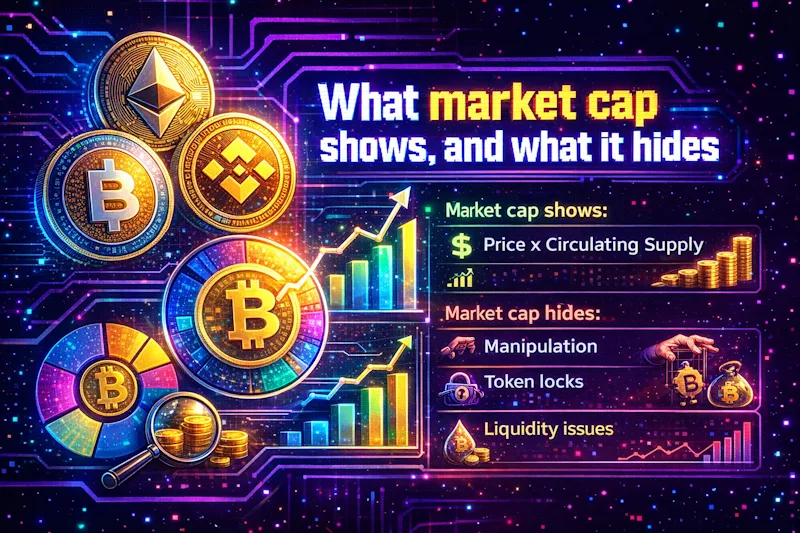
Market cap is useful because it allows you to compare a large number of assets with a single number. However, it is not the whole truth. It does not tell you how liquid the actual trading is. It also does not show you things like who actually owns the supply, whether massive unlocks are coming, or how big one issuer or brand is. So, this table based purely on market cap is just the beginning.
The same limitation applies to crypto market cap June 2026 and current crypto market cap June 2026 searches. A larger number does not automatically mean stronger liquidity, better token quality, or lower risk.
However, if you actually read this carefully, you will see some other things you might want to know:
- How much of the supply is held in a small number of wallets?
- How big is the difference between market cap and FDV?
- How is user activity changing?
- How dependent is this token on one company or issuer?
- How solid is this token’s liquidity beyond a handful of exchanges?
- How likely is it that regulations will affect market access for this token?
That is where ranking and analysis come in. An asset can be large and weak at the same time. One asset can be small but have better token economics. The ranking simply indicates which assets have the largest market cap currently. It says nothing about safety, cost, or robustness.
Disclaimer: Nothing in this article is investment advice. Even large-cap altcoins remain speculative, and future regulatory actions or policy changes can limit the ability to sell, exchange, or use a crypto asset. Market size alone does not measure suitability.
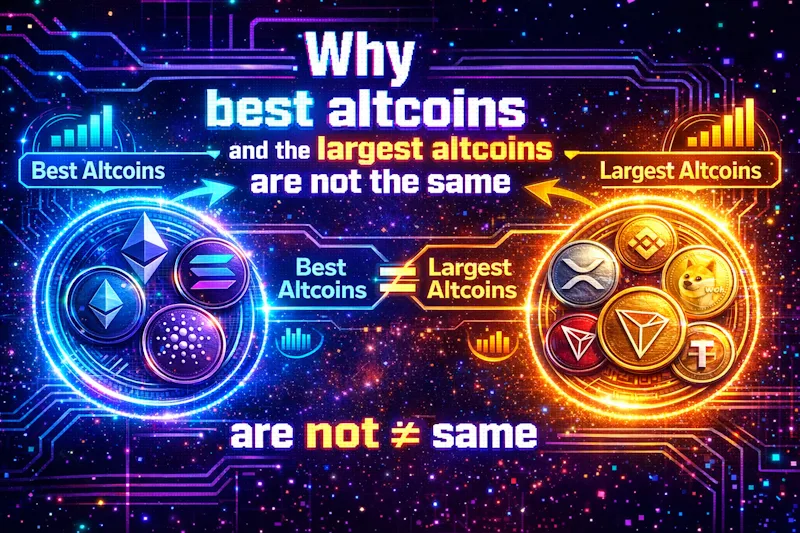
Why Best Altcoins and the Largest Altcoins Are Not the Same
These concepts address various queries. Best altcoins around means that users seek altcoin upside, altcoin fundamentals, altcoin adoption, and altcoin risk. The question answered in a top 10 altcoins by market cap post is more limited: users want to know current size in terms of circulating value. Therefore, top 10 altcoins to buy and top 10 altcoins by market cap aren’t the same search intent.
This also applies to broader searches like total crypto market cap June 2026, crypto total market cap June 2026, and total crypto market cap 2026. Those numbers describe market size, not whether any specific asset is good, cheap, safe, or attractive.
This distinction has real-world implications. For instance, USDT and USDC rank high because users view them as digital dollars. Nobody views either one as having upside potential. Dogecoin has high rank because of liquidity and brand. Many analysts would use a completely different approach to determine altcoin buys. Reality vs. opinion. That is why top performing altcoins 2026 lists may look very different from this ranking, since performance measures recent returns while market cap measures current circulating value.
In Bitwise’s 2026 outlook, Matt Hougan, Chief Investment Officer at Bitwise, argued that Ethereum and Solana could reach new all-time highs if regulatory clarity improves. This is useful here because it separates current market size from forward-looking thesis and shows why the largest assets are not automatically the same as the most attractive ones.
For users searching top altcoins 2026, the best answer depends on whether they mean the largest assets, the strongest performers, or the projects with the best forward-looking fundamentals.
FAQ
Is this a buy list or just a snapshot for today’s market size?
Nope. This is a snapshot for the current market size as of March 18, 2026. It is a snapshot for the current leaders on Circulating Market Cap, and that is why it includes stablecoins, even though they are not really an upside potential play.
What are the stablecoins in this top 10 altcoin rating, and why are they included?
This is a list of altcoins by Circulating Market Cap, and that includes every non-bitcoin crypto asset. USDT and USDC have huge circulating values.
What is the reason why Hyperliquid is included and ranked higher than Dogecoin in this snapshot for the current market size?
The reason is that this snapshot is for the current market size as of June 1, 2026, and that is why CoinMarketCap includes Hyperliquid and ranks it higher than Dogecoin. Hyperliquid ranks eighth, while Dogecoin ranks ninth. This is one reason why a new top ten altcoins 2026 article is different from an older article.
Does a cheaper altcoin have a chance to rank higher than a more expensive altcoin, and why or why not?
Yes, because this is a ranking based on market cap, and that means a cheaper altcoin may actually end up ranking higher if its supply is bigger.
What is the difference between Ethereum and Solana, and why is this important for the top ten altcoins ranking snapshot?
The difference is that Ethereum is still the bigger smart contract platform, while Solana is still a powerhouse for fast-moving app spaces. Both are important, but they are different.
Why people often think that the biggest altcoins are the best altcoins?
The reason is that size is easy to measure and easy to duplicate, and that is why people think that these are the best altcoins, while that is actually not the case.