Robinhood Chain launchpads have appeared rapidly since the network’s public mainnet went live in July 2026. Openfair, NOXA Fun, RobinPad, and hood.fun now offer no-code token creation, automated liquidity, and permissionless trading on an EVM-compatible Layer 2. However, every platform is extremely new, and none should be treated as mature infrastructure merely because it uses Robinhood branding.
This ranking compares the best Robinhood Chain launchpads by launch model, liquidity protection, fees, customization, and public contract documentation. These products are independent third-party applications and are not necessarily affiliated with or endorsed by Robinhood Markets.
Related: Best Robinhood Chain Projects: 9 Early Crypto Picks Before Everyone Else Finds Them
Contents
- What Is a Robinhood Chain Launchpad?
- How We Ranked the Best Robinhood Chain Launchpads
- Best Robinhood Chain Launchpads in 2026
- Robinhood Chain Launchpads Compared
- How to Launch a Token on Robinhood Chain
- Which Robinhood Chain Launchpad Is Best for Your Project?
- Common Mistakes to Avoid When Launching on Robinhood Chain
- Why Robinhood Chain Could Become the Next Major Token Launch Ecosystem
- FAQ
What Is a Robinhood Chain Launchpad?
A Robinhood Chain launchpad is an application that packages token deployment, initial price discovery, and decentralized exchange liquidity into a guided workflow. Instead of writing and auditing smart contracts manually, a creator connects a wallet, enters token settings, and approves an on-chain transaction.
How Token Launchpads Work
Most Robinhood Chain launchpads deploy a fixed-supply ERC-20 token and then use one of two models. A bonding curve sells tokens through an automated pricing contract before creating a public liquidity pool. An instant-liquidity model lists the asset directly through an automated market maker such as Uniswap V3.
The platform may also handle contract verification, anti-snipe rules, creator fees, token metadata, and LP locking. These features simplify a token launch, but they do not make the token valuable or safe.
Why Robinhood Chain Is Attracting New Crypto Projects
Robinhood Chain is an Arbitrum-based Ethereum Layer 2 using ETH▲$2,518.27 for gas. It is permissionless, EVM-compatible, and designed around financial services, Robinhood Chain DeFi, and tokenized real-world assets. Mainnet launched with infrastructure from Uniswap, Chainlink, Alchemy, and BitGo.
The broader Robinhood Chain ecosystem has a powerful distribution narrative: Robinhood serves nearly 28 million customers, while Stock Tokens are available through Robinhood Wallet in more than 120 countries where eligible. That does not mean a new Robinhood Chain memecoin automatically reaches brokerage users.
Related: Best Memecoins to Buy in June 2026: Data-Driven Look at the Most Traded and Trending Tokens
Launchpads vs Manual Token Deployment
Manual token deployment offers maximum control but requires Solidity development, testing, contract verification, DEX pool creation, and secure liquidity management. A Robinhood Chain token launcher automates most of those tasks.
The trade-off is standardization. Launchpads usually restrict supply formats, fees, trading rules, liquidity ranges, or upgrade options. Advanced teams building RWA products, regulated assets, or complex protocols may still need custom contracts.
How We Ranked the Best Robinhood Chain Launchpads
The best Robinhood Chain launchpads should reduce technical friction without hiding the mechanics that control pricing, liquidity, and creator privileges.
Ease of Launch
We favored one-transaction deployment, clear wallet prompts, verified contracts, transparent fees, and interfaces that explain how to launch token on Robinhood Chain without requiring code.
Liquidity Generation and LP Locking
A token is only tradeable if buyers and sellers can access reliable liquidity. We examined whether each Robinhood Chain token launchpad creates liquidity automatically, where the LP position is held, and whether any administrator can withdraw it.
Fair Launch Mechanics
A fair launch should disclose creator allocations, initial buys, trading limits, and price formation. “Fair” is not meaningful if insiders can mint extra supply, remove liquidity, or buy before the public under hidden rules.
Fees, Security, and Ecosystem Support
We reviewed launch fees, swap fees, creator revenue, anti-snipe controls, contract verification, wallet custody, DEX integration, and public documentation. Because the market is new, audits and operating history remain weak points across the category.
Best Robinhood Chain Launchpads in 2026
Openfair — Best Overall Robinhood Chain Launchpad
Openfair ranks first because it supports both a bonding-curve fair launch and an instant Uniswap V3 listing. Its published workflow includes immutable auto-verified contracts, permanent liquidity locking, optional anti-snipe protection, customizable buy and sell fees from 0% to 10%, and a 0.0005 ETH creation fee.
The fair-launch route targets a 5 ETH raise before DEX listing. The instant route creates single-sided token liquidity without starting ETH. This makes Openfair the strongest all-purpose Robinhood Chain token launchpad for creators wanting community price discovery or immediate trading.
Read more: What Is CashCat Crypto? Why Robinhood’s Memecoin Is Exploding
NOXA Fun — Best for Instant Uniswap V3 Listings
NOXA Fun sends new assets directly into single-sided Uniswap V3 liquidity, avoiding a separate curve-to-DEX migration. Its documentation identifies a Robinhood Chain launch factory and liquidity locker and describes instant DEX trading with no token taxes or LP migration.
This structure suits creators prioritizing immediate composability with Robinhood Chain DeFi tools. However, NOXA recently paused new token creation, so users must confirm that launches have resumed. Its short history provides little evidence about long-term reliability.
RobinPad — Best for Permissionless Fair Launches
RobinPad’s published model combines permissionless launch access with one-transaction ERC-20 deployment, direct Uniswap V3 liquidity, a fixed supply, permanent LP locking, and no administrative mint function. Its documentation describes a 1% pool fee split among creators, the platform, and referrals.
This is a fair-launch model through immediate market access rather than a literal pre-DEX bonding curve. Several unrelated products use “RobinPad.” This review refers to robinpad.fi; verify the domain and factory address before signing.
As of July 2026, RobinPad is not yet fully live so treat it as an upcoming platform rather than a fully operational launchpad.
Hood.fun — Best Pump.fun-Style Launchpad for Memecoins
hood.fun most closely reproduces the Pump.fun experience. Every token begins on a constant-product bonding curve with no presale or team allocation. Of the one-billion-token supply, 80% is sold through the curve and 20% is reserved for Uniswap V3 liquidity after graduation.
Creators choose a 1%–5% trading fee and receive 80% of curve fees. After roughly 6.5 ETH is raised, liquidity migrates to a 1% Uniswap V3 pool and is permanently locked. For a fast Robinhood Chain memecoin launch, hood.fun offers the clearest Pump.fun-style mechanics.
Robinhood Chain Launchpads Compared
| Platform | Launch model | Creation cost | Liquidity model | Best fit |
|---|---|---|---|---|
| Openfair | Bonding curve or instant listing | 0.0005 ETH plus gas | Permanent Uniswap V3 lock | Flexible launches |
| NOXA Fun | Instant V3 liquidity | Check current interface | Single-sided V3 LP and locker | Immediate DEX access |
| RobinPad | Direct-to-DEX fair launch | Check current interface | Permanent V3 LP lock | Permissionless community tokens |
| hood.fun | Bonding curve then graduation | No creation fee | V3 migration and permanent lock | Pump.fun-style memecoins |
Launch Model (Bonding Curve vs Instant Liquidity)
Openfair offers both choices. hood.fun uses a traditional bonding curve followed by graduation. NOXA Fun and RobinPad favor immediate decentralized exchange liquidity, removing the migration window but relying on concentrated-liquidity settings from launch.
Launch Fees and Trading Costs
Openfair charges 0.0005 ETH plus gas and lets creators set token fees. hood.fun charges no creation fee but takes part of curve and post-graduation trading revenue. RobinPad’s public pages differ on upfront cost but center on a 1% Uniswap pool fee. NOXA fees should also be checked on-chain because parameters can change.
Liquidity Locking
All four platforms claim permanent LP locking or an equivalent no-withdraw structure. Do not trust the interface alone: verify the locker address, LP NFT owner, and source code on the Robinhood Chain explorer.
Related: How to Launch a Memecoin on Openfair: Step-by-Step Guide for Beginners
Token Customization Options
Openfair provides the broadest configuration, including launch mode, supply, creator-set taxes, anti-snipe controls, and optional vanity addresses. hood.fun is more standardized. NOXA Fun and RobinPad emphasize fast deployment and immediate AMM compatibility rather than extensive tokenomics controls.
Best Launchpad for Beginners vs Advanced Builders
Openfair is the best starting point for beginners because it exposes two launch models in one interface. hood.fun is easier for creators specifically seeking a Pump.fun-style flow. NOXA Fun suits traders and builders who understand Uniswap V3, while advanced protocols should consider manual token deployment instead of any standardized launchpad.
How to Launch a Token on Robinhood Chain
Connect an EVM Wallet
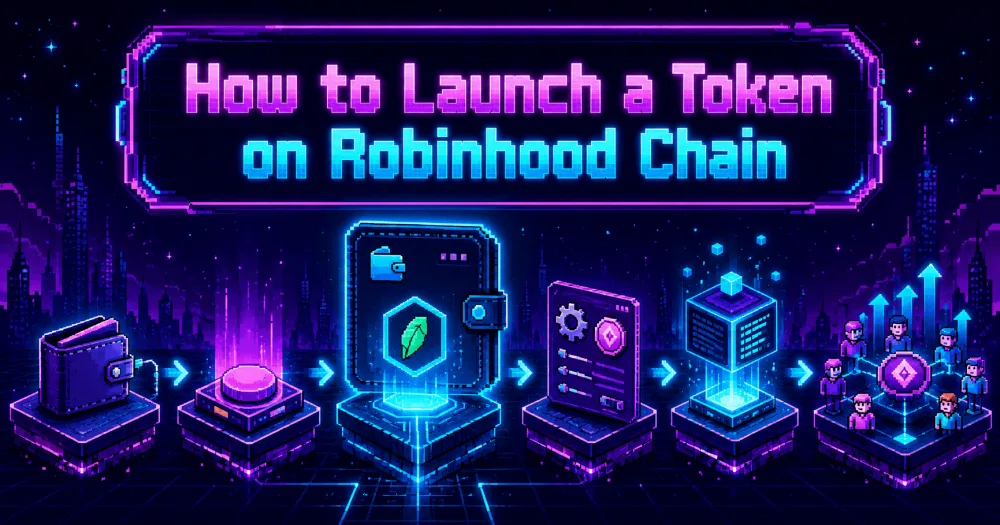
Add Robinhood Chain to MetaMask, Rabby, Robinhood Wallet, or another compatible wallet. The mainnet chain ID is 4663, and ETH is required for gas. Bridge only through the canonical Arbitrum route or a recognized partner.
Choose the Right Launchpad
Select a Robinhood Chain token launcher based on price discovery, liquidity treatment, creator fees, and customization. Do not choose solely because a platform is trending.
Configure Tokenomics and Security Features
Set the supply, ticker, allocations, fees, anti-snipe rules, and launch model. Good tokenomics disclose creator holdings and avoid hidden minting, blacklist, or liquidity-withdrawal powers.
Deploy Your Token
Review every field, verify the website and factory contract, then approve the token deployment transaction. A blockchain transaction is difficult or impossible to reverse after confirmation.
Promote and Grow Your Community
The technical process to launch token on Robinhood Chain takes minutes; building demand takes longer. Publish the verified contract address, explain the tokenomics, disclose team wallets, and maintain consistent channels before and after launch.
Which Robinhood Chain Launchpad Is Best for Your Project?
Memecoins
hood.fun is the strongest match for memecoins built around bonding-curve speculation and graduation. Openfair is better when creators want a choice between that model and instant listing.
AI Tokens
RobinPad, once fully operational, is suitable for permissionless AI community tokens, while teams creating functional agents may need custom smart contracts beyond a basic ERC-20 launch.
RWA and Tokenized Asset Projects
None of these Robinhood Chain launchpads is automatically suitable for regulated RWA issuance. Tokenized assets require legal ownership, transfer controls, disclosures, custody, and compliance—not merely token creation.
Community Tokens
Openfair and RobinPad offer the clearest community-oriented models. The better choice depends on whether the project wants bonding-curve distribution or immediate liquidity.
Common Mistakes to Avoid When Launching on Robinhood Chain
Choosing the Wrong Launch Model
A bonding curve can build momentum but rewards earlier buyers and creates migration risk. Instant liquidity is composable immediately but may produce sharper volatility and poor price discovery.
Ignoring Liquidity and LP Locks
Confirm how the liquidity pool is funded and who controls its LP position. LP locking reduces rug-pull risk, but it cannot prevent concentrated ownership, malicious taxes, or collapsing demand.
Poor Tokenomics
A fixed supply does not guarantee fair distribution. Hidden team wallets, oversized creator purchases, and weak vesting can undermine an otherwise transparent Robinhood Chain token launch.
Launching Without a Marketing Strategy
Permissionless deployment creates supply, not attention. A project without branding, documentation, community moderation, and launch-day communication can disappear within hours.
Why Robinhood Chain Could Become the Next Major Token Launch Ecosystem
Access to Robinhood’s Growing On-Chain User Base
Robinhood Chain is natively integrated with Robinhood Wallet and built to connect financial products with self-custody and DeFi. That creates a credible distribution advantage, although independent tokens do not automatically receive placement in Robinhood products.
Native Support for RWAs and Stock Tokens
Robinhood Chain was designed for financial services and tokenized real-world assets. Stock Tokens, lending, collateral use, and 24/7 trading could attract builders beyond speculation. Access remains jurisdiction-dependent, and tokenized securities are not generally available to U.S. persons.
Expanding DeFi Infrastructure and Developer Ecosystem
Uniswap, Chainlink, Alchemy, BitGo, 0x, and LayerZero supply core trading, oracle, custody, bridge, and development infrastructure. If activity persists, Robinhood Chain launchpads could become a major EVM token-creation category rather than a brief memecoin cycle.
FAQ
What is the best Robinhood Chain launchpad?
Openfair is the best overall option because it supports both bonding-curve fair launches and instant Uniswap V3 listings. hood.fun is stronger for a Pump.fun-style experience.
Can anyone launch a token on Robinhood Chain?
The network and its launchpads are permissionless at the contract level. Users must still follow local laws, platform terms, and securities rules.
How much does it cost to launch a token?
Costs vary. Openfair lists a 0.0005 ETH creation fee plus gas, hood.fun lists no creation fee, and other platforms may charge gas, deployment fees, or ongoing trading fees.
Are Robinhood Chain launchpads safe?
They reduce some technical risks through standardized contracts and LP locking, but smart-contract bugs, phishing, insider concentration, and market losses remain possible. Every platform is new and should be treated as experimental.
Which launchpad is best for memecoins?
hood.fun is the most direct Pump.fun-style option, while Openfair provides more customization and an alternative instant-listing route.
Do Robinhood Chain launchpads automatically add liquidity?
Most do. Openfair, NOXA Fun, RobinPad, and hood.fun automate liquidity creation, but the timing and mechanism differ between bonding-curve graduation and immediate Uniswap V3 listing.