Unlike existing Layer-1 blockchains that execute, reach consensus, and provide data availability on top of the same blockchain, Celestia blockchain modularizes these layers, permitting developers to build rollups without maintaining their own validator set, possibly boosting scalability and reducing infrastructure costs.

Contents
- What Is Celestia (TIA) and How Does It Work?
- Celestia (TIA) Price History and Market Performance
- Celestia Price Prediction 2026
- Why Investors Are Bullish on Celestia
- Celestia vs Ethereum vs Solana
- Key Catalysts That Could Push TIA Higher
- Risks That Could Hurt Celestia Price
- Is Celestia (TIA) a Good Investment in 2026?
- FAQ
What Is Celestia (TIA) and How Does It Work?
What Makes Celestia Different From Traditional Blockchains?
Celestia is a consensus and data availability layer. It does not execute smart contracts directly, but it uses a Data Availability Sampling (DAS) mechanism to allow light nodes to verify data availability without downloading the entire block, improving scalability relative to most other monolithic chains.
Understanding Modular Blockchain Architecture
Modular blockchain projects include layers that each specialize in different aspects of the blockchain’s functionality. In Celestia, the ordering and publishing of transaction data is decoupled from the execution of transactions that take place on separate rollups and application-specific chains (appchains).
Backers believe that this is one of the most viable ways to achieve blockchain scalability solutions, as decoupling execution from consensus allows a blockchain to scale without all nodes executing every transaction.
Why Celestia Is Called the First Modular Blockchain
Celestia is described as the first modular blockchain that was built from the ground up, as opposed to being monolithic. The project strives to serve mainly as a data availability layer for rollups and sovereign chains.
This positioning helped the network as it became one of crypto’s most closely watched infrastructure projects following its mainnet launch, with research analysts seeing modular blockchain Celestia as a foundation for future Layer-2 ecosystems.
How TIA Powers the Celestia Ecosystem
TIA is Celestia’s native token. It is used for paying transaction fees, staking, and governance. Developers deploying rollups on the network pay with TIA for blobspace, and the network is secured via Proof-of-Stake.
Read Also: Hedera (HBAR) Price Prediction 2026: Institutional Adoption, Valuation Model & Long-Term Forecast
The token can also be used for long-term ecosystem incentives, and demand for TIA is increasingly linked to the growth of rollups and data availability networks with why is Celestia important for modular blockchain development.
Celestia (TIA) Price History and Market Performance
TIA All-Time High and Major Price Corrections
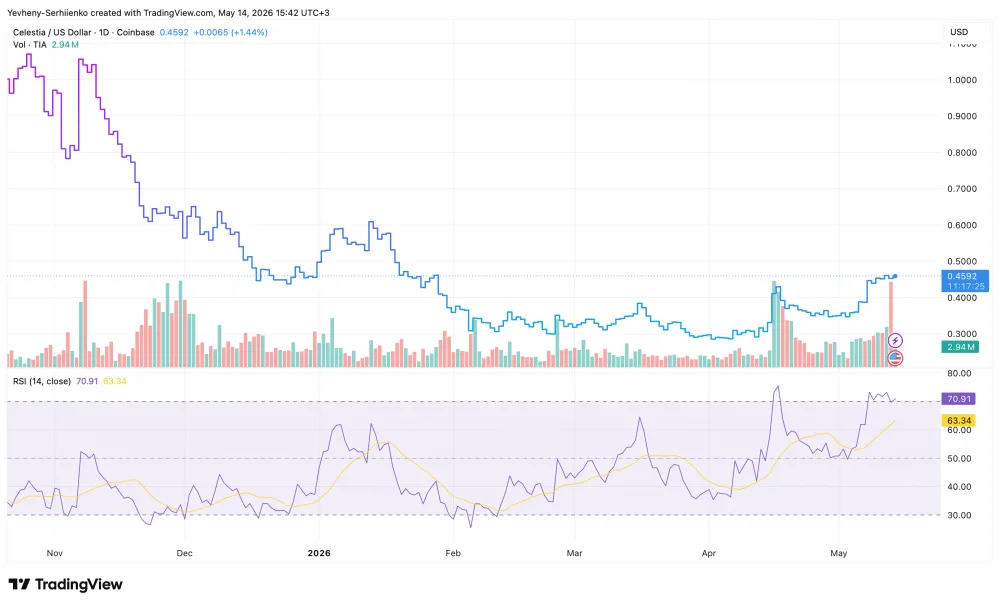
After launching in late 2023, Celestia was seen as one of the best-performing new crypto tokens of the cycle, hitting an all-time high of nearly $20.85 in February 2024, as interest in modular infrastructure and rollup scaling surged in the crypto ecosystem.
As with many other high-growth altcoins, the token has followed the same trend of high valuation corrections due to market-wide downtrends, post-launch profit taking, unlocking of tokens, and speculation, which contributed to extreme volatility in Celestia crypto price in 2025 and 2026.
Why Celestia Became One of the Most Watched Altcoins
Celestia was set apart from other projects as it did not market itself as a competitor to other smart contract blockchains like Ethereum and Solana, but rather as a solution for rollups and modular ecosystems. This explanation ignited some of the earliest discourse around Celestia prediction.
Because of the growing interest in data availability layers and Layer-2 scalability, and the growing number of Ethereum scaling projects, Celestia has been framed as a modular blockchain infrastructure project for the future not just a Layer-1 token.
Key Factors Behind TIA Price Volatility
As with other cryptocurrencies, TIA has followed the pattern of Bitcoin rallies and altcoin corrections. Other major influences on short-term price movements and broader TIA coin price analysis models include token unlock schedules, ecosystem growth, and rollup adoption.
As Celestia is still an early-stage infrastructure project with relatively low liquidity compared to larger cryptocurrencies, its price is prone to considerable increases and decreases during periods of high buying or selling activity of the token.
TIA Market Cap, Trading Volume, and Investor Interest
Despite the drop in price from its all-time high, TIA remains with hundreds of millions of dollars in market cap and active trading. According to major trackers, TIA’s market cap is over $414M and the average daily volume is over $113M during periods when TIA is actively traded on major exchanges.
Thus, developer adoption, rollup integration, and network usage are some of the main metrics analysts look at to determine the project’s projected duration and are increasingly affecting Celestia price outlook, as investors evaluate whether modular blockchain infrastructure will gain adoption.
Celestia Price Prediction 2026
Bullish TIA Price Prediction for 2026
TIA price prediction 2026 could depend on the adoption of modular infrastructure and the growth of Ethereum-based rollups. If Celestia succeeds as a prominent data availability layer, some analysts speculate that TIA could make progress in the next altcoin season, possibly reaching the previous high of $4-6.
Supporters’ arguments have included upcoming network upgrades and increasing developer interest. Market outlook over modular blockchain infrastructure also has a strong impact on any aggressive TIA price prediction 2026 modeling.
Bearish Scenario for Celestia in 2026
Bearish forecasts are based on weak ecosystem growth, sustained token unlocks, and slower rollup adoption, with many models forecasting TIA below $0.45 for most of 2026 due to the huge fall from its 2024 high.
Analysts agree that Celestia will still be dependent on the wider crypto ecosystem if Bitcoin dominance remains high or the institutional interest fails to diversify from large-cap assets; infrastructure tokens are unlikely to return to their old levels.
Average Analyst Forecasts for TIA Price
Most current TIA models hold a wide range of outcomes due to the still-early stage of development of the project and of the tokenomics. While CoinCodex and Kraken estimate a conservative range of $0.3-$0.5 for late 2026, other models have estimated it might be above $1 in a good market.
That divergence further illustrates how uncertain the wider TIA price forecast remains, with analysts increasingly focusing on rollup adoption, fee growth, and consistent network usage rather than speculation.
Can TIA Reach $20, $50, or Even Higher?
Questions around how high can TIA go in 2026 remain closely tied to modular blockchain adoption, ecosystem growth, and the strength of the wider crypto market cycle.
Indeed, Celestia price would be a massive market cap at $50, with a lot going on in the ecosystem. However, there are still bullish investors who talk about Celestia future price potential. Most analysts do not consider this scenario likely for 2026.
| Scenario | Estimated TIA Range | Main Drivers |
| Bearish | Below $1 | Weak adoption, unlock pressure, weak altcoin market |
| Base Case | $1–$6 | Moderate rollup growth, stable crypto sentiment |
| Bullish | Above $20 | Strong modular adoption, major altcoin cycle |
Why Investors Are Bullish on Celestia
Growing Demand for Modular Blockchain Solutions
Research into modular infrastructure has gained meaningful traction with developers looking for blockchain scalability solutions. Modular stacks are composed of multiple layers where execution, consensus, and storage are separated rather than being conducted on a single blockchain. Celestia was specifically designed around this architecture.
It consequently became one of the most heavily discussed modular blockchains projects in crypto infrastructure by proponents, who argue that its model enables cost reductions for rollups and increased scalability without sacrificing decentralization.
Celestia’s Role in Layer-2 Scaling
Celestia essentially acts as a data availability layer where multiple rollups and appchains can publish transaction data. Execution layers can have their own implementation of smart contract execution, and run Celestia for consensus and data availability.
This has led to it gaining relevance for the Layer-2 ecosystem of Ethereum. In this ecosystem, developers building Layer-2 networks on Ethereum may use Celestia to save on data costs. It is thus discussed as part of Celestia vs Ethereum scalability.
Institutional Interest in TIA and Modular Crypto Projects
Celestia originally attracted institutional funding from major crypto venture capital firms, including Bain Capital Crypto, Polychain Capital, and Placeholder. As the sector of rollups, data availability, and modular designs matured, broader interest in blockspace infrastructure grew.
Although still smaller than Bitcoin and Ethereum in terms of institutional adoption, TIA continues to appear among speculative long-term Celestia crypto prediction owing to its infrastructure-focused narrative and accelerated participation in Layer-2 ecosystems.
Developer Activity and Ecosystem Expansion
Celestia supports rollups and appchains that use Celestia’s data availability layer. Its flexible architecture allows developers to deploy custom blockchains without the need to develop their own consensus layer from scratch.
Developer adoption is another important indicator of long-term sentiment on the project. When considering is Celestia a good investment, investors may be more focused on the growth of the ecosystem or the active rollups rather than price fluctuations in the short term.
Celestia vs Ethereum vs Solana
Can Celestia Compete With Ethereum?
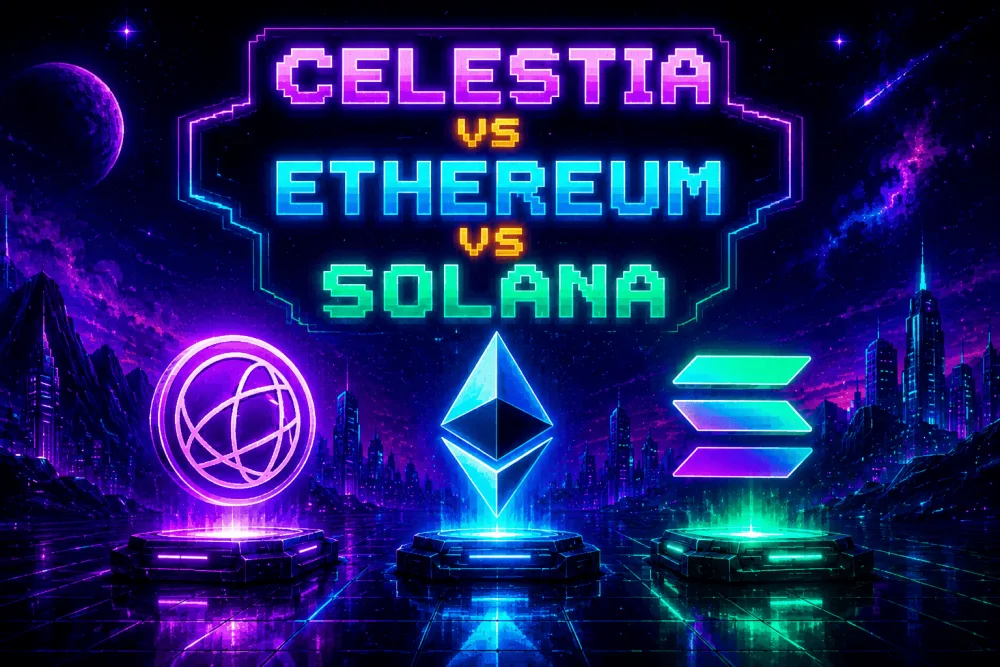
Celestia is not designed to compete with Ethereum as a general smart contract layer: the goal is for rollups to use Celestia as a modular data availability and consensus layer, and let rollups settle on the Ethereum base layer or another layer-1 blockchain.
Read Also: Top Ethereum Gas Fee Solutions in 2026: How Cheap Is ETH Now?
In the wider Celestia vs Ethereum scalability debate, Ethereum has stronger liquidity, developer activity, and DeFi activity. Celestia is mainly seen as an infrastructure providing lower costs and efficiencies for rollups, rather than as an execution environment that competes with Ethereum directly, in its base layer.
Celestia vs Solana: Speed, Scalability, and Adoption
Solana is a monolithic blockchain, meaning that execution, consensus, and data availability run on a single chain. This allows for high throughput but increased hardware requirements and infrastructure complexity as the network scales.
Celestia separates the execution layer and settlement layer, creating a modular blockchain, and some suggest it can provide more flexibility than appchains or rollups. However, Solana had more users, more trading volume, and more developers as of 2026.
Why Modular Blockchains Could Replace Monolithic Chains
The rationale for the modular thesis is that task-specific layers are more efficient than all-in-one blockchains. A modular blockchain would separate execution, settlement, consensus, and data availability as distinct system components rather than treating the blockchain as a monolithic, multi-purpose system.
It is expected that as blockchain use for gaming, DeFi, AI, and enterprises expands, this architecture will drive interest in other modular blockchain structures, and in infrastructure models beyond Layer-1 blockchain more generally.
Which Blockchain Has More Long-Term Upside?
Though Ethereum is the largest smart contract ecosystem, Solana is one of the best-positioned general-purpose high-throughput blockchains, given its performance and growing array of consumer-facing applications.
Celestia’s long-term upside is tied to whether modular infrastructure becomes a dominant way of scaling blockchains in the next cycle. As of the time of writing, bullish investors see Celestia as a higher risk, higher reward infrastructure play tied to the future of rollups and best Layer 1 crypto 2026 narratives, with adoption trailing Ethereum and Solana at the time of writing.
Related: RaveDAO Price Prediction 2026: Is RAVE a Scam or Legit?
Key Catalysts That Could Push TIA Higher

New Partnerships and Ecosystem Growth
The long-term success of the ecosystem will depend on its adoption. Since the launch of its mainnet, Celestia has seen the construction of several rollup frameworks, appchains, and modular infrastructure, looking to pursue scalable data availability solutions.
Several Cosmos and Ethereum ecosystem projects have either integrated or experimented with Celestia’s modular approach, and community ecosystem expansion is a meaningful motivator for bullish Celestia price outlook scenarios.
Impact of Bitcoin and Altcoin Bull Markets on TIA
Like most infrastructure-centric altcoins, TIA is highly correlated with the movements of the overall crypto market. Bitcoin rallies also bring new speculative money and liquidity into the altcoin market, benefiting new blockchain infrastructure projects.
If we do see this extended altcoin bull cycle, the stand-alone Celestia crypto prediction narrative becomes much more bullish, as capital gets rotated into L2 scaling solutions, rollups, and modular blockchain infrastructure.
Crypto ETF Momentum and Institutional Adoption
Following the approval of spot Bitcoin ETFs in the US, digital assets have experienced greater institutional adoption and a general improvement in sentiment, with analysts debating if this increased institutional interest will likewise go beyond Bitcoin and Ethereum towards infrastructure-focused digital assets.
Despite having speculative characteristics, as institutional interest in blockchain scalability and modular architecture grows, short- and long-term prospects could be further improved for projects utilizing rollup infrastructure and blockchain scalability solutions.
Upcoming Celestia Network Upgrades
Upgrading the network is another important TIA catalyst. Celestia has a roadmap to improve data throughput, developer tooling, interoperability, and rollup support as the modular stack becomes competitive.
Investors often watch upgrade activity because it can affect ecosystem adoption and transaction demand. As the ecosystem matures, upgrades are likely to remain an important factor for Celestia price analysis 2026 discussions and long-term forecasts.
Risks That Could Hurt Celestia Price

Competition From Other Layer-1 and Modular Projects
Celestia’s competitive landscape is seen as increasingly crowded. Other data availability-oriented systems include Ethereum and Solana blockchains, as well as newer solutions such as EigenDA and Avail, both of which focus on rollup scaling and modularity.
That competition could also prevent long-run market share if rival ecosystems attract more developers, liquidity, or enterprise integrations. The speed of alternative modular networks’ growth poses one of the biggest threats to long-run Celestia prediction models.
Regulatory Pressure on Crypto Markets
Like most altcoins, TIA is vulnerable to global regulatory risk. Changes or clarifications to the classification of tokens, staking services, or compliance by cryptocurrency exchanges could negatively impact liquidity and interest in infrastructure-based cryptocurrencies.
The majority of institutional capital goes to larger coins like Bitcoin or Ethereum. This means that smaller coins may experience much higher volatility under regulatory scrutiny. This could dampen the general Celestia crypto price outlook.
Token Unlocks and Selling Pressure
Token unlock schedules are a key driver of TIA market volatility. Messari and Tokenomist data indicate that a large portion of the token supply has been unlocked linearly over time via vesting schedules for investors, contributors, and ecosystem allocations.
Major unlocks have always raised concerns about market-wide selling pressure. In October 2024, a particularly large TIA unlock represented a meaningful proportion of the circulating supply and was closely observed by investors at the time.
For TIA coin price analysis, supply growth is one of the most important factors, along with adoption and general sentiment in the market.
Weak User Adoption and Ecosystem Risks
Long-term success depends upon continued developer growth over time, as well as actual adoption of modular blockchain infrastructure. The modular thesis has received a fair amount of attention from the industry, but the landscape is still early relative to other smart contract ecosystems.
Read Also: Crypto Exchange Battle 2026: Binance vs Bybit — Where Do Traders Prefer to Trade?
If rollup demand were to slow or developers were to leverage other infrastructure providers, the bullish projections for what will Celestia be worth in 2026 will be considerably diminished; thus, the project’s performance will largely depend on its ecosystem and network activity.
Is Celestia (TIA) a Good Investment in 2026?
Who Should Consider Investing in TIA?
Celestia is considered a more speculative infrastructure play in the cryptocurrency ecosystem. Likewise, TIA could also be a speculative play for those interested in modular blockchain solutions, rollup scalability solutions, and early-stage blockchain infrastructure, but who don’t see it as a mature asset yet.
As this project is dependent on the adoption of modular ecosystems, TIA may attract speculative investors with risk appetite for early-stage technology. A discussion of whether is TIA a good long term investment would likely return to these uncertainties.
Short-Term Trading vs Long-Term Holding
TIA has remained highly volatile since launch, making it an object for opportunistic short-term trading alongside other large altcoins. Consistent price fluctuations following token unlocks, shifts in the price of Bitcoin, and changes in general market sentiment have enabled a rapid turnover of the token.
Long-term holders, however, are more focused on supporting ecosystem activities and the adoption of modular infrastructure over the coming years. For investors asking is Celestia a good investment, the question is whether the future of crypto scalability will happen more in the spirit of modular blockchain architecture.
Can TIA Become a Top-10 Cryptocurrency?
For Celestia to be considered a top 10 project, it would need to grow many times larger in adoption, liquidity, and network activity from where it is today. It would likely need to become a core layer of infrastructure for rollups and appchains across many different ecosystems.
Supporters say increased demand for modular blockchain infrastructure could strengthen Celestia price prediction bullish case, although most analysts still view a top-10 ranking as highly speculative in the near term.
What Analysts Expect From Celestia by 2030
Long-term TIA estimates vary widely. It is still unclear how fast blockchain-based solutions will penetrate the current market. Some estimates, which may be too optimistic, assume that demand for modular infrastructure will exceed current demand by 2030 if rollups become the dominant method for blockchain scaling.
However, due to competition, tokenomics, and regulatory issues, the long-term Celestia price target projections are heavily reliant on modular blockchain technology being rapidly adopted from a niche infrastructure use case to a larger crypto use case.
FAQ
What is Celestia used for?
By providing data availability and consensus for rollups and modular blockchains, Celestia allows developers to build scalable blockchain applications without having to build their own validator network.
What makes Celestia different from other blockchains?
To allow for better scalability and flexibility for developers, Celestia separates the execution, consensus, and data availability layers from each other, as opposed to a monolithic chain.
What factors affect TIA’s price?
Factors influencing Celestia token price include overall crypto market mood, token unlock schedules, modular infrastructure adoption, and rollup ecosystem activity.
Is Celestia an Ethereum sidechain?
Yes. Several rollups and other Ethereum-related scaling solutions can take Celestia advantage to save costs and improve scalability by using it as an external data availability layer.
What are the biggest risks for Celestia?
Risks include competition from infrastructure projects, uncertain regulation, inflationary supply of the token as unlocks occur, and slower-than-expected ecosystem adoption.