A quiet standoff shapes how people talk about the Hedera price prediction 2026. Early that year, HBAR▲$0.0730 traded close to eleven cents, dipped toward nine, then stayed stuck below ten, even with strong proof of utility behind it.
Hedera (HBAR) Market Data
| Market Cap | $3.26B |
|---|---|
| Fully Diluted Valuation (FDV) | $3.71B |
| Volume (24h) | $57.48M |
| Volume / Market Cap | 0.0177 |
| Circulating Supply | 43.83B HBAR |
| Total Supply | 50.00B HBAR |
| Max Supply | 50.00B HBAR |
| All-Time High (ATH) | $0.5692 |
| All-Time Low (ATL) | $0.00986111 |

During 2025 alone, the platform handled settlements worth more than ten billion dollars, led all networks in development work on real-world assets, saw a dedicated ETF launch on American markets under Canary Capital, and welcomed McLaren Racing into its leadership group alongside firms like Google, IBM, Boeing, and Deutsche Telekom.
Still, prices show little reaction, which brings up a deeper issue whenever working through any Hedera price prediction: what triggers value recognition after trust is built? Through models, expert estimates, and extended outlooks, clarity on the Hedera price prediction 2026 emerges slowly, piece by piece.
Read more: Top 5 Altcoins for the Next 100x Crypto Bull Run in 2026: High-Potential Crypto Picks
Contents
- Hedera Market Analysis: Enterprise Strength Meets Weak Technicals
- HBAR Price Prediction 2026: What Analysts Are Targeting
- Hedera Valuation Model: Three Frameworks for HBAR Fair Value
- Institutional Adoption and Hedera Price Prediction 2026: The Catalyst That Changes Everything
- Hedera Long-Term Forecast: 2027–2030 and Beyond
- Hedera Price Prediction 2026: Bull, Base, and Bear Cases
- FAQ
Hedera Market Analysis: Enterprise Strength Meets Weak Technicals
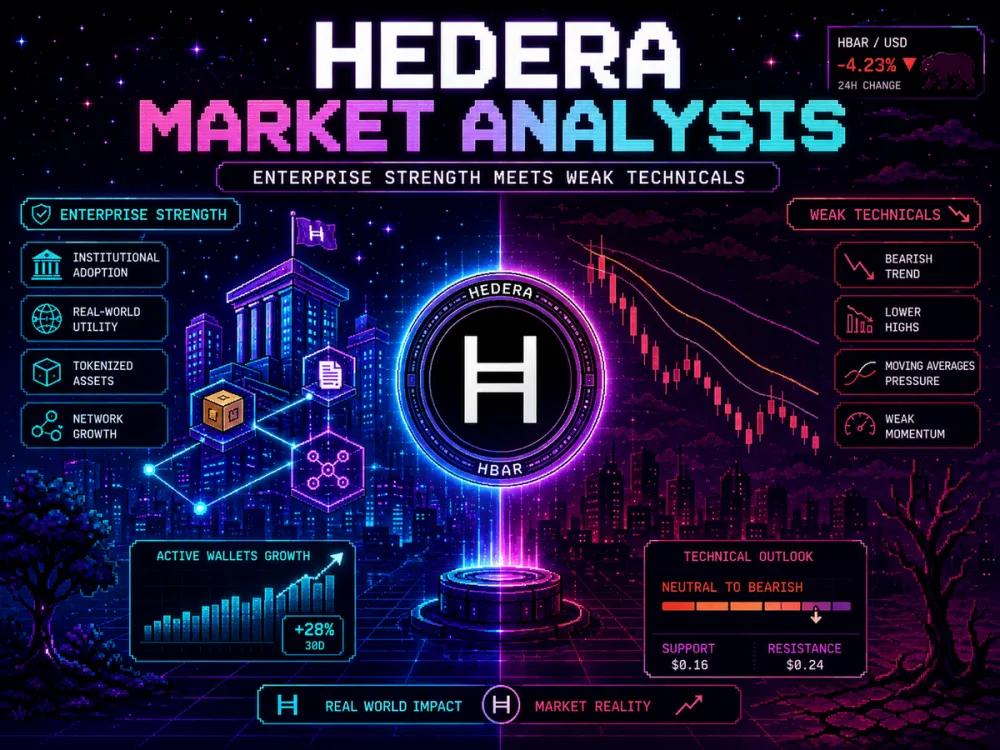
A close look at the Hedera market analysis for 2026 reveals an odd contrast. Despite being overlooked by many investors, the platform hosts tangible adoption few peers can match. One notable example emerged in 2025. A landmark trial in the UK saw Lloyds Banking Group and Aberdeen employ tokenized funds and government bonds as backing in foreign exchange deals.
At the same time, Australia moved forward with its digital currency initiative built via Stablecoin Studio atop Hedera. Meanwhile, far beyond financial experiments, Georgia finalized the transfer of its entire property records system onto the blockchain. Year-on-year, daily active wallets rose sharply by 190%, while tracked dApp transaction volume jumped 386%, reaching 2.7 million.
Though late to market, the Canary Capital HBAR ETF — launched on Nasdaq in October 2025 with symbol HBR — currently stores around 473 million HBAR. That amount represents about one-hundredth of all tokens currently in circulation.
Despite appearances, technical indicators paint a restrained picture for the HBAR market analysis. Below every major moving average throughout early 2026 stood HBAR — beneath the $0.102 20-day EMA, the $0.113 50-day EMA, and even the $0.131 100-day level. Confirmation came via a death cross, cementing downward momentum. Near 36, RSI values hover close to oversold zones yet fail to produce any clear turnaround cue. What emerges aligns closely with late-phase accumulation — institutions slowly entering amid muted interest from smaller traders.
Despite apparent growth, the central question around Hedera market analysis by 2026 lies in how enterprise uptake affects actual on-chain need for HBAR. When major organizations rely on off-ledger methods like prepaid balances or closed networks, the open network sees little effect, leaving price untouched by operational advances. Value movement emerges only when real-world systems go live and consistently pay fees using the token.
HBAR Price Prediction 2026: What Analysts Are Targeting
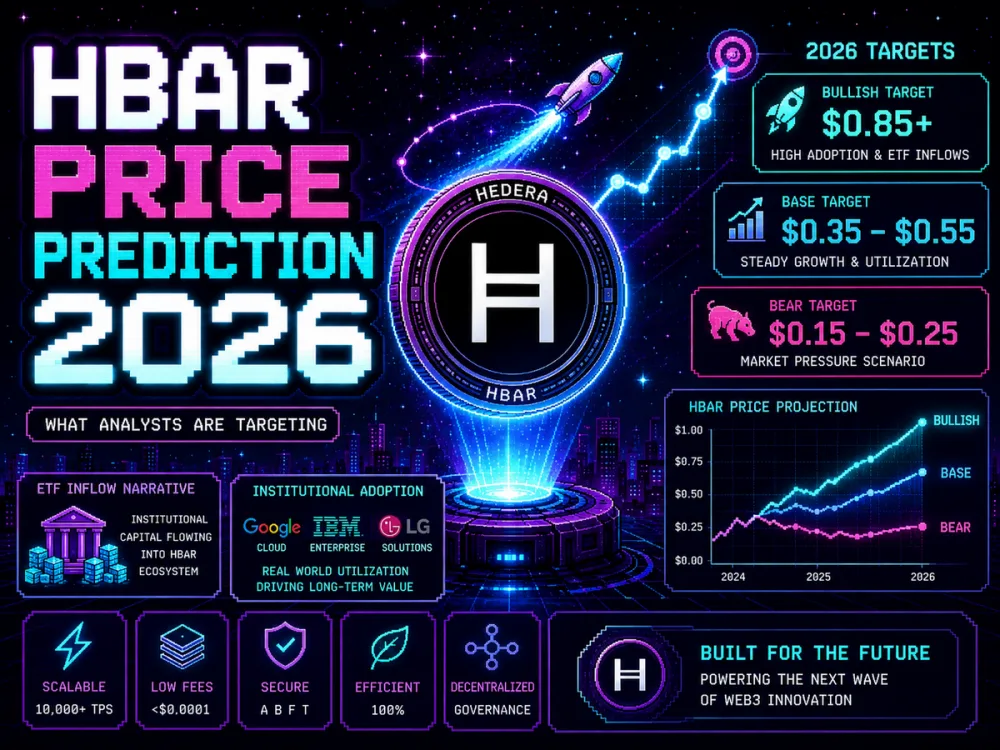
Forecasts within any HBAR price prediction 2026 review show a split view. Near $0.18 to $0.25 gathers most cautious estimates. At about $0.24 sits Cryptopolitan’s central estimate for 2026, viewing corporate uptake as tangible yet less influential on value than hopeful projections suggest. Slightly below that, Binance’s combined forecast lands at $0.218 — an increase of nearly 140% from prices around $0.089 — stable growth, nothing bold, fitting Hedera’s focus on business use above all.
A moderate Hedera price target 2026 outlook appears plausible. Coinpedia estimates values between $0.45 and $1.05, with a midpoint near $0.80 — support rooted in potential ETF greenlights, growth in real-world asset adoption, along with favorable shifts in broader economic trends. Traders Union suggests $0.35 may emerge as a central estimate by December, provided volume tied to RWAs climbs into the $15–$20 billion band while Bitcoin surpasses $110,000. Within this perspective, reflected in the Hedera forecast 2026 from this camp, HBAR takes shape less like a volatile alternative token, instead aligning with structured developments grounded in measurable milestones.
Read more: Top 5 Altcoins Whales Are Buying Aggressively in May 2026
Should market sentiment turn highly positive, projections for the HBAR forecast 2026 reach between $0.40 and $0.60 by December, according to Coindcx. Mike Maloney, an analyst focused on broad economic trends, sees $0.27 as a short-range objective, with a much higher level around $25 possible over extended timeframes. His outlook treats HBAR not merely as speculative but as positioning prior to wider financial adoption. This kind of perspective suggests interest now extends into circles far removed from typical digital currency enthusiasts.
Hedera Valuation Model: Three Frameworks for HBAR Fair Value
Despite many alternative coins relying on stories and trends for value, the Hedera valuation model stands apart through measurable activity in actual applications. Three frameworks are worth applying.
One approach within the Hedera valuation model relies on payment-driven demand. Across each Hedera function — agreement systems, tokens, contracts, files — usage requires HBAR. Fees set in U.S. dollars ensure rising activity leads to greater amounts destroyed. Suppose real-world asset transfers jump from ten to twenty billion; assume decentralized applications maintain rapid yearly expansion. In such cases, need for HBAR strengthens visibly through blockchain records. Growth becomes traceable without external verification.
Second comes a model based on supply movement. By 2025, the HBAR vesting timeline indicates nearly all tokens assigned to team members and investors had already unlocked. After this stage, fresh issuance arises almost entirely from treasury releases, which significantly restrains the pace of new supply. As a result, upcoming inflation becomes easier to anticipate while diminishing sell-offs — previously seen during prior market phases — are less likely to recur. Approximately one percent of existing coins are held within the Canary Capital ETF; meanwhile, proposed funds from Grayscale and 21Shares await regulatory decisions, limiting even further the volume accessible for short-term speculation.
Third comes a network-based comparison approach. With a market value around two to four billion dollars, Hedera trades below the potential tied to worldwide asset digitization. Should it hold its top position among real-world asset builders while moving part of its corporate projects into live use, gains beyond present pricing appear plausible. Working relationships with PwC, NATO’s DIANA initiative, Tata Communications, and Shinhan Bank reflect actual institutional adoption Hedera has already secured — timing remains uncertain, though validity does not.
Institutional Adoption and Hedera Price Prediction 2026: The Catalyst That Changes Everything
What shapes Hedera future price most is not chart patterns, but how fast institutions move from commitment to real-world blockchain use. Signs seen in early 2026 show progress. In March of that year, a shared decision by the SEC and CFTC placed HBAR under digital commodity status, lifting uncertainty that had delayed investment decisions. Because of this shift, funds once held back now flow; one example is the Canary Capital ETF reaching $93 million in registered holdings, while fifteen more similar products await approval. On March 26 came another milestone: release of the Agent Lab system, designed to simplify development for artificial intelligence tools tied to blockchains — timed ahead of new European rules starting August 2026 requiring systems able to track outputs, something Hedera was made to support.
Because these updates target the missing piece in the institutional adoption Hedera thesis — clear rules and easier access — they influence what may happen to HBAR future price. Approval of some upcoming ETF applications, followed by steady investment flow, might quickly reduce available supply. That shift could impact price sharply given how small the current market size is.
Related: What Is AI Mining in Crypto? Top 5 Best AI Mining Platforms to Earn in 2026
Hedera Long-Term Forecast: 2027–2030 and Beyond
Beyond 2026, the Hedera long-term forecast — and by extension the Hedera price prediction 2026 baseline from which it builds — rests entirely upon whether its position among enterprises grows stronger or weakens. Should advantages like ISO 20022 alignment, governance through a council structure, and early dominance in real-world asset tokenization build over time, then surpassing $1 per HBAR by 2030 becomes plausible. According to Benzinga, the value could settle near $0.873 at that point. In contrast, Coinpedia’s analysis suggests a range between $1.40 and $3.00 if usage continues rising steadily. Meanwhile, Changelly estimates a ceiling of $2.20, assuming the platform wins substantial presence within worldwide markets for tokenized assets.
One possibility stands out in the Hedera long-term forecast: growth follows only if early institutional adoption Hedera has pioneered turns into widespread operational use. Should Lloyds Banking Group deploy widely, activity may rise sharply — a similar effect likely with NHS, Tata Communications, or Shinhan Bank moving live. Each such move might bring transaction volume measured in tens of millions, along with increased need for HBAR. Yet a steady concern persists — solutions built privately allow influence without economic benefit. Dominance in design does not guarantee value capture where access stays closed.
Hedera Price Prediction 2026: Bull, Base, and Bear Cases
Three possible paths for the Hedera price prediction 2026 help shape how investors assess exposure. Altogether, expectations span modest rebound trends through to strong upward momentum under favorable conditions.
A rise toward $0.60–$1.05 before December appears possible under certain conditions. Should regulators clear several ETF applications, capital could begin shifting in response. When even a few corporate trials move into live deployment, momentum may build. Recovery of Bitcoin beyond $110,000 would further support upward pressure. Progress within the Agent Lab might spark renewed interest among builders. Such outcomes fit patterns projected at Coinpedia’s top boundary. Estimates from Coindcx point in a similar direction.
A target range of $0.25 to $0.45 is expected before year-end under baseline conditions. Modest expansion of the Canary ETF contributes to this outlook, while progress in one or two enterprise rollouts adds further influence. Support comes from Bitcoin maintaining levels beyond $80,000, aiding a slow revival among alternative coins. The midpoint estimate of $0.35 reported by Traders Union fits within this scope, just as Binance’s reference level at $0.218 remains relevant. Toward its upper edge, sentiment gains strength if underlying factors persist.
A downward scenario positions HBAR between $0.10 and $0.20. Should ETF clearances stall again, institutional uptake stays limited to trials absent live blockchain deployment, while worsening economic conditions reduce investor tolerance for alternative tokens. That outcome hinges on prolonged regulatory uncertainty alongside weak market sentiment affecting digital assets broadly.
Should HBAR reach new heights by 2026? Evidence points toward a range of $0.25 to $0.45 under normal conditions — modest improvement exists, yet nothing like sudden surges seen elsewhere. Because enterprise usage shapes Hedera’s path differently, any shift upward may hold longer due to underlying design. The Hedera price prediction 2026, in that sense, rewards patience over momentum trading. For 2026, valuation appears tied less to hype and more to measured progress.
FAQ
What is the most likely HBAR price at the end of 2026?
By late 2026, HBAR could reasonably sit near $0.35. Most trusted forecasts suggest a span from $0.25 up to $0.45. That projection rests on gradual growth of the Canary Capital ETF. Alongside it, movement of pilot projects into live use matters. So does stability in Bitcoin’s present trading area. Pessimistic views, such as those seen at Cryptopolitan or Binance, hover near $0.18 to $0.24. On the opposite edge, optimistic takes — Coindcx and Coinpedia, for instance — suggest peaks between $0.60 and $1.05. Such highs would require strong market tailwinds.
What makes Hedera different from other Layer-1 blockchains?
Hedera stands apart due to its unique foundation. Instead of a standard chain structure, it runs on a protected method called hashgraph. This design allows more than ten thousand operations each second. Fees remain stable, expressed clearly in U.S. dollars. Confirmation happens immediately — no waiting periods apply. Oversight comes from a diversified group: names like Google, IBM, and Boeing take part. Such involvement brings a level of oversight rarely seen in crowd-directed systems. Standards alignment appears at the core — one recognized globally under code 20022. Financial hubs, including state-backed monetary authorities, find this compatibility meaningful. Payment intermediaries also see value here.
How does the Canary Capital HBAR ETF affect the price?
This fund, live on Nasdaq since October 2025, owns close to 473 million HBAR tokens — about one percent of what is now in circulation. Because it offers a compliant path for institutions, entities like pension pools, private investment groups, and advisory firms may access HBAR without managing storage themselves. Each fresh dollar entering reduces how much remains free to trade. As fifteen more such exchange-traded products wait for SEC decisions by early 2026, added green lights might deepen this trend of shrinking availability.
What are the biggest risks to the Hedera price prediction 2026?
Could enterprise preference for closed systems pose a threat to Hedera’s 2026 outlook? Likely so, if companies stick with internal setups or advance-funded accounts that avoid the open HBAR chain entirely — use grows, yet token activity stays flat. Another concern emerges should ETF greenlights slow down, adding uncertainty. Outside forces matter too: broad economic strain may dull investor interest in speculative assets. Alternatives play a role; recent blockchains built with segmented designs could pull attention elsewhere. Note this — HBAR moves closely with Bitcoin, nearly 0.89 in step, hence any steep drop in BTC▲$62,630.00 might drag sentiment lower, even when Hedera advances independently.
Can HBAR realistically reach $1 in 2026?
Is $1 achievable for HBAR by 2026? Possible, though only under ideal conditions — think approved ETFs drawing real capital, major firms launching live blockchain operations, alongside broad altcoin momentum fueled by Bitcoin’s rise. Still, most experts see $1 as a distant goal, likely not holding sustainably until well into 2029 or even 2030. A more plausible route sees prices settling around $0.35, with upside potential stretching toward $1.05 if everything aligns just right.