Ethereum fees explained 2026 show a very different market structure from previous cycles, as Layer 2 ecosystems now process transactions for cents thanks to blob-based scaling introduced through EIP-4844.
Contents
- Ethereum Gas Fees in 2026 — Current Cost Structure Explained
- How Cheap Is Ethereum Now Compared to Previous Cycles
- Top Ethereum Gas Fee Solutions in 2026
- Best Tools to Track Ethereum Gas Fees in Real Time
- Cheapest Ways to Transact on Ethereum in 2026
- Hidden Costs of Ethereum Transactions Users Often Miss
- Which Ethereum Scaling Solution Is the Most Cost-Efficient in 2026
- FAQ
Ethereum Gas Fees in 2026 — Current Cost Structure Explained
Average ETH Gas Fees in 2026 Across L1 and L2
Other networks like Arbitrum, Base, and Optimism now account for a large share of retail applications, with lower Ethereum transaction fees for swaps, NFT minting, and stablecoin transfers. After the Dencun upgrade, rollup fees dropped considerably since blob transactions lowered the Data Availability costs for Layer 2 operators.
Why Ethereum Gas Fees Still Fluctuate Despite Scaling Upgrades
ETH▲$1,761.17 gas fees are not falling continuously despite scaling solutions for the same reasons as above. Trading memecoins and issuing new tokens can quickly drive the gas prices of both mainnet and rollups in periods of increased DeFi activity.
Ethereum still has a multi-layer fee model. Moreover, because rollups still use Ethereum for settlement and data availability, users are still subject to blob market congestion and L1 activity. Multiple studies following EIP-4844 identified short-term price volatility during synchronized periods of rollup demand.
Key Factors That Influence ETH Transaction Costs (Network Demand, Congestion, L2 Usage)
Real-time demand for blockspace remains the largest driver of Ethereum network fees. However, trading volatility, NFT drops, liquidations, and high-frequency DeFi applications can still drive gas prices higher even with scaling.
Read Also: Ethereum Whale Accumulation 2026: Top Holders Moving the Market Right Now
With Layer 2 solutions, the lowest Ethereum transaction cost depends both on Ethereum network traffic and the architecture of the Layer 2 solution being used. Optimistic rollups generally optimize for liquidity within the network, while some ZK-rollups prioritize compression and throughput.
How Cheap Is Ethereum Now Compared to Previous Cycles
Ethereum Gas Fees in 2021 vs 2024 vs 2026
The contrast between Ethereum fees 2021 vs 2026 is substantial. During the 2021 NFT and DeFi boom, Ethereum transaction fees often exceeded $50 and even $100 (for NFT mints and aether swaps, respectively) in times of increased network strain. Moreover, gas prices have repeatedly exceeded 200 Gwei in other periods of speculation.
With the Dencun upgrade in 2024, which introduced EIP-4844, the cost of Layer 2 data fell by more than 90%, allowing networks such as Arbitrum, Base, and Optimism to process transactions for cents instead of dollars.
As of 2026, ETH gas fees are close to multi-year lows with high throughput, leading many users to ask: Is Ethereum cheap now compared to previous market cycles?
A common price to transfer ETH on the Ethereum mainnet is $0.10 to $0.25, and many Layer 2 transactions cost a fraction of a cent.
| Period | Ethereum Mainnet Fees | Layer 2 Fees | Market Context |
| 2021 | $50–$100+ during peaks | Limited adoption | NFT and DeFi boom |
| 2024 | ~$1–$10 typical activity | Often below $0.10 | Dencun + EIP-4844 rollout |
| 2026 | ~$0.10–$0.25 transfers | Fractions of a cent | Mature rollup ecosystem |
What Changed After EIP-4844 and Proto-Danksharding
EIP-4844 introduced blob transactions (proto-danksharding): a separate data layer for rollups, which was made cheaper than forcing rollups to compete with the rest of Ethereum’s blockspace.
The upgrade reshaped Ethereum scaling solutions’ impact fees by sharply reducing rollup operating costs and improving transaction throughput. Overall, Ethereum is now viewed as a modular settlement network instead of a monolithic execution chain.
Impact of Rollups on ETH Transaction Pricing
Rollups are a revolutionary technology that supported later Ethereum cost-reducing updates by moving most of Ethereum’s execution off Layer 1, using the batchification of optimistic rollups and proof efficiency of ZK-rollups to power high-performance applications at lower cost.
As a result, users became trained to compare networks, rather than just rely on Ethereum mainnet. Questions like “how much are Ethereum gas fees” become dependent on the selected Layer 2 network, the bridging fees, and the Ethereum ecosystem liquidity.
Top Ethereum Gas Fee Solutions in 2026
Layer 2 Rollups (Arbitrum, Optimism, Base) and Their Fee Reductions
As of 2026, Rollups act as a primary solution to high Ethereum Layer 2 fees by executing swaps, NFTs, and stablecoin transfers on layer 2 networks like Arbitrum, Optimism, or Base at considerably reduced costs. After the introduction of blob transactions with the Dencun upgrade, operating costs fell sharply.
Under these circumstances, Arbitrum gas fees, Optimism network fees, and Base network fees are frequently measured in cents or less during normal usage, whilst maintaining access to Ethereum liquidity and settlement security. Optimism keeps expanding its Superchain ecosystem.
ZK-Rollups vs Optimistic Rollups — Which Is Cheaper in Practice
In practice, ZK rollups’ Ethereum fees depend heavily on transaction type, since validity proofs allow more productive data compression and lower execution costs. For larger amounts transferred or payment activity, fees are lower.
Optimistic rollups still power a majority of Ethereum’s DeFi applications, making Ethereum rollups cost comparison increasingly dependent on liquidity depth and bridge efficiency.
As liquidity and applications remain deeper on larger optimistic rollups, the cost comparison of Ethereum rollups should consider bridge friction, access to liquidity, execution reliability, and gas costs.
Using Sidechains for Ultra-Low Transaction Costs
Sidechains remain one of the best Ethereum gas fee solutions for applications that value low costs and fast confirmation. For example, the Polygon PoS network remains popular for gaming and other consumer applications, with costs often less than a cent.
Read Also: Best Ethereum Tokens and Projects to Invest in 2026
Sidechains, on the other hand, are independent and use their own security model and validators, not Ethereum’s consensus.
Gas Optimization Techniques for Developers (Batching, Compression, Efficient Smart Contracts)
Developers have continued to reduce Ethereum transaction fees through batching, call data compression, and more efficient smart contracts. Reducing storage and computation in smart contracts is one of the best ways to optimize.
Most applications now use modular contracts, account abstraction, and off-chain computation to reduce Ethereum gas fees while lowering expensive Layer 1 usage.
Best Tools to Track Ethereum Gas Fees in Real Time
As Ethereum evolved from a single chain to a multi-layered network, constantly changing gas prices prompted the need to track fees. Base rates, priority fees, and average estimated costs of trading, transferring, and using NFTs can be tracked via Etherscan Gas Tracker. Mempool congestion and short-term spikes in Ethereum gas price today can be tracked via Blocknative.
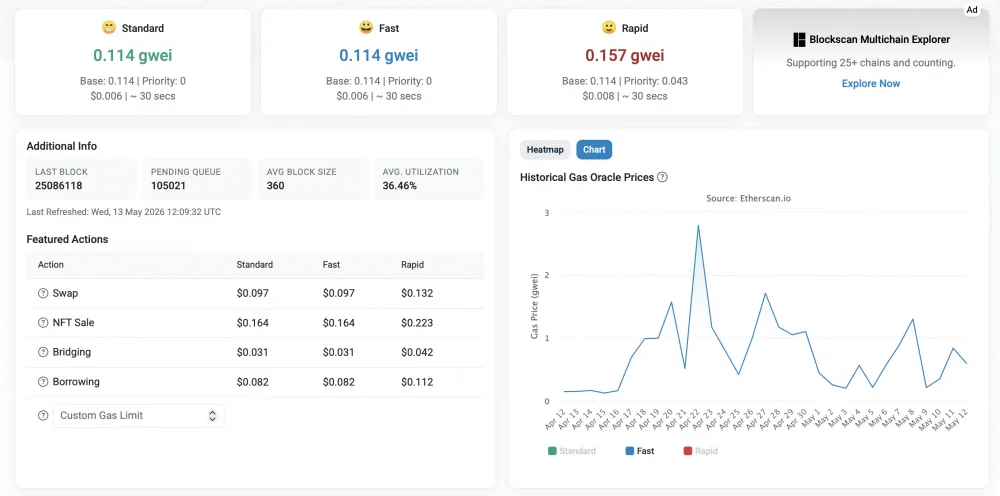
Dashboards such as L2Beat show a snapshot of Arbitrum, Base, Optimism, zkSync, and other networks’ transaction costs updated in real time, permitting traders to know the cheapest way to use Ethereum, based on liquidity, bridge, and network traffic.
Wallet Integrations That Auto-Optimize Gas (MetaMask, Smart Wallets)
Smart wallet applications like MetaMask now offer automated fee estimators, which optimize for blockchain congestion, priority fees, and the expected time for fulfilling a transaction.
Account abstraction provides automated routing and batching of transactions. Some smart wallets use paymasters to sponsor gas costs or route through Layer 2 networks, so users can avoid Ethereum gas fees in times of high mainnet traffic.
On-Chain Analytics Tools for Predicting Gas Spikes
Some analytics platforms monitor the mempool and model transactions to gauge Ethereum network traffic. The analytics platforms Blocknative and Dune Analytics build models of incoming transactions, whale activity, and liquidation risk to identify an increase in network traffic before it occurs.
For protocol operators and active traders, predicting gas prices is almost as important as receiving real-time gas price estimates. NFT launches, token unlocks, and sudden market swings have become critical to understanding how to avoid Ethereum gas fees, as execution is becoming increasingly precise.
Cheapest Ways to Transact on Ethereum in 2026
When to Execute Transactions for Lowest Gas Costs
Timing is still a low-hanging fruit for reducing Ethereum transaction fees. While other scaling solutions progressed, Ethereum’s activity is still bound to US trading hours, token launches, NFT events, and price fluctuations. Further, quiet times previously were concentrated around weekends, or off-peak sessions in Asia, or in the USA.
Modern wallets and gas trackers can help identify good times to execute by monitoring the current and upcoming state of the mempool, for instance, by monitoring Etherscan or Blocknative, permitting users to save a lot by avoiding non-time-sensitive transactions during blockchain congestion.
Using L2 Bridges to Minimize Fees
Layer 2 migration has been one of the best ways of how to avoid Ethereum gas fees in 2026, with users bridging to Arbitrum, Base, Optimism, and zkSync before using DeFi, NFT projects, or gaming applications.
Some protocols optimize routing and liquidity provision to minimize transfer costs, while others can require additional fees or have longer withdrawal times. But in many cases, the total cost is not only dependent on bridge pricing, but also on congestion experienced on Ethereum mainnet at the time of a transfer.
Stablecoin Transfers vs ETH Transfers — Cost Differences
Different types of transactions on Ethereum require different amounts of gas. Transferring ETH native to Ethereum is cheaper than transferring ERC-20 stablecoins (which are an Ethereum token standard), because the ERC-20 stablecoin transfer requires interaction with an ERC-20 token smart contract.
The spread later narrowed as the adoption of rollups increased, but Ethereum network fees for stablecoin transactions are still higher than for non-stablecoin transactions on Ethereum mainnet during peak congestion, although layer 2 networks typically settle stablecoin transactions for a few cents or less.
NFT Minting on L2 vs L1 Gas Savings
NFT use cases also exposed the most visible component of Ethereum’s fee market, and at their peak in the 2021 cycle, average Ethereum fees to participate in projects were above $100 per user.
Read Also: Ethereum Updates 2026: Upcoming Changes That Could Transform the Network
By 2026, most creators and marketplaces were using Layer 2 infrastructure to obtain the lowest Ethereum transaction cost to mint large campaigns, with rollups decreasing the price of minting while allowing the project to remain interoperable with Ethereum ecosystem.
Hidden Costs of Ethereum Transactions Users Often Miss
Bridge Fees Between L1 and L2 Networks
Ethereum transaction fees are often assumed to only include on-chain transaction costs, but additional fees may be incurred when transferring assets from Ethereum mainnet or Layer 2. In addition to gas fees, bridges may have liquidity provider fees, routing fees, and withdrawal fees, depending on the bridge protocol and asset transfer routing.
Timing also matters when bridging. If Ethereum is congested, it may also incur other charges on Ethereum mainnet, such as when withdrawing from optimistic rollups, which have challenge periods and exit delays.
Slippage and MEV Impact on Total Transaction Cost
One of the highest hidden costs of trading on Ethereum is slippage and MEV extraction. Even when ETH gas fees appear relatively low, front-running, sandwich attacks, and high execution costs can hurt the quality of execution.
According to Flashbots’ research, MEV is the profit that a miner can obtain by including, excluding, or changing the order of transactions.
As rollups on Ethereum became more popular, MEV execution risks became applicable with the establishment of private transaction relays and MEV protection tools that go beyond simple gas optimizations.
Wallet and Swap Provider Fee Structures
More wallets and swap aggregators are explicitly factoring in their service fees into the transaction flows, although many user experiences continue to reflect low Ethereum network gas fees, and swap pricing may also be further subject to routing spreads, convenience fees, or aggregator commissions.
In times of market stress, speed and access to liquidity have higher priority than optimal execution for routing algorithms, making comparing providers a useful way to identify the real cheapest way to use Ethereum, rather than the apparent prices of gas.
| Cost Type | What Users Often Miss |
| Bridge Fees | Liquidity and withdrawal costs |
| Slippage | Price movement during execution |
| MEV | Sandwich attacks and frontrunning |
| Wallet Fees | Aggregator and routing commissions |
| Swap Spreads | Worse execution during volatility |
Which Ethereum Scaling Solution Is the Most Cost-Efficient in 2026
Comparison of Leading L2 Ecosystems by Gas Efficiency
As alternative scaling networks have launched, the main competition has become the execution costs of these networks. Following EIP-4844, reducing the cost of rollup data, Ethereum layer 2 fees in networks like Base, Arbitrum, and Optimism are often below $0.01, and swaps are often below $0.05.
Optimistic rollups remain the most liquid L2s in the DeFi ecosystem, but ZK-rollups have been making progress in improving compression efficiency and time to finality. The cheapest Ethereum L2 depends on the type of transaction, liquidity access, and any bridge that may be required.
Developer Adoption vs User Cost Tradeoffs
Tampering with low fees is no longer sufficient to attract adoption, with developers looking for liquidity, interoperability, and ecosystem tooling as main factors for selecting scaling environments. Despite growing ZK competition, optimistic rollups have retained the majority market share.
Considering user affordability is part of the larger best Ethereum gas fee solutions, in general, low-cost networks frequently suffer from fragmented liquidity or inferior applications.
Long-Term Sustainability of Low Gas Fee Models
Sustaining low per-transaction Ethereum fees long-term depends on the economics of blobs and the scaling of rollups. EIP-4844 has reduced the cost of posting blobs to the chain, but the extent to which users gain from this capacity depends on how Layer 2s use it.
While Ethereum scaling solutions impact fees far more effectively than in previous cycles, infrastructure costs and decentralization tradeoffs will continue shaping Ethereum’s long-term scaling economy.
FAQ
Is Ethereum still expensive to use in 2026?
Compared to previous cycles, Ethereum became significantly more affordable for retail users, and the gap in Ethereum fees vs Bitcoin fees narrowed as Layer 2 adoption accelerated.
Why does Ethereum see spikes in fees at times of demand?
For users wondering why are Ethereum gas fees so high during certain periods, the answer usually comes down to sudden spikes in blockspace demand caused by trading activity, NFT launches, and memecoin speculation.
Are Layer 2 networks as secure as Ethereum mainnet?
Most major rollup types inherit their security model from Ethereum chain by settling transactions on the main Ethereum chain; optimistic rollups, ZK-rollups, and sidechains do not.
What is the biggest factor driving transaction costs today?
Eventually, network choice also has an impact, as the final price may vary based on whether users are using Ethereum mainnet, a rollup, or a sidechain, in addition to network congestion.