Ethereum doesn’t look smooth in early 2026. Instead, it feels packed – like chairs pulled tight around a poker game. Candles hold the gaze of small traders. Big money stays fixed on ETF movements instead. Platforms keep track of how much fuel sits in the tank. Those who follow blockchain trails watch the silent buyers, the ones showing up right when everything seems worn down.

Right now, big Ethereum holders gathering coins in 2026 stand out across the digital currency world. As of May 11, 2026, ETH▲$1,761.17 sits close to $2,335, hitting a day peak near $2,380, then dipping toward $2,318. Excitement isn’t boiling over. What matters more hides behind the numbers – where bets are placed beats the surface move.
Contents
One Wallet Doesn’t Hold the Whole Tale of the Whale
Surprisingly, those holding the most Ether aren’t hidden moguls. Usually, people picture shadowy figures stacking coins. Truth is, big balances belong to predictable systems. Think exchanges, protocols, long-term projects – quiet giants. Not drama-filled tycoons, just built-in network roles. What looks exciting turns out mundane. Structure wins over story every time.
Read more: Top 5 Wild Ethereum Price Predictions for 2026: From Realistic to Moonshot Scenarios
Right now, Etherscan’s tally of big Ethereum holders puts the Beacon Deposit Contract first – around 85.49 million ETH sits there, nearly 70.84% of what’s counted on that list. Coming next is Wrapped Ether, holding close to 2.16 million ETH. After that, major wallets tied to services like Binance, Robinhood, Upbit, Arbitrum, Base, Gemini, Bitfinex, and Kraken – all part of exchanges, custodians, or network setups.
One whale doesn’t own 70 percent of Ethereum – that number misleads. Instead, the Beacon Deposit Contract holds funds by design, part of how validators join, not someone hoarding coins. Wrapped Ether serves a function too, built into systems that need it, not parked there for profit. Seeing big balances on public ledgers might spark concern, yet context shifts meaning fast.
Even so, the data reveals a quiet shift. Not small accounts but staking pools now steer Ethereum’s flow. Exchanges hold sway, true. Big storage services tilt things further. Bridges to new layers add pressure. Company wallets grow heavier, too. One swing there shakes the supply more easily than endless tiny moves elsewhere.
What the ETH Rich List Really Shows
Out front, the 2026 ETH rich list isn’t merely a scoreboard of fortunes. Instead, it shows where big chunks of Ethereum sit still. Sitting near the top, one known Binance account stores close to 1.99 million ETH. Further down, a wallet tied to Robinhood keeps roughly 1.22 million ETH. Over a million ETH sits with Upbit. Not far behind, around 800,000 ETH lives on Arbitrum’s bridge. Close to that amount also rests inside Base’s portal. Numbers pulled straight from Ethereum’s public ledger.
Out here, these whales aren’t your average kind – they matter because they move near trading zones. You’ll find them hanging around bridges, wraps, deposits, yet vanishing during withdrawals. On-chain behavior on Ethereum makes more sense only when seen through location. When a large wallet shifts ETH toward an exchange, the signal usually hints at selling pressure. Out of the blue, ETH shifting to cold storage often seems like a positive sign. When ETH flows into a bridge, it might reflect engagement across platforms instead of just saving.
Now it’s the movement that grabs attention, not just totals. Who holds big amounts shows up on a snapshot. Action in real time comes through incoming and outgoing records. Ethereum watchers track shifts like clockwork. What matters today isn’t only ownership – it’s motion.
Related: Ethereum Analysis May 2026: Vitalik Buterin, ETH Accumulation & Bullish Price Forecast
Whale Wallets Are Buying Again
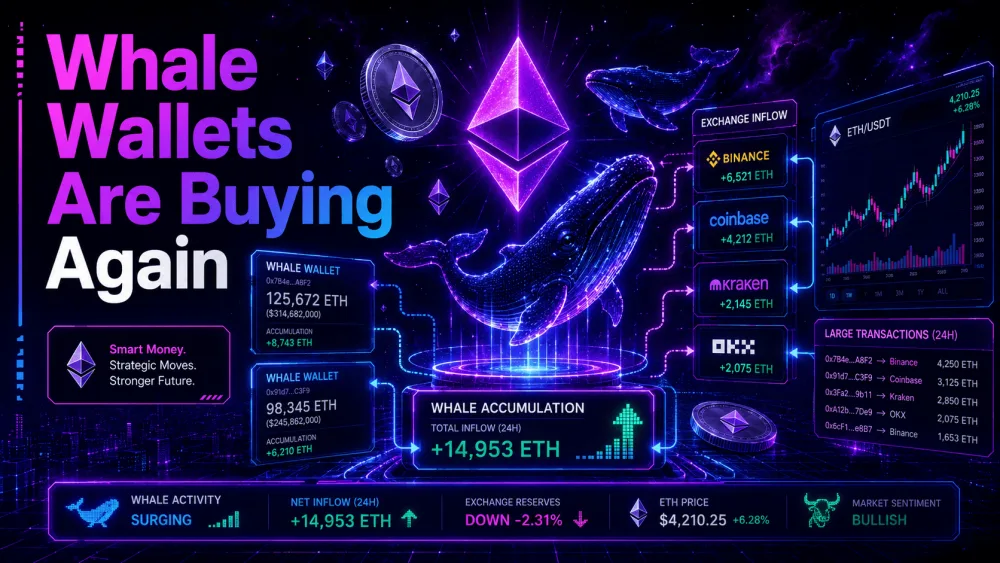
Spring saw more big players moving into Ethereum. Back in April, Santiment noted the count of addresses with 100,000 ETH or more jumped from 54 to 57 within seven days. Such shifts may seem tiny, yet they signal notable changes when it comes to who holds what at this level.
That early May stretch brought something extra. Reports citing Santiment data indicated big players were gathering ETH fast – over 140,000 ETH – in just three days, valued at nearly $322 million back then. The stash in sizable wallets climbed sharply, nudging up from roughly 13.83 million to nearly 13.98 million ETH through that window.
Right where earlier surges stalled, signs show informed buyers stepping into Ethereum once again. That zone matters – it’s where wallet growth began piling up through 2026. Big holders aren’t jumping on explosive moves. Instead, they’re building positions quietly, even as doubt lingers among smaller traders.
Here comes the usual game big players love: they gather coins while others argue about what’s happening, only for the market to rush in once it sees proof.
Ethereum Whales Buying Activity?
Whales diving into Ethereum lately? Value kicks things off, though that story runs deeper. What’s really going on stretches beyond price tags and spreadsheets.
Most people see ETH as just another coin for buying low and selling high. Yet behind the scenes, it powers loans and borrowing across decentralized apps. Without it, transactions would stall when moving USDC▲$0.9999 or DAI▲$0.9998 around. Validators lock it up to earn rewards over time. Companies hold it like digital reserves instead of cash. Layer 2 networks are built directly on top of the chain. This mix of jobs sets it apart. Other coins often ride a single idea until it fades.
Supply comes next. ETH sits more now in places meant for holding – staking setups, offline wallets, fund shares, and company reserves. Less movement means smaller waves of interest shift value more quickly. That quiet buildup period people mention? It ties right into how little floats around when most forget to look.
Sentiment shapes moves. By 2026, feelings around Ethereum aren’t sky high anymore – yet they’re climbing. This kind of phase tends to draw in large holders. Perfect timing? It hardly ever lands with both price and signals lining up neatly. Instead, purchases come when doubt still lingers in the air.
Read more: Best Ethereum Tokens and Projects to Invest in 2026
Institutions Have Become Visible Whales
Back then, big Ethereum stacks meant Grayscale, startup investors, or platforms holding coins. Now things look different. By 2026, one fund alone – BlackRock’s iShares Ethereum Trust – held over 7.37 billion dollars worth of ETH. That number comes from May eighth of that year. Instead of crypto wallets, it works like regular stock trading. Its goal? Track Ether’s value using familiar financial paths.
Early May brought shifts in ETF movement. Ethereum-based funds pulled in roughly $101.1 million on May 1, according to SoSoValue figures mentioned in financial updates. That number dipped to $61.2 million by May 4, then climbed close to $97.5 million two days later. Yet momentum didn’t last – May 7 marked a turn, with spot Ether ETFs shedding $104 million overall. A small rebound arrived on May 8, registering just $3.57 million coming back in.
What really matters isn’t daily buys by big players. What counts is that official access to ETH has grown too big to ignore. One massive holder might not show up as a lone wallet on Etherscan anymore. Often it shows up as a new ETF unit, a shift in stored assets, or a report from corporate reserves.
Out of nowhere, corporate treasuries have become unpredictable players.
ETH Treasury Companies Making Moves

What grabs attention isn’t just ETFs moving fast. Public company treasuries are shifting hard, too.
Out front, BitMine Immersion holds around 5.18 million ETH according to CoinGecko’s Ethereum treasury tool – that’s nearly 4.29% of all ether ever created. Close behind sits SharpLink, storing 868,699 ETH in its reserves. Then there’s The Ether Machine, which claims a stash of 496,712 ETH. These figures come straight from CoinGecko’s public tracking system.
Back in early May, BitMine revealed it held 4.36 million ETH staked. Its overall stash reached 5.18 million ETH around that time. Calling itself the biggest holder of Ethereum globally, the firm made the claim clear. That info came straight from its May 2026 public report.
Because corporate buyers see Ethereum differently than quick movers do, it shapes how ETH builds up over time. Not chasing price swings, they tend to hold it like cash savings, income plays, all rolled into one market narrative.
Danger lurks nearby. When cash flows freely, and investors are eager, company stockpiles may lift prices. Yet things crack under pressure – like shares dipping beneath their true worth, funding drying up, or owners resisting moves. Ethereum, favored by big players, does not mean it avoids loss. Just that it operates on a bigger stage now, with clearer intent and wider eyes watching.
Whales’ Influence on ETH Price
Big moves in Ether’s price happen because of trading volume, not tricks. When one large holder buys fifty thousand ETH during slow times, prices often climb. That same person using private deals might trade tons without shifting the chart much. Shifting coins to an exchange sometimes spooks traders, even if selling never follows.
Something big shifted near early May. Ethereum’s price brushed $2,375 to $2,400 right as whale wallets grew. Money flowed into ETFs around then, too. These clues stacked – no promise of gains followed, yet attention returned fast to large holders. Their moves started making sense mid-crowd noise. Traders noticed that timing linked pieces that others often ignore.
What makes it risky isn’t just the trade – it’s how much weight sits behind it. As derivative bets pile up near clear price points, big players aren’t stuck placing endless orders. A nudge is enough – just shift the value past breaking zones. Once those automatic exits kick in, quiet buildup explodes into sharp swings.
Even Now, ETH Shifting Currents Hold Weight
Nowhere is the story clearer than in exchange flows. Forget the whale moves – they distract more than help. Ethereum’s transfer patterns between wallets show what matters next. Pressure builds where money shifts often. Watch those tides, not rare big players.
Every time more coins move into exchanges, it might signal people getting ready to trade them away, lock up assets, or adjust positions. When transfers leaving platforms climb, that often points to ETH being shifted toward staking pools, decentralized apps, offline wallets, or secure holding services.
Related: Best Crypto ETF Contracts for 2026: Which ETFs Will Dominate Trading This Year?
One step forward, yet understanding feels tougher now compared to before. Come 2026, Ethereum might exit an exchange only to land in a staking setup. From there, it could jump toward a Layer 2 link instead. Maybe wrapping happens next, or perhaps DeFi takes hold – even sitting still under custody counts. All this adds depth to blockchain records. Still, confusion finds its way in just as fast.
Now, a careful observer checks three things before labeling any move positive or negative. Origin of the ETH – what’s the source? Destination – who holds it now? Past behavior of the new holder – has that wallet sold, kept coins, staked, moved chains, or added to pools? Missing these details turns tracking big players into horoscopes using blockchain IDs.
The ETH Supply Concentration Debate
True, big wallets hold lots of Ethereum – yet the story isn’t straightforward. Up near the top? Mostly smart contracts and storage platforms run by institutions. These inflate the appearance of centralization when you peek at raw numbers. Still, those same entities bundle up control risks behind the scenes. A shift from one large exchange, fund guardian, or staking hub sends ripples through price movements.
One standout case is the Beacon Deposit Contract. By volume, it towers over every other address – no competition. Still, calling it a whale feels off. Unlike someone with a personal wallet, this thing can’t decide to dump ETH overnight. Even so, those steady validator deposits shift things. They tweak how money moves through markets. Plus, they nudge the way people feel about holding coins.
Because of this, the term “top Ethereum holders” really calls for an added level. The biggest wallets might not reflect who actually holds power. Leading accounts on record? Often different from those steering value moves.
What Would Prove ETH Accumulation Is Real?
Out of nowhere, whale wallets grow heavier as big players quietly accumulate. Meanwhile, coins vanish from exchanges bit by bit. After a brief pause, money eases back into ETFs with steady steps. Companies add holdings slowly – not stretching their balance sheets too far. Right when things look shaky, ETH bounces off familiar floors. On top of that, more people start using the network again.
Downward pressure shows plainly. When big players pause buying, deposits to exchanges grow instead. Money moves out of ETFs across multiple days. Company purchases taper off slowly. Ethereum climbs but stalls at key levels, then drops below prior floors. This hints that earlier buildup was short-term positioning, not long-held intent.
Right now, Ether sits heavier in big wallets. Data hints at a buildup – yet it’s patchy. Some giants loaded up recently. Interest from exchange-traded funds flickers back, here and there. Firms shifted company cash into holdings, too. A small flicker of strength shows up on the screen. Still, no clear signal lights the path forward. Buying interest creeps in slowly. Confidence waits in the wings, unsure when to step forward.
Next Up for Traders: What to Keep an Eye on, Moving Forward
Most helpful signs for traders? Skip flashy images of one wallet. Focus shifts happen across groups. When accounts pack 100,000 ETH or above, eyes turn there. Money moving into or out of ETFs matters just as much. So do deposits and withdrawals at exchanges. Company balance sheets sometimes reveal hidden moves. Networks like Arbitrum or Base – see if they sit on big ETH stacks. After surges driven by massive players, the real test is staying power.
One thing about the Ethereum whale buildup by 2026 isn’t hidden dominance. Instead, big accounts slowly shape how much supply stays tradable. With ETH scattered through staking, ETFs, company reserves, trading platforms, and layer-2 chains, prices react fast if many flows align at once.
Ethereum whales in 2026 matter simply due to timing. Big wallets aren’t automatically wise, after all. Being rich doesn’t mean being correct each time. Yet silence in markets tends to highlight their moves first. Retail traders spot shifts much later – often too late. What looks calm might already hide a slow buildup.
FAQ. Ethereum Large Holder Activity 2026
What Is Ethereum Whale Accumulation in 2026?
One way to spot Ethereum whale accumulation by 2026 is by watching how major ETH owners slowly add more to their holdings. Instead of sudden spikes, it’s steady activity that matters – consistent purchases over weeks or months. Private wallets might do it, so could investment funds, trading platforms, companies holding crypto, custodial services tied to ETFs, and even groups involved in staking. What stands out isn’t a single move, rather ongoing behavior: pulling ETH off exchanges, locking it up through staking, or tucking it away where it won’t be traded soon.
Right Now, Who Holds the Most Ethereum?
Most of the biggest Ethereum accounts belong to systems, not people. Think deposit boxes for staking, tokens locked in bridges, or storage managed by big trading platforms. These aren’t personal fortunes – they hold pooled assets. Behind many large balances sit code-driven vaults or shared reserves. Sorting out actual wealthy individuals requires peeling back layers of automated protocols. Real insight comes when you filter out corporate pools and self-operating programs.
Are Some Ethereum Holders Adding to Their Bags?
Confidence in Ethereum’s place within DeFi stretches far into the future, shaping major decisions. Instead of treating ETH like a short-lived bet, big holders often view it as something that generates returns over time. Behind the scenes, activity around Ethereum has quietly built up through staking, stablecoin systems, and faster secondary networks. By 2026, growing interest in crypto funds tied to ETH begins mirroring moves made by larger financial players. A tighter supply, shaped by these trends, might help push prices ahead – slowly but steadily.
Can Whale Activity Move the Ethereum Price?
True, big Ethereum holders shifting funds might sway prices – especially if markets lack depth or trades cluster around key levels. When one snaps up coins fast, others often jump in behind. Yet sending a chunk to an exchange tends to spook folks, sparking worry about dumps. The actual effect, though, hinges on more than just size: who’s positioned where, how deep bids run, and whether smaller players copy the play. Context always changes what happens next.