Crypto ETF contracts have moved from novelty to necessity inside the investment landscape, and 2026 is shaping up as the year they redefine how both institutions and individuals access digital assets. S
ince U.S. regulators approved the first spot Bitcoin ETFs in January 2024, the market has expanded to Ethereum, Solana, XRP▲$1.13, and multi-asset structures, with Bitfinex analysts projecting assets under management across all crypto ETPs could exceed $400 billion by year-end.

With Bitcoin ETF 2026 inflows running strong and altcoin-linked structures gaining traction, this crypto ETF investment guide covers top products, key risks, and the best crypto ETF contracts to trade in 2026.
Contents
- What Are Crypto ETF Contracts?
- Why Crypto ETFs Matter in 2026
- Best Crypto ETF Contracts for 2026
- Top Performing Crypto ETFs to Watch in 2026
- Factors That Will Influence Crypto ETF Performance in 2026
- Risks of Trading Crypto ETF Contracts
- Crypto ETF Trading Strategies for 2026
- Are Crypto ETF Contracts a Good Investment in 2026?
- FAQ
What Are Crypto ETF Contracts?
Definition of Crypto ETFs and ETF Contracts
A crypto ETF is an exchange-traded fund providing investors with exposure to cryptocurrency price movements without requiring direct ownership of digital assets, with ETF contracts crypto-linked representing standardized ownership instruments bought and sold on traditional stock exchanges. This means operating within conventional brokerage infrastructure with regulatory protection, settlement mechanics, and custody frameworks.
How Crypto ETFs Work in Traditional and Digital Markets
Crypto ETF trading operates through the same creation-and-redemption mechanism used by all ETFs: authorized participants create new shares by delivering the underlying asset to the fund and redeem them in exchange for the underlying, keeping ETF prices aligned closely with net asset value.
Spot vs Futures Crypto ETFs Explained
The distinction between spot Bitcoin ETF vs futures ETF is among the most important choices facing investors. A spot ETF directly holds the underlying cryptocurrency, tracking actual market price closely. A futures ETF holds futures contracts instead, exposing investors to roll costs, particularly contango drag, as demonstrated by ProShares BITO’s 0.95% fee and structural underperformance for long-term holders.
Why ETF Contracts Are Becoming Popular in Crypto Trading
Several forces explain the surge in demand for the best ETF for crypto exposure. Investors gain crypto exposure through standard brokerage accounts, including IRAs, without managing digital wallets. The lowest-cost Bitcoin ETFs now charge as little as 0.14%, while product offerings have expanded to cover crypto index ETFs, covered call strategies, and hedged structures.
Why Crypto ETFs Matter in 2026
Institutional Adoption of Crypto ETFs
Institutional crypto ETFs have crossed a meaningful threshold. Bitwise projected that U.S.-listed ETFs may absorb more than 100% of new issuance of Bitcoin, Ethereum, and Solana as demand accelerates in 2026, with BlackRock’s IBIT already holding $55 billion in assets under management.
Regulation and Approval Trends in Global Markets
The regulatory environment has shifted meaningfully in 2026. In the U.S., faster SEC approval timelines and a crypto-friendly administration have compressed the path from filing to launch, with Bitwise projecting more than 100 new crypto ETFs launching in the U.S. through the year.
Impact of Bitcoin and Ethereum ETFs on the Market
By August 2025, monthly Ethereum ETF inflows overtook Bitcoin’s for the first time, with Ethereum products attracting $3.87 billion. Ethereum ETF price impact analysis shows that sustained institutional inflows have compressed ETH▲$1,761.17 volatility and raised its market floor relative to earlier cycles.
Growth of Altcoin-Based ETF Products
Beyond Bitcoin and Ethereum, 2025 and early 2026 saw significant expansion of blockchain ETF funds tied to alternative assets. The SEC-approved Grayscale GDLC tracks the CoinDesk 5 Index across Bitcoin, Ethereum, XRP, Solana, and Cardano, while non-Bitcoin ETFs collectively attracted $1.3 billion in inflows through crypto index ETFs.
Best Crypto ETF Contracts for 2026
Bitcoin ETF Contracts (BTC ETFs)
Bitcoin ETF 2026 remains the anchor of the space. BlackRock’s IBIT leads with $55 billion AUM, the deepest liquidity, and the most mature options ecosystem, processing over 2 million contracts in one session during the February 2026 volatility event. The Morgan Stanley Bitcoin Trust (MSBT), launched in April 2026, carries a 0.14% expense ratio, the lowest available and a benchmark among top performing Bitcoin ETFs 2026 forecast analysts track.
Ethereum ETF Contracts (ETH ETFs)
The Ethereum ETF forecast for 2026 is constructive, with BlackRock’s ETHA and Fidelity’s FETH as the primary regulated vehicles. Ethereum ETF price impact analysis across 2026 suggests ETH could reach $7,000–$11,000 if DeFi and real-world asset tokenization continue expanding.
Multi-Asset Crypto ETF Funds
For investors seeking diversified crypto index ETFs, Grayscale’s GDLC tracks the CoinDesk 5 Index with a 0.59% expense ratio, providing physically backed spot exposure across five assets in one fund. Amplify’s BLOK and similar blockchain ETF funds invest in blockchain-adjacent equities, providing indirect sector exposure without holding tokens.
Leveraged Crypto ETF Contracts
Leveraged crypto ETF contracts multiply daily returns of underlying crypto assets, typically 2x, and are designed for short-term directional trading rather than long-term holding. Because these products reset daily, compounding effects work against holders during sideways or volatile markets.
Emerging Altcoin ETF Opportunities
The most dynamic area of best crypto ETFs 2026 is altcoin-linked products. Spot Solana ETFs have accumulated nearly $880 million in cumulative inflows, while spot XRP ETFs have attracted $1 billion, validating institutional interest in cross-border payment plays.
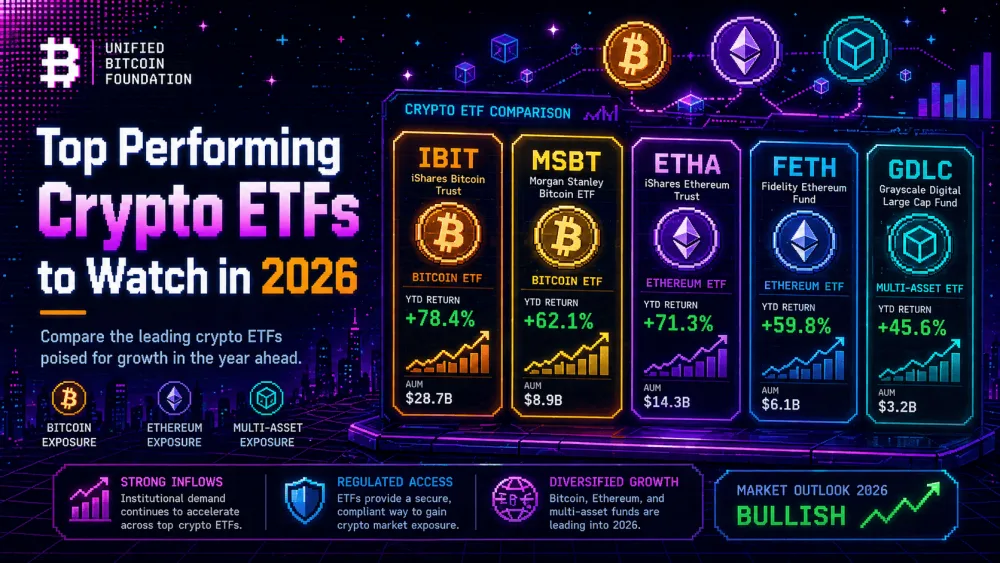
Top Performing Crypto ETFs to Watch in 2026
Bitcoin Spot ETF Performance Outlook
The top performing Bitcoin ETFs 2026 forecast centers on IBIT’s continued institutional infrastructure expansion, with Bitcoin ETF AUM projected to reach $180–$220 billion by year-end 2026.
Ethereum ETF Growth Potential
The Ethereum ETF forecast runs from $7,000 to $11,000 per ETH, with BlackRock’s ETHA and Fidelity’s FETH as the primary regulated vehicles and the CLARITY Act potentially accelerating institutional reclassification of ETH as a commodity.
The Rise of Thematic Blockchain ETFs
Thematic blockchain ETF funds have found a distinct portfolio role. Products like Amplify’s BLOK and the Schwab Crypto Thematic ETF (STCE) invest in equities across blockchain infrastructure, digital asset custody, and payment rails, offering long-term blockchain growth participation with less direct token exposure.
Comparison of Leading ETF Issuers
The major issuer comparison in 2026 centers on BlackRock, Fidelity, Bitwise, Grayscale, and Morgan Stanley. BlackRock leads on scale, Grayscale retains legacy AUM despite GBTC’s 1.50% fee, and Morgan Stanley has made the most aggressive recent move with MSBT’s 0.14% expense ratio.

Factors That Will Influence Crypto ETF Performance in 2026
Bitcoin Halving Cycle Impact
Bitcoin’s April 2024 halving reduced block rewards from 6.25 to 3.125 BTC▲$62,630.00, historically triggering a 12–18 month bull cycle now playing out through 2025 and 2026. Historical patterns place the potential cycle peak within the 2026 calendar year, providing a structural tailwind for Bitcoin ETF 2026 inflows.
Interest Rates and Macroeconomic Trends
Expected Federal Reserve rate cuts throughout 2026 would lower the opportunity cost of holding non-yielding assets, potentially driving institutional rotation into crypto ETF contracts 2026 as lower rates historically support higher valuations for growth assets.
Institutional Inflows and Demand
Institutional crypto ETFs are the dominant demand driver, with the January 19, 2026 inflow week seeing Bitcoin draw $1.55 billion, Ethereum $496 million, and Solana $45.5 million across one week.
Regulation in the US, EU, and Asia
In the U.S., the CLARITY Act framework and faster SEC timelines create conditions for continued ETF launches, while Hong Kong’s approved spot ETFs have opened regional institutional access in Asia. The key regulatory risk remains potential policy reversals after a high-profile market failure.
Crypto Market Volatility and Liquidity
During the February 5, 2026 volatility event, Bitcoin plunged below $61,000 in one session. IBIT maintained orderly trading while thinner ETFs widened materially, confirming that fund selection and liquidity depth matter during market stress.
Risks of Trading Crypto ETF Contracts
Market Volatility and Leverage Risks
ETF wrappers provide regulatory protection but do not dampen underlying price volatility. Leveraged crypto ETF contracts amplify this further through daily-reset mechanics that can cause severe return decay during choppy markets.
Regulatory Uncertainty
Despite progress, regulatory risk remains real. An adverse ruling or policy reversal in any major jurisdiction could impair ETF approvals, force product restructuring, or trigger sudden outflows.
Tracking Error vs Underlying Assets
Spot ETFs track their underlying assets closely, but tracking error can emerge from fees, custody costs, and creation-redemption mechanics during illiquid periods. Futures ETFs carry more substantial tracking error due to roll costs and contango.
Liquidity Risks in Emerging ETF Products
Altcoin ETFs for Solana, XRP, and others have far lower AUM and daily trading volumes than Bitcoin products, with wider bid-ask spreads and potential NAV dislocations during periods of market stress.
Crypto ETF Trading Strategies for 2026
Long-Term Holding vs Short-Term Trading
For long-term investors, the best ETF for crypto exposure comes down to lowest-cost spot products: MSBT at 0.14%, IBIT at 0.25%, and ETHA at 0.12% for initial assets. Short-term traders benefit more from IBIT’s high liquidity and deep options market.
Swing Trading ETF Contracts
Swing trading ETF contracts involves holding positions for days to weeks to capture directional momentum, with IBIT’s options market enabling directional views with defined risk alongside weekly ETF flow data from CoinShares for sentiment tracking.
Hedging Crypto Exposure Using ETFs
One practical application of ETF contracts crypto-linked products is hedging existing direct holdings. An investor holding spot Bitcoin can purchase put options on IBIT to protect against downside while retaining upside, while covered call strategies can generate income in sideways markets.
Diversification Strategies with ETFs
GDLC provides five-asset diversification in a single fund. Combining a core Bitcoin ETF position with an Ethereum ETF allocation and a satellite position in a thematic blockchain equity ETF creates a tiered exposure profile anchored to the largest assets while retaining participation in broader sector growth through crypto index ETFs.
Are Crypto ETF Contracts a Good Investment in 2026?
Advantages of ETF-Based Crypto Exposure
The best ETF for crypto exposure offers regulatory protection, elimination of self-custody risk, IRA eligibility, institutional-grade liquidity, and expense ratios as low as 0.14%. Crypto ETF trading through established brokers removes exchange counterparty risk and wallet management complexity without sacrificing meaningful price exposure.
Who Should Invest in Crypto ETFs
Crypto ETF contracts 2026 suit a wide range of profiles. Long-term allocators seeking growth or inflation-hedge exposure are ideal candidates for low-cost spot ETFs. Active traders benefit from IBIT’s options ecosystem, while income-oriented investors may find value in covered-call income ETFs.
Institutional vs Retail Investor Perspective
From an institutional perspective, crypto ETF contracts solve the compliance, custody, and operational problems that previously blocked large allocations. That dynamic explains why which crypto ETFs will dominate 2026 has a fairly clear answer: those with the deepest institutional infrastructure — IBIT, FBTC, ETHA, and MSBT — will continue to lead, while the altcoin ETF frontier expands around them.
FAQ
What are crypto ETF contracts and how do they differ from buying crypto directly?
Crypto ETF contracts are tradeable instruments listed on traditional stock exchanges that provide exposure to cryptocurrency price movements without requiring direct ownership of digital assets. Unlike buying Bitcoin or Ethereum through a crypto exchange, ETF contracts operate within standard brokerage infrastructure, offer regulatory protection, eliminate wallet management, and qualify for tax-advantaged accounts like IRAs. The trade-off is an ongoing expense ratio and limitation to market-hours trading.
What are the best crypto ETF contracts to trade in 2026?
The best crypto ETF contracts to trade in 2026 include BlackRock’s IBIT for Bitcoin, Morgan Stanley’s MSBT for lowest-cost Bitcoin exposure, BlackRock’s ETHA and Fidelity’s FETH for Ethereum, and Grayscale’s GDLC for diversified multi-asset exposure. For altcoin opportunities, Bitwise’s BSOL and spot XRP ETFs represent the emerging frontier. Selection should be based on expense ratio, liquidity, custody structure, and investment objectives.
What is the difference between a spot Bitcoin ETF and a futures ETF?
A spot Bitcoin ETF directly holds Bitcoin, so its performance closely tracks the actual market price. A futures ETF holds Bitcoin futures contracts, introducing roll costs that cause the fund to underperform spot price over time. For long-term holders, spot ETFs provide more accurate and cost-efficient exposure. Futures ETFs like ProShares BITO suit short-term tactical trades and specific hedging applications rather than buy-and-hold positioning.
Are crypto ETFs a good investment in 2026?
Are crypto ETFs a good investment in 2026 depends on individual risk tolerance and time horizon. Structurally, the case is strong: institutional inflows are at record levels, Bitcoin ETF AUM is projected to reach $180–$220 billion by year-end, and the post-halving cycle historically supports higher prices through 2026. The primary risks are crypto market volatility, regulatory uncertainty, and tracking error in non-spot products. For most investors, ETF wrappers represent a practical and risk-managed crypto entry point.
How do you trade crypto ETF contracts?
How to trade crypto ETF contracts follows the same process as trading any listed equity. Open or use a brokerage account with ETF access. Research products using expense ratio, AUM, and daily trading volume as primary filters. Place market or limit orders during exchange trading hours. For advanced strategies, explore the options market on IBIT for hedging or income generation. Monitor weekly ETF flow data from CoinShares and Farside Investors to track institutional sentiment.