Restaking is one of the most important DeFi ideas to emerge after Ethereum’s move to proof of stake. It sounds simple at first: take ETH▼$2,508.32 that is already staked and use it again to help secure other protocols. In return, users may earn extra rewards. That is the clean version.
The messier version is this: restaking turns Ethereum’s economic security into something other networks can borrow. It creates new yield opportunities, new infrastructure, new liquid tokens, and new risks that can spread across DeFi faster than most users realize.
EigenLayer made this idea famous. Liquid restaking tokens, or LRTs, made it easier for regular DeFi users to enter the trade. Together, they created a new market where staked ETH no longer just secures Ethereum. It can also help secure data availability layers, oracles, bridges, rollups, AI systems, and other Actively Validated Services.
That is powerful. It is also not free money. Crypto never gives free money. It gives complicated money wearing a nicer jacket.
Contents
- What Is Restaking?
- What Is EigenLayer?
- How Restaking Works
- What Are AVSs?
- Why Restaking Became Popular
- What Are LRTs?
- EigenLayer vs. LRT Protocols
- Why Restaking Matters for Ethereum
- The Rewards: Why Users Restake
- The Risks: Slashing, Smart Contracts, and DeFi Contagion
- LRTs vs. LSTs: What Is the Difference?
- Is Restaking Good or Bad?
- What Should Beginners Watch Before Using LRTs?
- Restaking in 2026: Why It Still Matters
- Final Takeaway
- FAQ
What Is Restaking?
Restaking means using already-staked crypto — usually ETH or a liquid staking token — to secure additional networks or services beyond Ethereum itself.
Normally, staking ETH means helping secure Ethereum. Validators lock ETH, follow consensus rules, and earn staking rewards. If they behave badly, they can be penalized.
Restaking adds another layer. Instead of only securing Ethereum, that same staked ETH can also be used to secure extra services. These services may pay additional rewards because they get access to Ethereum-grade security without needing to build their own validator network from scratch.
Read more: What Is Staking in Crypto? A Beginner-Friendly Guide
In plain English: restaking lets Ethereum’s security be reused. That is the core idea behind EigenLayer.
What Is EigenLayer?
EigenLayer is the leading restaking protocol on Ethereum. It allows ETH stakers and liquid staking token holders to opt into extra security roles.
The system connects three main groups:
| Participant | What They Do |
|---|---|
| Restakers | Provide staked ETH or liquid staking tokens as economic security |
| Operators | Run software and validate services on behalf of restakers |
| AVSs | Protocols that borrow security from restaked ETH |
AVS stands for Actively Validated Service. These are systems that need operators to run software honestly. Instead of launching their own validator economy, they can plug into EigenLayer and use restaked ETH as security.
This is the big unlock. Before EigenLayer, every new decentralized service often needed to bootstrap its own trust network. That is expensive, slow, and hard. EigenLayer says: why not reuse Ethereum’s existing trust?
How Restaking Works
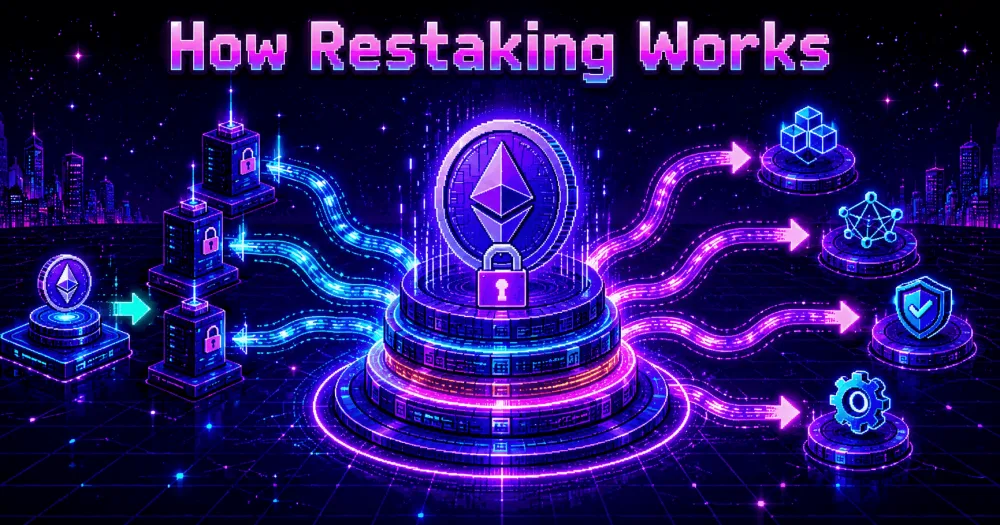
The basic flow looks like this.
A user stakes ETH or holds a liquid staking token such as stETH, rETH, or another accepted asset. Instead of stopping there, they deposit or delegate that position into EigenLayer. Then they choose an operator. That operator provides validation services to one or more AVSs.
If everything works properly, the AVS gets security, the operator earns fees, and the restaker earns additional rewards.
| Step | What Happens |
|---|---|
| 1 | User stakes ETH or uses a liquid staking token |
| 2 | User restakes through EigenLayer |
| 3 | User delegates to an operator |
| 4 | Operator validates one or more AVSs |
| 5 | AVSs pay rewards for borrowed security |
| 6 | Restaker receives extra yield, minus risk and fees |
That last part matters: minus risk and fees.
Restaking is not simply Ethereum staking with a bonus. It adds new rules, new counterparties, and new failure points.
What Are AVSs?
AVSs are Actively Validated Services. They are the protocols or systems that use restaked ETH for security.
Examples can include:
- Data availability networks.
- Oracles.
- Bridges.
- Rollups.
- Shared sequencers.
- Verification systems.
- AI-related infrastructure.
- Other middleware that needs decentralized operators.
The important point is that AVSs need trust. They need validators or operators to behave correctly. EigenLayer gives them a way to rent that trust from Ethereum stakers.
This is why restaking became such a major infrastructure narrative. It does not only create yield for ETH holders. It creates a marketplace for security.
Related: Top Staking Coins for Passive Crypto Income in 2026
Why Restaking Became Popular
Restaking became popular because it solves two problems at once. For users, it offers extra yield on assets that were already staked. For builders, it offers access to economic security without starting from zero.
That combination is extremely attractive. ETH holders want more return. New protocols want security. Operators want fees. DeFi wants new collateral and new tokens. Everyone gets a reason to care.
This is why the sector grew fast. EigenLayer helped turn restaked ETH into a major DeFi category, and LRT protocols made the trade easier to access.
But fast growth also creates blind spots. When everybody wants yield, nobody wants to read the risk section. The risk section, unfortunately, still exists.
What Are LRTs?
LRT stands for liquid restaking token.
A liquid restaking token represents a restaked position while staying usable in DeFi. Instead of locking assets and waiting, users receive a token that can potentially be traded, lent, borrowed against, or used in liquidity pools.
If liquid staking tokens made staked ETH more usable, LRTs try to do the same for restaked ETH.
| Token Type | What It Represents | Example Use |
|---|---|---|
| ETH | Native Ethereum asset | Hold, spend, stake |
| LST | Liquid staking token | Represents staked ETH |
| LRT | Liquid restaking token | Represents restaked ETH or restaking exposure |
LSTs made staking more flexible. LRTs push that idea one step further.
That is useful, but it also adds complexity. A user may no longer hold simple ETH. They may hold a token that represents a restaked position, routed through a protocol, delegated to operators, exposed to AVSs, and then used somewhere else in DeFi.
At that point, “I’m just earning yield” becomes a dangerous oversimplification.
EigenLayer vs. LRT Protocols
EigenLayer is the restaking infrastructure. LRT protocols, such as Ether.Fi, are user-facing products built around restaking access and liquidity.
Think of it this way:
EigenLayer creates the restaking marketplace.
LRT protocols package restaking into easier-to-use tokens.
| Layer | Role |
|---|---|
| EigenLayer | Core restaking protocol and AVS marketplace |
| Operators | Run validation services |
| AVSs | Buy or use restaked security |
| LRT protocols | Create liquid restaking tokens for users |
| DeFi apps | Let users trade, lend, borrow, or farm with LRTs |
This is where things get interesting. LRTs can make restaking more accessible, but they can also turn a security mechanism into a DeFi leverage loop.
Related: What Is XRPL Update: Is It Finally Ready to Beat Ethereum in RWA and DeFi?
A user may deposit ETH, receive an LRT, use that LRT as collateral, borrow against it, and chase another yield opportunity. That can work in calm markets. In stressed markets, it can become a domino setup with neon lighting.
Why Restaking Matters for Ethereum
Restaking matters because it may expand Ethereum’s role beyond its own chain.
Ethereum already has one of the strongest validator networks in crypto. EigenLayer tries to let other services borrow that security. If this works, Ethereum becomes not just a settlement layer, but a trust layer for many external systems.
That could make ETH more productive. It could also make Ethereum more central to crypto infrastructure.
For builders, this is attractive because security is hard to bootstrap. Besides, it creates new reward opportunities for ETH holders and a new category of yield-bearing assets for the market.
The bullish argument is simple: if more services need Ethereum-grade security, restaking could become one of the most important infrastructure layers in crypto.
The Rewards: Why Users Restake
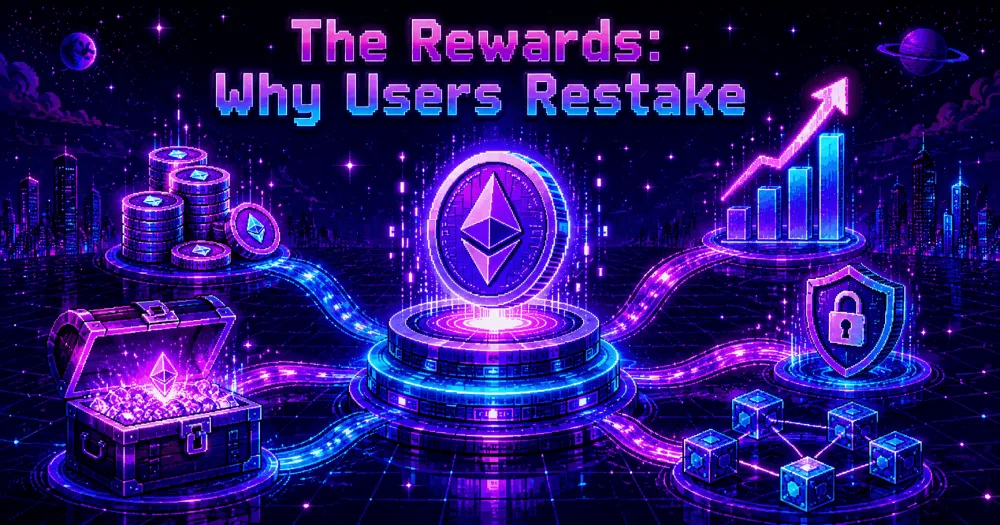
Users restake because they want more yield.
Standard ETH staking gives one layer of rewards, usually around 3-5%. Restaking may add rewards from AVSs. LRT protocols may also offer points, incentives, token rewards, or DeFi opportunities.
This created a powerful flywheel:
More users restake — more assets flow into EigenLayer and LRT protocols — more AVSs want access to that security — more incentives attract more users — more DeFi integrations make LRTs easier to use.
The flywheel is real. But so is the risk. Yield usually comes from somewhere. If a system cannot explain where yield comes from, assume the explanation is hiding under the carpet with the leverage.
Related: Top 5 Wild Ethereum Price Predictions for 2026: From Realistic to Moonshot Scenarios
The Risks: Slashing, Smart Contracts, and DeFi Contagion
Restaking carries several major risks.
First, there is slashing risk. If an operator breaks the rules of an AVS, some restaked assets may be penalized. This is what makes restaking security credible. But it also means users are accepting more than normal Ethereum staking risk.
Second, there is operator risk. Restakers delegate to operators, and operator behavior matters. A poor operator can create losses.
Third, there is smart contract risk. EigenLayer, LRT protocols, AVSs, bridges, and DeFi integrations all depend on code. More code means more places something can break.
Fourth, there is liquidity risk. LRTs may trade below the value of the underlying ETH exposure during stress. If everyone rushes for exits, the “liquid” part can suddenly become theoretical.
Fifth, there is interconnected risk. LRTs can be used across DeFi. If one major protocol fails or one widely used LRT loses confidence, the damage can spread into lending markets, liquidity pools, and collateral systems.
That is the dark side of composability. Everything connects beautifully until one piece catches fire.
LRTs vs. LSTs: What Is the Difference?
LSTs and LRTs are related, but they are not the same.
| Feature | LSTs | LRTs |
|---|---|---|
| Full name | Liquid staking tokens | Liquid restaking tokens |
| What they represent | Staked ETH | Restaked ETH or restaking exposure |
| Main reward source | Ethereum staking rewards | Ethereum staking plus AVS/restaking rewards |
| Risk level | Lower, but not risk-free | Higher and more complex |
| Main use | Keep staked ETH liquid | Keep restaked positions liquid |
| Extra risk | Validator and smart contract risk | AVS, operator, slashing, liquidity, and DeFi contagion risk |
LSTs made staking easier to use in DeFi. LRTs made restaking easier to use in DeFi. That extra layer is the opportunity. It is also the problem.
Is Restaking Good or Bad?
Restaking is neither automatically good nor automatically bad. It is a powerful financial primitive. Like most powerful financial primitives, it can be useful when understood and dangerous when blindly farmed.
The good side is clear. Restaking can improve capital efficiency, help new protocols launch securely, create new yield opportunities, and strengthen Ethereum’s position as crypto’s trust layer.
The bad side is also clear. Restaking can create hidden leverage, overlapping risks, slashing complexity, and market contagion if LRTs become deeply embedded across DeFi.
The honest answer is boring but correct: restaking is useful, but only if users understand what they are actually holding.
What Should Beginners Watch Before Using LRTs?
Beginners should not only chase the highest advertised yield. That is how DeFi turns curiosity into tuition.
Before using an LRT, users should understand several things:
- What asset backs the token?
- What protocol issues it?
- Which operators are involved?
- Which AVSs create rewards and risk?
- Can the token be redeemed easily?
- Where does it trade?
- How deep is liquidity?
- Could it depeg from ETH?
- Is it being used as collateral elsewhere?
The last question matters more than people think. If an LRT becomes common collateral in lending markets, problems with that token can spread beyond its own holders.
Restaking in 2026: Why It Still Matters
Restaking remains important in 2026 because crypto is still searching for sustainable yield and reusable security. EigenLayer showed that Ethereum’s validator base can support more than Ethereum itself. LRTs showed that users want liquid access to that opportunity.
The next phase will likely be stricter. Early restaking was driven by points, incentives, and speculation. The mature version needs real AVS revenue, clear slashing rules, better risk dashboards, and rewards that come from actual demand rather than promotional campaigns.
That shift matters. If AVSs generate meaningful fees, restaking becomes more durable. If rewards depend mostly on emissions and hype, the market will eventually notice. It always does, usually after everyone has bought the prettiest acronym.
Final Takeaway
Restaking lets staked ETH secure additional protocols, creating extra yield opportunities and a new marketplace for Ethereum-based security. EigenLayer is the main protocol behind this idea, while LRTs make restaked positions liquid and usable across DeFi.
The opportunity is real. Restaking can make Ethereum more useful, help new services launch, and give ETH holders more ways to earn. But the risks are also real. Slashing, operator mistakes, smart contract bugs, liquidity problems, and DeFi contagion can all turn extra yield into extra regret.
So, what is restaking? It is Ethereum security being reused.
What are LRTs? They are liquid claims on that restaking exposure.
And what is the catch? The same thing that makes restaking powerful also makes it dangerous: everything is connected.
FAQ
What is restaking?
Restaking is the process of using already-staked ETH or liquid staking tokens to help secure additional protocols beyond Ethereum. In return, users may earn extra rewards from those services.
What is EigenLayer?
EigenLayer is a restaking protocol on Ethereum. It lets users restake ETH or supported liquid staking tokens and delegate them to operators who help secure Actively Validated Services.
What are LRTs?
LRTs are liquid restaking tokens. They represent restaked positions while remaining usable in DeFi, meaning users can potentially trade them, lend them, or use them as collateral.
Is restaking risky?
Yes. Restaking adds risks beyond normal ETH staking, including slashing risk, operator risk, smart contract risk, liquidity risk, and contagion risk across DeFi.
Is restaking better than normal staking?
Not always. Restaking may offer higher rewards, but it also carries higher complexity and risk. Normal staking is simpler. Restaking is more aggressive and should be understood before use.