ZORA was founded in 2020 by former Coinbase employees Jacob Horne, Dee Goens, and Tyson Battistella as an experimental NFT protocol that sought to give creators more control over how their digital goods are priced, owned, and traded.
Contents
- What Is ZORA?
- How Does ZORA Work?
- What Are ZORA Attention Markets?
- Why Is ZORA So Popular in 2026?
- ZORA’s Expansion Beyond Base
- What Is the ZORA Token?
- How Creators Make Money on ZORA
- ZORA vs Other SocialFi Platforms
- Advantages and Risks of ZORA
- Is ZORA a Good Investment in 2026?
- The Future of ZORA
- Final Thoughts
- FAQ
What Is ZORA?
The Origins of ZORA
Instead of being forced to market and sell on centralized marketplaces, creators could capture value using open and permissionless infrastructure.
Since the beginning, the team’s aim wasn’t only to build a market for digital collectibles, but to ensure creators own their audience, distribution, and revenue. That philosophy would help lay the foundation for the on-chain creator economy we see today.
Related: Jamie Dimon Clashes with Coinbase Over Clarity Act as JPMorgan CEO Hardens Crypto Regulation Stance
From NFT Marketplace to Creator Economy Platform
Launched as an NFT marketplace and media protocol, ZORA allowed artists, musicians, and brands to mint and sell NFTs without intermediaries. With a growing number of platforms offering similar services, Zora developed tools focused on creator monetization, moving away from their initial collectible-oriented model.
By 2025-2026, ZORA had become a full-fledged ZORA creator economy platform, with posts, images, videos, and memes becoming tradeable content. ZORA now sits at the intersection of social media, crypto, and creator ownership, and is one of the most well-known experiments in SocialFi.
ZORA’s Mission and Vision
ZORA’s philosophy includes the goal of building a creator and community-owned version of the internet, as opposed to other models where the value generated by its content goes back to other platforms. This model is centered on open participation and ownership transparency through the blockchain infrastructure.
ZORA seeks to make online creation natively financial, without relinquishing ownership, by creating digital art and content as on-chain assets to build a sustainable creator economy in Web3. Such an economy provides an incentive to pay creators to create, maintain, and expand markets for their creations.
How Does ZORA Work?
Turning Content Into Tradeable Assets
One way to answer what is ZORA is that it transforms digital content into blockchain-based assets that can be traded on open markets.
When someone publishes a post, image, video, or meme to ZORA, the post is minted as a token that is then automatically linked to an on-chain market in which this token can be bought, sold, and held.
Unlike customary social platforms that democratize consumption but not the monetization of attention, ZORA allows creators to capture the economic value of their popularity while permitting users to share in the success of what they discover before it becomes popular by showing it to their friends.
Related: BTC Lightning Network Adoption: Is Bitcoin Becoming a Payment Network?
How Creator Coins Work
As part of the creator coins model, every ZORA profile is linked to and given its own tradable asset. An individual Creator Coin token is assigned to every ZORA account using the account’s profile name, by default, including every new post in the token.
According to ZORA documentation, creator coins have a fixed supply of one billion tokens. Half of the supply is made immediately liquid, while the other half is gradually vested to the creator over time (to align the incentives of creators and their communities).
As posts are liked, saved, and users exchange a creator’s posts, this attachment to a specific post or the creator’s profile can create both a feedback loop of audience interaction and market participation.
| Feature | What It Represents | Who Can Benefit |
| Posts | Individual pieces of tokenized content | Creators and traders |
| Creator Coins | Tradable assets linked to creator profiles | Creators and communities |
| Attention Markets | Markets based on trends, memes, and narratives | Traders and trend participants |
Minting and Trading on ZORA
Publishing to ZORA platform involves creators uploading their content, binding it to the smart contract, and releasing it for sale without having to separately create a token or establish a marketplace.
The protocol is built on the Ethereum blockchain and integrated with Base, giving creators and traders lower-cost transactions and speedier market launches than previous NFT-focused protocols built on other blockchains.
How Users Earn on the Platform
Creators can earn money through any trading activity within their own content and their profile. Just like their posts, ZORA’s website notes that creators receive a cut of transactions for Creator Coins.
It distinguishes itself from existing social networks, wherein posts that become viral ultimately result in value to advertisers and owners of the platforms, through aligning the incentives of creator monetization crypto within the protocols themselves.
Read Also: Top 5 Altcoins Whales Are Buying Aggressively in May 2026
Users can buy, trade, and sell these assets, and their profits wax and wane depending on the overall market’s demand, the liquidity of the content, and the community’s engagement. Like all types of social trading crypto, it is a risk as well as an opportunity.
What Are ZORA Attention Markets?
The Concept of Trading Attention
In February 2026, ZORA announced ZORA attention markets launch, a new product that enables users to create tradable markets around trends, memes, hashtags, and other narratives. Attention markets are a shift from ZORA’s previous creator-focused products, concentrating instead on collective attention and the momentum they generate online.
This reflects the growing popularity of attention economy crypto concepts among traders, allowing people to trade on topics with high levels of social engagement. According to CoinDesk, the product allows traders to bet on online debates instead of financial or political events.
How Attention Markets Function
Attention Markets are tokenized markets, usually based on topics, trends, or conversations. Users can create markets and trade on the probability that a certain amount of attention will be gained by a topic on social media and online communities.
The product was launched on Solana; ZORA said its fast transaction speeds and low transaction fees made it well-suited to markets that react to quickly shifting trends on the Internet.
While ZORA’s earliest creator-focused products allowed users to trade exposure attached to a creator or specific post, attention markets crypto expands this intention to allow users to trade exposure on markets depicting narrative trends, viral events, or even emergent internet subcultures.
Why Attention Markets Became a Major Trend in 2026
It was launched during a period of increased interest in SocialFi, creator-owned social networks, and other innovative on-chain participation mechanisms, as many crypto projects allocate more time and funding to develop new ways of incentivizing access to attention in online environments.
Partly because of the continued convergence of social media with blockchain technologies, ZORA’s system was designed to enable users to trade internet trends in a similar way to how creator coins and other SocialFi projects do.
While this idea has produced some considerable discussion throughout the crypto industry, the early days of the model were characterized by relatively thin and very volatile trading, which points to the challenge of building liquid markets of online attention.
Why Is ZORA So Popular in 2026?
The Rise of SocialFi
In part, ZORA’s growth has been spurred by the rise of SocialFi, the industry combining social media with blockchain technology to ease ownership and monetization.
As users look for alternatives, projects that allow creators and communities to capture value from their work directly have been getting more attention.
As the platform expanded into creator markets and Attention Markets, it was increasingly discussed among projects competing for the title of best SocialFi crypto in 2026.
Growth of the Creator Economy
The size of the creator economy is expected to grow into hundreds of billions of dollars globally in the years to come. The growth of the creator economy has instigated the emergence of platforms enabling creators to monetize content beyond advertising and sponsorship deals.
ZORA’s infrastructure is one of the closest examples of a Web3 creator economy due to the on-chain nature of the content publication process and the ability for creators to take part in the value generated around their work, which coincided with the rise of creator-owned networks.
Meme Culture and On-Chain Communities
Internet culture has become the driving force behind crypto markets, with trends, narratives, and memes being socialized around communities. As a result, ZORA was built as a product to understand internet culture through a blockchain-based market, ultimately building products around the cultural dimension of its mission.
The launch of Attention Markets allowed users to create and trade on markets around memes, topics, and other events going viral. When the product was launched, it was described as an attempt to bring internet trends and cultural conversations on-chain.
Read Also: Top 5 Altcoins for the Next 10-100x Crypto Bull Run in 2026: High-Potential Crypto Picks
ZORA soon became associated with new on-chain creator economy communities that view culture, content, and attention as digital assets native to the web.
The Appeal of Monetizing Viral Content
Unlike customary social media, where creators are compensated through advertising or sponsorships as part of a platform’s monetization program, ZORA allows content and attention to become a tradeable asset in blockchain-based markets.
This has attracted creator crypto looking for new forms of monetization where, instead of depending solely on audience size or ads, they can join in on economic activity around their content and communities.
As of 2026, turning viral posts, trends, and other forms of tradeable content on-chain has become one of the defining ZORA ecosystem use cases.
ZORA’s Expansion Beyond Base
Why ZORA Added Solana Support
In early 2026, ZORA launched Attention Markets on the Solana blockchain, marking the launch of ZORA’s first product on a blockchain other than Base and its multi-chain expansion strategy.
ZORA and other industry sources note that Solana was selected because of its high throughput (transactions per second) and low fees, which are important for products that rely on high-speed trades or price updates (for Attention Markets, the fast internet trends it is based on were a key consideration).
Base vs Solana
Before expanding to additional networks, ZORA Base activity helped establish the platform as one of the leading applications for creator-driven content tokenization. Base was also the main network for ZORA ecosystem and the primary network for Creator Coins.
While both have their own advantages, Base is more aligned with the Ethereum ecosystem and is the center of creator product development, while Solana is known for its low transaction fees and high throughput, making it a good fit for Attention Markets and trading-centric dApps.
While some members of the Base community criticized the launch for departing from the chain that helped spur ZORA’s growth, existing creator products on Base still function.
Benefits of a Multi-Chain Strategy
This cross-network approach lets ZORA expand its user base beyond a single blockchain ecosystem and lets products launch on chains that best match their technical requirements.
The expansion also gives access to Solana’s large existing user base and liquidity. The move was perceived as a way to provide ZORA’s products to users who live mostly within its own ecosystem.
As of 2026, the ZORA Solana expansion remains centered on Attention Markets, while Base continues to support the project’s creator-focused infrastructure.
What Is the ZORA Token?
ZORA Token Utility
In April 2025, ZORA token launched on Base with a total supply of 10 billion tokens. According to ZORA, the token was created mainly to allow for participation and incentive models throughout the protocol rather than act as a governance token.
According to ZORA’s documentation, the token is designed for entertainment, social engagement, and ecosystem incentives. As an example, $ZORA is the default reward token for payments to creators and the platform, as well as liquidity for newly created creator markets.
Creator Incentives and Rewards
A significant portion of the token supply was allocated to community incentives. At launch, ZORA distributed 10% of the total supply through a retroactive airdrop that rewarded users based on their activity across the platform, including posting, minting, trading, and referrals.
Additionally, the protocol integrates with $ZORA into its creator reward system, with the token being the default asset used to reward creators, traders, and the ecosystem in a way that corresponds to incentives, according to ZORA’s MiCAR documentation.
Read Also: Understanding Altcoins: Types, Examples, and How They Work in 2026
As the platform has expanded from NFTs to creator coins to on-chain social experiences, the rewards offered to members have increasingly been tied to ZORA creator economy.
The Role of the Token in Ecosystem Growth
In addition to incentivization, the token is also used to fund long-term ecosystem development. ZORA allocated a portion of the token supply towards community incentives, grants, liquidity programs, and the treasury to grow the ecosystem over time.
The release of the token is also tied to the expansion of ZORA ecosystem of creator coins, tokenized media, developer tools, and social applications built on the protocol, with tooling to help builders create new experiences for creators and traders outlined in ZORA’s developer documentation.
For users looking for ZORA crypto explained in simple terms, official documentation describes it as an incentive layer designed to reward participation, content creation, and ecosystem activity.
How Creators Make Money on ZORA
Monetizing Posts and Memes
Through ZORA protocol, users can mint their posts to be on-chain and tradable. In practice, a user can create a market by creating a post on the platform, and other users can buy or sell exposure to the post.
This strategy allows creators to monetize when the market is most active around their content, instead of solely relying on ads or sponsorships.
The strategy commenced to gain traction when ZORA broadened its scope from NFTs to include tokenized social content, where the fungibility of the content enabled new modes of creator monetization crypto that tied spectator interest to on-chain value.
Building Communities Around Creator Coins
The Creator Coin system is one of the platform’s most meaningful features. Every creator profile is associated with a coin that both represents the creator and can be traded by members in the community.
This model is intended to let creators build their community over time and engage with the wider ZORA creator economy, as they create more work, rather than simply realizing a single transaction.
A new way to be involved is through Creator Coins, which allow followers to take a more active role in a creator’s economy, trading in markets associated with them directly on the platform.
New Revenue Opportunities for Digital Creators
Other than the posts and Creator Coins, creators using ZORA platform have access to a range of monetization tools that use on-chain ownership to enable content, communities, and social engagements to coalesce as part of the same economic system.
This model illustrates a wider trend within the Web3 creator economy of compensating creators directly for adding to a platform, creating content, and building and supporting the community.
In its current form, ZORA platform keeps focusing on building products for creators that enable them to have better ownership over their own content as well as value around it.
ZORA vs Other SocialFi Platforms
ZORA vs Friend.tech
While both projects were born out of SocialFi, Friend.tech is focused on individual account access trading via “keys,” and ZORA is focused on content tokenization and creator marketplaces. As of the current Coins Protocol, ZORA posts can be traded as assets per individual creator profile across the platform.
The ZORA vs Friend.tech comparison highlights two different approaches to SocialFi: one centered on social access and the other on tokenized content.
ZORA vs Farcaster
Farcaster, a decentralized social protocol, is described in its documentation as infrastructure for building decentralized social applications, where users own a self-custodied account and their social graph across several clients (protocol implementations).
Unlike these tokens, ZORA is focused on content tokens and enabling creator monetization. According to Zora’s documentation, the Coins Protocol allows creators to convert their posts and content into tradable assets and generate income via activity surrounding those assets.
In contrast, discussions around ZORA vs Farcaster usually refer to a creator-focused economic platform and a decentralized social networking protocol, rather than two directly competing products.
ZORA vs Lens Protocol
Lens Protocol is mainly designed as a social graph controlled by the user. It is referred to as a social infrastructure layer for SocialFi applications, with users controlling profiles, content, posts, and connections, while developers build on top of the protocol.
While ZORA has the same goal of creator ownership and value capture, its protocol is built around content tokens, creator coins, and content-linked markets, rather than the social graph.
Though both products target the overall SocialFi space, Lens is developer infrastructure, while ZORA is a consumer-facing protocol dedicated to the on-chain creator economy.
ZORA vs Pump.fun
While Pump.fun focuses on token launches, ZORA focuses on tokenizing content and creator participation. The Coins Protocol is responsible for converting posts into tradable assets tied to the creator and cultural momentum, according to ZORA’s documentation.
The difference started to become apparent by 2026, with ZORA launching on Solana, and with the launch of Attention Markets on Solana, even though both products are on Solana. Pump.fun is mostly about the creation of tokens, while ZORA is focused on the creator markets, tokenized content, and ZORA creator economy.
| Platform | Primary Focus | Core Asset |
| ZORA | Content monetization | Posts and Creator Coins |
| Friend.tech | Social access | Keys |
| Farcaster | Decentralized social networking | Social graph |
| Lens Protocol | Social infrastructure | User-owned profiles |
| Pump.fun | Token creation | Newly launched tokens |
Advantages and Risks of ZORA
Key Advantages of the Platform
One of ZORA’s features is the creator ownership model, which allows creators to publish content on-chain and participate in the economic activity that derives from that content through means such as Coins and the creator markets. ZORA’s documentation states that assets linked to content can be easily created from posts.
ZORA’s accessibility model is also positive. ZORA seeks to abstract away the complexity of NFTs and publishing on-chain, making it easier for developers to build on-chain tools and for creators to explore new ways to monetize their work. ZORA’s growth from Base to Solana expanded the audience.
At the same time, the project sits at the center of the emerging on-chain creator economy, combining content publishing, creator earnings, and tokenized social interactions in a single ecosystem.
Risks of Attention Markets
Markets that are based on attention (a measure of engagement with internet content) face rapidly changing trends in attention, resulting in rapid price changes that do not reflect classical financial information such as fundamentals or news.
The issue of liquidity is also a challenge, as many of the markets are based on topics or cultural moments, meaning the activity levels in all ZORA attention markets might ebb and flow.
Regulatory and Adoption Challenges
ZORA, like other cryptocurrencies, has a legal regime that is quickly evolving, with laws and regulations governing digital assets, tokenized content, and markets linked to content creators developing in key jurisdictions.
Adoption is a further obstacle. While interest in SocialFi projects has grown, SocialFi is still in the early stages compared to mainstream social media, and wider adoption is important.
Is ZORA a Good Investment in 2026?
Bullish Arguments
For those evaluating a potential ZORA investment, market data showed more than 1.1 million token holders and active trading volumes throughout 2026.
In 2026 alone, CoinMarketCap statistics claimed that there were over 1.1 million ZORA token holders, that the cryptocurrency had a market capitalization of around $46 million, and that it had a 24-hour trading volume of roughly $56.6 million.
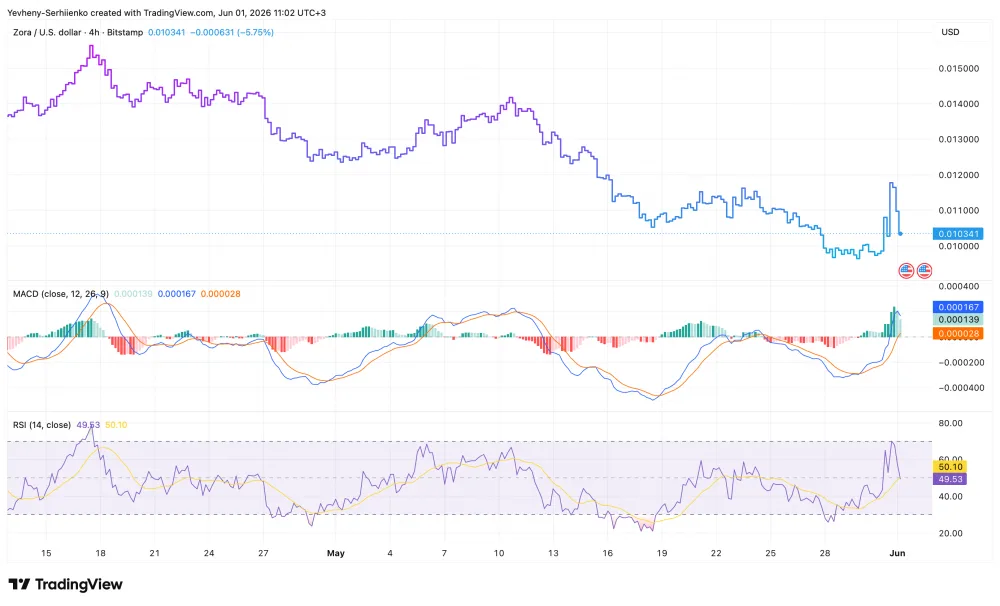
The product has expanded rapidly over the past two years. The launch of ZORA’s ZORA token in 2025, the launch of Coins Protocol, and the launch on Solana through Attention Markets in 2026 expanded ZORA’s product from NFTs and creator collectibles to content tokenization and creator marketplaces, respectively.
Potential Risks for Investors
While the activity on the project continues to grow, ZORA still competes with many other SocialFi projects, as well as established decentralized social protocols and social media platforms with large existing user bases.
As with any speculative asset, ZORA ecosystem products like Creator Coins and Attention Markets are exposed to market volatility, as the supply and demand for these products are still nascent at the time of 2026 and sensitive to activity and trading volume.
The token economy continues to grow: according to CoinMarketCap, there are approximately 4.46 billion ZORA in circulation out of a maximum supply of 10 billion. More tokens are expected to be released into circulation over time.
Long-Term Growth Potential
Factors that would support the continued ZORA ecosystem functionality could also be identified. Now that the protocol is live on Base and Solana, it could connect to two of the largest blockchain communities, distributing its creator tools to a larger audience.
In addition, ZORA has since expanded beyond its original NFT marketplace into tokenized content, Creator Coins, creator rewards, and Attention Markets, with a general focus on building out the on-chain creator economy beyond just non-fungible tokens.
ZORA had over 1 million token holders as of 2026, according to cryptocurrency market data aggregator CoinMarketCap, with a fully diluted market capitalization of more than $100 million as ZORA continues to build its creator and social-finance infrastructure.
The Future of ZORA
Can Attention Markets Go Mainstream?
In 2026, ZORA released Attention Markets on Solana, which allow for the creation and trading of markets on phenomena such as internet trends, memes, and narratives instead of financial assets. According to CoinDesk, Attention Markets was designed around online attention and cultural momentum.
Read Also: How AI Agents Trade Crypto: Autonomous Trading Bots Explained
Attention Markets, despite being a new area as of 2026, continue to evolve and gain traction in practice.
The Future of Creator Monetization
Additionally, direct monetization of creator content remains a key focus of ZORA platform: through the Coins Protocol, creators can mint their posts into collectible assets tied to on-chain markets.
This tool is part of the Web3 creator economy, where creators are starting to use blockchain-based tools to monetize content and communities.
What’s Next for the ZORA Ecosystem
ZORA’s ecosystem has expanded beyond an NFT marketplace to include ZORA token, Coins Protocol, creator royalties, and tokenized content, and Attention Markets on Base and Solana.
The project also continues to build infrastructure for its creators and, according to the documentation, ZORA offers APIs and developer tooling designed for use cases around creative applications and creator-owned marketplaces.
As of 2026, ZORA ecosystem has formed a multi-product, multi-network platform focused on the on-chain creator economy.
Final Thoughts
Key Takeaways
Since its launch as an NFT-native protocol, ZORA marketplace has expanded to include Creator Coins, tokenized content marketplaces, ZORA token, and Attention Markets as of 2026. ZORA’s mission centers on creator-driven social finance, beyond customary digital collectibles.
Expanding from product launches on Base and Solana, easing the on-chain creator economy, according to the ZORA documentation, the project continues to build tools connecting content creation, community participation, and on-chain ownership across protocols and ecosystems.
Why ZORA Is One of Crypto’s Most-Watched Projects in 2026
No other crypto project has broadened the boundaries for creator monetization and content tokenization like ZORA. Over the last two years, ZORA has released the Coins Protocol and its token, expanded to the Solana blockchain, and pioneered the emerging Attention Markets category, causing stir across the crypto ecosystem.
With the platform seeing comparisons to other potential future spaces such as SocialFi, creator-owned internet, and tokenized web content, ZORA crypto has become one of the most watched projects on the market, with many creators, builders, and investors paying close attention to its future development.
FAQ
Is ZORA an NFT marketplace?
Initially concentrated on NFT-related applications, ZORA protocol and market now enable tokenized content, creator markets, and social finance applications for anyone to publish or create.
Can I publish anything on ZORA?
Yes, users can publish to the platform and interact with the creator tools if they have a supported crypto wallet and have access to the supported blockchains.
Which blockchains are supported by ZORA?
ZORA’s core components were originally built on Base and Ethereum. With the launch of Attention Markets in 2026, ZORA transitioned to the Solana blockchain.
What makes ZORA different from customary social media?
Unlike existing social networks, ZORA implements the issuance and ownership of content on the chain so that independent creators and communities can participate in economic activity.
Does using ZORA involve financial risk?
Yes. As with other blockchains, there is market volatility, liquidity risk, and price fluctuations of the token. Users should research items prior to purchase.