Midnight trades happen just as fast as noon ones. Because of this, artificial intelligence tools for cryptocurrency shifted slowly from oddity to standard gear. While Tokyo sleeps, prices may climb suddenly, shift sideways over Paris, then crash hard under Manhattan’s skyline – all before breakfast for most investors. Machines that trade digital coins aim at shrinking delays between spotting patterns, choosing moves, and acting on them.

Even so, self-running trading robots aren’t instant money makers. While they handle vast amounts of data faster than humans, they sometimes latch onto meaningless patterns, break under sudden market swings, or react to poor-quality inputs. Anyone wondering about the mechanics behind AI-driven trades, the function of independent trading setups, or the relevance of automated agents in cryptocurrency markets needs to first peel away glossy promises to see what actual automation truly involves.
Related: DeFi Security Pioneer Says AI Makes All Smart Contracts Unsafe
Contents
- AI Trading Agents in Crypto?
- How Do AI Crypto Trading Agents Work?
- Types of AI Trading Agents in Crypto
- AI Crypto Trading Bots Use Various Strategies
- AI Agents Help Trade Crypto
- Risks and Limits of AI Trading Bots
- AI Agents Trading Crypto Versus Human Crypto Traders
- AI Agents and Crypto Markets Ahead
- Once You Start Using AI Crypto Trading Bots
- FAQ
AI Trading Agents in Crypto?
Autonomous AI Trading Bots Explained
Out there, some programs watch price shifts, study patterns, then act – making moves without constant oversight. When it comes to digital coins, one of these setups might link straight into trading hubs, storage tools, decentralized finance apps, plus live updates from external sources.
How AI Agents Are Different Than Regular Trading Bots
One way to look at algorithmic trading versus AI trading is through how they handle change. A simple bot sticks to preset conditions without shifting course. On the flip side, a system built with machine learning might tweak its moves if crypto markets start acting differently. What sets them apart isn’t code – it’s response.
Why AI Agents Have Gained Traction in Crypto
Weekends don’t stop crypto – it runs nonstop. Wild price swings happen at any hour. Different platforms show different prices. Machines spot moves faster than people can. One exchange might lag another by seconds. Algorithms track money shifting between wallets. Mood shifts on social media get measured, too. Futures markets hint at where things could go. Watching all of it together reveals hidden patterns.
Automation Machine Learning On Chain Execution
Out of raw numbers, hints emerge – those nudges turn into choices, those choices shape trades. When tasks loop, bots take over. Patterns hide in noise until clever systems spot them. From blockchains, artificial minds push actions live via coded deals.
Related: Best Crypto Exchanges 2026: Top 5 Platforms for Easy, Safe & Profitable Trading
How Do AI Crypto Trading Agents Work?
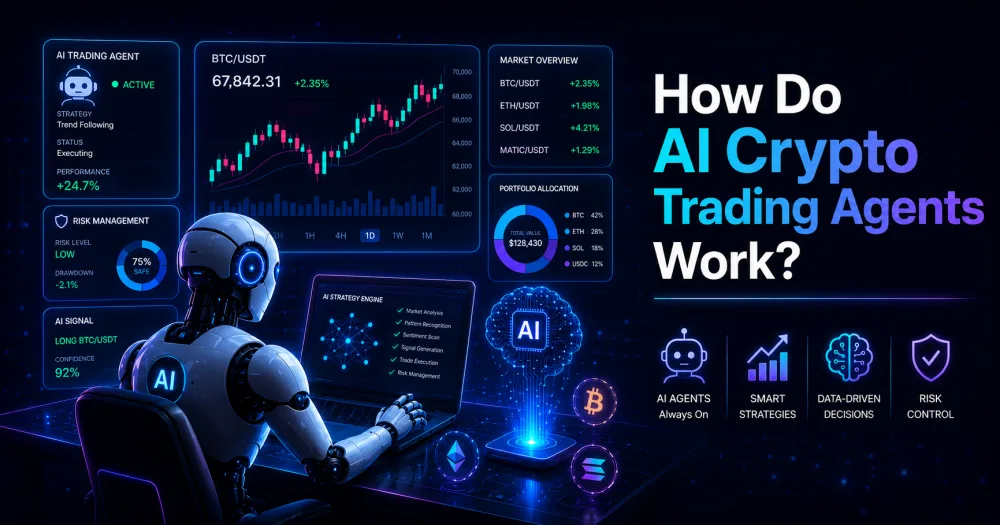
Data Collection and Market Signal Processing
Out of raw pieces comes a signal – prices, order books, funding ticks, positions held open, network costs, money moving between platforms, big holders’ moves, coin releases, headlines. From noise, structure forms when the machine reshapes what it sees into something it understands.
How AI Reads Price Moves and Market Mood
Out of nowhere, patterns emerge when machines scan endless currency combos. Sudden spikes? They catch those fast. Strange gaps between prices show up clearly, too. Even online chatter gets parsed without delay. In digital coins, feelings tend to shift value more quickly than cold facts. That is why programs tuned to mood make sense here.
How Autonomous Trading Systems Make Decisions
Most times, artificial intelligence in trading rates deals using chance, possible gains, and how much could be lost. Rather than simply picking yes or no on a purchase, strong setups adjust how big a bet is made, where to step in, when to leave, plus moments best avoided entirely.
Execution Layer Placing Trades on Exchanges
Out of a signal comes an order, shaped by the execution layer. Connected to centralized exchanges are API crypto trading bots. DEX routers talk directly to smart contract trading bots. Liquidity pools join that conversation. Wallet contracts appear in the loop, too.
APIs Smart Contracts Blockchain Integration Roles
Most of the time, automated blockchain trades need steady links. When information flows right, pricing updates arrive through API channels instead of delays. Machines that trade inside decentralized finance run by rules written into code. These programs make moves like switching assets, taking loans, giving loans, protecting value, or adjusting positions – all without middlemen. Execution happens directly where records are kept.
H3: AI Crypto Trading Bots Compared by Type
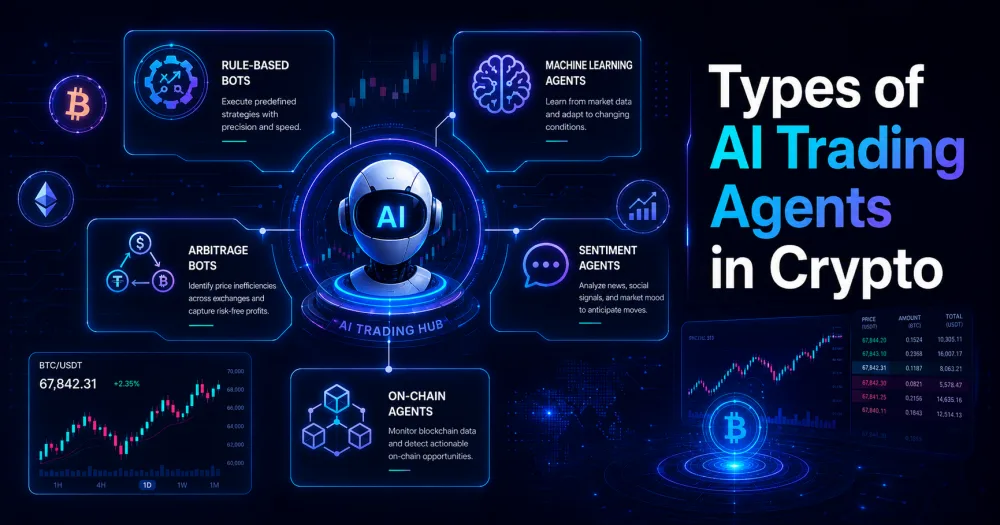
| Bot type | How it works | Best use case | Main risk |
|---|---|---|---|
| Rule-based bot | Follows fixed trading rules | Simple automation, grid trading, DCA | Cannot adapt to new market regimes |
| Machine learning bot | Learns patterns from market data | Signal detection and strategy optimization | Overfitting historical data |
| Sentiment AI bot | Tracks news, social media and market mood | Narrative-driven crypto assets | False signals during hype cycles |
| On-chain AI agent | Executes trades through smart contracts | DeFi swaps, arbitrage, yield optimization | Smart contract and wallet risk |
| Hybrid human-AI bot | AI supports, human supervises | Risk-controlled portfolio trading | Still depends on human decisions |
Types of AI Trading Agents in Crypto
Rule-Based and Machine Learning Bots
A rule-driven bot shows its work clearly, though it sticks strictly to code. Yet one powered by machine learning adapts on its own, yet hides how decisions form. Instructions guide the former, while experience shapes the latter through fresh inputs over time.
Trading Agents That Learn from Experience
Out of mistakes come better choices – bots tweak moves after playing out trades in old market scenes. When returns climb, or losses shrink, that success shapes their next steps. Rewarded behavior sticks around; missteps fade from memory over time. Improvement shows up quietly, step by step, without loud promises. The path forward? Learning what works, then doing it again.
Related: Best Prediction Markets 2026: Regulated Access, Crypto Liquidity and Risk Filters
Sentiment Driven AI Trading Systems
Headlines, chatter around tokens, how fast posts spread – these get logged by sentiment tools. When stories drive prices, such setups often help. Yet when excitement builds, what looks like insight might just be digital static pretending to mean something.
Fully Autonomous On-Chain Trading Agents
Out there, self-running blockchain bots keep an eye on DeFi spots – spotting price gaps across pools while calculating trade impact before pushing trades through paths. Strong capability comes with downsides: users face smart contract flaws plus outcomes that can’t be undone once triggered.
Hybrid Human AI Trading Models
Most times, hybrid setups feel closer to real life. As the AI keeps an eye on openings and follows set guidelines, a person handles the big picture – steering direction, capping risk levels, making sense of major market shifts, broken trades, or new laws.
AI Crypto Trading Bots Use Various Strategies
Market Making and Liquidity Provision Approaches
Starting close to the price, market-making bots place bids and offers, aiming to collect small gains from each trade. When things get shaky, artificial intelligence shifts pricing using live signals like stock levels or heavy buying interest. Instead of fixed rules, these tools adapt using patterns found in shifting data flows. Here is when autonomous crypto trading bots based on AI come in useful.
Arbitrage Across Exchanges
Most arbitrage bots scan markets to catch mismatches in prices between platforms. What matters isn’t spotting differences – it’s judging if costs eat up gains before a trade finishes.
Trend Following and Momentum Trading
Buying happens when prices climb, and selling occurs when they drop. These systems often watch breakouts but check volume first – sometimes layering in market mood or how wild price swings get. Fake moves slip through less often that way. Funding rates add another clue, helping tell real surges apart from empty noise.
Mean Reversion Strategies
Backward drift bets on wild swings settling back near normal. Machines spot stretched prices, shrinking trade interest, or packed betting markets – yet stumble hard once momentum truly shifts. What feels like excess might just be the start.
High Frequency Trading in Cryptocurrency Markets
Speed rules when trading crypto every second. Not everything depends on smart algorithms – wires and servers often decide wins. Small players enter at a cost, since delays plus charges eat into gains fast.
H3: Key Benefits and Risks of AI Trading Agents
| Factor | Benefit | Risk to watch |
|---|---|---|
| Speed | Reacts faster than human traders | Can execute bad trades quickly |
| Automation | Trades 24/7 without manual input | May continue trading during abnormal markets |
| Data processing | Reads large market datasets in real time | Poor data can produce poor decisions |
| Emotion control | Avoids panic and revenge trading | Lacks human context and judgment |
| Strategy testing | Can backtest ideas before live trading | Backtests may not match live results |
AI Agents Help Trade Crypto
Always on Auto Trading
Most useful thing? Constant tracking. While someone eats dinner, clocks out, or flies across time zones, bots still watch prices – this is the key measure when values shift overnight without warning.
Ability to Handle Big Data Quickly
Out of all the noise – exchange trades piling up, wallet movements ticking through, votes on proposals, fees shifting block by block, chatter buzzing across forums – comes a flood no human can sort alone. Piecing it together, machine minds see patterns wider than any single desk ever could.
Related: Top 5 Crypto Trading Setups for Quick Gains: Boost Short-Term Performance
Risks and Limits of AI Trading Bots
Model Mistakes and Overfitting Dangers
A model might seem perfect during testing simply by memorizing past randomness. When real trading begins, shifts in the market expose its flaws instead.
Market Swings and Sudden Crashes
When crypto swings hard, old guesses fall apart fast. A sudden drop might trigger a shutdown built into the bot instead of waiting. Limits on loss amounts keep risk in check when prices jump wild. Strange gaps between buy and sell numbers change how orders run. If price updates vanish, the system follows backup steps quietly. Exchange stops sending data. Rules already decide what happens next.
Liquidity Risks in Crypto Markets
Most times, a signal fails when there’s not enough trading volume. Charts might make small-cap tokens seem promising, yet even a single order shifts prices sharply. Slippage sneaks in fast; exits collapse without warning. Positions sit stuck, unable to move.
Security Risks in Smart Contracts
One wrong move while trading might lead to total loss. If API keys get hacked, wallets give too much access, harmful contracts run, or routing glitches occur, things go bad fast. Security just cannot keep up.
AI Agents Trading Crypto Versus Human Crypto Traders
Speed and Efficiency Compared
Besides speed, machines handle vast amounts of data without fatigue. Yet when situations twist unpredictably, people often see what codes miss. Software never tires, yet it can’t feel pressure or motive. On the flip side, workers need rest – still, they grasp fear in ways circuits cannot.
Risk Management Differences
When bots apply rules, they never feel. Should markets shift, people adjust what was fixed before. Power shows up where machines stick tight, yet someone watches closely.
Performance in Bull and Bear Markets
Bull runs often suit momentum strategies – rising cash flow helps price surges gain traction. When the market turns south, fake bounces pop up, order pools shrink, and sudden flips mess with robotic trading.
Why People Still Play a Role in Trading Choices
Even now, people stay relevant – markets grow from human interaction. Though machines calculate odds well enough, they miss the weight of rules, how founders really act, whether exchanges hold up, or what happens when nations clash. What feels uncertain to code comes naturally to lived experience.
Common Ways AI Trading Agents Are Used
Institutional Crypto Trading Desks
Using AI helps institutions handle trades, study market depth, adjust investments, and watch risks closely. Better trade results drive their efforts, more than guessing prices ever could.
Retail Automated Trading Platforms
Most retail sites include tools like grid bots, DCA setups, trend followers, and signal helpers powered by AI. Entry gets easier because of these – still, risk stays part of the game.
DeFi Yield Optimization Bots
Capital flows through DeFi bots, shifting across lending platforms, staking options, or liquidity setups. While AI might sort returns by potential, it won’t erase dangers tied to code flaws or cross-chain transfers.
AI Agents and Crypto Markets Ahead
Rise of Fully Autonomous Trading Ecosystems
Out here, trading spots pop up fast while bots handle trades and adjust holdings without much human push. Smoother wallets make that jump happen quicker. There.
Connecting Defi and Smart Contracts
Code lets AI move money freely across DeFi’s open systems. Swapping tokens happens without people pushing buttons – just logic running. Borrowing unfolds when conditions match, not by asking permission. Lending follows preset rules, triggered silently behind scenes. Protection against risk is built in step by step through smart contracts. Mistakes coded into transactions stick – they replay forever once live.
AI Agents Trading with Each Other
Bots might build their own trading spaces, swapping assets without people. One type handles cash flow, another focuses on trades, while some tackle danger levels, information flows, or how money gets split across investments.
Regulation and Compliance Challenges Ahead
Expect scrutiny of tech tools promising quick profits or shaking up fair trading. Platforms deemed high-risk might face tougher rules, more transparent reporting, and tighter oversight instead of leniency. Oversight won’t wait for disasters – proactive checks could become standard before issues arise.
Once You Start Using AI Crypto Trading Bots
How to Pick an AI Trading Platform
First up, check how trustworthy a platform is before anything else. Safety matters just as much as which exchanges they work with. Look into their fees – some hide costs until later. Controls that manage risk should be clear, not buried in fine print. Promises of sure wins? Walk away fast. Markets shift too wildly for any system to catch every turn.
Connecting Wallets and Exchanges
Start with tighter API access, maybe split user roles, or lock down transfer rights when feasible. Wallet bots work better if past contract grants get checked now and then ripped away once outdated.
Setting Risk Parameters and Strategy Types
Start by setting how much you will risk per trade, where your exit points are, maximum loss allowed, which coins or currencies you’ll use, along with the borrowed funds level – get all that clear ahead of real trading. Those new to it might try to practice runs without money; otherwise, step in slowly, using only a little cash.
Common Beginner Mistakes to Avoid
Most errors come from using too much leverage, believing historical simulations are guarantees, overlooking costs, jumping into thin markets, and juggling endless approaches without focus. Machines offer tools, yet people still hold the blame when things go wrong.
FAQ
Can AI Trading Bots Make Money in Crypto?
Profit comes only if conditions align just right. When the approach lacks precision, results often fall short. Execution stumbles slow every plan eventually. High costs eat into gains without warning. Thin markets add pressure at the worst moments. Swings in price test even careful plans. Poor handling of danger leads straight to loss.
What About AI Agents and Human Traders?
Only partly. While machines handle data review and tasks automatically, people set goals, decide on boundaries for risk, plus weigh choices during rare situations.
Are AI Trading Bots Safe?
When access is tight, sites are trustworthy, and safeguards are strong, harm drops. Danger rises if people hand unchecked control to apps they do not know.
Most tools work without knowing code. Some might require a bit of scripting now and then. Others fit right into workflows, minus any programming. A few still expect a basic tech know-how behind the scenes. Not every option demands developer experience, though.
Most of the time, you do not need to code at all. Some tools let users build bots without any programming. If someone wants unique trading rules or deeper system checks, then coding becomes useful. Connecting straight to an exchange might require it too. For everyday tasks though, writing code stays optional.
Best Markets for AI Trading?
Most times, AI bots perform well where trading flows smoothly, info stays clear, spreads stay narrow, yet movement exists. Instead of tiny low-volume coins, it is better to begin with big names like BTC▲$62,630.00 or ETH▲$1,761.17. Markets need life, not just noise.