
Contents
What Is Crypto Arbitrage Trading?
Basic Definition of Crypto Arbitrage
Crypto arbitrage trading is essentially the act of profiting from the differences in pricing of the same asset on separate platforms. Arbitrage in general is a trading strategy that exploits price differences of the same asset among different exchanges; crypto arbitrage takes this strategy into an environment of numerous digital asset exchanges.
With a simple definition of crypto arbitrage, a trader buys an asset on one platform at a low price and sells the asset (at a high price) on a second platform, taking advantage of the “spread” in prices as their profit.
“Profitable? Potentially. Easy? Absolutely not.” — Zipmex Research.
How Price Differences Occur Between Exchanges
Crypto exchange price disparities are due to the fact that every single one of them is its own individual market; they have different levels of liquidity, users, and order flow. Supply and demand differences (i.e., trading volume) and the level of participation from different geographic regions also create temporary pricing inequities.
In addition to this, the lack of data synchronization between exchanges and the differing fees charged by each exchange will further worsen these inequities. Due to the decentralized nature of crypto markets, there is no central pricing mechanism. Prices, therefore, fluctuate individually on each exchange until a state of equilibrium is reached.
Why Crypto Markets Are Ideal for Arbitrage
The characteristics of cryptocurrency markets create a unique opportunity for arbitrage. A combination of the volatile nature of these markets and the fact that they have a truly global presence with 24-hour trading opportunities creates a setting conducive to inefficient prices. In addition to the volatile nature of the market, there is also the existence of numerous (hundreds) of exchanges at any given time, which increases the probability of disparate pricing among them.
As opposed to traditional equity markets, which are highly structured and subject to regulation and therefore have a much higher degree of synchronous pricing, the crypto space has many exchanges that can be considered structurally inefficient in terms of pricing synchronization. As such, it presents a lower barrier to entry as far as arbitrage trading is concerned.
Types of Crypto Arbitrage Opportunities
Spatial (Cross-Exchange) Arbitrage
Arbitrage, or spatial arbitrage, commonly referred to as cross-exchange arbitrage, is typically a trader’s best opportunity for profit. The idea behind this strategy is that you buy an asset at a lower price on one exchange and sell it at a higher price on another.
This type of trading is very simple in theory; however, it relies significantly on speed of execution and how quickly funds can be transferred between different trading platforms. Many traders maintain separate account balances on each platform they trade with to avoid transaction processing time and to more effectively capture spreads.
Triangular Arbitrage
Triangular arbitrage is an advanced form of arbitrage strategy crypto, which takes advantage of mis-priced exchanges between two different pairs of cryptocurrency at one exchange.
The difference with triangular arbitrage is that instead of taking the money off the first exchange to use on another (i.e., transferring it to another platform), you will simply trade your way through the entire asset base using the same exchange for each step, such as BTC▲$62,630.00 → ETH▲$1,761.17 → USDT▲$0.9991 → BTC.
This creates a high-speed arbitrage opportunity since all transactions take place on the same exchange, making it possible to get into or out of a position very quickly.
Statistical Arbitrage in Crypto Markets
Statistical arbitrage employs quantitative modeling as well as past price behavior and relationships to determine short-term market mispricing. The statistical arbitrage methodology does not rely solely upon direct price comparisons but rather utilizes elaborate mathematical formulas (algorithms) to recognize when asset correlation deviates from its “normal” or historical levels.
Read Also: What is Crypto Liquidation in Trading? How Crypto Liquidation Works
This is an increasingly popular form of arbitrage among institutional and algorithmic traders in cryptocurrency markets. This approach represents a higher level of advancement than traditional forms of crypto arbitrage and typically requires access to large-scale databases, automated trading platforms, and/or low-latency order entry/execution systems.
Decentralized Exchange (DEX) vs Centralized Exchange (CEX) Arbitrage
Arbitrage between decentralized and central exchange platforms continues to grow as a component of an arbitrage strategy in the cryptocurrency markets. The primary reason price disparities occur is that DEXs are priced using automated market makers (“AMM”), whereas CEXs’ prices are determined from Order Books.
There will be situations where these structural differences bring about temporary inefficiencies, particularly during periods of high volatility or low liquidity on DEX’s. Traders need to consider additional costs, including network fees, slippage, and transaction verification time, when reviewing the potential for profit.
How to Find Crypto Arbitrage Opportunities

Monitoring Price Differences Across Exchanges
Understanding how to find crypto arbitrage begins with constantly identifying price differences across all available cryptocurrency exchanges. Each exchange works independently, so to find profitable opportunities, a trader will compare real-time “bid” and “ask” prices for the same cryptocurrency on several platforms. The spread created by the different pricing creates an opportunity for traders.
While manual analysis is possible, it becomes too difficult to keep up with rapid changes in fast-moving markets. In order to have an opportunity to exploit arbitrage, a trader has typically established accounts on two or more exchanges and monitors feed from these exchanges at one time, allowing them to react as soon as opportunities appear.
Using Crypto Arbitrage Scanners and Tools
Automated crypto arbitrage scanners are used to identify large-scale arbitrage trading opportunities. The automated arbitrage scanning tool is able to quickly locate profitable pricing differences across several exchanges by aggregating exchange pricing information. This removes the necessity for manual monitoring of prices to find spread profits.
Many advanced arbitrage platforms adopt filtering features (i.e., fee, liquidity, speed of execution) that allow users to only view those arbitrage opportunities that can be executed. With increasing competition in the space of arbitrage trading, automation has evolved into an essential element of successful arbitrage execution as opposed to being simply an option.
Tracking Liquidity and Trading Volume
A big part of looking for arbitrage opportunities is that there needs to be enough liquidity in the market. Just because there are some prices that differ does not mean there will be enough people willing to trade to get you the price you want. Higher volumes usually indicate better liquidity, and thus lower spreads.
Crypto arbitrage is about finding the best way to make money. Analyzing volume is very important in determining if an arbitrage opportunity has potential, versus being purely theoretical. Slippage is often found in low-liquidity markets, and it could potentially negate your profit.
Identifying Market Inefficiencies in Real Time
The ability to successfully conduct an arbitrage is dependent upon your ability to recognize and exploit inefficient pricing as it occurs. The inefficiencies are typically caused by extreme price movements, regional supply and demand imbalances, or slow communication of new prices among different platforms.
A successful strategy for identifying crypto arbitrage opportunities will require both high-speed feeds of price data, an alert system that automatically signals when there is an opportunity to trade, and a platform capable of rapidly executing trades.
Because market efficiency is constantly improving, the amount of time available to execute trades based on identified arbitrage opportunities has decreased significantly. Therefore, the need for speed and accuracy has increased.
Best Tools for Crypto Arbitrage Trading
Automated Arbitrage Bots
Automated “bots” have evolved into one of the most commonly used arbitrage tools crypto due to their ability to rapidly find and complete an arbitrage opportunity using a combination of automated scanning and trading that eliminates the need for any human involvement.
By constantly monitoring multiple exchanges simultaneously, these programs can quickly identify an opportunity to create a spread and then automatically complete a trade on it.
Exchange Comparison Platforms
The exchange comparison platforms are essentially an initial or primary crypto arbitrage scanner that can aggregate pricing information from different markets. The exchange comparison platforms will display side-by-side comparisons of each market’s prices, spreads, etc.
They also allow you to see if there exists an opportunity in the market; it does not automate your trades. It allows you to quickly find out where the inefficiencies are and when. Therefore, they are most beneficial for people who want to manually trade but would like some quick, accurate data concerning the opportunity.
Real-Time Price Tracking Tools
Real-time monitoring systems provide a way of identifying variable market conditions as they occur. They also provide traders with live data in terms of price levels on the markets (real-time price feeds) and the ability to set up alert notifications. Traders then have access to real-time charts/dashboards so that they may immediately act upon changes in prices.
Because every second counts in extremely competitive trading conditions, most traders use both tracking systems and an alert system, which will notify them when certain threshold values are reached; thereby increasing their speed of reaction and the accuracy of trade executions.
API-Based Trading Systems
API-based systems are considered to be the highest level of arbitrage in crypto technology that enables the building of custom infrastructures through which traders can collect their own data and execute trades. Users have the ability to directly access an exchange’s order book via the exchange’s API and therefore retrieve live market data, and also use APIs to create a trading logic automation.
Read Also: How to Read Crypto Charts in 2026: Cryptocurrency Trading Guide for Beginners 2026
The primary users of these API-based systems tend to be professional or automated (algorithmic) traders. The reason is due to the fact that they require a high degree of technical expertise; however, the API-based systems provide both maximum flexibility and speed. In practice, many professionals combine bot and scanner technologies with API driven strategies so as to develop a complete arbitrage workflow.
Step-by-Step Guide to Crypto Arbitrage Trading
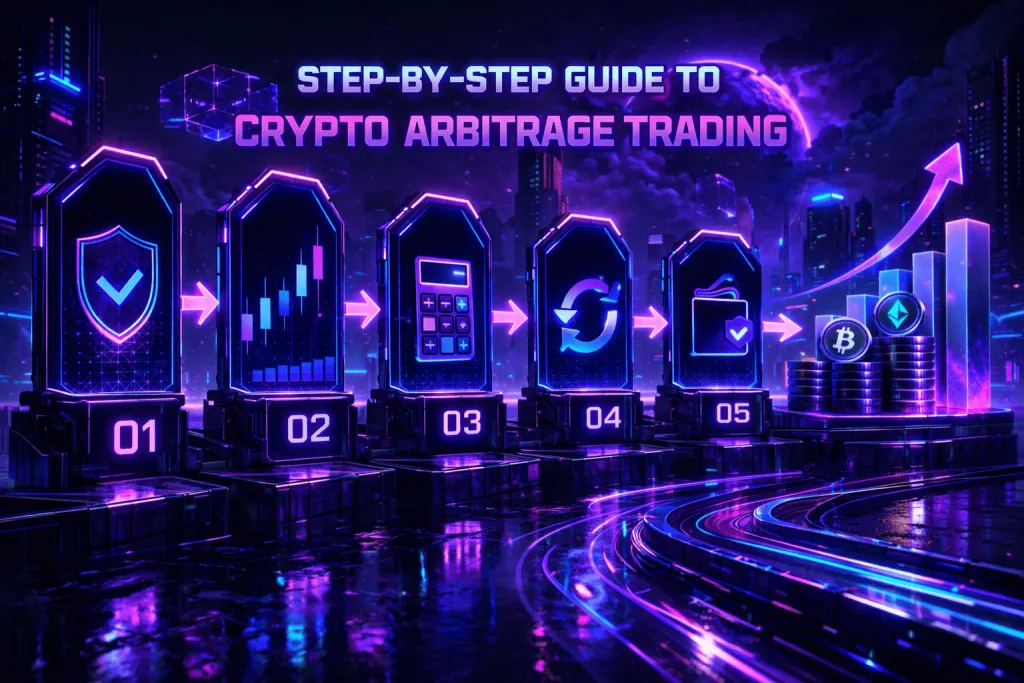
Step 1 – Choose Reliable Exchanges
Selecting reliable exchanges with high trading volume is the first step in developing a crypto arbitrage strategy. Exchanges that have proven security track records and deep liquidity, offering tight spreads and fast execution, are ideal for arbitrage.
Withdrawal limitations, supported assets, and fee structures should be evaluated by traders when determining which platform to trade on in arbitrage. This is because of the significance of operational reliability, just like pricing, delays, or restrictions can eliminate potential profit.
Step 2 – Compare Asset Prices
Once you have identified a good exchange, you will need to identify any possible discrepancy in the pricing of an asset on your chosen exchange compared to other exchanges. This will help you identify possible opportunities where you may be able to profit from buying low and selling high.
This process is usually performed with the use of either a scanner or a dashboard to display all available pricing information in real-time. With high-frequency arbitrage crypto trading, even very small price differentials can provide a basis for potentially profitable trades.
Step 3 – Calculate Fees and Profit Margins
Before making a single trade, you need to take into consideration all of the costs involved with the trade. Trading fees, withdrawal fees, and even potential network costs can severely decrease or completely wipe out your expected profit.
The concept sounds simple. The execution is where complexity lives, as noted in 2026 research by Zipmex, showing how cost calculation is often the difference between hypothetical and real profit.
“The concept sounds simple. The execution is where complexity lives.” — Zipmex Research.
In order for there to be an effective crypto arbitrage strategy, the price difference (spread) between two exchanges must exceed the cost of transacting on both exchanges. The trader must also consider slippage, especially when trading in illiquid markets. Slippage is when the actual execution price at which you buy/sell an asset differs from what was listed by quoting exchanges.
When calculating accurately, this will help you find opportunities that are actually profitable instead of theoretically attractive, yet impractical.
Step 4 – Execute Trades Quickly
Arbitrage trading crypto is largely dependent on speed due to rapid price movements, which are typically only seconds. In order for an arbitrageur to profit from such differences, they must be able to enter both their buy and their sell orders nearly at the same time; if not, the prices will likely adjust prior to them being able to do so.
There are many arbitrageurs who use automated systems in order to meet this requirement. However, there also exists a possibility for manual entry; however, there is a much greater probability of missing an opportunity or receiving a partial fill when executing trades in a rapidly moving market.
Step 5 – Transfer and Secure Profits
Once you have completed your trades, it is important to move those profits around and secure them as quickly as possible. In some cases, this may mean sending assets from one exchange to another, so that they can be consolidated back into a single account for continued trading.
When you send assets, there are several other risk factors introduced. For example, each transfer could take anywhere from seconds to days and will also result in fees. Experienced traders typically have multi-exchange accounts with sufficient balance in order to minimize the need to constantly move money.
In conclusion, proper fund management is the last of three essential steps necessary to create an ongoing profit-generating crypto arbitrage strategy; by properly managing your funds, you ensure that all of the gains you make remain intact, while at the same time preparing them for redeployment.
Risks of Crypto Arbitrage Trading

Transaction Delays
One of the greatest crypto trading risks for arbitrage traders that is often underappreciated is the potential costs associated with trade latency.
While there may be profit opportunities created from an asset’s current price difference across two markets, the time it takes to execute orders can greatly limit these opportunities.
This is especially true where cross-exchange transactions are involved. Slow confirmations, internet congestion, etc., can all cause a trader delay in executing their trades, resulting in what used to be thought to be a potentially profitable position now being a losing one.
Exchange Fees and Hidden Costs
The high frequency of fees associated with crypto arbitrage is a structural barrier, as they are an explicit reduction in margin.
All three of these types of fees (trading fees, withdrawal fees, and deposit fees) need to be taken into account to assess the feasibility of any one particular trade. In addition to those which you can see, hidden items such as spreads, slippage, and funding rates will also eat away at your returns.
Small differences between expected and actual execution prices will result in the total elimination of arbitrage profits.
An extensive cost analysis should be performed prior to making any trade decision as part of an overall crypto trading risk management strategy.
Market Volatility
Volatility is one of the defining characteristics of crypto markets, creating both prospects and risks. The price fluctuation creates arbitrage possibilities; however, it will also accelerate price convergence before all trades can be executed.
Related: Crypto Trading Volume Fell Nearly 40% in Q1: CoinGecko
In fast-moving environments, price movements between the buying and selling legs of a trade could potentially be extreme. This possibility of large price movement during this time frame adds execution risk, particularly for manual traders who do not have automated systems in place, underscoring key arbitrage risks in crypto.
Withdrawal Limits and Liquidity Issues
The operational restrictions that exist for a trader, i.e., daily/weekly/monthly withdrawal limits on an exchange or platform, will limit the amount of money a trader has available to fund positions on other trading platforms. Additionally, many platforms have imposed daily/account-based limits on withdrawals.
These operational limitations will cause delays in capital redeployment and lower the number of trades executed due to fewer arbitrage opportunities.
How to Maximize Profit from Crypto Arbitrage

Automating Arbitrage with Bots
Automation serves an important role in successful crypto trading, particularly in arbitrage when time is of the essence. Bots have the ability to continually scan various exchanges for price discrepancies, identify arbitrage opportunities, and make trade executions at speeds far greater than those that are possible by humans.
The use of automation in a current-day arbitrage strategy increases speed and removes emotion from trader decisions. Parameters in a bot can be defined by traders with regard to criteria, including a minimum threshold for a bid-ask spread, position sizing, and/or risk levels, which will allow a trader to consistently execute trades in varying market volatility conditions.
Choosing Low-Fee Exchanges
The reduction of transaction costs plays an important function in maintaining profit margins in arbitrage trading because the spread that exists between two markets is typically very thin; therefore, it may be possible for even relatively minor variations in the trading or withdrawal fees associated with every exchange to make or break a particular trade.
To create a successful crypto arbitrage strategy, one needs to identify which exchanges have the most competitive fee structures. Many traders will compare different levels of fees as well as how different exchanges (maker/taker) and networks charge fees when they decide where to commit their capital.
When competing against other participants in a market, having optimized your strategies so you can pay less for the same services than others can result in considerable advances in profitable crypto trading.
Scaling Trades Safely
Scaling arbitrage requires an increase in trading volume or number of transactions; this has to be done with caution so as not to cause problems in order to execute orders.
Trading larger volumes will have the potential to affect the price of a security traded on a given exchange; this is particularly true for illiquid markets where there may be large amounts of slippage due to lack of liquidity and/or decreased profit margins.
Sustainable crypto arbitrage strategies concentrate on scaling gradually while maintaining the quality of execution. Arbitrageurs are also able to hedge their exposures by trading among different currency pairs and exchanges to reduce exposure to one particular market.
Scaling properly allows traders to ensure that deploying additional capital results in greater earnings without expanding operational risks.
Timing Market Inefficiencies
Timing is very important when taking advantage of arbitrage opportunities, as market inefficiencies are usually caused by a short period of time with a lot of price movement, by a surprise event from the media, or because there is an imbalance in the amount of money on each exchange.
The best traders are always watching out for this type of situation and use up-to-date information and notifications so they can take action quickly. Oftentimes, there may only be a few seconds before all of the prices adjust to their new equilibrium.
FAQ
Is crypto arbitrage trading risk-free?
No, crypto arbitrage is not risk-free. While it aims to exploit price differences, factors such as fees, delays, and volatility can reduce or eliminate profits.
How much capital do you need to start crypto arbitrage?
The required capital depends on the exchanges and strategy used. However, higher capital generally allows traders to benefit more from small price differences after fees.
Do you need bots for crypto arbitrage trading?
Bots are not strictly required, but they significantly improve execution speed and capability. In competitive markets, manual trading frequently struggles to capture short-lived opportunities.
How long do arbitrage opportunities last?
Most arbitrage opportunities exist for only a few seconds or minutes. As more traders and automated systems act on price differences, markets quickly correct inefficiencies.