For new traders, the fastest method to recognize price movement, deceleration, and high-risk zones is via the chart. Once you learn how to read crypto charts unlocks the meaning of stochastic candlesticks as a legitimate form of auction data, as opposed to noise.
This guide will systematically break down the components of candlesticks, timeframes, trend, volume, support and resistance, and some essential indicators.
This framework will provide a foundation to start reading crypto charts with a strategy. It also works as a practical cryptocurrency trading guide for beginners 2026 because it focuses on the core chart-reading skills that matter first.
| Skill | What you look at | Why it matters | Simple example |
|---|---|---|---|
| Candle reading | Open, high, low, close | Shows the fight inside one period | A 1-hour candle moves from 42,000 to 42,480 |
| Timeframe choice | 1D, 4H, 1H, 15m | Changes context and timing | A pullback on 15m may be normal on 4H |
| Trend check | Higher highs or lower lows | Shows market direction | Three higher lows often support a trend |
| Level mapping | Support and resistance zones | Helps define risk and targets | Price rejects 2.50 three times |
| Volume read | Volume bars under price | Tests if a move has backing | Breakout with 180% of average volume |
| Indicator use | RSI, EMA, SMA | Adds structure, not certainty | RSI 74 near resistance needs caution |
That roadmap keeps the learning sequence simple from the first chart. For anyone wondering how to read crypto charts for beginners, the answer starts with candles, trend, levels, and volume rather than with fancy indicators.
This guide is educational material, not financial advice. Crypto markets move fast, liquidity can thin out, and chart setups can fail. Use position sizing, stop losses, and judgment before trading. That remains one of the most basic live crypto trading tips for beginners 2026: staying alive matters more than catching every move.

Contents
- What Crypto Charts and Crypto Market Charts Show
- How to Read Crypto Chart for Beginner: How to Read Trading Candles
- Timeframes, Trend, and Levels in Crypto Trading
- Volume and Crypto Charts Analysis
- Crypto Chart Patterns and Core Signals
- Which Reversal Patterns to Know First
- How to Read Crypto Charts for Day Trading
- Where to View Live Crypto Charts and Free Crypto Charts
- Common Mistakes and a Step-by-Step Checklist
- FAQ
What Crypto Charts and Crypto Market Charts Show
A chart shows the price as a function of time. The vertical axis represents the price, and the horizontal axis represents time. For a line chart in the context of a cryptocurrency exchange, the line represents the closing price and does not show the path taken during the time period. A candlestick chart shows the path by providing information on open, high, low, and close price values. This is the main reason why candlesticks are popular. For a cryptocurrency exchange market chart, the price of a single asset might have slightly different high price values.
In simple terms, as part of cryptocurrency explained for beginners 2026: price charts are just a visual record of where buyers and sellers agreed to transact over time.
How to Read Crypto Chart for Beginner: How to Read Trading Candles
Candles are the base layer of chart reading. Each candle records four prices for one period: open, high, low, and close. When people ask about how to read crypto charts for beginner, they often start with color alone, but color is only the surface. You need the full structure. One candle can mislead, especially on low liquidity pairs. A series of candles near a level gives a better signal than a single bar in isolation. That is why how to read crypto charts and how to read cryptocurrency graphs really mean learning to read sequences, not isolated candles.
| Candle part | What it shows | Example value | What a beginner should note |
|---|---|---|---|
| Open | First traded price in the period | 1.245 | Starting point only matters in context |
| High | Highest traded price | 1.310 | Long upper rejection may show selling |
| Low | Lowest traded price | 1.210 | Long lower rejection may show buying |
| Close | Last traded price in the period | 1.298 | Close matters more than an intraperiod spike |
| Body | Distance from open to close | 0.053 | Wide body shows stronger push |
| Wick | Distance beyond the body | 0.012 above | Wicks show rejection or thin liquidity |
With that map, each candle becomes a data block instead of a color signal.
As Steve Nison, founder of Candlecharts.com and a leading educator in Japanese candlestick analysis, has shown, candles work best in context. A doji, hammer, or engulfing bar matters far more near support, resistance, or a trend shift.

What the Body and Wicks Mean
The body defines the space between the opening and closing prices, and this defines which force dominated at the end of the period. The wicks show the extent of price movement before the reversal occurred at either end. Long wicks in cryptocurrency charts are common when there are triggered stops or order books are sparse, something commonly seen in smaller-cap cryptocurrencies where a large order can push a candle out considerably from its body.
The basic explanation for this becomes obvious when both parts are examined individually. A large body implies that one force was driving prices with little opposition. A small body near the middle might imply indecision in the markets. Long wicks at either end might imply that there was some opposition at the high and some buying at the low. It must be noted, however, that equal-length wicks do not necessarily imply neutrality in the markets. Once this pattern is understood, it becomes easy to compare two candles instead of looking at the color.
Which Candles Matter to Beginner
The beginner doesn’t need to be aware of the extensive variety of candle types. The three types will cover the majority of the early lessons:
- Doji: A candle with the open and close close together.
- Hammer: A candle with an elongated lower shadow.
- Engulfing: A candle that completely engulfs the previous candle.
In the cryptocurrency charts, these candles will be useful in the vicinity of trend changes or significant levels. Within the middle of a trading range, these will be more likely to cause confusion. The doji candle can be seen as a sign of balance; however, the lack of balance is not necessarily significant.
The following is the list of the key candle patterns that the beginner should be aware of:
- Doji: The open and close of the candle will be in close proximity.
- Hammer: The candle will have an elongated lower shadow.
- Engulfing: A single candle will completely engulf the previous candle.
In the vicinity of support levels, the hammer will be more significant. After an extensive move up in the market, the engulfing candle will need the support of volume.
Timeframes, Trend, and Levels in Crypto Trading
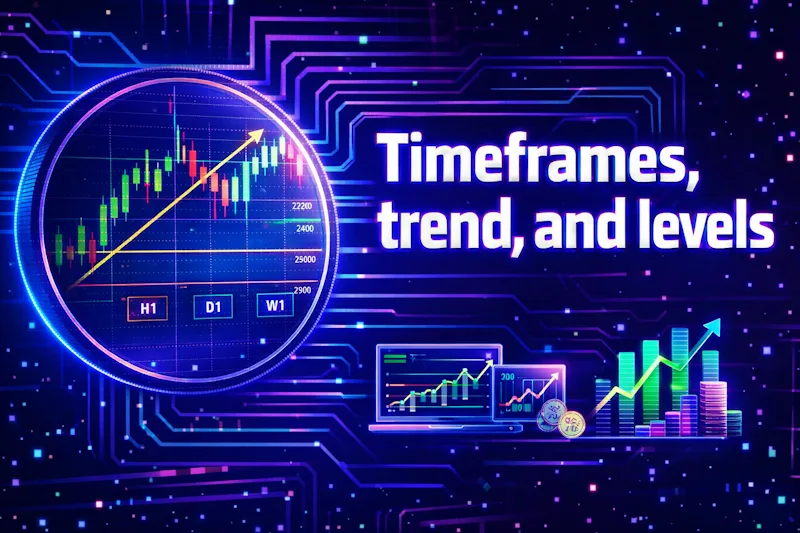
The timeframe will affect how price movements are interpreted. A price drop on a 5-minute chart may be a minor correction on a 4-hour chart. The trend shows whether the market is producing higher highs and highs or lower highs and lows. The levels show areas where prices have reacted before.
In high-quality crypto charts, these three factors are used together. If there is a trend but no level, there will be no price location. If there are levels but no trend information, there will be poor timing. Considering that cryptocurrency trading takes place on weekends too, changes may occur in the trend when other markets are closed.
As Katie Stockton, Founder and Managing Partner of Fairlead Strategies, explains through her multi-timeframe process, the larger trend deserves priority. The lower chart should refine timing and risk, not override the broader market structure.
Which Timeframe Is Better to Check First
Start with a broad approach and gradually move towards the specific. This helps in eliminating noise and gaining contextual understanding before focusing on the specifics. Many times, the approach involves looking at the cryptocurrency trading chart over a small time scale and then subsequently adding a story to random candles.
It would be wise to first glance at the daily chart or the four-hour chart and then subsequently move to the one-hour or fifteen-minute chart. The goal of the smaller scale chart should be to answer the question, not create the question. The top-down approach can be kept simple.
A practical example is “Bitcoin technical analysis 4h timeframe April 2026,” where the 4-hour chart helps define structure before lower-timeframe entries are even considered.
- First, it is essential to look at the daily chart to identify the general trend direction as well as key support and resistance levels.
- Next, it is essential to look at the 4-hour chart to further refine support and resistance levels, as well as identify recent structural levels.
- The 1-hour chart or 15-minute chart should only be used to further refine entry timing. That is where something like “Bitcoin technical analysis 15-minute chart April 2026” becomes useful: not for the big thesis, but for execution and risk control.
- If there is conflict between the lower chart and the higher chart, it is essential to rely on the higher chart.
- If there is ambiguity on the larger chart, it is essential to wait for clarification.
This ensures stability as events unfold.
How to Know Where the Market Is Moving
A rising market will make higher highs and higher lows, while a falling market will make lower highs and lower lows. If you are not seeing these types of formations, then you may be looking at a ranging market. This may be more important on a crypto chart than many indicator schemes. There are many new traders out there who are mistaken in assuming every move is a reversal. The question you want to ask yourself is whether or not the structure of the swing has changed or if you are simply continuing to move within a range.
Direction can be diagnosed through a series of checks.
- Higher highs and higher lows are normally a sign of an uptrend.
- Lower highs and lower lows normally mean a downtrend.
- And if it just keeps failing at the high, then that can be a sign of a range.
- If highs are equal or lows are equal, then that normally means drawing in liquidity before a breakout occurs.
- A single strong candle will not normally change a trend unless there is follow-through.
This view focuses on structure rather than emotion.

How to Draw Support and Resistance in Crypto Trading
Instead of thinking of support and resistance as hard lines, think of them as more like zones. Look for the spots where there is a stall, reversal, or strong movement. These are the places where buying and selling are actually occurring. If you’re looking at charts for cryptocurrencies, these levels become more relevant if there are several bumps and changes at roughly the same point. The price can fluctuate slightly because it is traded on several exchanges with a small spread.
Keep it simple when drawing levels.
- Don’t mark the zone, but a zone based on a few clear reactions.
- Focus more on the levels that appear on the higher timeframes.
- Look for price action when the price comes back to the zone.
- A clean break with volume can turn resistance to support.
Don’t overvalue the micro levels, which only show up on a single timeframe.
Volume and Crypto Charts Analysis
Volume indicates the level of participation in the price movement. Prices may be rising even with low volume. However, this does not necessarily mean the rising prices are stable. A breakout with high volume has more strength behind it than one with low volume. This is the basic concept behind the chart analysis of cryptocurrencies. The volume in the crypto chart helps distinguish between a breakout and a blip in the prices. The focus shifts from “is the price moving?” to “how much volume is behind the movement?” The weekends may be weak in terms of volume because of low liquidity.
As Buff Dormeier, Chief Technical Analyst at Kingsview Wealth Management, argues in his volume research, price alone is incomplete. Volume reveals conviction, confirms trend quality, and helps separate a real breakout from a weak move with little participation.
Crypto Chart Patterns and Core Signals
Patterns must be meaningful in the context of trend, level, and volume. The most basic set of patterns starts with just four. These include the triangle, the double top, the double bottom, and the head and shoulders. When dealing with cryptocurrencies, the actual appearance of the pattern must be considered. A triangle with significant resistance has a different meaning than the same triangle in the middle of the range. The pattern must be considered in the context of the overall market.
| Pattern | What it often means | What confirms it | What can fail it |
|---|---|---|---|
| Triangle | Price compression before expansion | Break with rising volume | Break without follow-through |
| Double top | Repeated failure near the same high | Loss of neckline support | Strong reclaim above the top |
| Double bottom | Repeated defense near the same low | Break above neckline | Weak bounce with flat volume |
| Head and shoulders | Trend fatigue after a rise | Neckline break and weak retest | New high after the pattern forms |
The table matters only when you combine shape with context and execution.
Which Continuation Patterns to Know First
Continuation patterns involve a pause in the course of an ongoing price movement. There are two types of continuation patterns at the entry level: triangles and consolidations. These patterns indicate that the market is compressed before the next expansion. This is an important aspect of cryptocurrency charts because the price often fluctuates between low volatility and high volatility in a cyclical pattern. A narrow range near trend support can be a launchpad, while the same range near significant resistance can be a trap.
Start with the following list:
- Ascending triangle – price holds a flat ceiling while lows rise.
- Descending triangle – price holds a flat floor while highs fall.
- Tight consolidation – candles shrink and overlap before expansion.
- Volume often dries up during compression and rises on the break.
- The break matters more than the label you give the pattern.
This ensures the practical application of the pattern as a useful concept and not just a cosmetic description.
Which Reversal Patterns to Know First
Of all the patterns, reversal patterns are likely to be misused the most. New traders should be looking to identify double tops, double bottoms, and head and shoulders patterns. On crypto price charts, these patterns will be important if there is a large price movement or if the patterns are located near a major support or resistance level. A double top identified near a noisy price range is probably noise. The first indication of any reversal pattern is usually signs of weakening momentum, rejection, or even a break.
The pattern setup can begin small.
- Double top: Price makes a common high twice, then falls.
- Double bottom: Price makes a common low twice, then levels off.
- Head and shoulders: The middle peak is higher than the shoulders.
- The neckline is important because it is where the potential change in control is.
- Without volume or structural changes, it is not yet complete.
This rule avoids a lot of false reversals and costly mistakes.
Trading Indicators without Overload
You don’t need a ton of overlays on one chart if you’re just starting out. For the first step, two or three tools will probably be enough. You can consider the volume, the RSI, and one or two moving averages. The quality of the indicators on your crypto chart is based on your setup. Too many indicators can cause your own level, the trend, and your candlestick skills to become jumbled. A simple chart will allow you to make the right calls compared to a sweaty chart. Having fewer tools will allow you to read the trends more easily.
For most beginners, the best technical indicators for cryptocurrency trading 2026 are still the boring ones: volume, RSI, and one or two moving averages used consistently.
| Indicator | Basic setting | What it adds | Common misuse |
|---|---|---|---|
| EMA | 20 or 50 | Tracks short to medium trend | Treating every touch as an entry |
| SMA | 50 or 200 | Shows broader direction | Ignoring price structure around it |
| RSI | 14 | Flags stretch and momentum shifts | Selling only because RSI is high |
| Volume | 20-bar average comparison | Confirms interest behind moves | Ignoring low volume breakouts |
Choose one trend tool, one momentum tool, and volume, then stay consistent for several weeks.
As John Bollinger, Founder of Bollinger Capital Management and creator of Bollinger Bands, notes, indicators should answer a specific question. They work best beside price, volatility, and context, not as a shortcut that replaces disciplined chart reading.
RSI and Moving Averages
The Relative Strength Index (RSI) indicates the level to which the price may be stretched in comparison to recent movements. The Exponential Moving Average (EMA) and the Simple Moving Average (SMA) help in understanding the direction and the speed. These tools can be easily utilized because free crypto charts are available. The actual benefit of these tools depends on the interpretation. The RSI above 70 does not necessarily mean the price will go down. It just indicates you’re in the overbought zone in an uptrend. A quick check can be much more limited than you might think.
- When the RSI is above 50, this usually indicates bullish momentum.
- When the RSI is below 50, this usually indicates bearish momentum.
- EMA acts quicker than the SMA because it places more emphasis on recent prices.
- SMA takes longer to act because it smooths out the choppiness.
- When the price is above the rising average, this indicates the trend is in good health.
They are just tools to help you make your decision.
How to Read Crypto Charts for Day Trading
Intraday trading involves condensed decision-making. This involves awareness of context, clear definitions of support and resistance levels, and effective risk management. This is where the practice of cryptocurrency chart interpretation for day trading changes from analysis to execution. Most day traders use either the 4-hour or 1-hour chart for context before switching to either the 15-minute or 5-minute chart for execution. The main mistake most traders make is reacting to individual candles. Although there are more signals on a smaller timeframe chart, most signals are less significant.
What to Check Before Start Trading
Before the execution of the trade, it must be ascertained that the trade makes sense in the larger framework. This helps avoid impulsive decisions. The majority of traders ask the question of how to read crypto charts as a search engine query. However, the actual process begins with a series of checks carried out in the same manner. The absence of any element of the process makes the process incomplete. Certainty is not necessary; what is needed is the structure of the process, the determination of the point of entry, and the magnitude of the loss before the movement. The verification must be concise. That is the practical side of crypto trading tips for beginners 2026: build a repeatable checklist before you think about profit.
- Check the higher timeframe direction first.
- Mark the nearest support or resistance zone.
- Wait for the way the price reacts, not when it actually gets there.
- Examine the breakout volume in relation to the average recent volume.
- Establish your stop loss first, then your profit target.
- Do not consider trades with unclear structure or bad risk/reward ratios.
A quick routine is more effective in reducing impulsive entries than a single indicator.
Where to View Live Crypto Charts and Free Crypto Charts
You won’t need a whole lot of tools to create a functional trading system. All you need is candles, timeframes, volume information, indicators, levels, and layouts. If you’re looking to view crypto charts live or free crypto charts, the key factor is the suitability of the service to your needs, not the service provider. You might need crypto charts live or crypto live charts to be visible enough on your screen during your busy periods. You can search phrases like “best live crypto charts,” “best charts for crypto,” or “crypto charts live with indicators” before selecting your layout.
If you’re not willing to spend money on crypto charts, you can search phrases like “live crypto charts free” and then select your layout.
| Feature | Why it matters | Minimum useful standard | Example benchmark |
|---|---|---|---|
| Candlestick mode | Core price structure | Available on all timeframes | 1m to 1W |
| Volume bars | Confirms move strength | Toggle below price | 20-bar comparison |
| Indicators | Adds structure | EMA, SMA, RSI at minimum | 3 to 5 saved studies |
| Drawing tools | Marks zones and trendlines | Horizontal levels and trendlines | 10 saved objects |
| Layout save | Speeds repeated analysis | One-click template save | At least 3 templates |
| Market coverage | Lets you compare pairs | Major coins and key pairs | 100+ pairs |
A platform becomes practical when it removes friction from the same routine you use every day.

Common Mistakes and a Step-by-Step Checklist
The reason most beginners fail is that they don’t see the big picture. They look at a candle and forget to look at the big picture. They don’t have a plan and are focused on indicators. There may be movement on crypto live charts, but that doesn’t mean you have to use it. It’s not about predicting everything. It’s just about getting the right framework and sticking to it. Crypto live charts can be a good way to go if you can be consistent. That is why a good cryptocurrency trading guide for beginners 2026 is less about prediction and more about process.
Here’s a quick list of things to look at before you trade/study:
- First, grab a chart with a daily or 4-hour time frame so you can see the big picture.
- Mark the trend by drawing in the high and low points.
- Draw in the support and resistance levels.
- Check the volume on breaks, rejections, and tests.
- Add one Moving Average and RSI if it helps you.
- Think about where the trade might go wrong before you even think about where it might go right.
- After you’ve made a trade, think about what happened and what you might have missed.
This will help you develop discipline faster than trying to find more tools.
Technical analysis improves structure, not certainty. Even clean setups break during news shocks, liquidations, or thin sessions. Risk money you can afford to lose and trade only with a plan. And for people coming from the basic “how to use Bitcoin beginner guide 2026” stage, chart reading is the next step after learning wallets, orders, and simple market structure.

FAQ
Why does one coin show different highs on two chart platforms today?
The variation in prices is due to the existence of different order books, spreads, and degrees of liquidity. Because of the fragmented nature of the cryptocurrency market, it is possible to have a larger wick on one exchange than another. Therefore, it is important to view the prices not as specific levels but rather as ranges. While analyzing the breakout or rejection, it is important to compare similar markets. For example, it is important to compare spot markets with spot markets.
Should I use line charts first or candles when I start chart analysis?
It is important to use candlestick charts because it is possible to view the open, high, low, and close all in one chart. Although it is possible to use a line chart to make analysis easier, it is not possible to view the intraperiod movements. Therefore, while carrying out initial analysis, it is important to use a candlestick chart. However, while carrying out analysis with the aim of understanding trends, it is important to use a line chart. That is how to read crypto charts for beginners if you are just starting out.
How many indicators should a beginner keep on the chart at once?
It is important to have two or three analysis tools while carrying out analysis. Therefore, while carrying out analysis, it is important to have a moving average, RSI, and volume. Having more tools will only confuse the analysis. Therefore, it is important to have fewer tools and rely on the price structure and level analysis. For most people learning how to read cryptocurrency graphs, fewer tools means fewer stupid mistakes.
What volume change matters most when price breaks a key level?
Essentially, the focus is on the expansion in terms of the recent average, not necessarily the specific numbers. If the volume remains constant in this breakout, the breakout may not be successful. On the contrary, if the volume expands in the follow-through, the breakout has more chances of success. Compare the current volume with the preceding twenty bars. Observe if the price maintains the level following the breakout.
Which chart timeframe is best for learning before active trading?
Start with the daily chart and the four-hour chart. These charts help clean the noise and provide clarity on the levels. Subsequently, use the one-hour chart to fine-tune the levels. The fifteen-minute chart should be used solely for timing. Engaging in such small timeframes may create undesirable trading habits because the noise may be mistaken for actual signals. That is why traders often study “Bitcoin technical analysis 4h timeframe April 2026” for context and “Bitcoin technical analysis 15-minute chart April 2026” only for entries.
What should I check first when I open crypto charts live each day?
Start with the higher timeframe trend and the levels. Subsequently, focus on the recent volume and the levels. Check if the price is near the support, resistance, or open space. Then move to the lower timeframe to get more clarity. After this, apply your newly gained knowledge of how to read crypto charts in the same order every day instead of improvising.