First there was Bitcoin. Every digital currency introduced afterward usually fits into a group known as altcoins. Features absent from Bitcoin’s design began showing up – smart contract capability arrived, then private transactions, quicker processing times followed, along with different ways of making decisions within networks. This piece turns a simple term – altcoin – into something clearer through examination. Major groups appear here, each defined by purpose; notable instances illustrate differences; key points to verify emerge ahead of any deep look at projects.
Contents
- What Are Altcoins?
- How Altcoins Differ from Bitcoin
- How Crypto Altcoins Work
- Why Altcoins Appeared
- Types and Categories of Altcoins
- Popular Altcoins: Examples by Category
- Altcoins vs Stablecoins
- Benefits and Risks of Altcoins
- How to Buy Altcoins Step by Step
- How to Evaluate Projects and Search for Best Altcoins
- What Matters in Top Altcoins and Market Lists
- Where to Follow the Market and Altcoins News
- FAQ
What Are Altcoins?
Simply put, altcoins refer to any digital currency except Bitcoin. Though grouped together, these coins serve distinct purposes – a single category might hold a medium of exchange, a voting-based asset, or a price-stable unit. People seeking clarity on altcoins usually hope for a straightforward definition. Yet the reality shifts: certain ones operate independently on dedicated blockchains, whereas others function as embedded units within larger platforms.
Briefly, the core idea looks like this.
- All cryptocurrencies except Bitcoin
- Native coins and tokens inside existing networks
- Use cases from payments to governance and app access
That short view is enough for orientation. The next sections add structure.
How Altcoins Differ from Bitcoin
A single wallet may contain both Bitcoin and alternative coins, although their purposes are not aligned. Security and limited supply define Bitcoin’s aim. Other systems emphasize fast transactions, flexible code, or niche roles instead. Thus, understanding altcoins requires more than watching numbers rise or fall. One sees Bitcoin as foundational. The remaining platforms serve experimental paths.
Clarity arrives once key factors align next to one another.
| Criterion | Bitcoin | Altcoins |
|---|---|---|
| Main purpose | Settlement, store of value | Apps, payments, governance, privacy, interoperability |
| Typical block or slot time | About 10 min | About 0.4 sec to 12 sec on many fast chains, minutes on some others |
| Typical throughput | About 3 to 7 tx/s | About 20 to 65,000+ tx/s, depends on design |
| Smart contracts | Limited on base layer | Common on many networks |
| Supply model | Fixed cap of 21 million | Fixed, inflationary, burn-based, or mixed |
| Change and failure risk | Lower protocol change rate | Higher project, tokenomics, and execution risk |
The table is broad, but it explains why one label hides many design choices.
How Crypto Altcoins Work
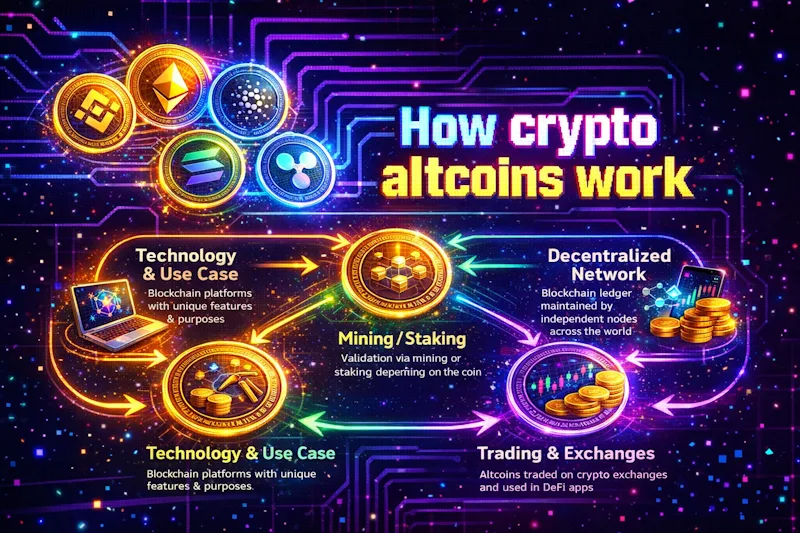
A single category holds digital assets built either atop independent blockchains or within established platforms. Depending on the system, these function under distinct agreement protocols, availability structures, total users, and network breadth. Through participation, some help validate transactions by locking funds. Others simply cover costs while operating software tools. This explains how identical-looking trends might hide entirely separate inner workings.
The moving parts are easier to see one by one.
- Consensus mechanism – The rule set that validates transactions
- Tokenomics – Supply cap, emissions, burns, and unlock schedules
- Utility – What the token lets users do
- Network effect – How many developers, users, apps, and exchanges support it
Once these parts change, the project category often changes too.
Why Altcoins Appeared
Following Bitcoin’s limited scope, fresh initiatives arose as alternative coins addressed unmet needs. Where one project sought speed, another pursued cost reduction in transfers. Smart contract capability drew interest here; transaction privacy attracted focus there. Movement across blockchains became a priority for some, while others emphasized decisions guided by community votes. Clarity around the nature of these alternatives revealed a trend. Function defines the groups they join, not popularity or noise.
Types and Categories of Altcoins
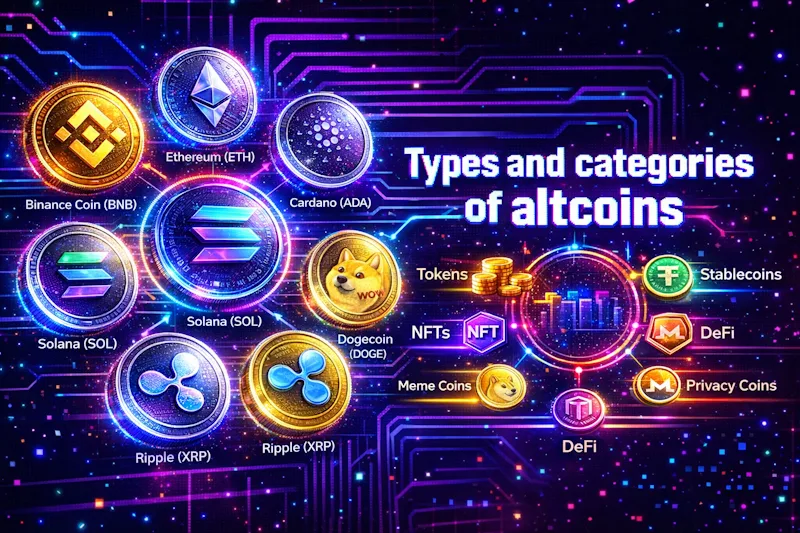
What a coin aims to achieve becomes clear through its category, while grouping altcoins by purpose brings clarity. Blockchain support comes from platform coins, each designed for network funding. Price steadiness defines stablecoins, their goal set around consistency. Influence in decisions emerges with governance tokens, access granted through ownership. Sorting the broad market this way results in something practical – a guide shaped by role rather than name.
Here is the fast map before the deeper breakdown.
| Type | What it is for | Examples |
|---|---|---|
| Platform coins | Run smart contracts and apps | Ethereum, Solana, Cardano |
| Payment coins | Transfers and settlement | Litecoin, XRP▲$1.39, Bitcoin Cash |
| Stablecoins | Price stability and collateral | USDC▼$0.9998, USDT▼$0.9996, DAI▼$1.00 |
| Utility tokens | Access to a product or service | BNB▲$723.92, BAT, GRT |
| Governance tokens | Voting in protocol decisions | UNI▲$6.32, AAVE▼$125.97, MKR |
| Privacy coins | Transaction confidentiality | Monero, Zcash |
| Interoperability coins | Cross-chain communication | Polkadot, Cosmos |
| Meme coins | Community and market attention | Dogecoin, Shiba Inu |
| Fork-based coins | Code or chain branches | Ethereum Classic, Bitcoin Cash |
From here, each group deserves its own short explanation.
Platform Altcoins
Not every coin serves the same purpose; some form the base layer where applications operate. Fees emerge through usage, tied directly to transaction validation and system upkeep. Security grows stronger as participation increases across nodes and validators. Staking appears naturally within these systems, rewarding long-term commitment. When builders favor a network, activity expands quietly behind the scenes. Demand follows adoption, though slowly, shaped by real utility rather than speculation. Ethereum leads not by claim but by presence, joined by Solana and Cardano in function. Infrastructure reveals itself over time – less visible until relied upon heavily.
Expert comment — Chris Dixon, Founder and Managing Partner at a16z crypto: In Why Web3 Matters and Tokens: A New Digital Primitive, Dixon frames blockchains as user-owned infrastructure and tokens as a tool that aligns builders and users around network growth. That lens fits platform altcoins well, because their native asset is not just traded — it helps coordinate fees, incentives, and application activity across the chain.
Payment Altcoins
Focusing on moving money efficiently, payment altcoins prioritize fast settlements alongside reduced costs. Fewer intermediaries appear here when compared to traditional frameworks or sluggish blockchains. Positioned near real-world transactions, these assets serve purposes distinct from backend platforms. Litecoin emerges as one example now, along with XRP and Bitcoin Cash appearing in similar roles.
Stablecoins
Despite frequent mention alongside altcoins, stablecoins serve another purpose entirely. Not tied to speculative gains, these assets target consistency – typically matching the US dollar. Found across shared trading platforms, they occupy portfolio space without chasing returns. Through reliability, they enable transactions, back obligations, and reduce exposure briefly. Pairs in markets commonly hinge on their steadiness.
The main stablecoin models look like this.
| Model | Backing | Example | Usual volatility profile |
|---|---|---|---|
| Fiat-backed | Cash and short-term government debt | USDC, USDT | Often under 0.5% daily move in normal periods |
| Crypto-backed | On-chain collateral, often above 100% | DAI | Often under 1% daily move in normal periods |
| Algorithmic or hybrid | Rules, incentives, or mixed support | Varies by design | Depeg risk can be sharp |
The peg matters, but backing and redemption rules matter more during stress.
Jeremy Allaire, Co-Founder, Chairman & Chief Executive Officer at Circle: In Payment Stablecoins Support the Dollar and U.S. Economic Competitiveness, Allaire explains stablecoins as digital dollars built for internet-scale transfer and settlement. That supports the key distinction in this section: stablecoins are usually used for payments, collateral, and liquidity management, while most volatile altcoins are used for directional exposure, network access, or governance.
Utility Tokens
A single utility token opens doors – entry to tools, reductions on costs, functions within networks, or tasks inside ecosystems. Value typically follows real activity rather than stories told by teams. Should engagement slow, confidence in the asset might fade regardless of wider market motion. This connection becomes visible when trading volumes drop. Quiet periods test reliance on function.
Governance Tokens
Those who hold governance tokens gain the ability to guide a protocol by casting votes or submitting structured suggestions. Changes might touch emission schedules, how treasury funds are directed, handling of fees, or where incentives flow – depending on system structure. Yet actual participation tends to remain limited in many cases. As a result, decisions may rest within narrow circles despite broad token distribution. Over extended periods, such patterns introduce quiet imbalances into decision-making frameworks.
Common governance rights include the following.
- Vote on fee changes
- Approve treasury spending
- Adjust emissions and incentives
- Propose technical or policy updates
Voting power matters only if turnout and execution are real.
Miles Jennings, General Counsel & Head of Decentralization at a16z crypto: In Decentralization for Web3 Builders and Defining decentralization: It comes down to control, Jennings argues that governance only works when control is meaningfully distributed, not when voting exists on paper alone. That is a useful test for governance tokens: formal voting rights matter far less if treasury keys, upgrades, or core decisions still depend on a small inner circle.
Privacy Coins
Hidden details in transactions – like who sends, who receives, or how much – is the main aim of privacy coins. This emphasis shapes distinct risks. Users seeking secrecy may lean toward these assets, yet regulators often respond with tighter controls. Availability might shift suddenly if an exchange updates its stance. Such changes arrive without warning when platforms revise their rules.
Jerry Brito, Co-founder of Coin Center: In The Case for Electronic Cash, Brito argues that a world without private digital cash becomes a world where every transaction is intermediated, recorded, and easier to control. That helps explain why privacy coins remain a distinct category: for some users, their value is not speed or yield, but the ability to reduce financial surveillance and preserve transaction autonomy.
Interoperability Coins
Interoperability coins try to connect separate blockchains so data, tokens, and liquidity can move between systems. Their market role is connective rather than isolated. If the links work, users spend less time bridging value through manual steps. That can reduce friction for wallets, apps, and trading routes across many chains.
Meme Coins and Forks
One category does not fit both meme coins and forks. Driven by online trends, community energy powers the rise of meme-based tokens. Whereas protocol changes spark the creation of a fork, branching off from established code. Up to the divergence, shared transaction records remain intact – a detail frequently overlooked. History carries forward at the moment of separation, unlike fresh token launches.
It helps to separate the two with one simple check.
- Meme coin – A token driven mainly by community and market attention
- Fork – A split from an existing codebase or chain history
That split avoids many beginner mistakes.
Popular Altcoins: Examples by Category
A table listing well-known altcoins turns abstract ideas into clear names. Yet in reality, these digital currencies occupy entirely separate spaces within the financial landscape. While one handles payments inside software platforms, a second maintains stability against traditional money, whereas a third transfers assets between networks. This variety explains why understanding purpose comes before considering cost when selecting any coin.
This reference table is not a ranking. It is a function map.
| Coin | Category | Key function |
|---|---|---|
| Ethereum | Platform coin | Runs smart contracts and pays gas |
| Solana | Platform coin | High-throughput base layer for apps |
| Cardano | Platform coin | Smart contract chain with staking |
| Litecoin | Payment coin | Faster transfers with lower block time than Bitcoin |
| XRP | Payment coin | Focus on settlement and transfer efficiency |
| USDC | Stablecoin | Digital dollar for settlement and collateral |
| DAI | Stablecoin | Crypto-backed stable value |
| BNB | Utility token | Pays fees and supports ecosystem actions |
| BAT | Utility token | Powers rewards inside a browser ecosystem |
| UNI | Governance token | Votes on Uniswap protocol changes |
| AAVE | Governance token | Governs lending market parameters |
| Monero | Privacy coin | Hides transaction details |
| Zcash | Privacy coin | Offers shielded transaction options |
| Polkadot | Interoperability coin | Connects multiple chains |
| Cosmos | Interoperability coin | Supports cross-chain communication |
| Dogecoin | Meme coin | Community-driven payment meme asset |
| Ethereum Classic | Fork-based coin | Preserves a chain branch after a split |
The point is not to rank them. It is to match function with category.
Altcoins vs Stablecoins
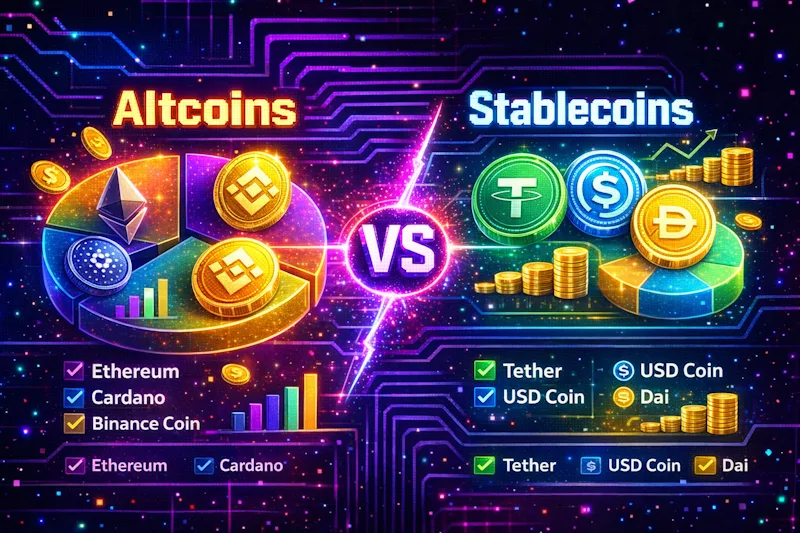
People often group stablecoins with the rest of crypto, yet altcoins and stablecoins solve different problems. Most altcoins are volatile and seek growth from network use or market demand. Stablecoins try to stay near a reference price, often 1 US dollar. In practice, traders use stablecoins as parking space, while volatile tokens carry more directional risk.
A direct comparison removes most of the confusion.
| Parameter | Altcoins | Stablecoins |
|---|---|---|
| Main goal | Growth, utility, governance, network access | Price stability and settlement |
| Typical daily move | Often 3% to 20%+ | Often 0% to 1% in normal periods |
| Main portfolio role | Directional exposure | Parking capital, collateral, payments |
| Key risk | Volatility, liquidity, execution | Depeg, reserve, issuer, regulatory |
| Upside profile | Open-ended but uneven | Limited by peg design |
Confusion falls fast once role and price behavior are separated.
Benefits and Risks of Altcoins
Clearly, altcoins gain attention when moving beyond catchphrases. Access unfolds toward distinct networks, alternative cost structures, decision-making roles, because Bitcoin focuses elsewhere. Yet difficulty arises just as often. Liquidity stays narrow across numerous initiatives, progress stalls frequently, incentive frameworks lack balance while usage fails to grow past brief financial phases.
A fair view needs both sides on one screen.
| Pluses | Minuses |
|---|---|
| New functions beyond Bitcoin | High volatility |
| Exposure to network growth | Thin liquidity on smaller assets |
| Access to DeFi, governance, and app ecosystems | Unlock and dilution risk |
| More use cases across sectors | Team and execution risk |
| Early-stage upside in some niches | Security, bridge, and custody risk |
The same feature that creates upside can also raise risk.
How to Buy Altcoins Step by Step
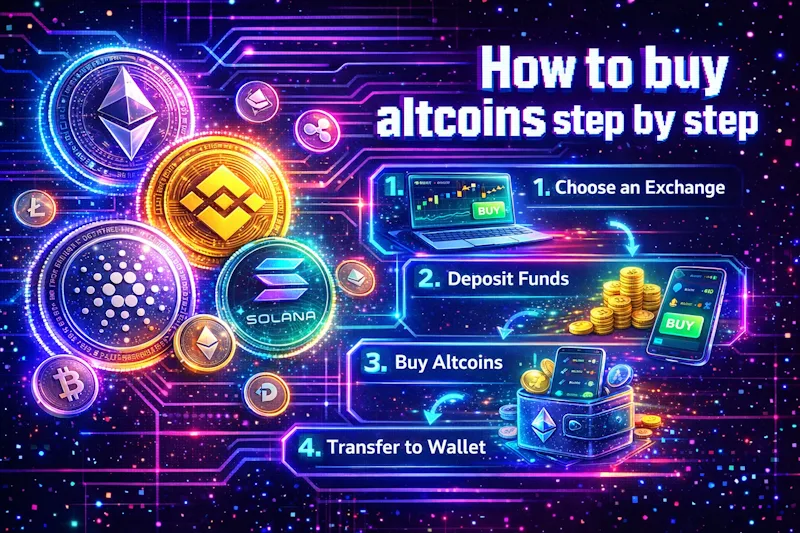
Pressing buy seems straightforward, yet preparation defines outcome. Though many tutorials ignore it, verifying the blockchain matters greatly. Funds may freeze, cost spikes occur – without correct chain selection. Start by confirming exchange listing first. Token operates on specific networks; pick matching one. Storing crypto needs a clear strategy set early. Transaction expenses differ across platforms. This sequence prevents common errors. Few mention these steps, most rush ahead. Order execution follows thoughtful checks.
The safest path is usually simple and repeatable.
- Choose an exchange or broker that lists the exact asset and trading pair.
- Check whether the asset is a native coin or a token on a specific network.
- Verify the token contract on the official asset page before buying or withdrawing.
- Create a wallet if needed, and confirm it supports the same network.
- Review trading fee, withdrawal fee, spread, and minimum withdrawal amount.
- Buy a small test amount first when using a new chain or wallet.
- Decide whether to keep the asset on exchange or in self-custody.
A small test transaction is slow, but it saves expensive errors.
How to Evaluate Projects and Search for Best Altcoins
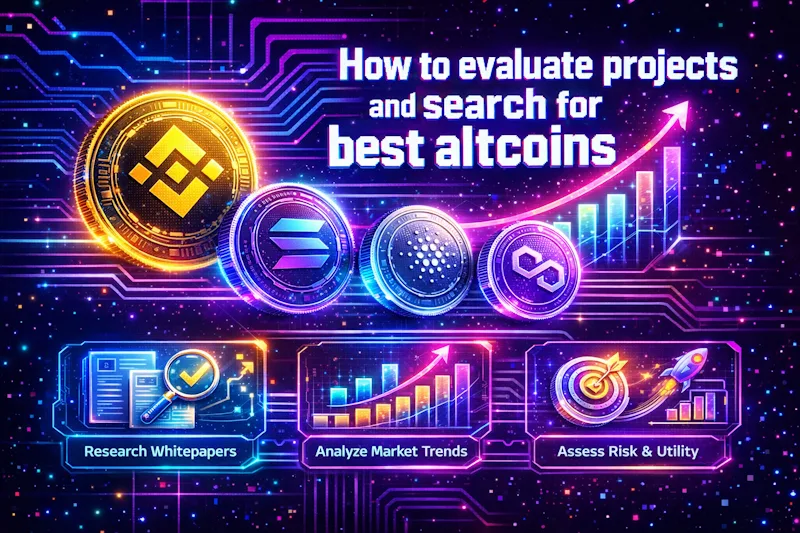
Best altcoins seems clear at first glance – yet functions mainly as a keyword. Evaluation improves once digital assets are seen not as symbols, but as systems, economic models, even financial statements. Success might rest with coding momentum here; elsewhere, trading volume or income generation takes lead. Objectivity emerges through structured review, one that shifts focus from price to function. What matters grows clearer when comparisons follow consistent rules.
The main checks should stay practical.
- Utility and real product demand
- Team visibility and execution record
- Tokenomics, including supply, emissions, burns, and unlocks
- Liquidity and exchange depth
- Smart contract and bridge security
- Roadmap progress and developer activity
- Governance structure and treasury use
- User growth and market fit
No single item decides the case. The pattern across them does.
Bobby Ong, Co-Founder of CoinGecko: In Understanding CoinGecko Developer Metrics and on his CoinGecko author page, Ong makes a practical point that still gets overlooked in retail analysis: a live token needs active builders. That is why a checklist for finding best altcoins should go beyond market cap and include development activity, product updates, and whether the team is still shipping.
What Matters in Top Altcoins and Market Lists
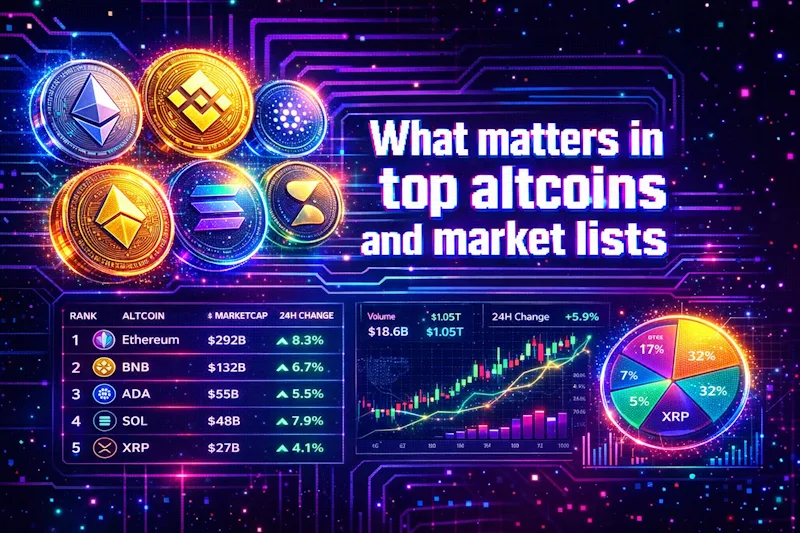
Despite common reliance on market capitalization, sheer scale fails to reflect real-world use, team progress, or upcoming need. High placement may stem from increased token availability rather than strength. Low position might hide active coding work behind the scenes. Sorting by biggest, quickest climb, or strongest return within a set period reveals distinct patterns. Each method draws boundaries in its own way.
The list title tells you more than many readers expect.
| Type of list | What it shows | Main limit |
|---|---|---|
| Market cap | Current size rank | Does not show code quality or demand durability |
| 24h gainers | Short-term price momentum | Often distorted by thin liquidity |
| 30d or 90d performers | Return over a set period | Depends on start and end date |
| Volume leaders | Trading activity | Volume can rise during stress, not quality |
| Yield screens | Staking or incentive rate | High yield can hide inflation or subsidy |
Read the label on the list before reading the coin names.
How to Read Top 10 Altcoin Lists
A ranking of ten alternative coins often relies on market capitalization instead of software strength or potential gains. While helpful for assessing scale and trading ease, this approach falls short when identifying emerging projects. Even if momentum fades, long availability, extended history, and wide listing access may lift a token’s position. Earlier promises do not always reflect later standing.
Why Top Gaining Altcoins Do Not Always Fit a Buy Plan
Appearing on a list of fast-rising cryptocurrencies does not confirm stability. Thin trading activity may amplify price jumps instead of strong value shifts. One headline alone sometimes triggers sharp swings across minor assets. Large percentage gains might reflect limited sell orders rather than improved outlooks. Entry points following rapid climbs tend to carry broader gaps between buy and ask prices. Late participation introduces greater exposure when momentum fades unexpectedly.
What Top Performing Altcoins Really Mean
Lists of top performing altcoins depend on the window, such as 7 days, 30 days, or one year. A coin can lead one window and lag another. Performance screens describe what already happened. They do not prove product demand, balance sheet strength, or cleaner risk for the next cycle ahead.
How to Read Top Altcoins to Invest
Queries for top altcoins to invest reflect investment intent, not an education category. Before using that label, set a time horizon, acceptable drawdown, sector focus, and exit rule. Without those filters, two readers can use the same list and build opposite portfolios because their goals and limits are different too.
The basic filters should be written down first.
- Time horizon – Weeks, months, or years
- Risk budget – Maximum drawdown you can accept
- Sector focus – Platform, payments, DeFi, privacy, interoperability
- Liquidity plan – Where you enter and how you exit
Those inputs turn a vague search into a usable filter.
Where to Follow the Market and Altcoins News
Tracking good altcoin news means looking beyond charts and announcements. What happens before price shifts? Often listings, unlocks, validator adjustments, voting outcomes, bridge failures, or supply reductions. A standard token release might weigh heavier than a collaboration reveal. Timing plays a role. So does scale. Also, how expected the development was. Sentiment turns on details others overlook. Event context shapes reaction. Market anticipation influences impact.
The most useful event groups are usually these.
- Exchange listings and delistings
- Token unlocks, emissions, burns, and treasury transfers
- Network upgrades, outages, validator changes, and fee model updates
- Governance proposals, partnerships, lawsuits, and regulatory actions
That mix explains why one headline can move the price while another does almost nothing.
FAQ
Do all altcoins compete with Bitcoin in the same way for users?
No. Several popular altcoins serve as infrastructure, payments, governance, or stable pricing tools. Bitcoin is usually treated as the base settlement asset. Many other networks target specific jobs, so they do not all compete on the same field.
Why can a token rise fast even when the product is still weak?
Fast rallies can come from thin liquidity, short covering, or one headline. Lists of best altcoins should never be built from one day of price action. Check volume, order depth, unlocks, and user activity first.
Is a stablecoin part of the altcoin market or a separate tool?
Stablecoins often trade inside the altcoin market, but their role is different. Most seek price stability near a reference asset. Volatile tokens seek growth or network utility, while stablecoins act more like settlement and collateral tools.
What should I check first before I buy a token on any exchange?
Start with the network and the token contract. Many losses come from sending a token over the wrong chain or copying an old contract address. Fees, storage, and liquidity matter next.
Can a large market cap hide weak demand or poor token design?
Yes. Many top altcoins screens rank size, not product demand, fee revenue, or governance quality. Market cap can stay large because of supply, exchange access, and old brand recognition.
Which news events matter most when I track a crypto project?
Useful altcoins news includes listings, unlocks, network upgrades, governance votes, bridge issues, and regulatory actions. These events change access, supply, or security, which often matters more than a simple price headline.
Disclaimer: This section is for educational purposes only and does not constitute investment, legal, or tax advice. Token availability, custody options, fees, and reporting obligations can differ by platform and jurisdiction, so readers should verify the rules that apply to them before making any transaction.