Bernstein analysts are keeping their “ambitious” $150,000 year-end target for bitcoin. They say growth will be driven by the gradual maturation of the crypto market.
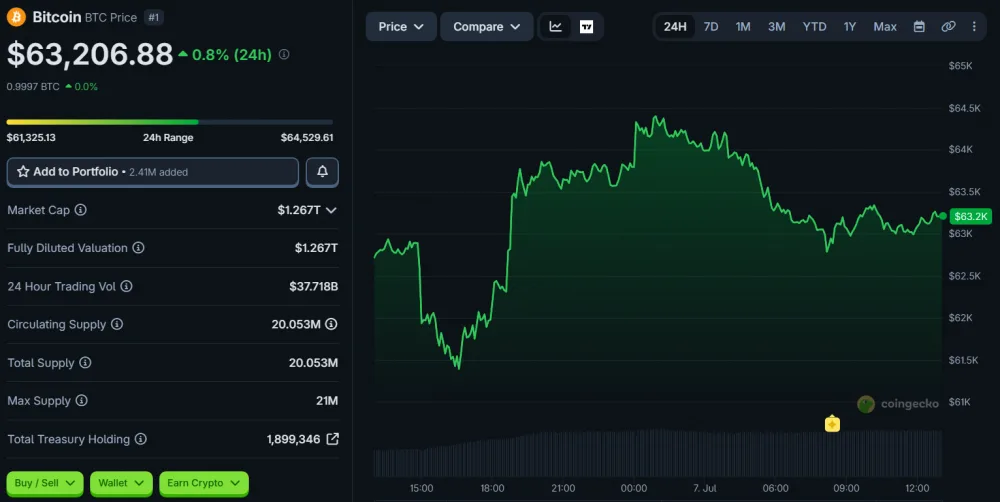
Investment bank Bernstein has reaffirmed its $150,000 year-end bitcoin (BTC) target, calling it “ambitious” but justified. At the time of publication, bitcoin trades at roughly $63,200, more than two times below that target. Over the past seven days, the cryptocurrency has risen 6.5%.
Hot topic: US Strategic Bitcoin Reserve Plans Stalled — What Happened?
The current correction stands at 54% from the October 2025 peak–significantly milder than the 75%-90% drawdowns seen in previous cycles. Bernstein called this a sign of crypto market maturation but warned it’s unclear whether the market has fully exited its downturn phase, as the correction has lasted three quarters–shorter than the historical 12-15 months.
Contents
Capital Flows and Strategy: Why Things Aren’t That Bad for Bitcoin
Total inflows from corporate treasuries and U.S. spot bitcoin ETFs in 2026 have reached $10B–a sharp drop from $60B in 2025. Spot bitcoin ETFs have lost $5.5B, with total assets at $74B.
However, treasury companies–led by Strategy–have provided net positive capital inflows. Bernstein argues that the $5.5B ETF outflow against a $74B asset base, combined with a 50% price correction, has made market sentiment look worse than actual flow dynamics.
Strategy remains a net buyer. In 2026, the company has acquired about 175,000 BTC for $14B, increasing its reserves to 847,363 BTC. Nevertheless, on July 6, the company sold 3,588 BTC worth roughly $80.8M. Strategy chairman Michael Saylor has never wavered in his bitcoin commitment and even believes the cryptocurrency will become a global means of payment within the next decade. But the sales are still rattling investors.
Bitcoin Miners Pivot to AI, Regulation Remains a Driver
Strategy’s bitcoin accumulation is offsetting sales from major US miners, which are shifting capacity to AI data centers. Bernstein expects the largest US-listed miners to fully exit bitcoin mining. Their hashrate share will be absorbed by international operators from Southeast Asia, Central Asia, and Latin America.
Network hashrate has fallen about 11% since the start of the year. The US miners’ share has declined by more than 40 basis points over two quarters, while emerging market miners’ share has grown by roughly 100 basis points.
Regulatory momentum remains. Work continues on stablecoin rules under the GENIUS Act, and perpetual crypto futures are launching in the US through Kalshi and Coinbase. Bernstein puts the odds of CLARITY Act passage in 2026 at roughly 50/50, citing Polymarket data.
Learn more: Is the Bitcoin (BTC) Bottom Finally In? What On-Chain Data Says About BTC’s Next Move