AI mining crypto refers to mining systems that use automation, predictive models, and data-driven tools to support cryptocurrency mining. Machines still perform the actual work, while AI helps adjust operations, improve efficiency, balance power consumption, and choose more profitable mining routes.

Most AI-driven cryptocurrency mining in 2026 resembles evolved cloud-based mining. Equipment ownership fades into the background for users. Power consumption, cooling, machine maintenance, and configuration are handled by the provider. Users access mining through contracts, leased computational strength, or token-backed mining models.
Even so, extracting cryptocurrency through artificial intelligence carries uncertainty. Profitability ties to Bitcoin’s value, network difficulty, service charges, contract conditions, electricity expenses, and the transparency of the operator.
Contents
AI Mining in Crypto Explained
AI Mining Definition in Crypto Ecosystem
The most basic AI mining explained definition begins here: within cryptocurrency, a self-running system uses software to study network activity and market trends so mining efficiency improves over time.
Read more: Bitcoin Mining Standard Gets Support From Foundry, AntPool and F2Pool
The crypto AI mining meaning usually includes hardware setups that provide computing power, tools that monitor earnings potential and blockchain metrics, and automated systems that distribute resources based on changing conditions.
So, what is AI mining in crypto? It is not effortless profit. It is mining supported by adaptive algorithms, optimization tools, and automated decision-making.
AI Mining vs Traditional Cloud Mining Models
With traditional cloud mining, a set amount of processing strength is assigned to users for a defined duration. Equipment operation rests entirely with the service operator, and payouts follow once expenses and usage charges are deducted.
Cloud AI mining crypto adds another layer. When conditions shift, the setup may alter mining pathways, change pool selection, monitor hardware performance, or redistribute computational power in real time.
Subtle distinctions may exist. Some AI crypto mining platforms remain ordinary cloud-based services, merely offering updated interfaces and promises of improved efficiency.
Role of AI in Hashrate Optimization and Profit Switching
AI hashrate optimization uses live information to adjust how mining capacity gets used across networks. Monitoring may include electricity cost, hardware function, Bitcoin’s market value, network difficulty, pool rewards, and projected results.
A profit switching mining algorithm can reallocate processing effort automatically when earnings change. That explains why AI mining algorithm crypto language appears so often in promotional material. Equipment still performs the work; intelligence layers only adjust how it is used.
Read more: Top 5 TON Ecosystem Projects in 2026: Best TON Crypto to Buy, DeFi Leaders & Telegram Gems
Why Most “AI Mining” Platforms Are Cloud Mining Systems
Despite the branding, artificial intelligence used in cryptocurrency mining often relies on remote facilities. Bitcoin mining requires specialized ASIC hardware, data centers, reliable power supply, cooling systems, and stable operations.
First comes confirmed computational work. A steady flow of earnings follows only when costs are open, predictable, and honestly calculated. Trust grows where withdrawals happen without delay and mining operations can be seen, not merely described.
How AI Mining Platforms Generate Crypto Earnings
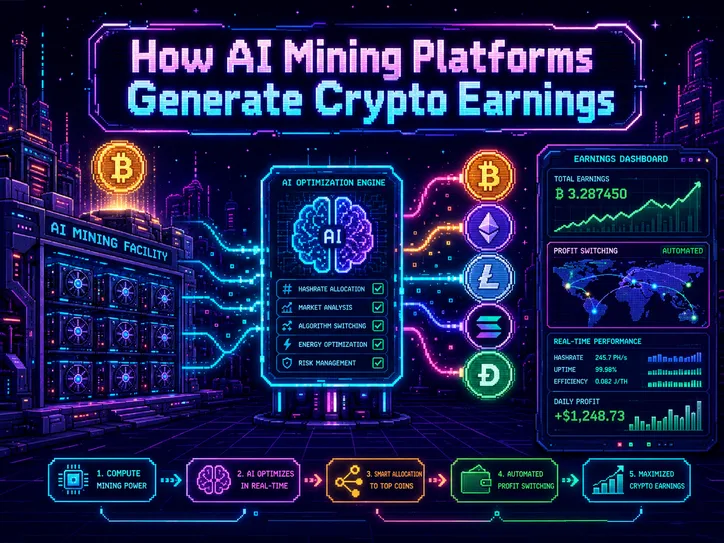
AI mining platforms create crypto earnings through managed hardware, leased processing strength, or hashrate marketplaces. The platform runs mining cycles, subtracts costs, and distributes returns according to individual contract terms or participation records.
Automated Hashrate Allocation Across Multiple Coins
One approach divides processing power among Bitcoin, Litecoin, Dogecoin, and other proof-of-work cryptocurrencies. Another method dedicates resources almost entirely to BTC▲$62,630.00.
When market conditions change, an automated crypto mining system adjusts operations. If profitability drops for a single coin, the program may shift computing power elsewhere. Flexibility across multiple cryptocurrencies is still uncommon.
AI-Based Profitability Switching Algorithms
Cloud mining AI optimization relies heavily on how well the platform calculates returns. Not every model looks beyond market value and blockchain difficulty. Some go further, factoring in mining pool consistency, reward fluctuations, electricity pricing, equipment performance, uptime, and price volatility.
This is how AI mining works crypto platforms usually present their value: reduced reliance on personal judgment, quicker response times, and steady targeting of higher-yield mining paths.
Energy Efficiency Optimization in Mining Data Centers
Power ranks among the top expenses in mining operations. In 2026, leading operators distinguish themselves through optimized hardware, effective thermal control, affordable energy sources, and stable infrastructure.
When AI oversees cryptocurrency mining operations, equipment performance drops can be spotted early. Configuration changes follow system feedback rather than manual checks. Downtime may decline as adjustments happen proactively. Across large machine fleets, minor improvements add up.
Passive Income Structure and Reward Distribution Models
Most passive crypto mining systems rely on fixed contracts, but some use marketplaces where hashrate trades between buyers and sellers. Hosted solutions appear elsewhere, while token-based structures, sometimes shaped as NFTs, link digital ownership to mined output.
AI mining passive income crypto may offer ease, but ease brings no guarantees. Daily earnings cloud mining crypto can drop sharply if Bitcoin falls, network difficulty rises, or service charges change.
Related: Best Crypto Exchange Platforms in the US 2026 — Picks for Fees, Liquidity, and App Access
Key Features of AI Mining Platforms in 2026
Among 2026’s top AI mining services, claim volume matters less than substance. The best AI mining platforms 2026 combine real operations, open conditions, smooth automation, and reliable withdrawals.
Cloud Mining Infrastructure vs Marketplace Models
Computing resources may be accessed through agreements offered by cloud-based mining systems. On marketplaces, those seeking processing capacity meet providers willing to supply it.
Bitdeer, BitFuFu, and ECOS operate closer to cloud mining infrastructure models. NiceHash allows users to trade processing capacity through an open marketplace. GoMining introduces blockchain-backed tokens that represent mining power.
Transparency of Hashrate and Mining Data
What sets trustworthy cloud mining services apart is openness. Clear indicators include visible hashrate, costs, service charges, mined coins, supported digital currencies, and withdrawal policies.
Weak platforms obscure basic details. Despite claims of steady gains, clarity on reward generation remains absent. When terms such as “AI arbitrage mining” appear without explanation, meaning fades.
Supported Assets (BTC, Altcoins, GPU Compute)
Bitcoin remains prominent in 2026 across many best crypto cloud mining sites 2026. Alongside it, some providers support Litecoin, Dogecoin, or GPU-based computation.
One reason Bitdeer draws attention is its reach across Bitcoin mining, cloud services, hardware supply, data operations, and high-performance computing. NiceHash is defined by its marketplace approach, where users can choose varied mining methods.
Risk Management and Platform Security Systems
Account security matters because users depend on the system to manage access, monitor rewards, handle withdrawals, and connect to mining infrastructure.
Key aspects include two-factor authentication, KYC/AML procedures when applicable, open fee details, withdrawal history, public corporate structure, and documented operational track record.
Risks of AI Mining Platforms
Useful though it may seem, AI-driven cryptocurrency extraction carries risks obscured by frequent exaggeration. Suspicion follows any offer that assures fixed daily returns.
Centralization Risks in Cloud Mining Providers
Centralized structure defines cloud mining at its core. Control of hardware rests entirely outside user reach. Machine management, energy contracts, pool configurations, and operational choices all sit with the provider.
If fees increase, access freezes, agreements shift, or systems fail, user influence remains minimal. Convenience through remote mining always brings these constraints.
Lack of Verifiable On-Chain Mining Proof
Most contracts fail to clearly link user agreements to actual mining results. Some providers share facility details, performance updates, or network strength measures. Others display nothing beyond interface figures.
When on-chain verification is missing, trust shifts toward past withdrawals, operating history, and reputation. Without clear proof, transparency becomes even more important.
ROI Volatility and Market Dependency
AI mining profitability 2026 relies heavily on Bitcoin’s market value, network difficulty, energy pricing, equipment performance, service fees, and maintenance charges.
For this reason, crypto cloud mining ROI 2026 remains uncertain. Performance may fall short, even with legit cloud mining platforms, if mining conditions weaken.
Related: What Is ROI? Complete Guide to Return on Investment and How to Calculate It
Scam Patterns in AI Mining Platforms in 2026
Common scam signals include unrealistic promises of steady daily profits, missing infrastructure details, absent company background, vague “AI trading plus mining” claims, referral-heavy payouts, early small withdrawals followed by later delays, hidden fee structures, and no clear hashrate explanation.
The question “is AI mining profitable” lacks a one-size-fits-all conclusion. Under specific circumstances, returns may occur. However, deceptive actors frequently apply artificial intelligence terminology to disguise simple scams as advanced systems.
Criteria for Choosing the Best AI Mining Platforms
With passive income from crypto mining, advertised returns tell only part of the story. What lasts often outweighs what impresses at first glance. Reliability tends to beat short-term promises.
Profitability and Historical ROI Consistency
Expect plausible returns, historical results, visible fees, and clear contracts. Platforms suggesting excessive profits without detailing operational realities should be set aside.
Withdrawal Reliability and Liquidity Access
If access to earnings is restricted, a platform loses purpose. Review minimum withdrawal amounts, supported payout currencies, transfer duration, and past payment issues.
Level of Automation and AI Optimization
A well-built AI-driven mining system gives clear details about its automated functions, such as tuning hashrate, shifting between algorithms, refining hardware output, lowering power demands, or overseeing pool operations.
When “AI” serves purely as a label without function, higher rankings are unwarranted.
Regulatory Standing and Market Reputation
Attention tends to favor established entities: publicly listed firms, officially registered providers, or companies operating transparent infrastructure. Registration alone cannot eliminate danger, but it often separates less credible ventures from those with measurable presence.
Top 5 Best AI Mining Platforms in 2026
Among cloud-based mining solutions tied to artificial intelligence, certain services distinguish themselves through operational scale, automation, transparency, or ease of access. The five platforms below represent different ways to approach how to earn crypto with AI mining in 2026.
Bitdeer – Institutional-Grade Mining Infrastructure
Among global players in Bitcoin mining infrastructure, Bitdeer holds notable presence. Operations include self-run mining activities, cloud-based solutions, miner support, data center management, and systems tied to artificial intelligence and high-performance computing.
For users researching bitdeer cloud mining review topics, scale stands out first. Bitdeer is not a casual platform; it operates like a publicly traded entity with documented reports and visible operations.
Best for: users seeking advanced-level access to professional mining operations.
Main drawback: availability may differ by region, while outcomes remain tied to mining market fluctuations.
BitFuFu – Scalable Cloud Mining for Retail and Institutions
The BitFuFu mining platform offers remote access to Bitcoin mining through cloud-based systems. Instead of purchasing hardware, users may rely on its infrastructure to participate. Equipment setup, hosting, and maintenance are handled externally.
For everyday users and larger participants, BitFuFu holds value because of its expandable mining capacity and adaptable resource allocation.
Best for: users seeking flexible cloud mining contracts.
Main drawback: profitability remains tied to contract terms, Bitcoin’s value, fees, and network difficulty.
ECOS – Regulated Cloud Mining Platform with Fixed Contracts
Years of operation mark ECOS, drawing attention when users search whether ecos cloud mining legit claims hold up. Its model centers on structured access, KYC/AML standards, and fixed cloud mining contracts.
Because the contract terms are clear, beginners may find the platform easier to understand. A straightforward layout replaces marketplace complexity.
Best for: beginners who want a direct first step into cloud mining.
Main drawback: if markets shift, rigid agreements may deliver weaker results.
NiceHash – Hashrate Marketplace with Dynamic Profit Switching
A marketplace forms the core of NiceHash. Through this system, buyers seeking processing power meet sellers offering it. This structure sets it apart from conventional cloud mining platforms.
NiceHash profit switching is a key reason users consider the platform. It supports multiple mining methods and allows adaptation based on market demand and earning potential.
Best for: users seeking greater control within a market-driven mining approach.
Main drawback: newcomers may struggle with complexity, while income levels can change quickly.
GoMining – NFT-Based Bitcoin Mining Model with Passive Income
GoMining offers ownership of mining capacity through digital tokens backed by Bitcoin production. Rather than handling hardware, users receive access through NFT-based rights.
Interest in the GoMining NFT mining platform comes from its straightforward approach. Accessibility, mobile integration, and passive BTC rewards shape much of its appeal.
Best for: users who want automated mining paired with digital ownership.
Main drawback: results depend on GoMining’s ecosystem, NFT liquidity, and reward design.
Comparison of Top 5 AI Mining Platforms
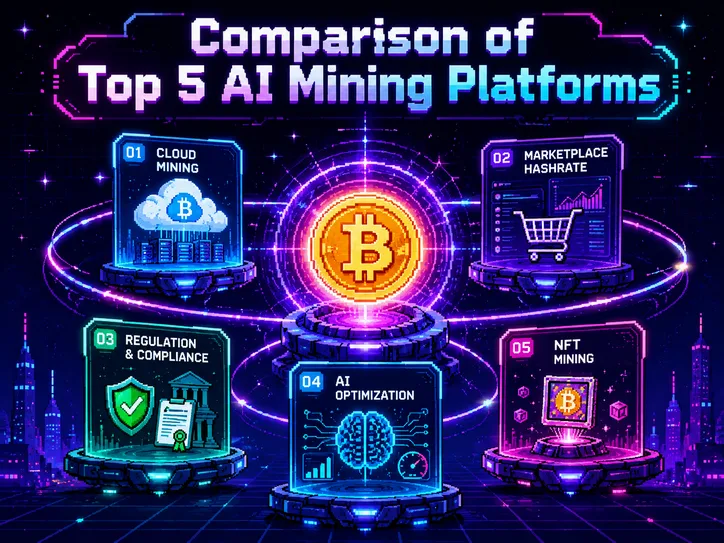
Bitdeer vs BitFuFu vs ECOS vs NiceHash vs GoMining
| Platform | Model | Best For | Main Strength | Main Risk |
|---|---|---|---|---|
| Bitdeer | Mining infrastructure and cloud mining | Professional exposure | Scale and reporting | Market volatility |
| BitFuFu | Cloud and hosted mining | Retail and institutional users | Flexible capacity | ROI changes |
| ECOS | Fixed cloud mining contracts | Beginners | Simplicity | Limited flexibility |
| NiceHash | Hashrate marketplace | Advanced users | Dynamic profit switching | Complexity |
| GoMining | NFT-linked BTC mining | Passive income users | Easy access | Platform dependency |
Best Platform for Beginners
For those starting out, ECOS stands out because of straightforward cloud mining with set conditions. GoMining also suits newcomers drawn to mobile-driven, hands-off cryptocurrency earning methods.
Best Platform for Maximum Yield Seekers
Maximum returns may attract some users to NiceHash because its marketplace setup enables finer choices. Still, added freedom often means extra steps and deeper involvement.
Bitdeer may suit users who want access to extensive mining setups while avoiding daily marketplace decisions.
Best Platform for Long-Term Passive Income Strategy
When aiming at lasting returns without active effort, Bitdeer may suit users focused on scale. BitFuFu fits those who prefer structured cloud mining access. GoMining enters where digital miner ownership matters most.
Scale comes through Bitdeer. Structured access arrives via BitFuFu. Digital miners emerge under GoMining’s model. Market exposure remains across all options, so users should compare fees, contract duration, withdrawal conditions, and projected returns before committing funds.
By 2026, AI mining crypto may offer practical value. Top performers stand out by explaining income methods clearly, showing operational frameworks transparently, and maintaining consistent withdrawal access. Clarity in function and financial flow defines dependable services better than the word “AI” itself.
FAQ
What is AI mining in crypto?
AI mining in crypto means using automation, algorithms, or AI-assisted systems to improve cryptocurrency mining operations. Most platforms are cloud mining services that adjust hashrate, power use, profitability, or reward distribution with adaptive software.
Is AI mining profitable?
AI mining can be profitable, but outcomes rely on Bitcoin’s price, network difficulty, power costs, provider fees, and contract terms. Promises of guaranteed gains often signal risk.
What are the best AI mining platforms in 2026?
The best AI mining platforms 2026 include Bitdeer, BitFuFu, ECOS, NiceHash, and GoMining. Each operates under a different model, from physical infrastructure and cloud mining to hashrate marketplaces and NFT-linked mining.
How does AI mining work in crypto?
AI mining works through automated processes. Software manages hardware use or hashrate access, tracks profitability, assigns resources, and issues payouts according to individual agreements or mining shares.
Is cloud AI mining crypto safe?
Cloud AI mining crypto can be safer when the operator is transparent, reputable, and realistic about returns. The main risks are centralized control, weak proof of mining activity, withdrawal delays, market volatility, and fraudulent services using AI branding to attract users.