For many first-time readers, what is bitcoin sounds technical, but it is about money rules. Bitcoin is a digital asset bitcoin that moves on a public network without banks in the middle. When someone asks what is btc, it means the ticker used on exchanges and wallets. On trading screens, what is btc appears next to pairs like BTC▼$77,272.00/EUR. Think in units and rules, not apps. Those rules define supply, transfers, and block validation.
Disclaimer (not financial advice) ⚠️ Crypto prices can move fast, and losses can be total. This guide explains concepts, not investment decisions.
Contents
How this material was prepared
The content was compiled from protocol documentation, major reference sources, and research reports. The goal is to explain how the system works, not to sell products. In practice, the query what is bitcoin shows up when people want rules, not hype.
What is a bitcoin and why it exists
A single what is a bitcoin question often hides two needs: storing value and sending value. The same phrase, what is a bitcoin, matters when you learn it is divisible into satoshis. One bitcoin is a scarce unit tracked by the network, not by a bank ledger. In Austria, many people first see BTC and EUR side by side in an app. That view can distract from the main point: controlling keys, not an account.
Bitcoin in one minute
If someone types bitcoin what is it into a search bar, they usually want a plain model of the system. In support chats, bitcoin what is it also appears after a withdrawal delay. Bitcoin is a shared ledger where new entries are grouped into blocks about every 10 minutes. Each block references the previous one, so history becomes hard to rewrite. No admin can “edit balances” on request. That design trades reversibility for clear settlement rules.
Here is the quick mental checklist
- 🧩 Fixed supply rule, capped at 21,000,000 coins
- 🔑 Ownership comes from a private key, not a name
- 🧾 Transfers are signed messages, broadcast to the network
- ⛏️ New blocks are added by Proof of Work
That model makes later details easier to follow without memorizing jargon.
How Bitcoin differs from crypto and from blockchain
Many newcomers ask what exactly is bitcoin and then mix it with “blockchain” or “crypto” as general terms. “Blockchain” is a data structure, “crypto” is a broad market, and Bitcoin is one specific protocol with its own rules. Confusion leads to wrong expectations, like assuming all networks have the same fees. A small comparison helps keep terms separated.
| Topic | Bitcoin | Other crypto projects | Blockchain as a concept |
|---|---|---|---|
| Main focus | Peer-to-peer value transfer | Many goals (apps, tokens, governance) | Data ordering and audit trail |
| Supply policy | 21,000,000 cap | Often changeable by governance | Not a currency rule |
| Typical block target | ~600 seconds | Varies by network | Not fixed |
Once the terms are separated, it is easier to judge claims and risks.
Where Bitcoin is used in practice
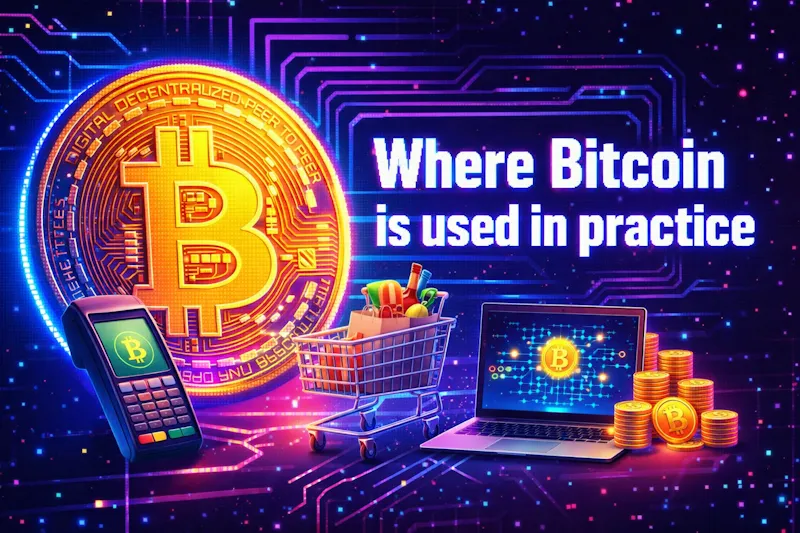
People search what is bitcoin used for when they want examples beyond charts. In the EU, a common use is moving value across borders outside banking hours. Another use is custody outside a broker account, which matters during bank holidays. Some also use it as a settlement layer between businesses that already handle FX. It is not the best tool for every purchase, but it can fit certain flows.
Common practical uses in Europe
- Cross-border transfers when SEPA timing is slow
- Travel backups for card outages
- Large online payments where chargebacks are risky
- Merchant acceptance via payment processors
After first use, most users notice that the hardest part is key management, not sending.
🏫 “Bitcoin’s value tends to sit in settlement neutrality and predictable issuance, not in promised cash flows. That makes valuation hard. Disputes are inevitable because people weigh dilution, censorship, and volatility differently. If you see it as gold, you focus on holding; if you see it as rails, you focus on fees.” — Dr. Lena Hofmann, Financial Economist.
How Bitcoin works in plain terms
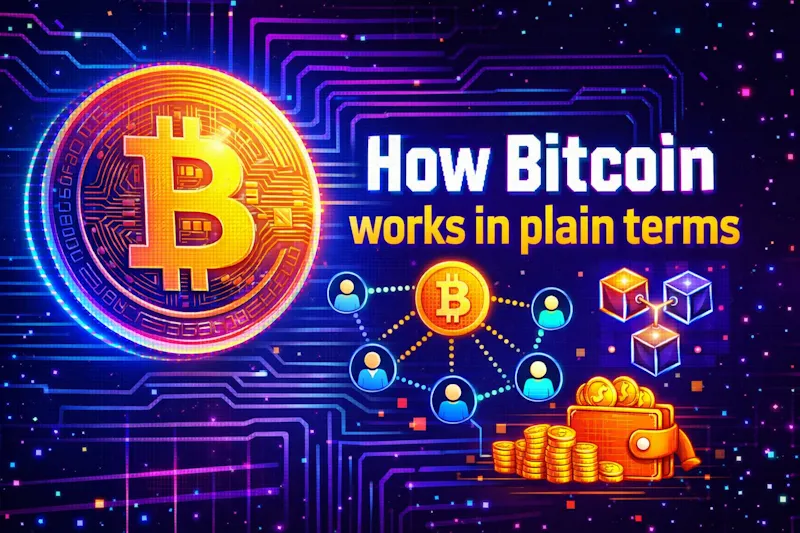
When a beginner reads what is bitcoin and how does it work, follow one transfer from wallet to confirmation. After a few test transfers, what is bitcoin and how does it work becomes a practical question about addresses and confirmations. A wallet creates a signed transaction. It says, “move these coins to this new address.” Nodes then check the signature under bitcoin rules and that the coins were not spent before. Miners then package valid transactions into blocks.
Blockchain as a public ledger
If a friend asks what is a bitcoin and how does it work?, start with the ledger idea. The blockchain is a public record of transactions, replicated across many computers. Each block includes a hash of the previous block, which links history. Anyone can verify the chain with software, without asking permission. That openness is why researchers can study flows even without identity labels.
Transactions, confirmations, and fees
Users often look up what is the price of bitcoin and miss that fees are paid in bitcoin too. Fees are not a “bank charge,” they are a market for block space. A transaction is often treated as safer after several confirmations, because deeper reorgs are rare. When the network is busy, fee rates rise, and small payments can feel expensive. That is why many services batch outputs.
Key parts of a transfer
- Inputs prove which coins are being spent
- Outputs define who can spend next
- Confirmations count how deep the transaction sits
- Fees depend on bytes and demand, not on amount
This fee logic explains why two equal-value transfers can cost very different amounts.
Private key and signature, why access cannot be restored
A lot of support tickets start with what is a bitcoin wallet and end with a lost seed phrase. A private key is a secret number used to sign transactions. The network validates signatures, not passports or bank letters. If the key is lost, there is no reset button, because no central party can prove ownership. That is why backups matter more than in online banking, even in regulated EU services.
Network nodes and consensus
People use what is btc mean as a search query, but the deeper idea is that BTC is enforced by nodes. A node validates blocks against consensus rules and rejects invalid history. Miners add blocks, but they cannot change supply rules if nodes refuse. This separation is why software updates are sensitive and slow. In practice, consensus is “agreement on rules,” not “agreement on politics.”
💻 “The protocol enforces valid signatures and supply limits through verification. That holds if users run honest software. It does not guarantee low fees, fast confirmation, or instant finality. Block intervals vary and fee markets spike with demand. It does provide a shared settlement state that anyone can audit.” — Marco Steiner, Protocol Engineer.
Warning ⚠️ A wrong address or the wrong network selection often means irreversible loss. Always test with a small amount before a large transfer.
Pros and cons of Bitcoin versus traditional money
A fair comparison starts with what is bitcoin backed by. That question points to different trust models. Fiat money is backed by state capacity and banking systems, while Bitcoin is backed by rules and incentives. That does not make one option fit every need. It means the failure modes differ. For daily bills in EUR, fiat stays the base layer in Austria.
| Dimension | Bitcoin | Traditional money |
|---|---|---|
| Issuance | Capped schedule | Policy-driven supply |
| Reversals | Hard to reverse | Chargebacks possible |
| Availability | 24/7 transfers | Bank hours, rails |
| Governance | Protocol + users | Central banks, law |
This table helps frame trade-offs without ideology.

Limited issuance and scarcity
Some ask what is the point of bitcoin and land on scarcity as the main answer. The supply cap is enforced by validation rules, not by a promise. New issuance declines over time due to halvings. Scarcity can appeal to people who worry about monetary expansion. Still, scarcity alone does not guarantee stable purchasing power in the short run.
Irreversibility of transactions
New users repeat an address check after a wrong paste, because irreversibility is real. A valid spend cannot be undone bitcoin by calling support. That is a feature for settlement finality, but a risk for consumer payments. In Austria, consumers are used to card disputes and SEPA recalls in some cases. Bitcoin works more like cash: once sent, it is gone unless returned.
Decentralization, benefits and trade-offs
When asked what is btc mean in plain terms, decentralization is part of the story. No single party can freeze the network, but upgrades are slow and coordination is hard. Decentralization can reduce censorship risk, yet it cannot stop scams or user mistakes. Many users choose a middle ground: self-custody for long-term holdings, and custodial apps for small spending. That balance shapes adoption across regions.
Key decentralization trade-offs
- No central operator, so failures are not fixed by decree
- Rules are transparent, but user responsibility rises
- Access is open, but education becomes the gatekeeper
Who it may not fit 🧩
It can be a poor match for people with low risk tolerance. It can also fail for anyone who needs chargebacks for routine payments.
Risks that must be stated plainly
A lot of newcomers see what is bitcoin? and assume the main risk is price. Operational risk is often bigger: losing keys, sending to the wrong place, or trusting the wrong app. Regulatory risk also matters, because services can change KYC requirements overnight. In the EU, MiCA increases standards for service providers, but it does not remove market risk. Honest planning includes worst-case scenarios.
Loss of access: keys and transfer mistakes
People search wallet recovery steps right after a phone breaks. If you do not have the seed phrase, coins are effectively locked forever. Another common error is choosing the wrong network on an exchange withdrawal screen. Even a correct address can fail if it is on a different chain. Test transactions and slow checks are basic operations, not paranoia.
Scams, phishing, and fake wallets
Many posts answer mining questions with memes, but the real threat is social engineering. Attackers use fake support chats bitcoin and cloned app icons. Some malware swaps addresses in the clipboard, so the pasted destination is not the one you copied. A few minutes of verification saves months of recovery attempts. Scams evolve faster than protocol rules, so habits matter more than headlines.
| Scam pattern | What it looks like | What to do |
|---|---|---|
| Phishing restore | “Enter seed to fix wallet” | Never type seed online |
| Fake app | Same logo, different publisher | Install only from official pages |
| Clipboard swap | Address changes after paste | Verify on device screen |
| SIM swap | SMS codes stop working | Use authenticator and carrier PIN |
After one near-miss, most users change workflow and stop trusting random links.
Regulation and taxes: what to check
Beginners ask what is a bitcoin etf and forget that tax rules can differ across products. The same topic also matters for reporting, because some products are taxed differently than spot coins. In Austria, crypto gains are generally treated as capital income under the special tax rate regime. With bitcoin, local platforms can withhold tax in some cases. In the EU, MiCA sets licensing and conduct rules for service providers and token issuers. Always check current local guidance.
What to verify in your country
- 🏛️ How capital gains on crypto are taxed and reported
- 🧮 Whether swaps, staking, or mining are taxable events
- 🧾 What records you need: timestamps, fees, and counterparty
- 🏦 Whether your bank requires source-of-funds evidence
Keeping a simple spreadsheet of buys, sells, and transfers makes reporting less painful.
🧮 “Most tax systems treat disposal events as taxable, including selling for fiat and often swapping between assets. Fees matter because they change the taxable base, so records should include timestamps and costs. Consistent tracking from day one helps if a platform withholds tax or if you need to justify source of funds.” — Julia Kern, Tax Consultant.
Disclaimer (tax and regulation change) ⚠️ Tax rules and enforcement can change, and guidance can be updated. Always confirm the current rules in your jurisdiction.
Author’s note from Daniel Mercer, Digital Assets Writer.
Bitcoin is a tool for moving value with clear rules. It rewards patience, careful custody, and respect for risk. For beginners, the benefit is learning how money can work without a central operator. The public ledger makes verification possible, so trust comes from transparency rather than promises. In the euro area, SEPA is reliable, yet weekends, limits, and account blocks happen. That context explains why some users keep a bitcoin balance as a rail during payment disruptions.
The small minus is usability: key management and irreversible transfers demand discipline. That friction is real for people used to chargebacks and bank support. With good habits—test sends, hardware wallets, and tax records—bitcoin can fit as a small, deliberate part of personal finance. It works best when treated as a system to understand, not a shortcut to profit. That mindset keeps risk measurable.
FAQ about Bitcoin
Can a person buy only a small amount of satoshis today?
Yes. Most platforms allow tiny buys, and wallets can hold satoshis directly. Start with an amount you can lose, then practice sending a test transaction.
How long do transfers take, and why can they be slow sometimes?
Most transfers appear quickly but confirmations depend on fees and congestion. If you set a low fee rate, miners may pick it later in busy periods.
Can a transaction be cancelled after it is sent?
Usually no. Once confirmed, it is effectively final, and receivers are not forced to return funds. Testing and address checks reduce mistakes.
Is it safe to store funds on an exchange for months?
It can be convenient, but you take counterparty risk and policy risk. Use exchange custody for small amounts, and consider self-custody for long-term holdings.
What happens when the creation of new coins nearly stops?
Block subsidies keep shrinking, and fees become more important for miners. The network can still work, but fee markets may matter more for settlement demand.
When people ask what is the highest bitcoin has ever been, what do they mean?
They usually mean the all-time high on major spot markets. Different venues vary slightly, so look for a time-stamped reference and the market used.
Does a spot ETF mean you own coins directly?
Usually no. You own shares in a fund that holds assets on your behalf. It can fit some portfolios, but it does not teach self-custody.
What is the difference between a wallet and an exchange account?
A wallet holds keys and signs transfers. An exchange account is a claim on a platform’s internal ledger until you withdraw on-chain.
Can bank transfers in Europe be blocked when buying crypto?
Yes. Some banks flag crypto transactions and may request source-of-funds documents. Using SEPA and reputable platforms reduces friction but does not remove it.
How should a beginner think about all-time highs and crashes?
Treat extremes as reminders of risk, not targets. Plan position size, keep records, and avoid leverage until liquidations and fees are understood.
Risk reminder ⚠️ Prices can fall fast, and mistakes can be permanent. Start small and verify every step.