Stablecoins are cryptocurrencies with a value that is pegged to or backed by a stable outside asset such as a fiat currency. Unlike other cryptocurrencies (Bitcoin, Ether, etc.), the market stablecoins value is more immune to volatility and has blockchain advantages.

Contents
- What Are Stablecoins and Why They Are Used for Payments?
- How Stablecoin Payments Work
- How to Pay with Stablecoins Step by Step
- Popular Stablecoins Used for Payments
- Fees and Costs When Paying with Stablecoins
- Where You Can Pay with Stablecoins
- Security and Risks of Stablecoin Payments
- Regulatory and Compliance Considerations
- Best Practices for Using Stablecoins in Payments
- FAQ
What Are Stablecoins and Why They Are Used for Payments?
Definition of Stablecoins in Crypto Payments
Therefore, there has been a growing number of stablecoin use cases for transfers, settlements, and online payments. Stablecoins are used to transfer value across blockchain networks with lower volatility than regular cryptocurrencies.
Types of Stablecoins
Most stablecoins are fiat-backed, pegged to the value of the dollar by having their underlying assets held in reserves of money, cash equivalents, or short-term government securities. The most widely used stablecoins are USDT▼$0.9997 and USDC▼$0.9999, which account for most of the volume used for payments.
Read Also: Top 10 Crypto Wallets (May 2026): Hot & Cold Options Reviewed
Crypto-backed stablecoins are backed by digital assets and are usually over-collateralized due to price fluctuations in the collateral. The most well-known example is the DAI▼$0.9998 stablecoin.
Algorithmic stablecoins rely instead on supply and demand to maintain their peg, and have historically been considerably less stable in the event of a market downturn, despite their innovative design.
| Stablecoin Type | Backing Mechanism | Example | Common Payment Use Cases |
| Fiat-Backed | Cash, cash equivalents, or government securities held in reserve | USDT, USDC | Online purchases, remittances, merchant payments, business settlements |
| Crypto-Backed | Cryptocurrency collateral locked in smart contracts | DAI | DeFi payments, on-chain settlements, decentralized applications |
| Algorithmic | Supply-and-demand mechanisms designed to maintain a peg | Various algorithmic models | Limited payment adoption due to higher stability risks |
Why Stablecoins Are Preferred for Transactions
One of the primary purposes of stablecoins is to provide price stability along with near-instant settlement on a blockchain. Such stablecoins can be used to make transactions around the clock without requiring bank support or business hours, which is particularly helpful for cross-border transactions.
Another potential stablecoin advantage is efficiency, as stablecoin transactions are generally faster and easier than those conducted with most other payment methods, especially in countries with expensive or low availability of banking services.
Use in e-commerce payments, remittances, and business-to-business settlement has also helped strengthen stablecoins’ positions in the crypto payments landscape.
Key Differences Between Stablecoins and Traditional Cryptocurrencies
The main difference between stablecoins and cryptocurrencies like Bitcoin is that stablecoins have their price pegged to a specific reference asset, while cryptocurrencies like Bitcoin derive their value from market demand and supply, which makes them highly volatile assets.
This makes them attractive for payments and transfers. Most investors use cryptocurrencies to speculate on their future value or gain exposure to the rest of the crypto economy, whereas stablecoins are usually more appropriate when looking for a stable currency or a fast settlement.
How Stablecoin Payments Work
Blockchain Transactions Explained
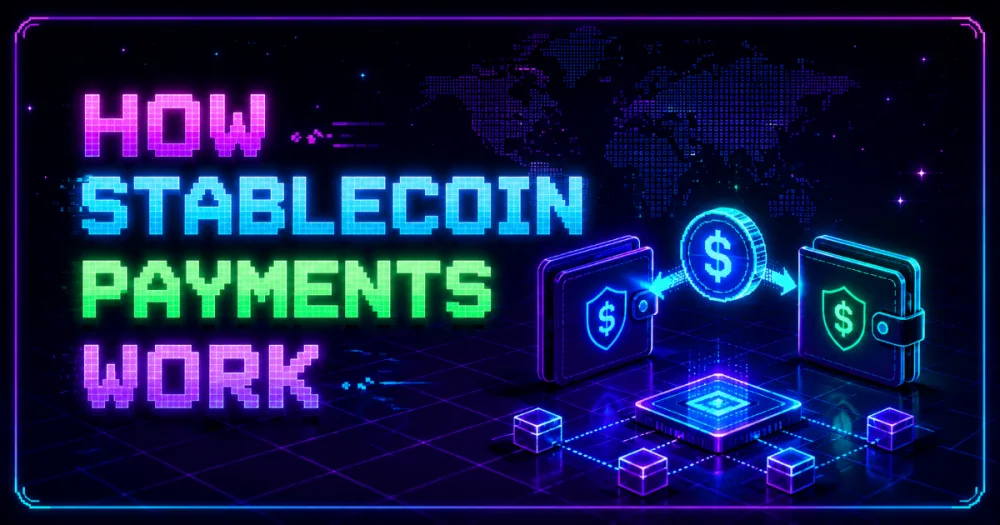
Stablecoin payments are recorded on the blockchain according to the consensus rules of the stablecoin network. If a transaction is confirmed by the network, it becomes an immutable part of the blockchain, which can be viewed by the public in a blockchain explorer.
Unlike other payment systems, where a single intermediary records everyone else’s balances, the blockchain distributes a shared account ledger directly among all participants, allowing value to be transferred and verified using on-chain transactions.
Wallet-to-Wallet Transfers
Making a stablecoin payments typically just requires transferring stablecoin from one blockchain wallet/account to another, which consists of the user entering the recipient’s wallet address and the transfer amount, approving the transaction, and paying a network transaction fee before broadcasting the payment to the blockchain.
As ownership of blockchain holdings is determined by a user’s wallet keys (not bank account numbers), stablecoins can be sent internationally without correspondent banks.
Read More: Why Stablecoins Are the New Global Payment Layer in 2026: The Shift in Global Finance
However, because on-chain transactions are irreversible once settled, they require users to carefully check their transactions to ensure that they have the correct address for the destination.
Role of Smart Contracts in Payments
Stablecoins often use smart contracts to ease the automatic issuance and redemption of tokens as well as their transfer, and other operations in accordance with rules defined in the protocol.
Smart contracts also enable programmable blockchain payments. They ease settlement workflows, escrows, and other payment processes depending on a particular use case, all without the intervention of any centralized operator.
Transaction Speed and Settlement Process
The speed of settlement differs between blockchains. A major stablecoin-based payment rails advantage is that they operate 24 hours a day, 7 days a week, and are not limited to banking hours. Blockchain networks can also be used across different time zones.
According to Fireblocks and Chainlink, stablecoin settlement can happen near instantaneously or much faster than any existing cross-border payment mechanism. The payment is settled when the confirmations of the payment have been registered on-chain, and settled according to the rules of the settlement network being used.
Due to their continuous settlement capabilities, stablecoin transactions have been increasingly used to ease cross-border payments, treasury transaction flows, merchant settlements, and other payments with continuous settlement capability.
How to Pay with Stablecoins Step by Step
Setting Up a Crypto Wallet
The first step in how to pay with stablecoins is selecting a wallet on which the stablecoin chain runs. Self-custody wallets such as MetaMask, Trust Wallet, and Coinbase Wallet support multiple blockchain networks and assets on their respective networks. Other exchanges offer custodial wallets where the exchange holds the digital asset.
Wallets are generally associated with a public address that is used when receiving or sending cryptocurrency. Access to the wallet is generally protected by use of a recovery phrase or a private key, which should be kept secret because it can be used to gain access to the funds kept in the user’s wallet.
Buying Stablecoins on Exchanges
Most users buy stablecoins through cryptocurrency exchanges like Coinbase and Kraken. These exchanges allow users to fund an account via a supported payment method, then buy USDC and, where available, other major stablecoins.
When following how to use stablecoins for payments step by step, it is important to check which network will be used for withdrawals, because some exchanges provide the same asset on multiple blockchains, which may not be compatible with the receiving wallet’s network.
Sending Stablecoins to a Recipient
After converting funds to a stablecoin wallet, a user can send stablecoins to another wallet by typing in the wallet address, the stablecoin amount they want to send, and confirming the transaction. The process is the same on most major blockchain networks for how to send stablecoins to another wallet.
Incorrect transfers of crypto and NFTs are costly and irreversible. Most blockchain transactions are final when added, meaning that validating recipient addresses is a common precaution for asset transfers on a blockchain.
Confirming Transactions on the Blockchain
The transfer is then broadcast onto the network and uses the consensus mechanism of the blockchain to confirm the transaction. When the transfer is included in new blocks, it can be viewed by a blockchain explorer.
Transaction status, wallet addresses, transaction fees, and confirmation progress for multiple transactions can be tracked using explorer tools on each blockchain ecosystem.
Common Payment Platforms That Accept Stablecoins
Stablecoin infrastructure has crossed over into non-crypto contexts, with Stripe, PayPal, and Coinbase Commerce supporting limited stablecoin payments in selected markets, showing mainstream adoption of digital asset settlement for commerce.
As adoption grows, businesses are increasingly exploring how to accept stablecoin payments for business alongside traditional payment systems, particularly in e-commerce, remittances, and digital services.
Popular Stablecoins Used for Payments
USDT Overview and Use Cases
USDT, which is issued by Tether, has the largest market capitalization of any stablecoin and is one of the most commonly used stablecoins for transfer, trading, and settlement. Tether claims each USDT token is 1:1 backed by U.S. Treasury bills, cash, and other assets belonging to Tether’s real-world reserves.
Due to its presence on a variety of blockchains, many users choose to pay with USDT for cross-border remittances, exchange settlement, and merchant transactions, particularly on networks such as Tron and Ethereum.
USDC for Payments

USDC was developed by Circle, which seeks to maintain a one-to-one value pegged to the U.S. dollar. Circle indicates that reserves backing USDC are held in cash and short-duration United States Treasury securities, with reserves information made publicly available.
The stablecoin is also used for settlement, treasury operations, and by businesses that pay with USDC for selected payment and treasury workflows.
Circle also expanded USDC’s use case to other blockchains to allow businesses and individuals to transport dollar-denominated value on blockchain infrastructure.
DAI and Decentralized Stablecoins
Compared to other central stablecoins, DAI’s issuance and maintenance are achieved by the Maker Protocol through a pool of crypto assets stored in smart contracts. The variables used to maintain DAI’s algorithmic peg are within the purview of the Maker Protocol’s governance organization, Sky, a decentralized autonomous organization.
Read Also: “We Need This”: France Shifts Its Approach to Stablecoins and Tokenized Deposits
Unlike most fiat-backed stablecoins, DAI stores collateral on-chain rather than with a company, and has become one of the largest decentralized stablecoins used to settle transactions on DeFi applications.
Other Emerging Stablecoins in 2026
In addition to the existing leading stablecoins USDT, USDC, and DAI, newer stablecoins, such as FDUSD and PYUSD▼$0.9998, are created to maintain a peg to the U.S. dollar and bring more options for digital payments and settlement.
As of 2026, the market has converged between bank-backed, fintech-backed, and decentralized models, with stablecoins increasingly used for digital dollar payments beyond cryptocurrency exchanges.
| Stablecoin | Type | Issuer/Protocol | Primary Payment Use Cases |
| USDT | Fiat-Backed | Tether | Exchange settlement, remittances, merchant payments |
| USDC | Fiat-Backed | Circle | Business payments, treasury operations, settlements |
| DAI | Crypto-Backed | Maker Protocol (Sky Ecosystem) | DeFi transactions, on-chain payments |
| FDUSD | Fiat-Backed | First Digital | Trading and digital payments |
| PYUSD | Fiat-Backed | PayPal | Consumer payments and digital commerce |
Fees and Costs When Paying with Stablecoins
Network Fees Explained
Network fees depend on the settlement blockchain. In Ethereum, transaction fees are based on network demand and gas prices. Further Etherscan data for early June 2026 showed gas prices of 0.1-0.2 Gwei, and Ethereum transaction fee trackers estimated an average transfer was under $1 for this period.
Because the transaction fee is paid to the network validators and not the stablecoin issuer, sending USDT or USDC on the Ethereum network can have a different fee than sending it on the Tron, Solana, or Base blockchains, where the transaction fees are set by the network protocol.
Exchange Fees and Conversion Costs
Buying stablecoins on exchanges often incurs trading, deposit, and withdrawal fees, and currency conversion spreads. These can vary based on the exchange, method used, total trading volume, and the user’s country.
For this reason, the total cost of USDT payments or USDC payments is generally more than the network transaction fees alone. Exchanges that allow USDT or USDC trading typically offer a fee schedule that should be checked before trading.
Cross-Border Payment Cost Comparison
The World Bank’s Remittance Prices Worldwide database reported that the global average cost of sending remittances from one country to another was 6.36% in the last available period.
Read Also: World Liberty Financial (USD1): A New Era of Stablecoins or Just Another Hype Token?
Most crypto cross-border payments only incur blockchain settlement fees (and possible crypto-to-fiat exchange fees), with final costs depending on the particular network, local regulations, fiat conversion, and the provider engaged by the parties making the payment. Because of these variables, no stablecoin transfers have a single fixed cost and can vary between transactions.
How to Reduce Transaction Costs
To save on a transfer, a comparison of the blockchains supported by the service may be valuable. Ethereum fee trackers have revealed that transaction costs vary depending on the time of day, meaning that off-peak hours may be a money-saver.
Transaction costs can be reduced by limiting the conversions from fiat currency to crypto assets. Considering the exchange rate and the blockchain fees together as a whole gives a more detailed overview of the full transaction costs for crypto payment methods than only considering either of them separately.
Where You Can Pay with Stablecoins

Online Merchants and E-commerce Platforms
Stablecoins are accepted by a large number of online merchants through payment services and dedicated crypto payment processors. Payment processors like Stripe and Coinbase Commerce allow merchants and e-commerce sites to have payments settled in stablecoins.
E-commerce services are exploring general-purpose blockchain-based payment infrastructure, with Shopify, Stripe, and Coinbase integrations allowing merchants to accept how to pay online with USDT or USDC by supported cryptocurrency wallets and payment gateways, with merchants paid via a blockchain network with lower fees than alternative options based on Ethereum and Bitcoin.
Freelance and Remote Work Payments
Stablecoins have also been adopted by international freelancers and remote workers for practical reasons, such that businesses in the industry may pay persons with dollar-pegged assets via non-customary banking rails in regions where cross-border payments may take longer or be more expensive.
How to pay freelancers with stablecoins is one of the biggest problems contractors face when dealing with clients internationally. These services send stablecoins directly to eligible wallets. They also allow for continuous settlement as a result of international banking hours.
DeFi and Web3 Applications
Stablecoins are also widely used in DeFi and in the Web3 ecosystem to lend, borrow, provide liquidity in decentralized exchanges, and other on-chain financial applications that operate without intermediaries, relying on smart contracts on blockchains.
Many users of decentralized applications, blockchain-based services, and digital asset markets also pay with crypto stablecoins. Due to their price-stable nature, stablecoins are often used as a payment settlement asset across various Web3 environments.
Peer-to-Peer Transactions
The most common use case is to send money peer to peer from one user to another, without using a bank account, card network, or payment intermediary to settle the transaction.
This flexibility has caused family transfers, personal payments, and international remittances to be a growing use case, as users come to use stablecoins to transfer dollar-linked value across borders while still being able to utilize the benefits of blockchain-based settlement.
Security and Risks of Stablecoin Payments
Wallet Security and Private Key Management
The security of a stablecoin wallet depends on its key management system. Self-custody wallets give a stablecoin holder full control and access over their funds, meaning anyone who has access to their private keys can take their funds. Experts recommend creating offline backups and using hardware wallets to increase security.
Blockchain transactions cannot be undone, so users must protect their wallet information and verify transaction details before send stablecoins step.
Smart Contract Risks
Many stablecoin systems have the ability to programmatically issue, transfer, and settle stablecoins using smart contracts, which can be exposed to security vulnerabilities through errors in the underlying code.
While security audits and code reviews reduce this risk, smart contracts have historically failed in stablecoin systems, and no protocol is immune to risk.
Stablecoin Depegging Risks
However, stablecoins may deviate from their peg in times of market stress, liquidity shortages, or instability in underlying reserve assets.
Read Also: South Korea Plans to Regulate RWA and Stablecoins Under Existing Financial Laws
In 2023, USDC fell below a dollar for a short period after its backing bank, Silicon Valley Bank (SVB), collapsed. Some of Circle’s reserves were held at SVB, but the peg was restored. Thus, when assessing whether are stablecoin payments safe, users may look to reserve disclosures and the quality of a stablecoin’s collateral.
Scams and Phishing Risks in Crypto Payments
Stablecoin users can be targets for phishing, fake websites, fake wallet apps, impersonation scams, and other targeting methods aimed at stealing private keys.
Users can avoid falling victim to fraud by verifying wallet addresses, ensuring that the website is legitimate, and not using private data such as usernames and passwords. These basic security precautions can go a long way in preventing fraud in blockchain-based payments.
Regulatory and Compliance Considerations

KYC and AML Requirements
Most regulated cryptocurrency platforms that offer stablecoin services require customer identity verification and compliance with applicable Anti-Money Laundering (AML) regulations and KYC requirements.
These measures may assist with identity verification, transaction tracking, and countering illicit finance. Recent legislation and regulations in the United States and Europe have focused on anti-money laundering requirements for services involving stablecoins.
As the regulation evolves, issuers and service providers will likely be subject to the same standards as customary financial institutions, including customer due diligence and transaction monitoring.
Regional Restrictions on Stablecoin Use
Stablecoins have been regulated differently in different jurisdictions until the EU’s Markets in Crypto-Assets (MiCA) Regulation created a broad regulatory framework for crypto assets, with similar regulatory frameworks under consideration or being developed in other jurisdictions.
As a result, stablecoins and related payment services may be available in some countries and not in others. Stablecoin users may therefore need to consider national regulation when using them for payment.
Tax Implications of Stablecoin Payments
Different tax treatments apply depending on the jurisdiction. Stablecoin transactions may also trigger tax reporting requirements, as do payments, conversions, and transfers of cryptocurrencies used for transactions and other activities, with different laws governing each type of activity.
Individuals and businesses wanting to use stablecoins are advised to check with the tax authorities or a tax professional.
Institutional Adoption and Regulations
Legislation such as the U.S. GENIUS Act and the EU’s MiCA regulation have created clear frameworks for stablecoins by regulating reserve backing, transparency, supervision, and right of redemption, contributing to the institutional interest in stablecoins.
As a result, banks, fintechs, and payment service providers are increasingly considering implementing stablecoin payment infrastructure, so understanding of how stablecoin payments work is becoming more relevant as regulated digital payment networks continue to expand.
| Compliance Topic | What Users Should Check |
| KYC Verification | Whether identity verification is required before using the platform |
| AML Rules | Whether transactions may be monitored under applicable regulations |
| Local Restrictions | Whether stablecoin services are available in the user’s country |
| Tax Obligations | Whether payments, transfers, or conversions are taxable |
| Stablecoin Issuer Compliance | Whether the issuer follows applicable regulatory requirements |
| Reserve Disclosures | Whether reserve information is publicly available |
| Redemption Policies | Whether users can redeem stablecoins under the issuer’s terms |
Best Practices for Using Stablecoins in Payments
Choosing the Right Blockchain Network
Multiple networks are supported by stablecoins, including Ethereum, Tron, Solana, and Base. Users are encouraged to confirm network compatibility when sending payments, as paying on an unsupported network can lead to unrecoverable transactions and loss of funds.
Network choice can affect both transaction fees and transaction speed. Research on retail stablecoin payments has also found differences in transaction fees, scalability, and transaction throughput capacity of the blockchains, making network choice an important aspect of stablecoin guide.
Verifying Wallet Addresses Before Sending
Since stablecoin transfers are not reversible once they are confirmed on-chain, wallet addresses should be checked before sending any transactions.
Read Also: Stablecoins Explained: USDT, USDC, and DAI Compared
Common instructions from wallet providers include double-checking recipient addresses, selecting the correct network, and verifying details before initiating a crypto transfer or stablecoin transaction.
Managing Transaction Fees Efficiently
Transaction fees vary from blockchain to blockchain and from period to period, depending on the load of the network. Some blockchains are created to allow cheaper payments compared to others.
Comparing supported networks before sending and monitoring current network conditions can reduce these risks, while payment infrastructure providers are likely to continue focusing on further increasing efficiency and reducing settlement friction as stablecoin usage grows.
Keeping Funds Secure in Self-Custody Wallets
Self-custody wallets are wallets where individuals have access to their cryptocurrency or digital assets through a private key and recovery phrase, which allows them to own and hold their assets without third-party involvement, while bearing the entire burden of responsibility.
Recommended practices for wallets include offline storage of recovery phrases, backup copies, and enabling strong authentication where possible. Given the proliferation of stablecoins, protecting users’ wallets is one way blockchain can be used to make payments.
FAQ
Are Stablecoin Payments Instant?
Most stablecoin transactions are settled in a few seconds or minutes, depending on the network and state of congestion, although it might take longer in some instances.
Can I Send Stablecoins Internationally?
Yes. Stablecoins can be sent cross-border via an underlying blockchain network without using the correspondent banking system.
Which Stablecoin Is Safest to Use for Payments?
There is no one option that is considered universally safer. Reserve transparency, regulatory compliance, redeemability, and the past performance of the issuer are some of the factors on which stablecoins are chosen.
Do I Need a Bank Account to Use Stablecoins?
No. Stablecoins can be stored and transferred using supported crypto wallets. A bank account may still be required for converting between fiat currencies and cryptocurrencies through regulated virtual asset service providers.
Are Stablecoin Payments Taxable?
Depending on a jurisdiction’s tax laws, transactions involving stablecoins may be subject to information reporting or tax, including payments, conversions, or disposals.