We break down how the Balance Coin attack happened and what the BLC depeg meant for crypto market participants.
On July 22, algorithmic stablecoin Balance Coin (BLC) lost its dollar peg and crashed nearly 100% after an alleged attack on its governing organization, 42DAO. According to CoinMarketCap, BLC traded at $0.001358 versus $0.9954 before the crash.
Hot topic: Bitcoin Hits Monthly High Above $66,000 as Five-Day ETF Inflows Reach $727M
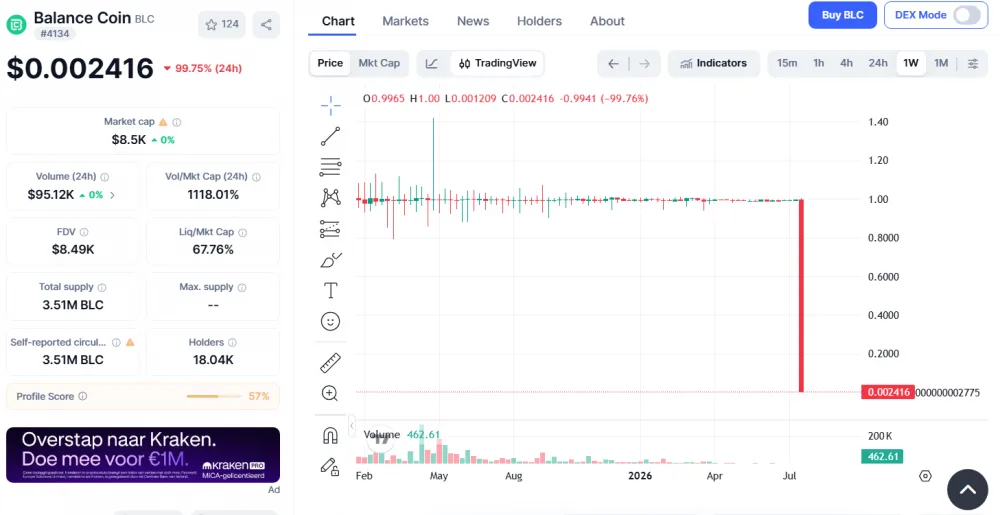
At the time of publication, the stablecoin trades at approximately $0.002416. The decline over the past 24 hours stands at 99.75%.
Blockchain analytics firm SlowMist linked the crash to a BTCB oracle price manipulation. The attacker liquidated collateral in multiple BTCB vaults that shouldn’t have been liquidated, then swapped the extracted assets for profit.
PeckShield analysts estimated damages at roughly $915,000.
Contents
How the Balance Coin Attack Happened: Oracle Price Manipulation in a Single Transaction
According to SlowMist, the attack was executed in a single transaction. The attacker exploited the lack of price protection and liquidation delays in the Maker-style system. That allowed them to use an abnormally low BTCB oracle price to liquidate positions that wouldn’t have been liquidated under normal conditions.
The extracted assets were then swapped for profit. PeckShield confirmed the incident affected 42DAO’s structure–the governing organization behind the Balance protocol, whose stablecoin is primarily backed by Bitcoin Cash (BCH).
Balance Protocol is a DeFi project offering the Balance Coin stablecoin, pegged to the US dollar. The token’s collateral is primarily based on Bitcoin Cash and other assets. After the attack, BLC’s value fell to near zero.
Read more: The Stablecoin Wars — Which Regulations Will Create the Next Winners and Losers?
Crypto Market Context: A Series of DeFi Hacks in 2026
The Balance Coin incident adds to a long list of DeFi attacks in 2026. Smart contract exploits, key compromises, and bridge vulnerabilities remain the main attack vectors.
June saw 40 incidents totaling $75.87M, with May at $81.7M. The year’s biggest attack remains June’s $36M Humanity Protocol hack.
Incidents involving algorithmic stablecoins and oracle manipulation highlight systemic risks tied to price mechanism dependencies in DeFi. After UST’s 2022 collapse and other similar cases, trust in algorithmic stablecoins remains low.
Learn more: How to Pay with Stablecoins — Complete Guide for 2026