A smart contract is basically a piece of code that lives on a blockchain and automatically runs when certain conditions are met. No fancy AI, no complicated legal talk — just straightforward if-this-then-that logic written into the program.
The name “smart contract” can sound intimidating, but at its core, what are smart contracts in crypto comes down to automated rules that execute without needing a middleman. Send the right input, and the code handles the rest: moving funds, updating records, transferring ownership, or locking assets.
Nick Szabo introduced the idea in 1996. In Smart Contracts: Building Blocks for Digital Markets, he defined a smart contract as “a set of promises, specified in digital form” and pointed out that the word “smart” does not imply artificial intelligence. The closest analogy is a vending machine: insert payment, select an item, receive the product. No cashier needed. Smart contracts on blockchain come down to this simple explanation: they are execution logic, not legal documents.

Contents
- What Are Smart Contracts in Blockchain, Explained Simply: How They Differ From Regular Contracts
- Bitcoin Smart Contracts: How This Works on Bitcoin and Other Blockchains
- Smart Contracts Explained: How Smart Contracts Work Step by Step
- Advantages and Limits of Blockchain Smart Contracts
- Smart Contract Applications in Practice
- Ethereum Smart Contracts: Why Ethereum Became the Main Environment
- Bitcoin Smart Contracts: Does Bitcoin Support Smart Contracts?
- Smart Contracts Explained: Tokens, DeFi, and Real Use Cases
- When a Smart Contract Does Not Solve the Problem
- What to Remember About Smart Contracts
- FAQ
What Are Smart Contracts in Blockchain, Explained Simply: How They Differ From Regular Contracts
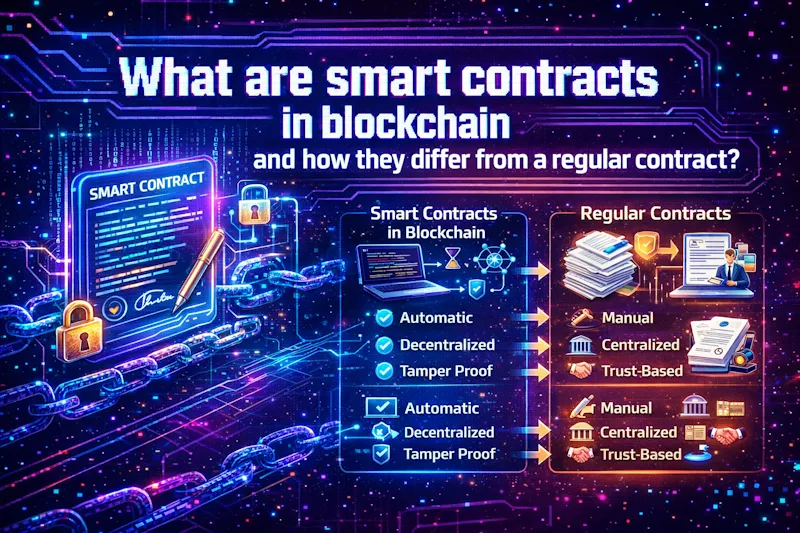
The word “contract” creates confusion because it implies signatures and legal obligations. In reality, smart contracts don’t replace traditional agreements but automate the parts that can be clearly defined in code.
A regular contract outlines rights, responsibilities, deadlines, and what happens if someone breaks the rules. A smart contract executes narrow, measurable actions. In many real deals, both work together — the legal paper handles the big picture and disputes, while the smart contract handles the automatic execution.
A short comparison makes the gap easier to see.
| Feature | Regular contract | Smart contract |
|---|---|---|
| Main purpose | Describes obligations | Executes coded rules |
| Who carries it out | People, firms, courts | Blockchain network |
| Can it be changed | Often yes | Usually difficult |
| Where it is stored | Paper, pdf, database | Blockchain |
| What triggers it | Human action or dispute | Programmed condition |
| Typical cost | Legal and admin cost | Network fee |
| Typical speed | Hours to months | Seconds to minutes |
Primavera De Filippi, Director of Research at CNRS and Faculty Associate at Harvard’s Berkman Klein Center, makes the distinction clearly in her smart contracts overview for Internet Policy Review: smart contracts are software programs executed in a blockchain environment, while legal contracts remain “broader and more flexible in meaning.” The two serve different layers of the same transaction.
Bitcoin Smart Contracts: How This Works on Bitcoin and Other Blockchains
The same automation logic that powers smart contracts on Bitcoin and other blockchains could run on a regular company server. Banks already use rule-based systems that move money when conditions are met. The difference is control. When one organization owns the server, that organization can change the rules, alter logs, or shut the system down without external oversight.
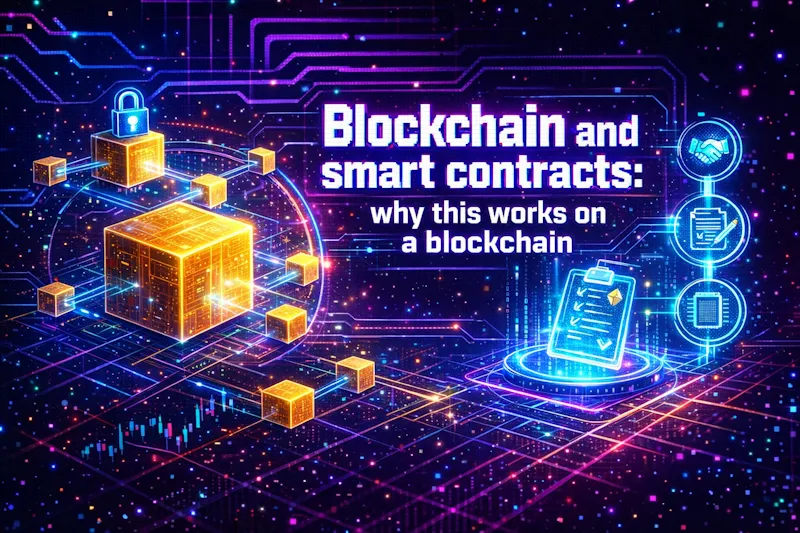
A blockchain distributes the code across thousands of nodes. Every action is verified by the network before it takes effect. The transaction history is shared, timestamped, and extremely difficult to alter after the fact. The relationship between blockchain and smart contracts is not about buzzwords — it is about shifting the trust model from a single operator to a distributed network where no one entity holds the off switch.
That shift is what makes smart contracts blockchain systems distinct from traditional automation. The logic may be similar, but the enforcement layer is fundamentally different. Smart contracts on Bitcoin and other networks create a shared execution layer, not just a shared archive.
Smart Contracts Explained: How Smart Contracts Work Step by Step
So, how do smart contracts work, exactly?
A developer writes a contract — a block of code containing rules. The contract is deployed to a blockchain such as Bitcoin, where it receives its own address. From that point, anyone can interact with it by sending a transaction to that address. When a transaction arrives, validators check whether it satisfies the contract’s conditions. If everything matches, the code executes and the result is written to the chain. If the conditions are not met, the transaction fails and nothing changes. That is how smart contracts work at the protocol level.
A practical example: a parametric flight insurance contract collects a premium upfront and monitors a trusted data feed. If a flight lands more than three hours late, the payout is sent to the policyholder’s wallet automatically. No claim form. No review process.

Logic of If and Then Inside Smart Contracts on Blockchain
Every smart contract on blockchain employs conditional logic. If the buyer deposits 1 ETH▲$1,761.17, unlock the file. If a loan’s collateral ratio drops below 150%, liquidate the position. If a deadline passes without delivery confirmation, refund the buyer. The code does not interpret edge cases or weigh context. It executes exactly what was written, which works well when the rules are unambiguous and poorly when they are not.
Who Verifies Whether the Conditions Were Met
The network handles verification. When a transaction is submitted, every validating node runs the same computation independently. Nodes compare results, reach consensus, and either accept or reject the state change. The result is recorded on-chain, where it can be audited by anyone. No single employee or institution makes the call.
Why the Code Is Hard to Change After Launch
Deployed smart contracts are generally immutable. That prevents anyone from rewriting terms after the fact, but it also means bugs cannot be patched the way they would be in normal software. A logic error in a contract managing significant funds can be extremely expensive to fix — often requiring a full migration to a new contract. This tradeoff is why security audits became standard practice in the industry.
Advantages and Limits of Blockchain Smart Contracts
Blockchain smart contracts perform best with repetitive, rule-based processes where transparency matters and manual approval creates bottlenecks. They are less effective in situations that require judgment, ambiguity handling, or real-world dispute resolution.
| Advantages | Limits |
|---|---|
| Automatic execution | Bugs can lock funds |
| Faster settlement | Hard to change after launch |
| Shared record | Depends on outside data |
| Fewer intermediaries | Legal status can vary |
| Clear rule enforcement | Offline disputes still exist |
| Continuous operation | Network fees can rise |
The DAO incident in 2016 remains a landmark example. A flaw in one contract led to roughly $60 million worth of ETH being drained, splitting the Ethereum community and eventually leading to a hard fork. That event accelerated the adoption of formal smart contract auditing across the industry.
Disclaimer: this article is educational. It does not replace legal counsel, a security audit, or investment advice. Contract logic can be technically correct and still conflict with local regulations, upgrade mechanisms, or operational risk.

Smart Contract Applications in Practice
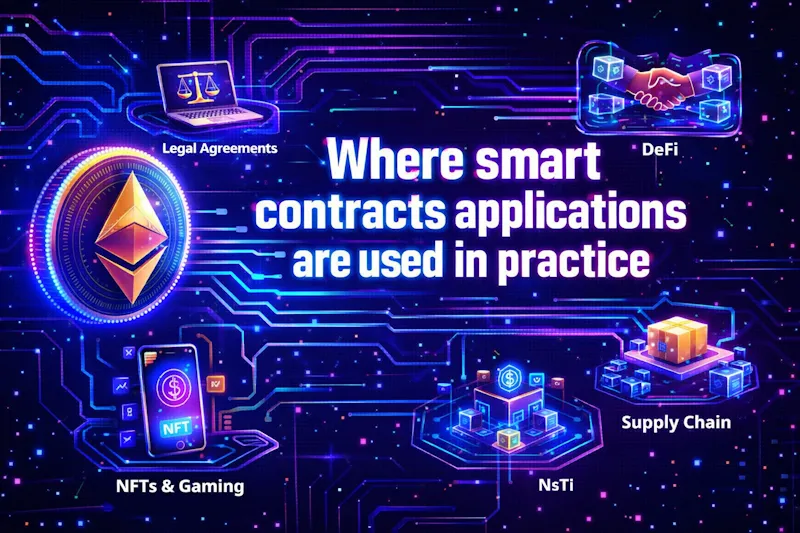
Smart contracts applications appear wherever rules are clear, repetitive, and tied to a measurable trigger. Payments that release upon delivery confirmation, loans that liquidate when collateral drops below a threshold, insurance that pays out based on verified data, membership tokens that expire on a set date — the pattern is consistent: condition met, action executed, result recorded. One event happens, the code checks it, and the next action follows without manual approval.
Finance, DeFi, and Payments
Decentralized finance is where smart contracts found their strongest product-market fit. First introduced as Bitcoin smart contracts, they quickly moved to Ethereum and other blockchains. Today most DeFi apps use smart contracts on other blockchains than Bitcoin. Exchanges like Uniswap run entirely on contract logic, handling liquidity pools and trade settlement without a traditional order book. Lending protocols like Aave allow borrowing against crypto collateral with no manual approval step. Stablecoin contracts manage issuance, redemption, and peg mechanics continuously. The advantage is speed and auditability. The risk is proportional: when bad oracle data hits a DeFi contract, cascading liquidations can cause losses in the hundreds of millions within minutes.
Logistics, Supply Chains, and Records
Supply chain use cases attract less attention than DeFi but offer strong practical value for traditional businesses. A contract can confirm that a shipment cleared customs, trigger partial payment to the supplier, and log the event for auditors — replacing multi-day email chains with a single automated sequence. Companies like Walmart, Maersk, and De Beers have run blockchain-based tracking pilots. The value comes from the automated handoff: event confirmed, next step executed. That is what smart contracts on Bitcoin and other blockchains handle well.
Ownership of Digital Assets and Access
Most everyday users interact with smart contracts through digital ownership without realizing it. NFTs — art, game items, event tickets — are all managed by contracts that track who owns what and enforce transfer rules. A wallet connects to a dApp, the contract checks whether the user holds the required token, and access opens or closes accordingly. This is one of the most tangible answers to what are smart contracts in blockchain: they act as the access-control layer behind token-gated products and services.
Ethereum Smart Contracts: Why Ethereum Became the Main Environment
Ethereum was designed from the ground up as a platform for programmable contracts. While Bitcoin supported basic scripting, Ethereum introduced a general-purpose virtual machine capable of running complex application logic on-chain.
The Ethereum whitepaper laid out a blockchain built not just to transfer value but to host decentralized applications with shared security guarantees. That design decision gave rise to ERC-20 tokens, the DeFi ecosystem, NFTs, DAOs, and a large number of alternative chains that adopted the EVM as their runtime. Ethereum smart contracts defined much of the vocabulary the industry uses today.
Several factors compounded over time: Solidity became the default contract language, developer tooling like Hardhat, Foundry, and Remix matured quickly, and network effects took hold — users followed apps, developers followed users. The gas mechanism also served a less obvious purpose: by pricing computation, it prevented badly written contracts from consuming unlimited resources and stalling the network.
Other platforms, including Solana, now offer higher throughput and lower fees. But Ethereum retains the deepest liquidity and the widest ecosystem, though the gap has been narrowing.
Bitcoin Smart Contracts: Does Bitcoin Support Smart Contracts?
Bitcoin smart contracts exist, but they operate within a narrower scope than what Ethereum offers. Bitcoin uses a scripting language called Bitcoin Script. It is intentionally limited — not Turing-complete, with no loops and no complex state management. What it does support are spending conditions: multisignature wallets that require multiple keyholders to sign, hash time-locked contracts (HTLCs) that power the Lightning Network, and time locks that prevent coins from moving until a certain block height.
| Feature | Bitcoin | Ethereum |
| Logic flexibility | Limited by design | Broad, Turing-complete |
| Main focus | Value transfer and storage | Programmable applications |
| Typical contract use | Time locks, multisig, HTLCs | DeFi, tokens, NFTs, dApps |
| State complexity | Minimal | Rich, account-based |
| Design philosophy | Security over expressiveness | Flexibility over simplicity |
This does not make one approach superior across the board. A Bitcoin smart contract serves a tighter set of goals, and that narrowness is a deliberate design choice — fewer features create fewer attack surfaces. Smart contracts on Bitcoin and smart contracts for Bitcoin refer to these limited programmable conditions rather than a full application ecosystem.
Andreas M. Antonopoulos addressed this directly in a podcast transcript: Bitcoin was built with “a simple and robust scripting language” that trades expressiveness for safety. The result is a network that supports multisig, payment channels, and basic programmable conditions — and has never suffered a smart-contract-level exploit in over 15 years of continuous operation.
Does Bitcoin Have Native Smart Contracts?
Yes. Every Bitcoin transaction is, at its base, a small script. Multisig setups, HTLCs powering the Lightning Network, and CheckLockTimeVerify (CLTV) time locks all run natively on Bitcoin’s base layer using Bitcoin Script. They do not require a sidechain or a separate virtual machine.
The question of whether Bitcoin supports smart contracts comparable to Ethereum’s DeFi applications has a different answer. Not at the base layer — at least not yet. Projects like Stacks, RSK, and Liquid add broader programmability as separate execution layers that settle back to Bitcoin. The Taproot upgrade, activated in late 2021, also expanded base-layer capabilities by enabling more complex spending conditions and improved privacy through Schnorr signatures and MAST.
The landscape for smart contracts on Bitcoin is developing steadily. It may never match Ethereum’s breadth of application logic, and it is not designed to. But the range of what is possible on Bitcoin’s base layer and its surrounding ecosystem continues to grow.

Smart Contracts Explained: Tokens, DeFi, and Real Use Cases
At the user level, the question “What are smart contracts in blockchain?” comes down to a more practical one: where does this technology actually affect the experience?
The answer is: almost everywhere a dApp is involved. Swapping tokens on decentralized exchange routes through a contract that handles pricing and settlement. Staking tokens for yield involves a contract that calculates and distributes rewards. Buying an NFT triggers a contract that transfers ownership on-chain. Voting in a DAO runs through a contract that tallies results. The code sits behind the interface, handling the mechanics.
For anyone using crypto beyond simply holding coins on a centralized exchange, smart contracts are already part of the workflow — even when they are invisible in the UI. Readers who are still getting oriented in the space may find our cryptocurrency guide for beginners useful for broader context. It describes the engine behind many services people already use. It also answers what are smart contracts from the market side, not only from the coding side.
When a Smart Contract Does Not Solve the Problem
A smart contract cannot evaluate whether the data it receives is accurate. If a faulty oracle feeds wrong information, the contract will execute based on that data — correctly from a code perspective, incorrectly from a business perspective. A delivery contract can mark a shipment as received based on a GPS ping even if the goods arrived damaged. A price feed can report a stale number and trigger millions in unnecessary liquidations.
Code also cannot fix a flawed process. If the tokenomics behind a project do not work, automating them only accelerates the failure. And smart contracts do not replace legal systems. Courts do not consider “the code ran as written” a sufficient defense when fraud or misrepresentation is involved.
Sergey Nazarov, co-founder of Chainlink, described this gap clearly in Chainlink: An Overview and Our Focus. He calls it the “smart contract connectivity problem”: a contract on-chain is only as reliable as its connection to off-chain data. If the oracle layer is poorly designed — stale feeds, single points of failure, no validation — the on-chain logic does not matter. The system breaks where the chain meets the real world.
What to Remember About Smart Contracts
A smart contract is code on a blockchain that executes when predefined conditions are met. That covers what are smart contracts in blockchain, what are smart contracts in crypto, and the core of how smart contracts work — all in one sentence.
They perform well where rules are unambiguous and processes are repetitive. They struggle where data is unreliable or context is required. They belong in a toolkit alongside legal agreements, security audits, and proper oracle infrastructure — not as a replacement for any of them.

FAQ
Can smart contracts replace legal contracts in every real case?
No. Smart contracts can automate execution, but they do not cover liability, disputes, fraud, or enforcement outside the blockchain. Legal agreements still matter.
Why are smart contracts usually linked with Ethereum first?
For many users, smart contracts became visible through Ethereum based apps, tokens, and defi services. Other networks support them too, but Ethereum drove early adoption.
Do Bitcoin smart contracts matter for normal users today?
Yes. Bitcoin smart contracts support useful functions such as time locks and multisignature control. Their scope is narrower than on Ethereum, but they still solve real problems.
Are smart contracts on Bitcoin the same as on Ethereum?
No. Smart contracts on Bitcoin usually offer more limited programmable conditions. Ethereum is better known for broader application logic and richer contract behavior.
What is the main risk when smart contracts handle funds?
The main risk is flawed logic or flawed data. If smart contracts are written badly, they can execute unwanted actions that are hard to reverse.
Where do users meet smart contracts in crypto most often?
Users often encounter them in exchanges, lending tools, NFT markets, and wallet based apps. In those products, smart contracts on blockchain handle swaps, access, and payouts.