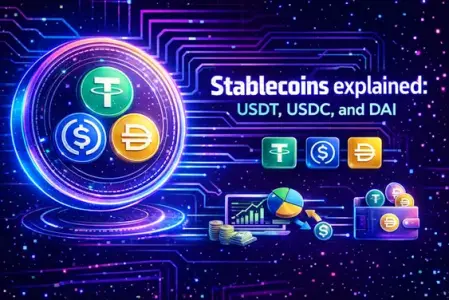
We explain everything you need to know about the stablecoin market in May 2026.
Total stablecoin market capitalization has reached a new all-time high, exceeding $323B. Over the past month, USDT▲$0.9991 drove most of the growth, while some competitors saw capital outflows.
Hot topic: Expert Warns of Liquidity Risks for Tether and Circle
Market Distribution
As of May 20, 2026, according to DefiLlama:
- USDT (Tether) — approximately 59% of the market
- USDC▲$0.9999 (Circle) — approximately 24%
- USDS▲$0.9998 (Sky, formerly MakerDAO) — less than 3%
These are followed by USD1 (World Liberty Financial), DAI▲$0.9998, USDe (Ethena), and PYUSD▲$1.00 (PayPal), each with a share below 1.5%.
Over the past 30 days, USDT’s market cap grew nearly 2%, while USDC fell 1.5%. USDe lost 25%, and PYUSD dropped 15%. The overall sector grew only about 1%, suggesting capital redistribution rather than new money entering the market.
Read more: USDC Perspectives 2026 — Can USDC Become the World’s Leading Stablecoin?
Individual Project Dynamics
USDe from Ethena shows one of the weakest performances in 2026. Experts link this to the project’s mechanics. Its yield depends on perpetual futures, which have become less effective in a low funding rate environment.
USDC maintains its lead in transaction volume at $377B compared to $322B for USDT. However, Tether still leads in transaction count at 96M versus 37M.
Regulatory Context
Market growth comes amid active regulatory discussions in the United States. The Senate Banking Committee approved the CLARITY Act, but many market participants doubt the bill will pass quickly in the full Senate. Wintermute analysts note that uncertainty is driving capital flows into less regulated assets like USDT.
Read more: Why Millions in USDT and USDC Are Suddenly Being Unfrozen on TRON and Ethereum
What Else Is Happening in the Stablecoin Market?
1. The European Qivalis project has expanded significantly. An additional 25 banks have joined the consortium, bringing the total number of participants to 37, including ABN Amro, Intesa Sanpaolo, Rabobank, BNP Paribas, ING, and UniCredit.

The group is working to create a pan-European euro stablecoin and has already applied for a license in the Netherlands. The project aims to reduce Europe’s dependence on dollar stablecoins and strengthen the euro’s position in cross-border settlements.
2. Japan has officially opened its doors to foreign stablecoins. Starting June 1, the FSA will classify trust-type stablecoins as electronic payment instruments.
This will allow the use of USDC, USDT, and other global stablecoins for everyday payments within the country, subject to strict reserve, audit, and AML requirements. Analysts call this one of the most significant regulatory moves in Asia in recent years.
3. AllUnity, based in Germany, is preparing to launch SEKAU, a stablecoin pegged to the Swedish krona. The launch is scheduled for June after obtaining necessary licenses under MiCA. The company also unveiled Agentic Payments infrastructure, a solution for automatic payments between autonomous AI agents.
Learn more: What Is Crypto Slang? Most Popular Crypto Terms Every Trader Should Know in 2026