Crypto slang is a key part of cryptocurrency culture. If you’re being introduced to the crypto community in 2026, you’re likely to be bombarded with a variety of abbreviations, memes, trading lingo, and viral phrases across the X platform (previously known as Twitter), Discord, Telegram group chats, Reddit, and Web3-focused platforms.

This crypto glossary of terms and slang will help demystify the market and allow beginners to better follow conversations surrounding Bitcoin, altcoins, decentralized finance (DeFi), NFTs, memecoins, and blockchain trends.
Newcomers to the cryptocurrency ecosystem usually look up the meaning of terms such as FOMO, LFG, or HODL, having seen them frequently used in trading communities or in discussions on social media.
In this guide, we cover the most commonly used crypto slang terms of 2026, what they really mean, and how they are used in the daily lives of crypto traders.
Contents
- Why Crypto Slang Matters in Modern Web3 Culture
- Bitcoin and Ethereum Slang: The Terms Dominating Crypto Communities in 2026
- How Crypto Twitter Creates New Slang Almost Overnight
- Must-Know Crypto Terms Every Beginner Should Understand in 2026
- Essential Crypto Slang Terms Every Trader Should Know in 2026
- FAQ
Why Crypto Slang Matters in Modern Web3 Culture
Crypto slang also has a more serious purpose than just generating memes on X or Telegram: it helps explain how these blockchain ecosystems and digital asset communities function in practice.
For 2026’s beginners, it’s easy to understand discussions about trading, DeFi protocols, NFT launches, and market mood by learning commonly used crypto terminology, acronyms, and abbreviations.
When traders say that “gas fees are brutal”, they are describing the costs to execute transactions on Ethereum blockchain to power smart contracts, Decentralized Finance (DeFi) platforms, Non-fungible Token (NFT) marketplaces, and token swaps in the Web3 ecosystem.
Once you understand what the slang means, blockchain technology conversations seem considerably less cryptic.
Read Also: Best Crypto Exchanges 2026: Top 5 Platforms for Easy, Safe & Profitable Trading
This can also be seen in the use of slang terms, such as “HODL”, “diamond hands,” and “rekt”. “HODL” is used to refer to buy-and-hold investors who continue to own their cryptocurrency and do not sell despite short-term market declines in price, while “rekt” is used by traders who lose large amounts of money in liquidations or lose any trading position. These terms became colloquial in the crypto culture to describe real-world experiences when trading digital assets on volatile markets.
Other slang is derived from technical expressions in the blockchain that give rise to the activities those terms describe, like “mint”, “airdrop”, or “rug pull”, referring to smart contracts and tokens.
If an incoming Web3 project that was offering staking, mints for NFTs, and tokens on launch suddenly quits and takes users’ funds, this is known as a “rug pull”. Importantly, this is a very real risk in the current web3 economy, and not just a meme from the web.
Bitcoin and Ethereum Slang: The Terms Dominating Crypto Communities in 2026

Since their beginning, Bitcoin and Ethereum have evolved far past their original use as currencies, with full-fledged ecosystems now existing on and around both networks that are rich in culture, ideology, and crypto jargon.
With Web3 mainstream adoption growing in 2026, traders, builders, NFT collectors, and DeFi enthusiasts continue to create, share, and adopt new slang on Crypto Twitter, Discord, Telegram, and blockchain-related forums.
Bitcoin phrases such as “stack sats” (to acquire Bitcoin in small denominations), “HODL,” and “not your keys, not your coins” are used in conversations within the Bitcoin community, the latter referring to controlling the private keys for Bitcoin ownership, they do not own Bitcoin under discussion.
It is also representative of a long-term view held by some Bitcoin advocates, who see BTC▲$62,630.00 as a future store of value and hedge against financial systems.
Ethereum vocabulary is impacted by the usage of smart contracts, NFTs, DeFi protocols, and other activities occurring on-chain. As a result, Ethereum lexicon is one that is rapidly changing to meet the needs of new blockchain projects and token economies.
Some of the most commonly used crypto jargon phrases in Ethereum and Web3 include:
- “Gas wars” — competition between users during popular NFT mints or token launches drives up Ethereum transaction costs to extreme levels.
- “Blum code” is a term from 2026 when early adopters of the platform posted viral referral codes to gain whitelist access, platform benefits, and future coin rewards.
- “Airdrop farming” is when wallets, dApps, and protocols are actively used to earn free token distributions.
Slang terms and phrases can often go viral within a matter of hours, resembling the behavior of active day traders on the volatile digital asset markets.
Within Bitcoin and Ethereum communities, there are often new slang terms introduced on a weekly basis, depending on the circulating hype around memecoins, landmark events, new token launches, or domain price increases.
How Crypto Twitter Creates New Slang Almost Overnight
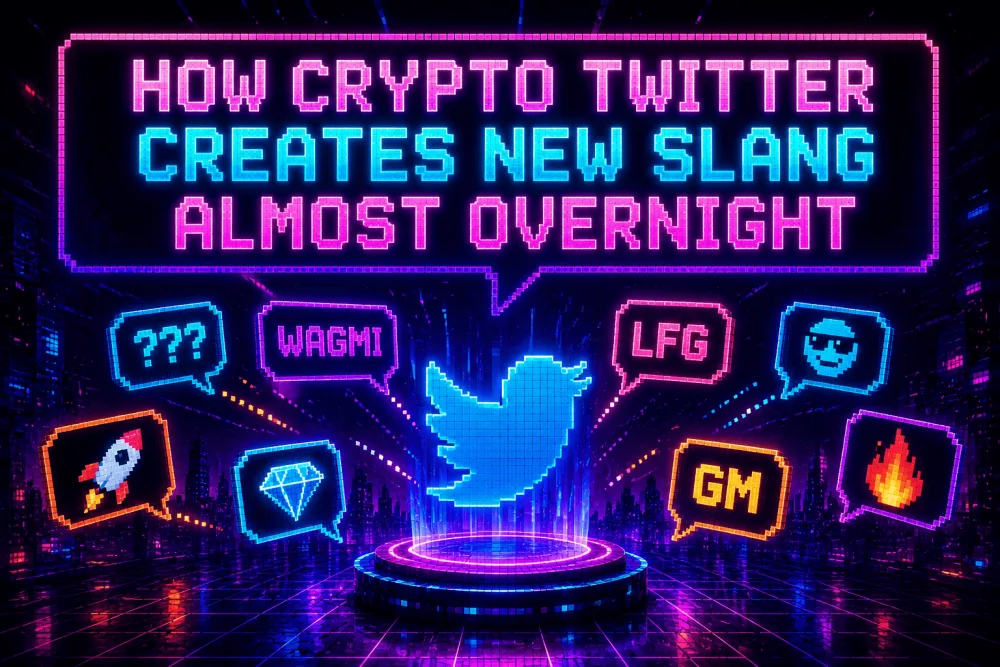
Anyone who stepped foot into crypto in 2026 would have quickly learned that most of the continuing culture of the blockchain lives on X, aka Crypto Twitter, aka “CT”.
A meaningful proportion of traders, developers, memecoin communities, NFT collectors and DeFi founders operate on the platform to react to market events effectively in real time, with new crypto slang spreading worldwide within hours.
New crypto jargon emerges with such speed that it can be impossible to keep up. Due to a single successful trade, a memecoin rally, or an NFT craze, new terms might be coined overnight.
Some of the recent examples include:
- “Cope” — directed at traders explaining why they did not profit from a major pump.
- “Floor is lava” — first appeared in NFT communities, when the increasing floor price caused buyers to be afraid of losing potential profit on a price increase.
- “Jeet” — used as an insult towards a trader who panic-sells a token before it goes up 10 times in price.
The defining characteristic of crypto slang is its rapid cycles of coining, adoption, and obsolescence based on the market’s mood. For example, the term “WAGMI” (“We’re All Gonna Make It”) might be a common meme on Crypto Twitter in a bull market, but it becomes ironic or overused within weeks.
For both day traders and investors with a three to five-year holding horizon, crypto terminology provides insight into the psychology of crypto markets, communities, and narratives long before their price effect is felt on exchanges or through blockchain updates.
Investors could use this awareness of Web3 culture to better understand hype cycles and speculative behaviors in cryptocurrency markets.
“Crypto language evolves faster than traditional financial terminology because Web3 communities react to narratives, volatility, and cultural trends in real time. In many cases, slang becomes a market signal before price action fully develops.” — Valentina Kuskova, researcher and co-author of From Tokens to Ties: Network and Discourse Analysis of Web3 Ecosystems
Must-Know Crypto Terms Every Beginner Should Understand in 2026
People entering the crypto space for the first time will quickly realize there are hundreds of new blockchain terms, trading terms, and Web3 concepts.
If beginners learn these basics, they may avoid rookie mistakes, learn to communicate better in crypto communities, and understand digital asset markets more easily.
Here are some of the most important cryptocurrency terms every beginner should know in 2026:
| Crypto Term | Simple Explanation | Why It Matters |
| Crypto wallet | A digital wallet that stores and manages your crypto assets | You need one to send, receive, stake, and hold cryptocurrency securely |
| Private key | A unique secret phrase or code that gives full access to your wallet | Losing it usually means permanently losing access to your funds |
| Crypto exchange | A platform where users buy, sell, or swap cryptocurrencies | Different exchanges offer different features, fees, liquidity, and security models |
| KYC | Short for “Know Your Customer,” an identity verification process | Most centralized exchanges require KYC before allowing fiat deposits or large withdrawals |
| Token | A blockchain-based digital asset built on an existing network like Ethereum or Solana | Tokens power DeFi apps, DAO governance, gaming ecosystems, and NFT platforms |
| Bag | A slang term for the crypto assets someone continues holding | Traders often use it when talking about coins they still own despite major losses |
Crypto wallets interface with the blockchain to hold and manage the user’s cryptocurrency, and can be either hot (connected to the internet) for convenience, or cold (offline) for security and long-term storage.
Your private key is central to crypto ownership. Unlike bank transactions, which are reversible, blockchain transactions are final. This is one of the reasons that long-term traders have famously cautioned: “Not your keys, not your coins.”
A cryptocurrency exchange is a marketplace for trading Bitcoin, Ethereum, memecoins, stablecoins, and cryptocurrencies. Generally, centralized exchanges (CEXs) are considered more user-friendly and offer more fiat options than decentralized exchanges (DEXs), which follow a self-custody and on-chain trading approach.
As of 2026, tokens power decentralized finance (DeFi) applications, blockchain games, governance systems, AI applications, and NFT platforms on layer 1 and layer 2 (L2) blockchains and act as foundational to Web3.
The term bag is still often used in the cryptocurrency niche; a trader who is said to be “holding a bag” is typically one who did not sell after a price drop, but is waiting for the price to recover.
Essential Crypto Slang Terms Every Trader Should Know in 2026
FOMO
FOMO is short for “Fear of Missing Out.” In the crypto space. It is the emotional drive to buy a coin because the price is going up, and everyone is making money off of the coin. FOMO typically happens in bull markets, memecoin seasons, and when new crypto tokens go viral. The emotional state associated with such conditions is impulsiveness, often followed by market swings.
DYOR
The acronym DYOR stands for “do your own research”. This is one of the most popular phrases used by crypto investors to warn against depending entirely on influencers, excitement, or social media for investment advice. Before investing in a token or a Web3 project, experienced traders advise newcomers to do their own research on the team, tokenomics, roadmap, and blockchain utility.
SAFU
Although SAFU originated from a meme on the Binance exchange, the letters stood for “Secure Asset Fund for Users”. Nowadays, crypto sites use this term to describe situations in which it looks like client funds are safe after an incident or exchange hack, or a security breach. When someone says “funds are SAFU”, they usually mean there are insurance funds or other means of protection in place.
Read Also: What Is Crypto Arbitrage Trading and How Does It Work? Complete Beginner’s Guide (2026)
OG
OG is an acronym of the phrase “Original Gangster,” but in crypto slang refers to early investors, veteran traders, or the first members of a community. An ‘OG Bitcoin holder’ is a holder who bought Bitcoin in its early days, and ‘OG NFTs’ are the original on-chain NFT collections.
WAGMI / NGMI
WAGMI (“We’re All Gonna Make It”) and NGMI (“Not Gonna Make It”) are expressions frequently used in crypto memes and online discussions. WAGMI is also a way for traders to convey optimism, while NGMI is used to mock traders who panic-sell their assets.
BTD
In trading circles, ‘BTD’ means ‘Buy The Dip’ and is usually used whenever the crypto price suddenly drops. The decline is seen as an opportunity to buy. There are many “BTD” posts on social media during cryptocurrency market declines, exhorting others to buy crypto at a low price.
GM
GM means simply, “Good Morning”. Although the phrase is very basic, it has become a major part of Crypto Twitter culture. GM is used by traders, NFT collectors, and web3 communities to greet their followers and to keep in touch with crypto communities internationally.
10X / 100X
When a token is expected to be a “10X,” it means the token’s price is expected to return ten times the original investment. Similarly, “100X” means a hundredfold. They have become a synonym for speculative cryptocurrencies, as the term is popularly used by memecoin traders for high-risk, high-reward projects.
PVP vs PPP
PVP (“Player vs Player”) refers to an environment where one trader’s gain is often the other trader’s loss. PPP (“Player Pump Player”) refers to a community type where numerous traders band together to build up a project as opposed to quickly exiting their position to capture a profit.
CT
CT stands for “Crypto Twitter”. It stayed as an abbreviation despite Twitter’s rebranding as X, because crypto users identified it as the online crypto community where Bitcoin and altcoins, NFTs, DeFi, AI tokens, and other blockchain narratives are discussed in real time.
Read Also: Top 10 Crypto X Influencers to Follow in 2026. Best Twitter Accounts for Signals & Insights
LFG
LFG is an acronym that stands for “Let’s F*cking Go” (traders will spam this message during a pump, successful launch or bull run of a specific coin). It’s also used in memecoin ecosystems and in high-risk trading communities.
FUD
FUD is an acronym for “Fear, Uncertainty, and Doubt”, and refers to negative news, rumors, or claims that are intended to erode investor assurance. Crypto traders often accuse critics, bearish influencers, or clickbaity headlines of spreading FUD to encourage panic-sells.
REKT
The name REKT is derived from the word “wrecked”, and is used by traders to say that they have lost significant amounts of money in a terrible leverage trade or a brutal market liquidation.
PA
PA usually means “Price Action” and appears in discussions about moves on the chart, support/resistance levels, breakouts, or market structure. Additionally, “bullish PA” or “weak PA” can be frequently seen in day trading discourse and technical analysis.
PnD
PnD (short for “Pump and Dump”) is a scheme where an insider group artificially builds up hype around a token, inflates its price, and then sells their tokens at the high. PnD is common for low-market-cap memecoins or newly listed tokens on centralized and decentralized exchanges.
WL
WL or “Whitelist” refers to whitelist spots on NFT projects or token launches. These spots grant early access to projects via minting, presale, or platform features. During the NFT boom, it became highly competitive to earn WL spots in Web3, where they continue to be essential.
DEGEN
The term degen is short for “degenerate”. Degens are traders who bet on risky opportunities without a second thought. Degens frequently invest in memecoins, micro-cap tokens, leveraged trades, and untested blockchain projects for potentially huge profits.
Read Also: Best Bitcoin Indicators for Timing the Market in 2026
HODL
HODL originated as a misspelling of the word “hold” in a post on an online bitcoin forum. The term is now considered one of the most well-known within crypto. It has come to signify holding rather than panic selling, and long-term coin holders identify themselves as “hodlers”.
IYKYK
IYKYK is an abbreviation for “If You Know, You Know”. In the crypto market, it is used to describe inside humor or alpha (information) exchanges popularized in private communities or specific to veteran traders. It’s often seen as a cultural elite marker within Web3.
Trenches
In crypto, “the trenches” refers to the wildest side of the ecosystem, searching for new memecoins, hidden gems, and speculative launches. This is the most risky side of crypto, and being “in the trenches” means looking for these types of opportunities.
Jeet
Jeet is also used to describe someone who sells regardless due to panic, impatience, and uncertainty. In memecoin communities, it is used to mock people who sell before a token price spikes in value.
| Crypto Slang | Meaning | How Traders Use It |
| FOMO | Fear Of Missing Out | Buying a coin impulsively because prices are rapidly rising |
| DYOR | Do Your Own Research | Encouraging users to research a project before investing |
| SAFU | Funds are secure or protected | Used after hacks, exploits, or exchange incidents |
| OG | Early adopter or crypto veteran | Refers to long-term Bitcoin holders or early NFT users |
| WAGMI | “We’re All Gonna Make It” | Expresses optimism during bullish market conditions |
| NGMI | “Not Gonna Make It” | Mocking poor trading decisions or weak conviction |
| BTD | Buy The Dip | Buying crypto after sharp price corrections |
| GM | Good Morning | Daily greeting used across Crypto Twitter and Web3 communities |
| 10X / 100X | Massive investment returns | Describes tokens expected to multiply in value |
| PVP | Player vs Player | A zero-sum trading environment where traders compete directly |
| PPP | Player Pump Player | Community-driven growth where everyone benefits together |
| CT | Crypto Twitter | The crypto community active on X (formerly Twitter) |
| LFG | “Let’s F*cking Go” | Hype phrase used during rallies, launches, or pumps |
| FUD | Fear, Uncertainty, and Doubt | Negative news or rumors intended to scare investors |
| REKT | Wrecked | Taking heavy losses in trades or liquidations |
| PA | Price Action | Refers to market movement and chart behavior |
| PnD | Pump and Dump | A coordinated manipulation scheme involving token hype |
| WL | Whitelist | Early-access list for NFT mints or token presales |
| DEGEN | High-risk speculative trader | Someone chasing aggressive crypto opportunities |
| HODL | Hold On for Dear Life | Holding crypto through volatility instead of panic selling |
| IYKYK | If You Know, You Know | Insider reference understood mainly by experienced users |
| Trenches | High-risk early crypto environment | Refers to speculative memecoin and low-cap trading |
| Jeet | Trader who sells too early | Used for people exiting before a larger rally |
FAQ
Why is crypto slang important for beginners in 2026?
Crypto slang should help clarify the language of crypto traders, investors, NFT lovers, and blockchain fans on social networks and forums, so newcomers can better understand what’s being discussed and follow the latest Web3 trends.
What are the most popular crypto slang terms right now?
In 2026, the most common crypto-related Internet slang includes HODL, FOMO, DYOR, WAGMI, FUD, REKT, DEGEN, and GM, and these terms are used daily on Crypto Twitter, in Telegram channels, on memecoin exchanges, and decentralized finance platforms.
How does Crypto Twitter influence crypto slang?
Much crypto slang originates on social media, especially Crypto Twitter. Traders, influencers, developers, and memecoin groups share community memes in real time as markets respond to events, tokens, mints, and prices.
But can you learn to speak crypto slang?
Yes. A large portion of crypto slang represents real market psychology and trader behavior. Understanding acronyms like FOMO, FUD, Buy The Dip, or Jeet can help traders identify hype cycles, emotions, and psychological patterns within often volatile cryptocurrency markets.