The Pi crypto value is still debated in 2026. According to exchange data, PI▲$0.1182 now trades around $0.125–$0.14, with reported market capitalization near $1.3B–$1.5B. That sounds like a real market price. Yet the problem is that Pi Network still sits in a strange middle ground between massive community adoption, ongoing migrations, uneven liquidity, and limited proven demand outside its own ecosystem.
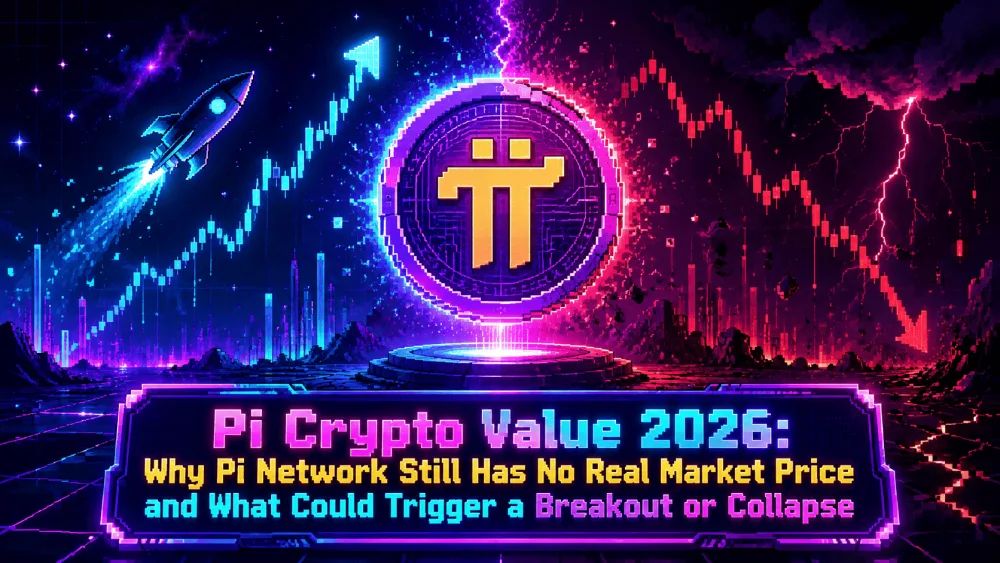
So, does Pi have a price? Yes, in the narrow exchange-traded sense. Does Pi have a fully reliable market value that reflects deep, open, mature demand? Not really. That is why Pi crypto value remains a controversial topic.
Contents
Pi Crypto Value in 2026: Current Market Snapshot

Pi Network is no longer just an enclosed app-mining project. Open Network launched in February 2025, external connectivity exists, and PI now appears on several market trackers. Still, the price remains fragile.
| Metric | Current / Recent Value |
|---|---|
| PI current price | Around $0.125–$0.14 |
| Reported market cap | Around $1.3B–$1.5B |
| Reported circulating supply | Around 10.6B–11B PI |
| Max supply | 100B PI |
| Reported all-time high | Around $2.99 on some trackers |
| Drawdown from peak | Roughly 95% |
| Main issue | Price exists, but market quality remains disputed |
This is the core problem. A token can have a displayed price and still lack strong price discovery. Thin liquidity, uneven access, uncertain unlock pressure, and migration delays can all distort what the market is really saying.
Why Pi Network Still Has a Confusing Market Price
The confusion comes from Pi’s unusual history. For years, users mined Pi inside a mobile app while the token did not trade freely on open markets. Then IOU-style markets appeared on some platforms before full market access existed. That created years of speculative pricing that did not always represent actual transferable PI.
Related: SLX Crypto Rise and Collapse: What Is Slimex and Why Did It Crash Over 90%?
Now PI has more exchange visibility, but old confusion remains. Some pages still reference Pi IOU data. Others show live PI data. Some prices differ because exchanges, supply assumptions, and market depth vary.
That is why Pi crypto value is not as simple as checking one chart. The market is still deciding what PI actually represents: a serious consumer crypto network, a large but weakly monetized community, or an overhyped token with too much supply chasing too little demand.
Pi Network’s Biggest Strength: The Community
Pi Network’s strongest asset is not price. It is distribution.
The project built one of the largest communities in crypto by making mining accessible through a mobile app. That gave Pi a huge user base long before many people could trade the token normally. In theory, this gives Pi a serious advantage: millions of users, strong brand recognition, and a ready-made ecosystem.
If even a small share of those users becomes active buyers, merchants, developers, or app users, Pi crypto value could improve quickly. Crypto markets love large communities because attention itself can become liquidity.
But community size alone is not enough. Users must actually do something with the token.
Pi Network’s Biggest Weakness: Utility Still Has to Prove Itself
Pi’s weak point is real utility. A huge user base matters only if PI becomes useful beyond checking balances and waiting for price appreciation.
The network needs more than belief. It needs apps, merchants, payments, developer activity, liquidity, and reasons for people to spend or hold PI. If most users only want to sell after migration, then the token faces pressure instead of support.
This is where the Pi crypto value argument gets uncomfortable. Many people hold Pi because they hope it becomes valuable. But a token does not become valuable only because many people hope it will.
Related: Degen Crypto Explained: Why High-Risk Traders Are Chasing 1000x Gains Again
Why Pi Could Break Out
A Pi breakout is possible if several conditions line up at once. PI has enough brand recognition to move fast if sentiment turns positive.
Potential breakout triggers include:
- Major exchange listings with deeper liquidity.
- Faster KYC and Mainnet migration completion.
- Clearer circulating supply data.
- Real merchant adoption.
- Useful apps inside the Pi ecosystem.
- Stronger wallet and payment infrastructure.
- More transparent communication from the core team.
- Broader crypto market risk appetite.
- A confirmed rise in real transaction activity.
The strongest breakout case would come from utility plus liquidity. If Pi becomes easier to trade and more useful at the same time, the market may reprice it.
In that scenario, Pi crypto value could climb because buyers would no longer be betting only on community size. They would be betting on actual network demand.
Why Pi Could Collapse
The collapse case is also clear. If migration unlocks more supply while demand remains weak, selling pressure could build. Many early users may see PI as “free money” and sell once they can. That is dangerous for any token with a large user base and uncertain buy-side strength.
Potential collapse triggers include:
- Heavy selling from migrated balances.
- Weak exchange liquidity.
- Failure to attract major listings.
- Low real-world usage.
- Poor developer traction.
- Confusing token supply data.
- Loss of community patience.
- Broader altcoin market weakness.
- Continued gap between hype and utility.
If the market decides Pi is mostly a large community with limited economic activity, price could fall further. Or the current low price may simply mean the market is still discounting risk.
Pi Price Dynamics: From Hype to Reality

Pi’s reported price history shows why traders are cautious. Some trackers show PI peaking near $2.99 before falling to the $0.125–$0.14 area. That is a drawdown of roughly 95%.
| Price zone | What it means |
|---|---|
| Around $2.99 | Hype peak on some market trackers |
| Around $0.125–$0.14 | Current traded range in early June 2026 |
| Around $1.00 | Major psychological recovery zone |
| Below $0.10 | Serious confidence breakdown zone |
| Above $0.20–$0.30 | First sign of stronger recovery attempt |
A move back to $1 would require several times growth from current levels. That is possible in crypto, but it would need serious liquidity and renewed demand. A quick social pump is not enough.
Related: Best Privacy Coins 2026: Why Monero, Zcash & DASH Are Making a Comeback
Why Exchange Listings Matter So Much
For years, Pi holders waited for broader exchange access. That matters because deep exchange liquidity helps create a more reliable price.
Without strong exchange depth (for example, only 1 million tokens was available via OKX upon launch), price can swing hard on relatively small trades. That makes Pi crypto value harder to trust. A displayed price does not mean every holder can sell at that number. Market depth decides what happens when real volume enters.
Tier-one exchange access could change the story, but it would not solve everything. Listings can create demand, but they can also create exit liquidity. If millions of users rush to sell into new liquidity, listings could trigger weakness instead of a rally.
That is the Pi paradox: better access can help price discovery, but it can also reveal how much sell pressure was waiting.
KYC and Migration Still Shape the Market
Pi’s KYC and Mainnet migration process remains important because it affects how much PI can actually move. A token’s price means less when large amounts are still locked, pending verification, or not fully migrated.
If migration accelerates and users become active ecosystem participants, that could support Pi. If migration mostly creates sellers, that could hurt price.
The market needs clarity on:
- How many users have migrated.
- How much PI is liquid.
- How much PI is locked.
- How much supply may enter the market later.
- Whether migrated users are spending, holding, or selling.
Until those answers become clearer, Pi crypto value will stay harder to judge than ordinary crypto assets.
Pi Network Utility: What Has to Improve
For Pi to justify a stronger valuation, it needs real economic activity. That means more than social media excitement and app logins.
Useful signs would include:
- More active Pi apps.
- Merchants accepting PI at market-based rates.
- Developer growth.
- Real transaction volume.
- Better wallet usability.
- Stronger payment integrations.
- Clear ecosystem incentives.
- More transparent network data.
If those pieces appear, Pi could become more than a speculative community coin. If they do not, the market may treat PI as another large-supply token searching for a reason to exist.
Pi Crypto Value Forecast for 2026
The 2026 forecast depends on whether Pi can turn community size into actual demand.
| Scenario | Conditions | Possible outcome |
|---|---|---|
| Bearish case | Weak utility, migration selling, poor liquidity | PI breaks lower and risks sub-$0.10 levels |
| Neutral case | Community stays active but usage remains limited | PI trades sideways around low ranges |
| Bullish case | Major listings, utility growth, stronger demand | PI attempts recovery toward higher resistance zones |
The base case is caution. Pi has enough community strength to avoid being dismissed completely, but not enough proven market demand to justify extreme bullish claims.
A serious Pi crypto value 2026 forecast should avoid both fantasy and panic. Pi is not worthless simply because skeptics dislike it. It is also not guaranteed to explode just because millions of people mined it on phones.
What Could Trigger a Breakout?
A breakout would likely require a visible change in the market’s opinion of Pi. The strongest trigger would be a combination of top exchange listings, clearer supply data, and real ecosystem growth.
A strong breakout setup would look like this:
- PI gains deeper exchange liquidity.
- Migration data becomes clearer.
- Developers build useful apps.
- Real payments increase.
- Selling pressure gets absorbed.
- The broader altcoin market turns bullish.
If those events happen together, Pi crypto value could rise sharply. The token has enough recognition for momentum to return fast.
What Could Trigger a Collapse?
A collapse would likely come from the opposite mix: more supply, weak demand, and fading patience.
A weak setup would look like this:
- More PI becomes liquid.
- Users sell instead of using it.
- Exchange liquidity stays thin.
- App usage remains low.
- Market sentiment turns bearish.
- Pi loses its “future potential” narrative.
That would pressure PI heavily. The danger is not only price decline. It is narrative decline. Once holders stop believing that utility is coming, the market can reprice brutally.
Expert Verdict: Does Pi Have Real Value?
Pi has a market price in 2026, but the quality of that price remains debatable. The token trades around $0.125–$0.14, yet its true value depends on liquidity, migration, supply clarity, utility, and whether the ecosystem becomes active enough to support demand.
The Pi crypto value 2026 question is not “what number appears on a chart?” The better question is: can Pi turn one of crypto’s largest communities into real economic activity?
If yes, Pi could still surprise the market. If no, it may keep sliding as early hype fades into disappointment.
Right now, Pi is not dead. It is not proven either. It is stuck in the most uncomfortable place in crypto: between massive expectations and incomplete evidence.
FAQ
What is Pi crypto value in 2026?
The Pi crypto value in early June 2026 is roughly $0.125–$0.14 on major trackers, though the quality of that price remains debated because liquidity, migration, and supply clarity are still major issues.
Does Pi Network have a real market price?
Pi has exchange-reported prices, but its market value remains disputed. Thin liquidity, IOU history, migration limits, and supply uncertainty make Pi harder to value than mature crypto assets.
Why is Pi price so low?
Pi price is low because the market remains uncertain about utility, liquidity, real demand, supply pressure, and whether Pi’s huge community will become an active economy.
Can Pi reach $1 in 2026?
Pi could reach $1 only if liquidity improves, major listings expand, utility grows, and buying demand absorbs future supply. Without those changes, $1 remains a difficult target.
What could make Pi collapse?
Pi could fall further if more supply becomes liquid while users mostly sell instead of spend or hold. Weak app usage, poor liquidity, and fading community patience could also pressure price.
What could make Pi break out?
A breakout could come from major exchange listings, stronger ecosystem utility, faster migration, clearer supply data, and real transaction growth across Pi apps and payments.