The Terra Classic is the old Terra blockchain that continued operating after the 2022 collapse, now using a new token called LUNC to replace the old LUNA. Simply put, Terra Classic is a legacy version of an older blockchain that was designed for algorithmically pegged stablecoins and has since become a community-maintained blockchain, focusing on governance and reducing supply.
Contents
What Is Terra Classic in Simple Terms?
The old system used a mint and burn between tokens LUNA and UST. When the first design model for the Terra Classic cryptocurrency did not work as planned, it lost its main purpose or use, which led to Terra Classic being a speculative, community-driven blockchain.
Why Terra Classic Still Matters After the Collapse
Even though Terra crashed in 2022, the LUNA Classic (LUNC) token has continued to have an active user base, with initiatives going on. By 2026, approximately 430 billion tokens were burned out of circulation for the first time; this shows that there are continued attempts to decrease the amount of available tokens — however, the total LUNC amount is above 5 trillion.
Trading is also happening with LUNC, and the project has liquidity on multiple large exchanges. The Terra Classic Price movement is typically driven by either speculation or technical indicators, instead of fundamental factors. This persistence explains why is Terra Classic still alive and continues to be widely discussed—it functions as both a recovery experiment and a speculative asset.
Difference Between Terra (LUNA) and Terra Classic (LUNC)
The difference between LUNA and LUNA Classic stems from the 2022 chain split. The original blockchain was renamed Terra Classic and has an associated currency of LUNC; whereas a newer network named Terra 2.0, launched (with its own LUNA token), but did not contain any of the elements that created the risk for the algorithmically generated stablecoin.
| Feature | Terra Classic (LUNC) | Terra 2.0 (LUNA) |
| Origin | Original chain | New chain (post-crash) |
| Stablecoin Model | Yes (failed UST) | No |
| Supply | Trillions | Limited |
| Governance | Community-driven | Structured ecosystem |
| Use Case | Legacy + speculative | Rebuilding ecosystem |
The History of Terra Classic
The Rise of the Original Terra Ecosystem
The beginning of Terra Classic history is connected to 2019, when Terraform Labs started Terra, a blockchain that used algorithmic stablecoins and digital payments for transactions. A mint-and-burn process was established between LUNA and TerraUSD (UST) in order to support price stability from reserve funds.
Terra was able to grow fast due to DeFi-based apps such as Anchor Protocol, which was giving users an opportunity to earn yields over 20% per annum on their UST deposit. The use case caused millions of dollars in new liquidity to flow into the Terra ecosystem, which placed it among the top-tier cryptocurrency ecosystems by total market capitalization in 2022.
What Caused the Terra (LUNA) Crash in 2022
To understand why did Terra Luna crash in 2022, it began as UST lost its dollar peg due to major withdrawals and sell pressure. This was followed by a decline in confidence that led to a substantial amount of LUNA being printed for defending the peg, which triggered extreme inflation and the rapid price drop.
This feedback loop is often referred to as a “Death Spiral,” but was further exacerbated by the dependence on unsustainable returns and concentration of demand within the ecosystem. In less than a week, tens of billions in value were erased, making Luna crash explanation of structural risk within algorithmic stablecoins.
The Split into Terra Classic and Terra 2.0
The Terra network went through an overhaul after the collapse, and this overhaul is commonly referred to as the Terra Luna split. The governance proposal created Terra 2.0 and preserved the old chain in the form of Terra Classic and renamed its native coin from LUNA to LUNC.
As a result, there were now two tracks: one being a new ecosystem that would not use the failed stablecoin model, and the other track for the community that wanted to maintain the legacy chain. Therefore, rather than a shutdown, what happened to the Terra network was its separation into parallel blockchains using different business models.
Impact of the Collapse on the Crypto Market
The collapse resulted in the loss of approximately $45 billion of market capitalization in under a week, and it caused shock waves throughout the cryptocurrency community. At the same time, it pointed out elevated volatility and interconnectivity risks to major asset classes, demonstrating that when an ecosystem fails, it can cause ripples into other areas of the overall market.
In addition to instant financial damage from the collapse, investors’ perceptions of the markets were altered, and regulatory attention was drawn. Terra Classic crypto’s failure represented a watershed moment for investors and regulators alike, and created new levels of scrutiny on stablecoin designs, DeFi models, and systemic risk associated with digital assets.
What Is LUNC (Terra Classic Token)?
Definition and Purpose of LUNC
LUNC is the native currency of Terra (now known as Terra Classic), which collapsed in 2022 and has been running on its own blockchain since then. The token LUNC today represents a legacy asset, and understanding what LUNC is requires recognizing its shift from a stablecoin support mechanism to a community-managed blockchain.
Read Also: P2P Trading Safety Guide 2026: How to Avoid Fraud, Secure Transactions, and Trade with Confidence
In the past, the primary purpose of the token was to maintain price stability for the UST by adjusting the amount of tokens available. After this method stopped working, the new use cases for the token were to support staking, governance, and speculation. As time passed, there has also been a focus on reducing the size of the large quantity of LUNC existing due to burn initiatives.
Role of LUNC in the Terra Classic Blockchain
Terra Classic LUNC is an important utility inside the Terra Classic ecosystem, as it can be utilized for paying for transaction costs, staking, or rewards from validators. It is still operating under a Proof-of-Stake model; users are delegating their tokens to the validator nodes to assist in securing the network while earning some type of incentive.
LUNC’s function has expanded along with several technology advancements that have taken place since 2026. Some examples include cross-chain functionality through the Cosmos-based infrastructure; this will enable LUNC to be used outside of its native ecosystem. However, there is much less use of LUNC than was seen prior to the collapse.
Community Governance and Decentralization After the Crash
Beginning after the collapse, Terra Classic became completely controlled by its community. In 2026, who controls Terra Classic now is based upon a decentralized system where validators and token holders vote on proposals for determining upgrades, parameters, and funding.
The Governance activity will remain as one of the major driving forces behind the Terra Classic ecosystem in 2026. There are continuing advancements being made within the voting mechanisms and participation.
The Decentralized structure has allowed Terra Classic crypto to continue to exist even though it’s at a much smaller size. Now, development and strategy for Terra Classic are determined through group decision-making instead of by a central authority.
Terra Classic Tokenomics Explained
Total Supply and Circulating Supply of LUNC
The most distinctive feature in Terra Classic tokenomics is an unusually high supply level of the coin. At present, the circulating LUNC supply is approximately 5.4-5.5 trillion tokens, while the LUNC total supply is greater than 6.4 trillion tokens. The large-scale supply of Terra Classic has resulted from the hyperinflation experienced by Terra Classic during its 2022 collapse.
Unlike many major cryptocurrencies with capped or predictable issuance, the Terra Classic token supply explained shows a system where supply expansion happened rapidly and is a structural constraint on price recovery.
Inflation Issues and Post-Crash Supply Dynamics
The post-crash situation for Terra put it into an oversupplied position relative to its own economy. As the price collapsed during this time, a large amount of trillions of tokens was minted by the protocol, attempting to keep the value of UST at par with the dollar. The inflationary forces from these actions are still felt today and will define the asset’s future direction.
Although since the crisis, there is little evidence of the community permitting continued uncontrolled mints, the existing token supply weighs on current values. Therefore, recovery will be dependent on reducing supply through either sustained demand or through some form of reduction strategy rather than being based on new creation.
LUNC Burn Mechanism Explained
The LUNC burn mechanism is primarily the method for addressing oversupply in LUNA Classic. As tokens are removed from circulation permanently, typically via transaction fees that destroy tokens, or other exchanges supporting token burns, it also removes them from circulation.
Practically speaking, a portion of all on-chain transaction fees is burned when the transactions occur; therefore, using the network creates an automatic decrease in available circulating tokens.
Using this model as a deflationary pressure model, if users increase their usage of the network, it will likely cause the burn ratio to increase, which will eventually lower the number of tokens currently in circulation.
Impact of Burns on Price and Scarcity
The burning tokens act creates a scarcity environment through the reduction of available supply; this, theoretically, will lead to an increase in value as long as there is no decrease in demand. As of today, over 430 billion tokens have been burned, with it being clear that the Burn has been a consistent community endeavor to create deflation.
While burn events are known to cause both short-term changes in price and increases in trading volume due to their ability to create volatility, the potential for long-term positive effects from these actions depends on the burn rate exceeding the sheer magnitude of the remaining token base.
Terra Classic Ecosystem Today
Current Development Activity in Terra Classic
Development in Terra Classic has been occurring at an increasingly slower rate due to continued development being done primarily by the community contributors. One significant event occurred in 2026 when a major upgrade to Cosmos SDK v0.53 took place, which improved how Terra interacts with other blockchain networks via IBC and expanded cross-chain capabilities.
The aim behind these updates is to update Terra’s underlying architecture and improve it technologically so that it can become more relevant again.
However, even though there are still many improvements that can be made to Terra’s underlying technology, because of its decentralized nature and lack of centralized funding like larger Layer-1 chains, development is progressing slowly.
Key Community-Driven Projects
Most of the innovations within Terra Classic crypto at this point are coming from grassroots efforts. Grassroots efforts by communities build various types of infrastructures, for example, burn tracking systems and small-scale DeFi integrations. As opposed to large application-level innovations, there is a strong focus on building out the infrastructure.
The governance proposals usually put forward are either related to some sort of parameter that would affect economics — such as increasing the burn rate or incentivizing validators — or expanding upon the overall ecosystem. The result is a steady flow of development that has been based on consensus among the community members.
Exchange Support and Liquidity Status
Terra Classic LUNC continues to be listed for trade on leading exchanges and maintains significant trading activity. The daily LUNC volume has been known to vary substantially, and at times, within volatile or highly speculative periods, has exceeded $100 million.
Read Also: Top 10 Crypto X Influencers to Follow in 2026. Best Twitter Accounts for Signals & Insights
While LUNC has a relatively thin liquidity compared with top-tier traded assets, this contributes to the sensitivity of price movement based on speculation. This situation provides for ongoing activity regarding LUNC in the markets, while providing additional proof backing it as an extremely volatile asset.
Is Terra Classic a Good Investment?
Price Performance After the Collapse
In 2026, Terra Classic traded mostly between the very low values of $0.00003 to $0.00005 after the huge price drop in 2022. Although there have been several price rallies with short-term spikes above significant support or resistance points, LUNA’s price movement is primarily speculative and technically motivated; therefore, there were no strong fundamental drivers of the price.
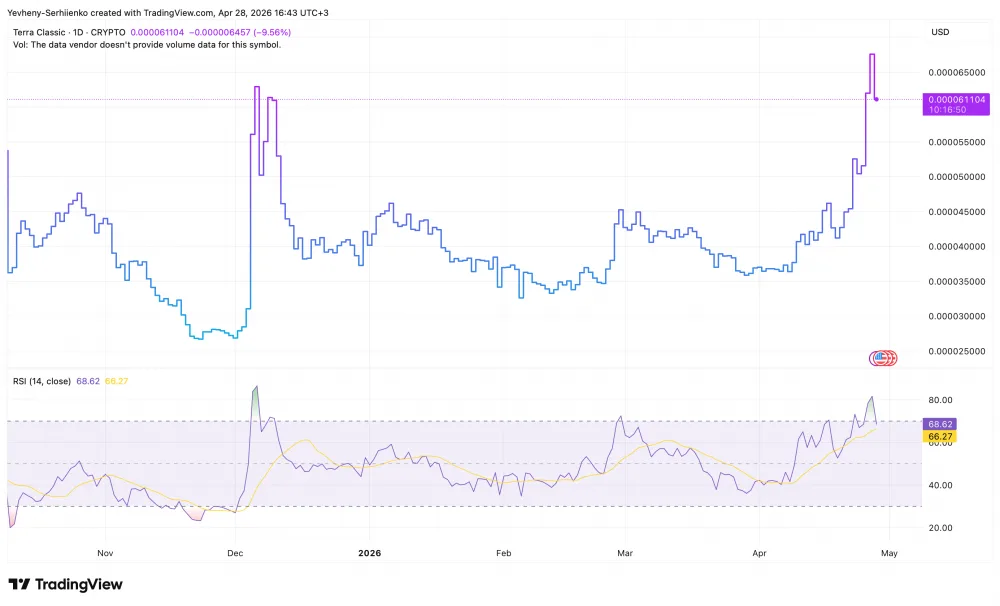
Because even a relatively small move in price will create an equally large percent change in price, due to its design, this makes LUNA attractive to short-term speculators, but not suitable as a long-term store of wealth.
Risks of Investing in LUNC
The main concern around is LUNC a good investment considering the substantial amount of coins available in circulation and the lack of real-world value/use. While burn efforts persist in reducing the number of coins in circulation, trillions of coins still exist, which can create continuous downward pricing pressures.
A similar view is shared by market researchers tracking the project’s long-term viability.
“Investing in LUNC in 2026 involves a unique set of risks relative to established assets like Bitcoin or Ethereum. The main risk is the lack of a centralized roadmap or corporate backing.” — Analysts Research (2026).
In addition to this, the high level of volatility associated with LUNC prices has created potential for rapid reversals in price, as many recent price increases were based on speculation as opposed to actual use/development within the ecosystem. In addition to that, LUNC’s reliance upon community-driven development creates significant uncertainty regarding prolonged growth.
Potential Upside Scenarios
Most of the bullish scenarios about Terra Classic future are generally tied to two variables: the rate at which tokens continue to be burned, and the amount of new economic activity within LUNA’s ecosystem.
If a significant number of tokens continue to be burned at an accelerating rate, such that the supply decreases significantly from the present level, it is possible that there will be enough scarcity to cause the valuation to increase.
Moderate bull calls have been made on price movement by some analysts. For example, several forecasters predict that in 2026, the LUNA price will range between 0.00004 and 0.00012. These predictions depend on continued growth in community coordination and improvements in demand.
Expert and Community Opinions
Most investors categorize LUNC as a high-risk, high-reward opportunity. Some traders will buy into the potential for upside from the volatility and hope of recovery; however, nearly all analysts stress that this is still a speculative investment based on hype rather than a solid fundamental opportunity.
However, community perception tends to be much more optimistic, with hopes of eventually burning out all excess supply through a variety of burn strategies. The difference between investor hesitation and optimistic stance among community members will continue to define how they perceive this investment opportunity.
Terra Classic Price Prediction & Future Outlook
Short-Term Price Expectations
In the near term, LUNC price prediction remains highly volatile, with most models placing 2026 trading ranges between roughly $0.00003 and $0.00006, depending on market conditions.
Most technical indicators display either neutral or slightly bearish momentum as there are little to no fundamental drivers in this space, and it is mainly driven by speculation.
For short-term movements, the primary influences include, but are not limited to, burn announcements, exchange activity, and general cryptocurrency sentiment. Due to these factors, price action is reactive, and price can spike rapidly and then fall equally as fast within relatively small ranges.
Long-Term Forecast for LUNC
Long-term predictions about Terra Classic’s future are wide-ranging, which represents how uncertain it is that the asset will recover.
Using conservative forecasting models, we see a trend toward growing at a slow rate towards $0.00004-$0.00007 by the end of the decade, as long as there is steady, albeit limited development.
Using more hopeful projections, we see that the values could be much higher than those in the previous forecast; however, even with very positive views regarding Terra Classic’s potential, we see that most of these estimates are still much lower than the values prior to the crash.
What Needs to Happen for Recovery
For will LUNC recover in future to become a realistic scenario, several structural changes are required. Most importantly, there is a significant decrease in the amount of coins being circulated at this time, with the present trillion-plus supply of tokens continuing to cap the upside price potential.
Furthermore, to achieve the type of price increase that would be sustainable as opposed to speculative, LUNA needs to have increased developer involvement, improve its underlying infrastructure, and create additional use cases for people to utilize, which could then lead to organic demand.
Without those variables, it seems reasonable to expect price increases to continue to be driven by speculation rather than by sustainable price increases.
Role of Burns and Adoption in Future Growth
The Terra Classic burn strategy is likely to be the most important factor that determines future expectations. The continued burning of tokens through continuous reductions in supply via transaction fees and exchange involvement should eventually create a scarcity environment for the token.
However, burns alone are unlikely to fuel long-term growth without parallel increases in adoption. The interaction between reduced supply and rising demand will ultimately determine how does LUNC burn work and translate into a meaningful price impact over time.
Key Risks and Challenges
Regulatory Risks
Regulatory pressures continue to be an important issue for Terra Classic crypto due to the effects of the 2022 collapse. As part of this, many countries have taken a closer look at both algorithmic stablecoins and related projects.
This has included investigations of Terraform Labs and its management, which will likely cause a persistent impact on the perception of the Terra Classic ecosystem.
Although Terra Classic is no longer operating under the stablecoin model, it’s still indirectly exposed to regulatory risks by virtue of its connection to the failure. It’s possible that future regulations may target higher-risk crypto assets or force exchanges to comply with even stricter standards; these possible restrictions would reduce access and liquidity.
Developer Activity Concerns
Sustaining development is a challenge that is somewhat different from that of a major Layer-1 network with an established team and budget. The Terra Classic model relies almost entirely on independent contributions and community-led initiatives.
Read Also: Top 5 Wild Ethereum Price Predictions for 2026: From Realistic to Moonshot Scenarios
While this model provides for continued operation and reduces the potential for discontinuity, it also may cause slower innovation and fewer large-scale developments.
In addition to continuing efforts, such as the Cosmos SDK updates, there are still questions regarding whether Terra Classic has the support or resources necessary to remain competitive long-term and to continue attracting new talent.
Market Sentiment Dependency
The movement in Terra Classic LUNC price is mainly driven by sentiment of the crypto space as a whole; news regarding burns, listing on exchanges, etc., can lead to large price movements.
The speculation that drives this also means there will be times when it reacts poorly to other crypto cycles; the decrease in interest and/or activity will likely increase the negative effect and lessen the likelihood of the asset’s ability to recover from those declines.
Competition from Other Layer-1 Blockchains
The competitive landscape creates additional pressures on the network. On one hand, established layer-1 networks like Ethereum and Solana are increasing their ecosystem capabilities through an abundance of developer talent, institutional capital, and active users.
On the other side of this equation is the difficulty that Terra Classic has in competing for attention from developers and users due to newer, faster technology replacing older, less functional platforms within DeFi and Web3.
FAQ
What happened to Terra after the 2022 crash?
After the collapse of UST, the first blockchain was preserved and renamed Terra Classic, while a new network (Terra 2.0) was launched with a separate token. The two now operate independently with different goals and structures.
Is Terra Classic still active today?
Yes, the network continues to function with active validators, ongoing governance proposals, and regular transaction activity. It remains operational, although on a much smaller scale than before the collapse.
What is the main purpose of LUNC now?
Today, LUNC is primarily used for staking, governance, and transaction fees within the network. Its role has shifted away from stablecoin stabilization toward maintaining blockchain operations and supporting community-driven initiatives.
Can Terra Classic return to its previous price levels?
A return to pre-2022 prices is considered highly unlikely due to the massive increase in token supply. When evaluating can Terra Classic reach $1, most projections suggest that any recovery would be gradual and dependent on long-term supply reduction and adoption.
How does the Terra Classic network evolve today?
The ecosystem evolves through decentralized governance, where validators and token holders vote on upgrades and changes. Development is ongoing but largely driven by community contributors rather than a centralized team.