Key takeaways
- Bitcoin reaching $100,000 in 2026 is possible, but far from guaranteed. It has become a realistic but contested target rather than a base-case outcome.
- The biggest drivers for $100K are strong ETF inflows, aggressive corporate buying, returning liquidity, and the structural supply tightness from the 2024 halving.
- The main risks that could keep Bitcoin below $100K are geopolitical tensions (especially the US-Israel-Iran conflict), high oil prices fueling inflation, a hawkish Fed, and continued weak ETF demand.
- Most experts now see a base case of $95,000-$120,000 by the end of 2026. Super-bullish forecasts reach $150K-$250K if everything aligns perfectly.
- Prediction markets are more cautious: they currently price in roughly 35-43% probability of Bitcoin hitting $100K before January 2027.
Bitcoin is trading below its previous peak of around $126,000, but the $100,000 level is still in focus. The question now is not about a new all-time high, but whether BTC▼$77,230.00 can return to that level in 2026 and hold it.
This matters right now because the market has changed. The cryptocurrency’s price is no longer driven only by the halving cycle or retail demand. Bitcoin ETF flows, institutional adoption, and broader macro conditions play a much bigger role in price movement.
Many experts consider $100,000 a realistic target for Bitcoin in 2026. At the same time, most of these views come with conditions. The outcome depends on liquidity, investor sentiment, and whether institutional demand continues to grow.
In this guide, we break down whether BTC can reach $100,000 in 2026, what factors could push it there, what could hold it back, and how realistic this scenario is based on current market conditions.
Contents
- Bitcoin Price in 2026: Where It Stands Now
- Why Did Bitcoin Drop from $126K? Key Factors
- Bitcoin Halving Cycle in 2026: Is the 4-Year Model Still Valid
- What Could Push Bitcoin to $100K in 2026?
- What Could Stop Bitcoin From Reaching $100K in 2026?
- What Prediction Markets Say About $100K
- Expert Bitcoin Price Predictions for 2026
- Bitcoin Price Scenarios for 2026
- So, Will Bitcoin Hit $100K in 2026?
- FAQ
Bitcoin Price in 2026: Where It Stands Now
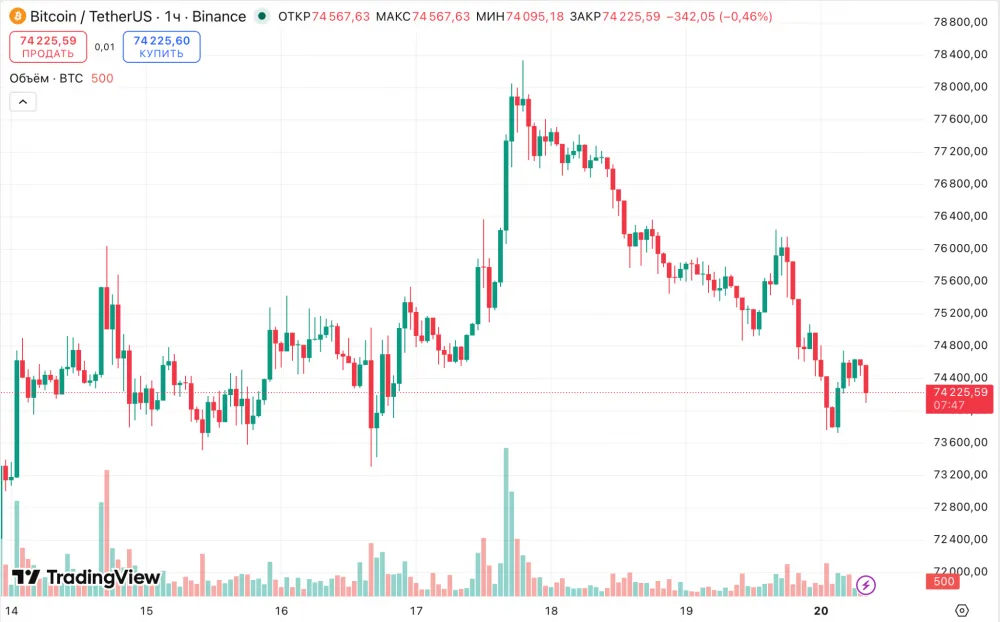
Bitcoin is trading well below its previous peak of around $126,000, but still far above earlier cycle highs.
After topping near $126,000 in October 2025, BTC entered a correction and moved into a wide, volatile range.
As of April 20, Bitcoin is trading in the mid-$70,000s.
Why Did Bitcoin Drop from $126K? Key Factors
Bitcoin did not fall from $126,000 for one single reason. The correction came from a mix of weaker demand, profit-taking, and leverage getting flushed out of the market.
One of the biggest factors was selling pressure from older holders. In its January 2026 research, Glassnode said Bitcoin had moved back into a dense supply zone between roughly $93,000 and $110,000.
That area was filled with long-term holder supply from 2025. The analyst also stated long-term holders were still realizing about 12,800 BTC per week in net profit, even after the pace of selling had slowed.
A second factor was weak spot demand. The move toward $95,600 was driven mainly by a derivatives-led short squeeze on thin futures volume, not by strong spot buying. Broader direction still depended on liquidity and derivatives positioning until persistent spot accumulation returned.
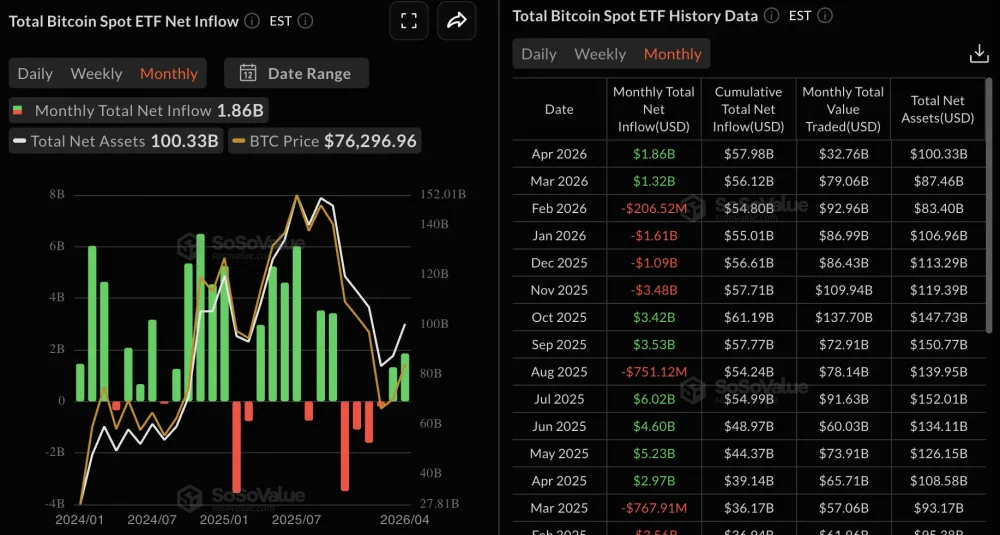
Institutional flow also lost momentum. Balance-sheet flows from ETFs, corporates, and sovereign buyers had gone through a full reset after a period of heavy outflows. In simple terms, one of the strongest sources of demand from the earlier rally was no longer pushing the market the same way.
CryptoQuant data points to the same cooling trend. In April 2026, the experts flagged that active Bitcoin addresses fell to their lowest level in eight years.
It also reported that BTC depositing addresses dropped to around 31,000 per day on a 30-day moving average, the lowest level in ten years. These suggest lower speculative activity and weaker retail participation during the correction.
There was also visible pressure from the mining side. Publicly listed Bitcoin miners sold more than 32,000 BTC in Q1 2026, which marked the largest quarterly outflow on record. That added more supply to the market during an already fragile period.
The correction was then made worse by leverage. CoinGlass explains that liquidations happen when traders use high leverage and the market moves against them. Forced position closures can then push the price lower and trigger more liquidations. In a correction, this creates a cascade.
The correction reflected a broader reset in market structure. The main drivers were:
- long-term holders kept taking profit
- spot demand stayed weak
- institutional flows cooled
- on-chain activity fell
- miners sold more BTC
- leverage amplified the downside
Bitcoin Halving Cycle in 2026: Is the 4-Year Model Still Valid
For years, Bitcoin investors relied on the 4-year halving cycle as a rough model for price moves. After each halving, the market usually entered a strong bull phase, followed by a peak and a long correction.
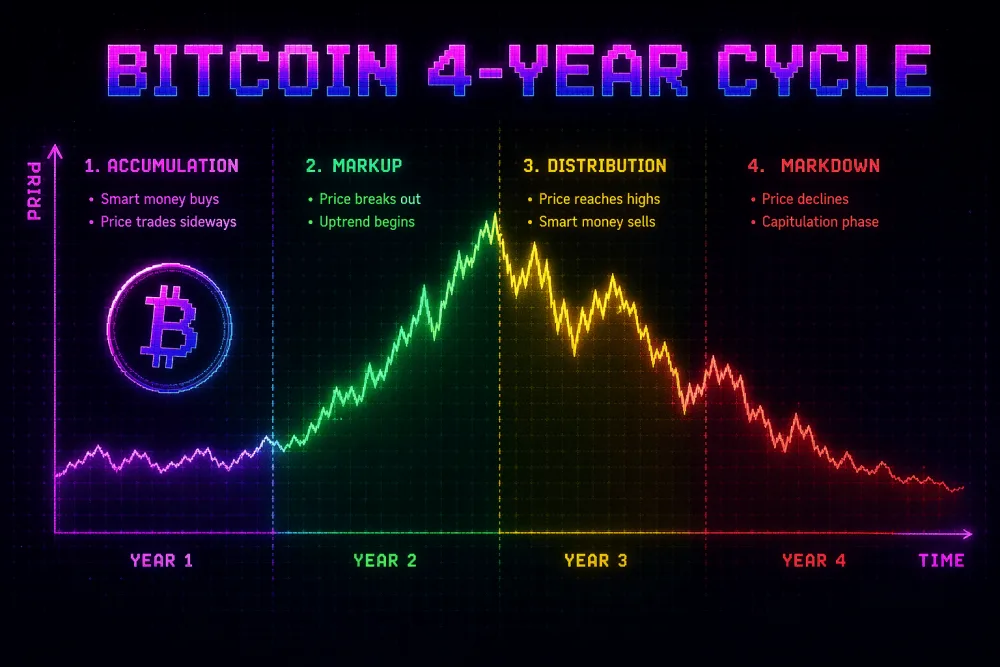
In 2026, this model looks less reliable.
The halving still matters. It reduces new Bitcoin supply and historically creates a bullish setup over time. But many analysts now agree that it is no longer the main driver of price.
Several market participants point to the same shift.
Some analysts from K33 and Bitwise say that the traditional four-year cycle is breaking down. The idea is simple. Bitcoin is no longer a small, isolated market. It is now influenced by larger forces, especially institutional capital and global liquidity.
Grayscale has also suggested that Bitcoin can grow outside of the classic cycle structure. Instead of a predictable post-halving rally, the market may now react more to capital flows and macro conditions.
Another common argument is that monetary policy is now a stronger driver than halving. When liquidity is tight and interest rates are high, risk assets struggle. When liquidity improves, Bitcoin can move higher — regardless of where it is in the halving cycle.
ETF flows are also changing the structure.
With spot Bitcoin ETFs, large amounts of capital can enter or leave the market quickly. This creates demand patterns that did not exist in previous cycles. Instead of a slow build-up after the halving, the market can now move faster and in a less predictable way.
Miners behave differently, too. In earlier cycles, miners were forced sellers after halvings due to reduced rewards. Now, with more developed financial tools and access to capital, miners can manage their positions differently, which smooths out some of the old cycle effects.
Because of this, some analysts are starting to describe Bitcoin less as a “cycle asset” and more as a liquidity-driven asset.
For 2026, this changes how the $100,000 question should be viewed.
Bitcoin does not need to follow a strict four-year pattern to move higher. But it also means that price growth depends more on external factors like ETF demand, institutional positioning, and macro liquidity.
That makes the outlook less predictable — and more dependent on the broader market environment.
| Factor | Bullish for $100K | Bearish for $100K |
| ETF flows | Strong inflows return | Outflows continue |
| Macro | Fed turns softer, liquidity improves | Inflation stays sticky, Fed stays hawkish |
| Demand | Corporate and institutional buying grows | Spot demand stays weak |
| Market structure | BTC reclaims higher supply zones | BTC remains stuck below key levels |
| Halving effect | Reduced supply supports demand shock | Halving matters less than expected |
What Could Push Bitcoin to $100K in 2026?
Many analysts still see a realistic path to $100,000 this year. Four main drivers can make it happen: strong institutional buying, better macro conditions, rising liquidity and risk appetite, and the lasting effects of the 2024 halving.
Let’s break down each of the points and explore what experts actually think.
ETF Inflows and Institutional Demand
Big institutions have become the main buyers of Bitcoin. Spot BTC ETFs turned this into an easy, regulated way for them to get exposure.
March 2026 brought a nice turnaround. U.S. spot Bitcoin ETFs saw $1.32 billion in net inflows — the first positive month of the year after four straight months of outflows.
April started strong too, with BlackRock’s IBIT pulling in nearly $100 million on some days.
Corporations are also stacking aggressively. Strategy (the company formerly known as MicroStrategy) and other public companies now hold well over $74 billion in Bitcoin combined.
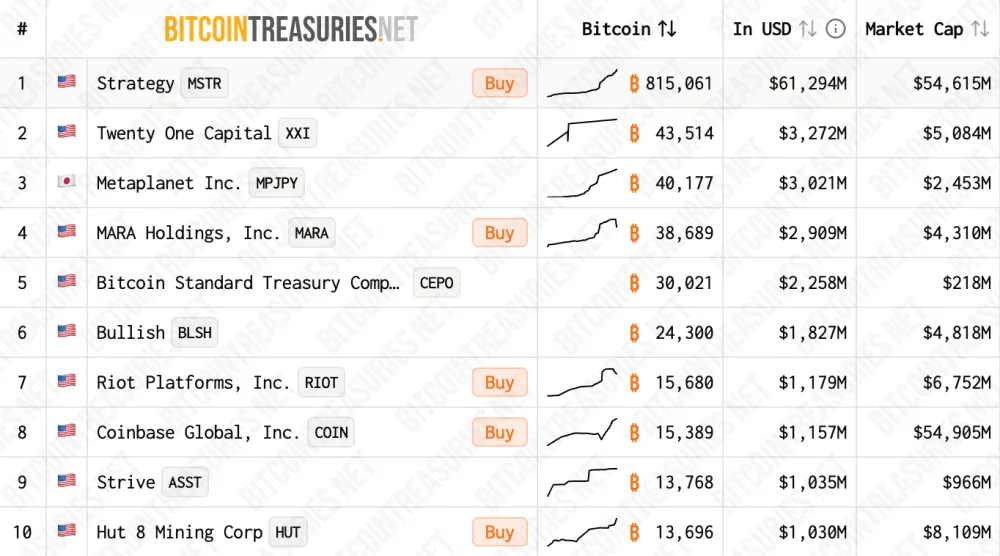
In many recent weeks, these big buyers have been absorbing two to three times more Bitcoin than miners are creating.
This is real demand pressure. When institutions keep buying at this pace, it creates actual scarcity in the market.
Analysts at Standard Chartered and JPMorgan point to ETF inflows as the single biggest driver for Bitcoin’s price this year. They say steady annual inflows of $10-15 billion could easily push Bitcoin toward $150,000.
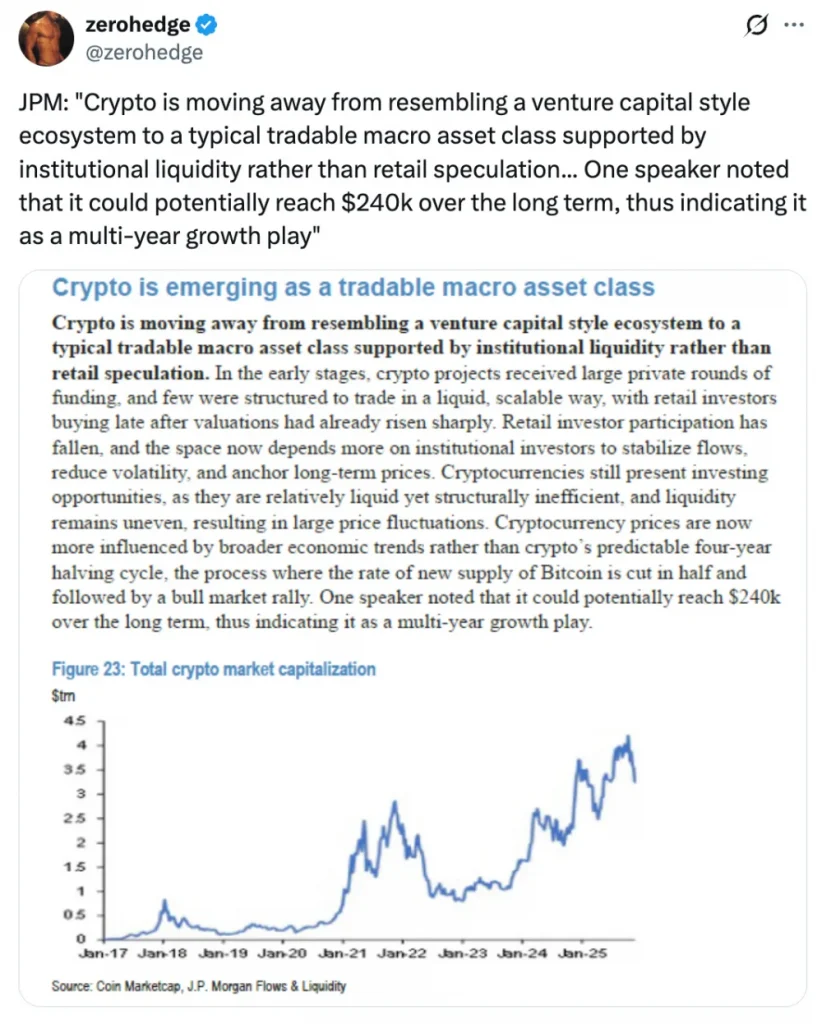
Citigroup is even more bullish, with a base case around $143,000 and a bull case near $189,000, largely thanks to these flows and improving regulations.
Macro Conditions and Fed Policy
Bitcoin now moves closely with the broader economy and interest rates. Right now, the Fed is holding rates at 3.50-3.75%. Inflation remains sticky, and markets aren’t pricing in many (if any) rate cuts for the rest of 2026.
Lower rates usually help risk assets like Bitcoin because they make bonds and cash less attractive. Even small hints of future easing tend to spark rallies.
Tom Lee from Fundstrat has been vocal about this. He believes any dovish signals from the Fed — even just one or two cuts later in the year — would act as a strong bullish catalyst and support targets between $150,000 and $250,000.
Many other analysts agree: Bitcoin increasingly “front-runs” Fed decisions rather than just reacting to them.
If inflation starts to cool and the Fed gives the market even mild encouragement, the market could see a quick shift in sentiment that lifts Bitcoin fast.
Liquidity and Risk Appetite
Bitcoin no longer acts like “digital gold” in every situation. These days, it trades more like a high-beta growth asset — very similar to tech stocks. When investors feel confident and money flows into risky bets, Bitcoin tends to soar. When fear kicks in and liquidity dries up, it drops hard.
Right now in April 2026, global liquidity has tightened noticeably. Bitcoin’s own market liquidity has halved since September 2025, and conditions got even worse in early April. Real yields are elevated, the US dollar remains relatively strong, and overall risk appetite stays fragile and uneven.
There’s been short bursts of optimism — for example, the recent Iran ceasefire triggered a $427 million short squeeze and pushed Bitcoin higher for a few days. But these moves often fade quickly because there’s no steady, broad inflow of fresh capital or strong investor confidence.
Here’s the important part: the flip side is extremely powerful.
If global liquidity starts expanding again — whether from lower rates, weaker dollar, or simply better economic data — risk appetite can return fast. When that happens, Bitcoin tends to rally sharply because it has high sensitivity to these shifts.
Many analysts point out that a clear improvement in liquidity and sentiment could be one of the fastest ways to push Bitcoin through $100,000 this year.
In short, this factor is one of the most volatile but also one of the most explosive drivers for BTC in 2026. It won’t create slow, steady growth — it creates big moves when the mood suddenly changes.
Post-Halving Supply Narrative
The 2024 Bitcoin halving cut the daily new supply in half — from around 900 BTC to roughly 450 BTC per day. That sounds dramatic on paper, and it is. Bitcoin’s inflation rate has now dropped to just 0.85%, which is lower than gold’s.
In previous cycles, this supply shock was the main catalyst that drove massive rallies 12-18 months after the halving. But this cycle feels different.
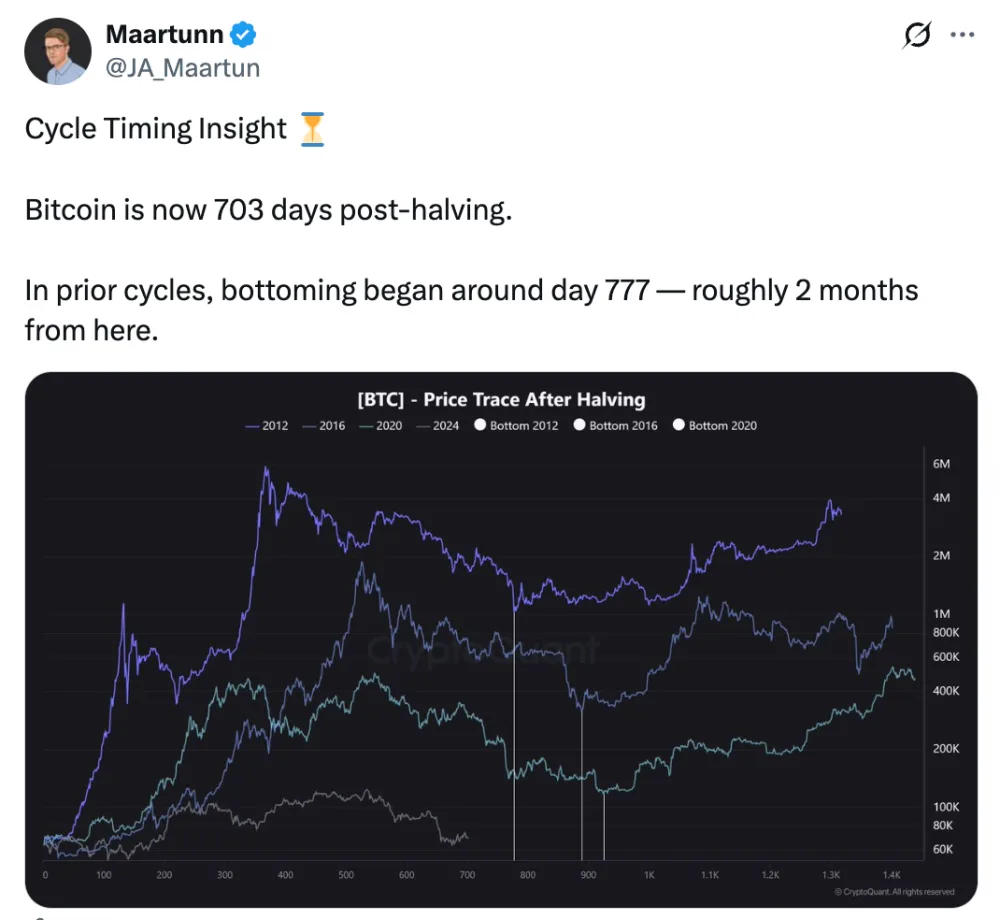
The market is much larger now. With a market cap often above $1.4 trillion, the same reduction in new coins has a smaller percentage impact than it did in 2020 or 2016. The pure “halving pump” is not as explosive as before.
However, the halving still plays an important role — just not by itself.
What makes 2026 special is the combination of this reduced supply with extremely strong demand. ETFs and corporate treasuries are buying thousands of BTC every week.
In many periods, institutional buying has absorbed 2-3 times more Bitcoin than miners can produce. This creates a real structural deficit.
Grayscale and Bitwise call this the beginning of the “institutional era.” They argue that constant buying pressure from big, long-term players is now more powerful than the halving supply cut alone. The halving simply makes this demand shock even more effective.
In simple terms: fewer new coins are coming in, while big money keeps stacking without selling. That imbalance is exactly what can push prices significantly higher — and why many analysts still believe the post-halving narrative supports a move toward $100,000 and beyond in 2026.
What Could Stop Bitcoin From Reaching $100K in 2026?
While the bullish drivers we just covered could push it higher, several real risks could easily keep it stuck below $100,000 — or even send it lower. Here are the four biggest threats analysts are watching closely.
Geopolitical Tensions and the US-Israel-Iran Conflict
The war between the US, Israel, and Iran that kicked off at the end of February 2026 changed everything for markets.
When the conflict escalated, Iran closed the Strait of Hormuz. Oil prices exploded. Brent crude shot past $120 a barrel at one point. Global markets went straight into risk-off mode. Stocks sold off hard, and Bitcoin dropped sharply too — it started trading more like a high-beta risk asset than a safe haven.
Even though a ceasefire was announced around April 8, the situation remains fragile. Any breakdown could restart the chaos.
Analysts at CryptoQuant point out that Bitcoin now reacts to geopolitical shocks in real time. On-chain data shows large holders moving coins to exchanges during these spikes, which often leads to selling pressure.
JPMorgan and Goldman Sachs both warned that prolonged uncertainty in the Middle East keeps investors nervous and delays any big Bitcoin rally.
Rising Inflation Pressure and Oil Price Shocks
The oil spike from the Iran conflict didn’t just hurt stocks — it created fresh inflation fears.
When energy prices jump, it feeds straight into higher costs across the economy. The Middle East conflict reversed early-2026 disinflation trends and forced central banks to rethink rate cuts. Oil stayed elevated for weeks, and that sticky inflation makes the Fed much more cautious.
Higher inflation and higher-for-longer interest rates are classic headwinds for Bitcoin. They keep money in safer assets and reduce risk appetite.
Standard Chartered specifically cited this macro backdrop when they cut their 2026 Bitcoin target from $150,000 down to $100,000 in February — and warned of a possible dip to $50,000 before any recovery.
If oil stays volatile or the ceasefire falls apart, inflation could spike again and push Bitcoin even further from $100,000.
Persistent ETF Outflows and Weakening Institutional Demand
Early 2026 brought a painful shift: U.S. spot Bitcoin ETFs flipped from massive inflows to heavy outflows.
After four straight months of outflows earlier this year, institutional buying slowed dramatically. CryptoQuant’s latest data (as of early April) shows overall spot demand is in deep contraction — down 63,000 BTC over the past 30 days.
Even with some big corporate purchases, broader market selling is winning right now.
Large holders (1K-10K BTC wallets) have turned into net sellers. This distribution cycle is one of the most aggressive on record.
Without steady ETF inflows returning, the demand side stays weak. Analysts at Bitwise and deVere Group say this lack of fresh institutional money is the biggest reason many forecasts for 2026 have been downgraded.
Hawkish Fed Policy and Recession Fears
The Fed shows little appetite for quick cuts. Sticky inflation from oil, combined with geopolitical uncertainty, makes any dovish pivot unlikely in the near term.
This “higher for longer” environment hurts risk assets like Bitcoin. It also raises the odds of a broader economic slowdown or even recession. CryptoQuant warns that in a worst-case macro stress scenario — higher oil, equities crashing 30%+, and risk-off everywhere — Bitcoin could test as low as $50,000 or worse.
Tom Lee and other bulls still see a path higher, but they admit that without clear macro improvement, Bitcoin stays range-bound or drops further.
What Prediction Markets Say About $100K
Prediction markets like Polymarket and Kalshi offer a different view from analyst forecasts. Instead of opinions, they show where traders are willing to place real money. That makes them useful as a live measure of market expectations.
On Polymarket, the big market “What price will Bitcoin hit in 2026?” has over $32 million in trading volume.
Right now the crowd gives these odds:
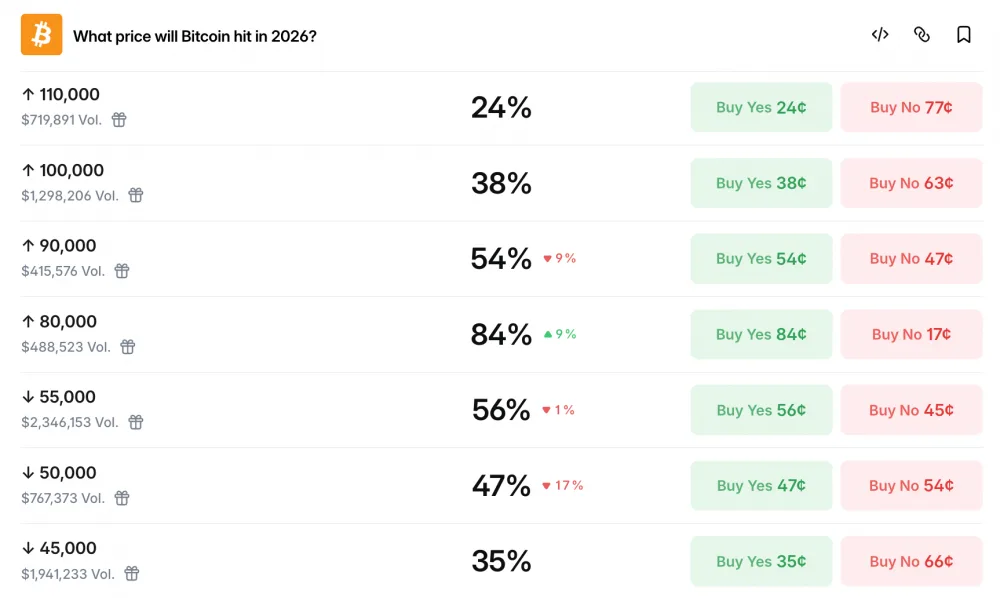
Bettors see $100,000 as possible — but far from guaranteed. Earlier this year the probability sat higher (around 47%), but it has dropped as the macro picture stayed uncertain.
Kalshi traders are even more careful. In the market “When will Bitcoin cross $100K again?” they put these probabilities:
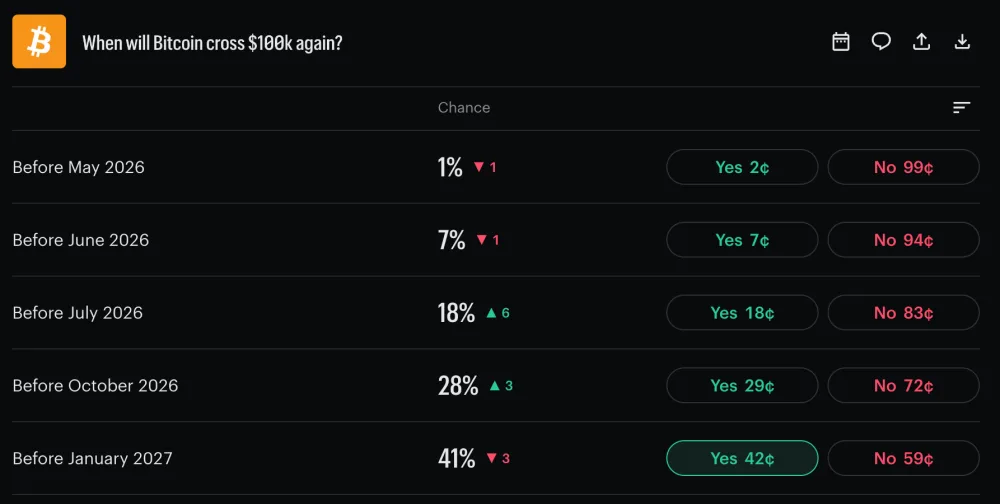
That means the crowd sees roughly a 30-40% shot at $100K anytime in 2026, depending on how you slice the timeline. Kalshi has millions in volume on these markets too, so the bets are serious.
Expert Bitcoin Price Predictions for 2026
As this cycle feels different, experts are more divided than ever. Some stay extremely bullish. Others have turned cautious after the 2025 correction and current macro risks.
Here’s a clear breakdown of the latest 2026 targets from major banks, funds, and well-known industry leaders:
| Analyst / Firm | 2026 Price Target | Stance | What They’re Saying |
| Tom Lee (Fundstrat) | $200,000-$250,000 | Very Bullish | Expects new all-time highs and says the old 4-year cycle is breaking down |
| Cathie Wood (ARK Invest) | New ATH + strong upside (stabilize $80,000-$92,000 first) | Very Bullish | Calls this the “shallowest four-year drawdown” ever. Sees 2026 as the real breakout year for institutions |
| Tim Draper | $250,000 | Very Bullish | Recently doubled down — believes Bitcoin goes mainstream in 2026 and hits this target |
| JPMorgan | ~$170,000 | Bullish | Strong upside if institutional demand continues |
| Citigroup | Base $112,000Bull case $165,000-$189,000 | Moderate to Bullish | Lowered base target but keeps high bull case on ETF inflows and regulation |
| Goldman Sachs | Up to $200,000 | Bullish | Still sees big potential but more cautious lately |
| Grayscale | New all-time high (> $126,000) | Bullish | Calls 2026 the “dawn of the institutional era” |
| Bitwise | New all-time high | Bullish | Classic 4-year cycle is dead thanks to constant ETF and corporate buying |
| Michael Saylor (Strategy) | Targets $150,000+ (long-term much higher) | Extremely Bullish | Keeps aggressively buying and sees Bitcoin as the dominant future asset |
| Galaxy Digital (Mike Novogratz) | Up to $250,000 (but 2026 uncertain) | Bullish | Sees 2026 as chaotic but still expects significant upside long-term |
| Pantera Capital | ~$148,000 | Bullish | Focuses on halving effects and institutional adoption |
| Standard Chartered | $100,000 | Cautious | Cut forecast twice. Warns of possible dip to $50K before recovery due to inflation and oil |
Analysts and industry leaders see a realistic path to $100,000 and beyond in 2026, but they admit this year will be volatile and uncertain. Success depends heavily on institutional buying, oil prices, inflation, and Fed policy.
Bitcoin Price Scenarios for 2026
So, experts and traders give different targets. Let’s now sum up and break all the forecasts into three groups, considering factors that could drive BTC price up or down.
Bullish Scenario (25-30% probability)
In this scenario, several bullish factors align at the same time.
ETF inflows return strongly and stay above $10-15 billion for the year. The Fed starts cutting rates, oil prices calm down after the Iran situation stabilizes, and risk appetite comes back fast. Institutional and corporate buying stays aggressive.
In this case Bitcoin easily breaks its old all-time high and finishes 2026 between $150,000 and $220,000.
Tom Lee, Cathie Wood and the most optimistic analysts see exactly this path.
Base Case (50-55% probability)
The most likely outcome.
ETF flows improve but stay moderate. Macro conditions get a little better, but not dramatically. Geopolitical risks fade slowly, inflation stays sticky, and the Fed remains cautious. Bitcoin grinds higher with some painful corrections along the way.
In this scenario BTC reaches $95,000-$120,000 by the end of the year. It probably hits $100,000 at some point, but holding above that level for long becomes the real challenge.
This matches the current consensus among most banks and the more grounded prediction markets.
Bearish Scenario (15-20% probability)
In this scenario, macro and market conditions remain weak.
ETF outflows continue, oil stays volatile because of Middle East tensions, inflation refuses to cool, and the Fed keeps rates high. Institutional demand weakens further and risk appetite stays low.
In this case Bitcoin stays trapped in a wide range and finishes 2026 between $60,000 and $85,000. It may test $50,000 in a worst-case macro shock (as CryptoQuant and Standard Chartered have warned).
So, Will Bitcoin Hit $100K in 2026?
Bitcoin is currently trading between $74,000 and $77,000 in April 2026 — still roughly 40% below its all-time high of $126,000 from late 2025.
So, will it hit $100,000 this year? Yes, it’s possible. But it’s not guaranteed.
The path exists. Strong ETF inflows, corporate buying, improving liquidity, and the post-halving supply squeeze can push Bitcoin well above $100K. Many top analysts — Tom Lee, Cathie Wood, JPMorgan, and others — still see this as a realistic outcome if macro conditions improve.
At the same time, the risks are real and significant. Geopolitical tensions (especially the US-Israel-Iran situation), sticky inflation from high oil prices, hawkish Fed policy, and continued weak ETF demand could easily keep Bitcoin stuck in the $70,000-$90,000 range for most of the year.
The realistic outlook:
- Most probable scenario: Bitcoin will test $100,000 at some point in 2026, but holding above it and closing the year there is no sure thing.
- Prediction markets currently give it roughly 35-43% probability of crossing $100K before 2027.
- The year looks jagged and uncertain — more dependent on macro liquidity and institutional flows than on the old halving cycle.
FAQ
Yes, it’s possible — but not guaranteed. Most experts see a realistic chance of Bitcoin testing $100,000, but holding above that level and finishing the year there is still uncertain.
As of April 2026, Bitcoin is trading between $74,000 and $77,000.
The biggest drivers are strong ETF inflows, continued corporate buying, improving liquidity and risk appetite, and the structural supply tightness from the 2024 halving.
The main risks are prolonged geopolitical tensions (especially the US-Israel-Iran conflict), high and sticky oil prices that fuel inflation, a hawkish Fed that keeps rates elevated, and continued weak or negative ETF flows.
Yes. Spot Bitcoin ETFs have become the dominant source of institutional demand.
It’s becoming less reliable. The halving still reduces new supply, but Bitcoin now reacts more to macro liquidity, ETF flows, and institutional behavior than to the traditional cycle timing.
That depends on your risk tolerance and time horizon. Bitcoin looks attractive for long-term holders who can handle volatility, but near-term risks remain.
The base case among analysts sits between $95,000 and $120,000. The bullish scenario reaches $150,000-$220,000, while the bearish scenario keeps it between $60,000 and $85,000.