Bitcoin is built around a fixed issuance rule that anyone can verify in code. The protocol event called bitcoin halving reduces the block subsidy by 50 percent at a set block height. The rule exists to slow new BTC▲$62,630.00 issuance over time and move supply toward the 21 million cap, which is why many people ask what is bitcoin halving when they first study the protocol. It can change miner economics and market expectations, but it does not guarantee any price outcome.
Expert insight: Daniel Harper, Senior Bitcoin Protocol Engineer. The halving rule is enforced by every full node that validates blocks. When the subsidy changes at the target height, nodes accept only blocks that match the new value. That makes the event predictable in code, while timing remains an estimate.
Disclaimer: This article is for educational purposes and reflects general information, not personalized investment advice. Crypto markets are volatile and you can lose money. If you act on any idea here, review your financial situation and consider advice from a licensed professional in your state.

Contents
- Key features of Bitcoin Halving
- How Bitcoin Halving works technically
- Why btc halving matters for the economy
- Bitcoin halving dates and reward history
- When is the next bitcoin halving?
- How halving can influence the bitcoin halving chart
- Pros and cons of halving bitcoin for the ecosystem
- Mining after the halving, what changes
- Bitcoin halving 2024 one year later, what metrics showed
- What happens when all bitcoins are mined
- How investors and traders use the halving theme
- Author view
- FAQ on Bitcoin Halving
Key features of Bitcoin Halving
At a high level, many newcomers ask what is bitcoin halving when they first see miner rewards on a block explorer. The supply cap stays 21 million BTC, so each subsidy cut makes future issuance smaller over time. In the US, that predictability often gets compared to central bank policy and inflation data. Demand and liquidity still matter, so the market response can differ across cycles.
Key points that help separate the protocol rule from market noise include:
- The block subsidy drops, while transaction fees still depend on network use.
- The change is automatic at a target block height, not voted in by miners.
- The schedule is transparent, but the market response is not predetermined.
- Supply changes do not force demand changes, so outcomes vary by cycle.
After the list, it helps to revisit what is a bitcoin halving as a repeatable rule that runs inside every validating node. In the United States, public mining firms publish production numbers and energy costs, which adds real world context. That reporting can make miner behavior easier to study than in earlier eras. Over time, the useful question is how incentives shift, not what a headline predicts.
Expert insight: Emily Chen, CFA, Digital Asset Market Strategist. Investors often treat the halving as a supply shock, but markets can reprice long before the milestone block. In the US, ETF flows, rates, and dollar strength can dominate. I watch positioning and funding, not the calendar.

How Bitcoin Halving works technically
Under the hood, the rule behind what is bitcoin halving is enforced by every node that validates each new block. No company can postpone it, and no government can reschedule it, because invalid blocks get rejected by consensus. Many users follow a bitcoin halving countdown tool, but that clock is only an estimate based on recent block times. When hashrate shifts, estimates shift too, yet the target height stays fixed.
| Protocol item | Typical value | What it controls | Quick numeric example |
|---|---|---|---|
| Target block interval | 10 minutes | Average time between blocks | About 144 blocks per day |
| Difficulty retarget window | 2,016 blocks | Keeps block time near target | About 14 days per adjustment |
| Halving interval | 210,000 blocks | When the subsidy step changes | Roughly 3.99 years at 10 minutes |
| Subsidy after 2024 | 3.125 BTC | New BTC per block from subsidy | About 450 BTC per day from subsidy |
| Subsidy after 2028 | 1.5625 BTC | Next subsidy level | About 225 BTC per day from subsidy |
| Max supply | 21,000,000 BTC | Long run cap | Issuance trends toward zero |
After the table, the key point is that bitcoin halving is a consensus rule, so miners cannot opt out without forking. If you read a bitcoin halving schedule page, check whether it explains block height instead of giving one rigid day. The most honest trackers show an estimated window and the next target height. That is why bitcoin halving dates are best treated as estimates, not fixed appointments.
That is also why future calendar predictions stay approximate. Many dashboards refresh estimates as each new block arrives.
Expert insight: Priya Natarajan, PhD, Blockchain Data Scientist. If you want to verify a halving, look at the coinbase transaction in blocks around the target height. The block subsidy is encoded in the coinbase output value, while fees come from summed inputs minus outputs. Explorers show both.

The 210,000 block rule and why it is not a calendar date
To understand bitcoin halving dates, start with the fact that the protocol counts blocks, not days. Blocks arrive faster or slower based on hashrate and difficulty adjustments. In the United States, power prices and weather can affect mining uptime, which can slightly nudge block timing at the margin. That is why date estimates can move even while the block height target stays unchanged.
How the block reward drops and where you can see it
When the step hits, only the subsidy changes, while fees remain whatever users pay. If you wonder, when was the last bitcoin halving, a block explorer around the milestone block can confirm the subsidy change. A useful detail is that fees are added on top of subsidy in the coinbase transaction. After the 2024 step, the subsidy matched the bitcoin block reward 3.125 btc halving 2024 figure on most trackers.
Why btc halving matters for the economy
From an economic view, the supply flow after bitcoin halving is smaller, so miners have fewer new coins to sell for expenses. Market participants often discuss scarcity, but demand and liquidity can still dominate the short term. In the United States, the tax system treats BTC as property, so realized gains and losses shape sell behavior. That local detail can matter during volatile months around each cycle.
Common economic links discussed by market participants include:
- Reduced new supply can lower baseline sell pressure, if miner costs stay stable.
- Narratives about scarcity can shape expectations and investor positioning.
- Miner margins can compress, which can change hashrate and payout behavior.
- Derivatives and leverage can amplify moves in either direction.
After the list, some traders watch a bitcoin halving chart and expect a repeat of prior shapes. A better habit is to compare the event with macro drivers like rates and credit conditions. If a reader searches next btc halving, they are often trying to connect the schedule to timing trades. That approach can work or fail depending on demand, not on the calendar alone.
Expert insight: Marcus Reed, Energy Economist, North American Mining Research. After a halving, miner break even costs tighten because BTC revenue drops instantly. In the US, power pricing, curtailment programs, and grid fees often decide who stays online. I model cash flow in dollars and translate it into hashrate risk.

Reduced new supply and the issuance rate
A practical way to frame btc halving dates is to translate rewards into new coins per day. Around the 2024 step, daily subsidy issuance fell from about 900 BTC to about 450 BTC. On an annual basis, that is roughly 328,500 BTC down to roughly 164,250 BTC, assuming 144 blocks per day. This view helps explain why the issuance curve is central to long term supply math.
| Period around the 2024 event | Subsidy per block | Approx blocks per day | New BTC per day | New BTC per year |
|---|---|---|---|---|
| Before the event | 6.25 BTC | 144 | 900 | 328,500 |
| After the event | 3.125 BTC | 144 | 450 | 164,250 |
| Change | -50% | 0 | -450 | -164,250 |
After the table, the phrase bitcoin halving date can be misleading if it makes you focus on one day. In reality, a btc halving date is shorthand for a block height milestone in the protocol. The supply effect starts at the milestone block and continues every day after. For context, the third step, bitcoin halving 2020, made the same 50 percent cut and then the market found its own path.
Fees and what stays unchanged
Even after the subsidy step, the 21 million cap is still the same, and difficulty rules stay intact. The protocol does not raise fees, and it does not change the fee market design. If you still ask what is bitcoin halving, remember it only changes the subsidy line item, not the fee rules.
In practice, bitcoin halving does not modify the difficulty algorithm, so retargeting still happens every 2,016 blocks. This helps keep the network predictable during miner turnover. It also means miners cannot rely on a rules change to restore revenue. That shift is gradual, so the network does not rely on one sudden fee jump. The transition gives miners time to adjust operations.
Bitcoin halving dates and reward history
People track bitcoin halving dates because the reward path is deterministic, yet future calendar rows remain estimates. A good starting point is the bitcoin halving history table, because it ties dates to block heights and subsidy levels. In 2024, most trackers list the milestone at block 840,000. They place it late on April 19 or early on April 20, depending on timezone. That difference explains why US readers may see a local date that is not the same as UTC.
| Halving number | Calendar date (UTC) | Block height | Reward before | Reward after | Approx subsidy BTC per day after |
|---|---|---|---|---|---|
| 1 | 2012-11-28 | 210,000 | 50 | 25 | 3,600 |
| 2 | 2016-07-09 | 420,000 | 25 | 12.5 | 1,800 |
| 3 | 2020-05-11 | 630,000 | 12.5 | 6.25 | 900 |
| 4 | 2024-04-20 | 840,000 | 6.25 | 3.125 | 450 |
| 5 | ~2028-04 | 1,050,000 | 3.125 | 1.5625 | 225 |
After the table, it helps to connect a query like last bitcoin halving date with the milestone block rather than a blog post summary. Many people also type bitcoin halving 2024 date april 2024 when they want the month without digging into block data. In some datasets, the bitcoin 2024 halving date is stored as a UTC timestamp for consistent charting.
In many US time zones, the bitcoin halving date april 2024 showed up on the evening of April 19, while UTC rolled into April 20. For precision, the bitcoin halving date 2024 exact date is usually reported as April 20, 2024 in UTC. If you label dashboards, the tag bitcoin halving date 2024 often appears next to block 840,000. Those details matter if you are labeling charts or reconciling data sources.
Expert insight: Laura Gomez, Director of Crypto Index Methodology. Dates differ across sources because blocks are timestamped and then converted into time zones. For clean backtests, I store the halving as the target block height and a UTC timestamp. Then I apply local time only for reporting, not analysis.

How to interpret bitcoin halving chart patterns and past cycles
If you look at a bitcoin halving chart, remember that charts compress many drivers into one line. In the US, market structure now includes spot ETF flows and deeper derivatives venues, so liquidity conditions differ from earlier years. That is also why bitcoin halving dates history should be read as context, not as a prediction engine. Past cycles show what happened, but they do not define what must happen next.
Disclaimer: Calendar estimates for halving timing can shift because blocks do not arrive on a fixed schedule. Use block height as the primary reference and confirm details with a reputable block explorer. Data tables can contain rounding, and minor differences may appear across sources and time zones.
When is the next bitcoin halving?
Most trackers estimate the next event near April 2028 at block 1,050,000, but the day can shift as block times drift. When US readers ask, when is the next bitcoin halving, they usually want both the block height and a date window. A shift of even one day is normal when blocks run faster or slower.
If someone types next bitcoin halving date, the best response is a window plus the target height, not a single day. For a clear reference, the projected bitcoin halving 2028 date is often shown as mid April 2028, but the estimate updates with block speed. Any bitcoin next halving date estimate should be treated as a moving range, not a fixed appointment. The subsidy after that step is expected to be 1.5625 BTC per block.
Some readers search next bitcoin halving date 2028 to get a single calendar entry for planning. A better habit is to track the target height and then follow an estimate as it updates. If you see a claim like next bitcoin halving date 2025, treat it as a misunderstanding, since the protocol is tied to blocks. The same correction applies to bitcoin halving date 2025, which is not a scheduled milestone under the 210,000 block rule.
Expert insight: Kevin Patel, CPA, Crypto Tax Specialist. US investors who trade around the halving often overlook taxes. Short term gains can face higher rates, and reporting errors are common without consistent records. Plan entries and exits with after tax returns in mind, and track cost basis from each fill.

How halving can influence the bitcoin halving chart
Market reactions around bitcoin halving chart movements often blend supply math with investor psychology. The supply side is simple, but demand can change with macro rates, risk appetite, and regulatory headlines. In the United States, retirement account access and broker integrations can expand demand, while tax selling can reduce it. The result can be delayed, uneven, or muted during certain periods.
Mechanisms that can push charts in different directions include:
- Lower issuance can reduce natural sell flow, but only if miners do not hedge more.
- Anticipation can move price earlier, then cool off after the event.
- Volatility can rise as leverage builds, then unwind in sharp moves.
- Macro shocks can override the protocol narrative for months.
After the list, it is useful to line up bitcoin halving dates with other market events, then test whether the same narrative still fits. If someone asks when is next bitcoin halving, they are often looking for a shortcut to timing the market. It is safer to treat the date as one variable among many. A chart is a summary, not a guarantee.

Why lower supply does not equal a higher price
Even if issuance falls, demand can fall too, so price can stall. Traders often ask, when is next bitcoin halving, then assume the market must respond in one direction. Real markets price flows, and flows depend on capital, liquidity, and risk appetite. In US terms, rate changes and a strong dollar can all change crypto demand regardless of issuance.
What priced in means without myths
In plain terms, priced in means the market has already reacted to widely known information. When people ask, when is the next bitcoin halving date, they are often trying to predict a reaction before it happens. The problem is that expectations compete, and new data can change the balance quickly. That is why you cannot compute a single outcome from one known event.
Pros and cons of halving bitcoin for the ecosystem
A balanced view of bitcoin halving includes benefits and costs that show up in miner economics and user experience. Lower issuance can strengthen the idea of predictable monetary policy, but it can also pressure smaller miners with higher costs. In the United States, that pressure matters because miners often run on industrial power contracts and report results publicly. Understanding both sides helps avoid simple narratives.
| Ecosystem angle | Potential benefit | Potential cost | A numeric way to frame it |
|---|---|---|---|
| Issuance | Lower inflation rate | Less subsidy to fund security | 900 to 450 BTC per day in 2024 |
| Mining | Incentive to improve efficiency | Margins compress for high cost sites | Revenue halves in BTC on the event |
| Fees | Fees gain importance over time | Fees can spike in congested periods | Fee share can jump during mempool spikes |
| Market | Predictable supply rule | Speculation can create hype cycles | Volatility can rise around the event |
After the table, the term bitcoin halving cycle is useful if you treat it as a study window, not as a template. The protocol step is fixed, yet the surrounding market regime changes. That is why the same supply cut can align with very different demand backdrops. A cycle framework should leave room for sideways markets and drawdowns.
Mining after the halving, what changes
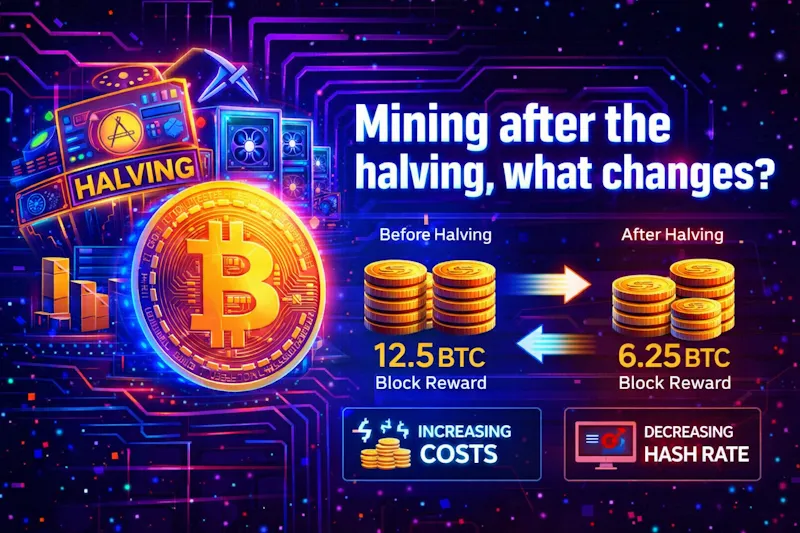
Right after bitcoin halving, miner revenue in BTC drops, even if the BTC price stays flat. Some US miners hedge with futures, some sell reserves, and some shut off older machines. The network continues because difficulty adjusts to keep blocks coming. Over weeks, the industry tends to consolidate toward lower power costs and newer hardware.
Expert insight: Olivia Bennett, Director of Mining Operations at a US hosting firm. Right after a halving, we review fleet efficiency, power contracts, and uptime, then decide which machines get moved or powered down. Difficulty adjustment helps over time, but operational discipline keeps margins from breaking.
Hashrate and difficulty, what scenarios are possible
After a major milestone near the bitcoin last halving date, hashrate can dip if marginal miners exit. A few weeks later, difficulty can adjust downward, which can restore profitability for the survivors. That adjustment is visible in each difficulty epoch report. In the US, regions with cheap power and stable regulation can attract new builds.
That can lift hashrate again, especially if balance sheets were stressed near the bitcoin last halving date event. The adjustment loop is the stability feature, not a sign of failure.
Scenarios that miners and observers often watch include:
- Temporary hashrate drop followed by a difficulty decrease within one or two retargets.
- Rapid hardware upgrades that offset revenue cuts with higher efficiency.
- Migration to cheaper power regions, such as parts of Texas or the Midwest.
- Higher fee periods that cushion revenue for miners in strong demand windows.
After the list, it can help to connect btc halving dates with difficulty data to see how fast the network adapted. If you see headlines about bitcoin halving 2024 impact, look for on chain signals like hashrate and fee share, not just price. That approach also works when you plan for the bitcoin next halving date 2028 window. It keeps the analysis tied to measurable network behavior.
Hash price and fees as part of mining economics
Hash price is a shorthand for revenue per unit of hashrate, often expressed in dollars per petahash per day. Around each bitcoin halving date, hash price tends to drop because the subsidy halves, then it moves based on fees and BTC price. When transaction demand is high, fees can offset part of the subsidy loss for short periods. In that revenue model, bitcoin halving is the step where subsidy per block falls by half.
When demand is low, efficiency and power cost dominate.
Bitcoin halving 2024 one year later, what metrics showed
Looking back, bitcoin halving 2024 created a clean subsidy step from 6.25 to 3.125 BTC, but market behavior still varied by month. Miner adaptation took time, as firms upgraded machines and chased lower power costs. In US filings, several miners highlighted changes in hosting mix and curtailment strategy. Those details matter because a fixed subsidy interacts with variable operating costs.
A concrete way to anchor this period is to note the bitcoin halving 2024 date block height at 840,000. Then track metrics from that point forward. In many dashboards, the label bitcoin halving date 2024 is paired with that height to reduce confusion. If you label charts, also keep the 2024 bitcoin halving date in UTC alongside your local time zone.
Metrics that are useful to review over the following year include:
- Hashrate trend versus difficulty trend, to see how quickly the network adjusted.
- Fee share of miner revenue, especially during demand spikes.
- Miner treasury behavior, such as selling, holding, or hedging output.
- Exchange inflow patterns, which can hint at broader sell pressure.
After the list, you can revisit bitcoin halving chart context and ask what changed besides issuance. Macro rates, dollar strength, and equity risk sentiment can shift demand in the US. Those drivers can dilute simple halving narratives. That is why one year of data can inform questions, but it cannot settle every debate.

What happens when all bitcoins are mined
The supply cap implies that, over decades, subsidy trends toward zero and fees carry more of the incentive. People sometimes treat bitcoin halving date questions as if the whole system hinges on one timestamp. The more important point is that the issuance curve is smooth across many halvings until around 2140. The long term debate is about whether fees alone can sustain security, not about a single cycle. Over decades, the subsidy cut repeats until the subsidy trends toward zero.
How investors and traders use the halving theme
In US circles, bitcoin halving becomes a framework for timing, even when timing is the hardest part. Some investors dollar cost average and ignore the date, while some traders try to front run narratives. Many newcomers ask, when is the next bitcoin halving, then build a plan that assumes a repeat of prior moves. A more resilient plan starts with risk limits, taxes, and liquidity needs. Some traders ask, when is next bitcoin halving, and then schedule reviews that do not depend on a single price target.
Common approaches people talk about include:
- Long term holding with periodic rebalancing, rather than a single event trade.
- Staged entries and exits around volatility windows, not around one day.
- Watching miner health metrics, such as hashrate, fees, and treasury sales.
- Using options to define risk, rather than leveraging spot positions.
After the list, it helps to track the bitcoin halving countdown as a calendar tool, not as a promise. Some traders also monitor a next bitcoin halving date estimate to schedule reviews of their positions. They often label that review cycle as the next btc halving window in their notes. If you see content that calls the next milestone the bitcoin next halving, check whether it cites the target height.
Expert insight: Aaron Stein, Head of Derivatives Research. Around halving narratives, leverage can build quietly through perpetual swaps and options. I look for rising funding, skew shifts, and open interest growth that is not matched by spot demand. When leverage leads, moves can reverse fast, so position sizing matters.

What to watch besides the halving
Besides bitcoin halving chart moves, macro conditions often set the ceiling on risk assets. Regulatory clarity, exchange access, and custody infrastructure can change how capital enters. Liquidity also matters, since thin books can exaggerate price moves. Large flows from institutions can outweigh miner issuance, especially when funds are net buyers.
Author view
Michael Turner, Independent Bitcoin Research Analyst.
To me, bitcoin halving is best understood as predictable issuance tightening, not as a price lever. In the US, it is useful because it creates clear milestones to review miner costs, fee markets, and liquidity. It can influence narratives, but market results depend on demand, rates, and risk appetite. Track block height, not headlines, and watch miner health metrics after each step. Keep taxes and time horizon in the plan, since those factors shape behavior more than the date.
FAQ on Bitcoin Halving
What is Bitcoin halving?
A short definition is that what is bitcoin halving refers to the programmed cut in the block subsidy. For example, the subsidy fell from 6.25 BTC to 3.125 BTC at the 2024 step. The goal is to slow issuance and approach the 21 million cap over time. That is why the rule is central to supply discussions.
When was the last halving and what became the reward?
In many searches, when was the last bitcoin halving comes up because people want a single reference point. Trackers usually list the milestone on April 20, 2024 UTC at block 840,000, which was April 19 in parts of the US. Many charting tools store that last bitcoin halving date as UTC to avoid local day shifts. After that, the subsidy became 3.125 BTC per block, with fees added on top.
When is the next halving and what will the reward be?
If you ask, when is the next bitcoin halving, most estimates point to April 2028 at block 1,050,000. After that step, the subsidy is expected to be 1.5625 BTC per block, plus fees. If you search next bitcoin halving date, treat the day as an estimate that updates with block speed. A block height target is the more precise anchor.
How many halvings are left and when does issuance end?
Each step cuts the subsidy, so there are many halvings left, but the last fractions stretch far into the future. The term bitcoin halving schedule matters here because it shows issuance slowing toward zero over decades. The final coins are expected around 2140, but that year is also an estimate. The key idea is that the supply approaches the cap asymptotically.
Does halving guarantee price growth?
The short answer is no, because demand can rise or fall and markets reprice constantly. When someone asks, when is the next bitcoin halving date, they may be hoping for certainty that markets cannot offer. Interest rates, liquidity, and regulation can dominate any supply narrative. Treat past patterns as context, not as a guarantee.
What happens to mining after the halving?
After the event, the subsidy revenue in BTC falls, so miners must adapt with efficiency, fees, or price appreciation. Right after the last bitcoin halving, some miners reduced output while others upgraded hardware. Many people search when was the last bitcoin halving, then notice that hashrate often recovers after an initial shakeout. Difficulty adjusts, which helps keep blocks near the target pace.
Disclaimer: Tax and regulatory treatment of Bitcoin varies by state and changes over time. This text is not legal or tax advice. For decisions involving reporting, custody, or trading, consult a qualified attorney or CPA and keep documentation of transactions, including exchange statements and wallet records.