Crypto after sanctions is no longer just about pro-poor transfers between individuals. Governments and large companies are all developing alternative financial networks and settlements that allow trade to continue when Western banks are inaccessible.

Russia is experimenting with crypto for foreign trade and expanding the digital ruble. Iran is using exchanges, stablecoins, and informal settlement networks. China is developing yuan-based payment infrastructure. These initiatives show how financial sanctions are accelerating the fragmentation of the global payments system.
Related: The New Crypto Cold War: How US, China, and Russia Are Fighting for Blockchain Power
Contents
- What Does Crypto After Sanctions Mean?
- Why Sanctions Encourage Alternative Financial Networks
- Russia: From Crypto Skeptic to Regulated Foreign Settlement
- China: Crypto Alternatives without Crypto
- Iran: Crypto as a Parallel Financial System
- BRICS and the Pursuit of Local-Currency Settlements
- Stablecoins Are Becoming Geopolitical Infrastructure
- Bitcoin’s Role in Alternative Financial Networks
- How Alternative Financial Networks Work
- Can Crypto Make Sanctions Ineffective?
- What Crypto After Sanctions Means for the Global Financial System
- Main Risks of Alternative Financial Networks
What Does Crypto After Sanctions Mean?
The phrase “crypto after sanctions” encompasses a range of technologies and approaches:
- Public cryptos like Bitcoin
- Dollar and national-currency stablecoins
- Central bank digital currencies (CBDCs)
- Tokenized deposits
- Blockchain-based trade settlements
- Domestic payment systems
- Exchanges and over-the-counter (OTC) brokers
What they have in common is the attempt to reduce exposure to traditional financial intermediaries.
Why Sanctions Encourage Alternative Financial Networks
Financial sanctions work by restricting access to particular financial institutions, currencies, and technologies.
A company may find its correspondent bank accounts closed or its foreign partners unwilling to deal with it. Banks may refuse to process payments, fearing penalties. Suppliers may demand settlement in a different currency or jurisdiction. Crypto cannot eliminate these risks, but it does make it easier for sanctioned entities to conduct transactions outside the view or reach of regulators.
Russia: From Crypto Skeptic to Regulated Foreign Settlement
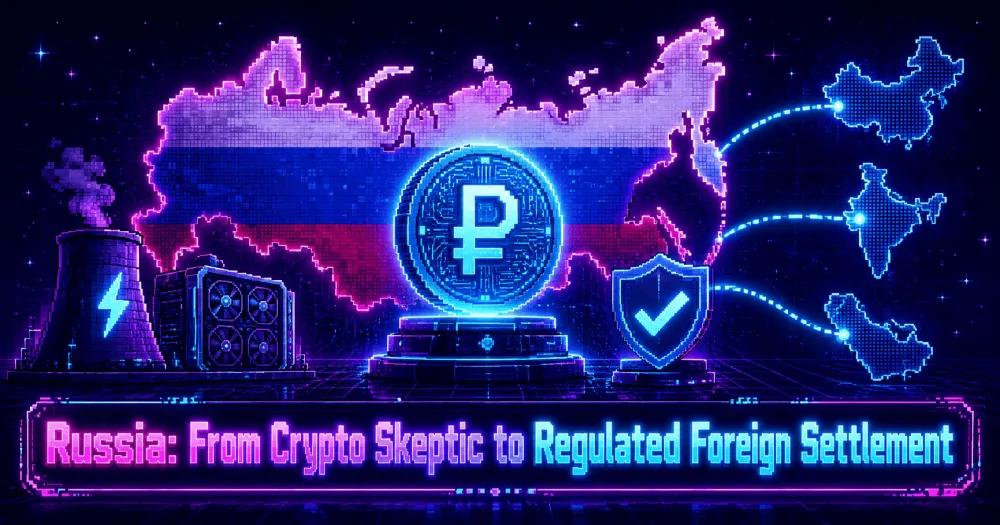
Russia is the most prominent example of a country that is now pursuing crypto as an official economic policy. Prior to the full-scale invasion of Ukraine, the Bank of Russia was generally skeptical of crypto as an instrument of international settlement. After losing access to Western financial infrastructure, the Russian government has been developing regulated channels for crypto mining, payments, and cross-border trade.
Experimental Cross-Border Crypto Payments
Russia’s 2024 law allows exporters and importers to use crypto in an experimental legal regime.
Note that Russia is not legalizing crypto payments per se but is creating a sandbox for authorized participants to use crypto for settling foreign trade. This is a reasonable middle ground: crypto has value as an international settlement tool, but its adoption should be gradual and state-regulated.
This law would allow businesses to use Bitcoin, stablecoins, or other digital assets to make or receive payments from foreign partners. It does not legalize crypto speculation or payments within Russia but creates a framework for authorized intermediaries to facilitate international transactions.
Read more: Putin Signs Landmark Crypto Law as Russia Opens Regulated Trading to Investors
Ruble Stablecoins Enable New Settlement Flows
The appearance of A7A5▼$0.0123 illustrates how quickly a national-currency stablecoin can be created and adopted within a sanctions environment.
A7A5 is a stablecoin that is backed 1:1 with rubles and operates on public blockchains. According to Chainalysis, A7A5 processed over $93 billion in less than a year and later exceeded $119 billion in transactions, with a strong concentration of activity on weekdays, suggesting that businesses were using the stablecoin for operational expenditures rather than speculation.
A7A5 provides a bridge between rubles and crypto, allowing businesses to tokenize their ruble deposits and use them to make payments or speculate on crypto exchanges. The United States, United Kingdom, and EU have all imposed sanctions on A7A5 addresses, exchanges, and associated entities. The wallet Grinex, which was one of A7A5’s trading platforms, has since been de-listed.
Russia Is Launching the Digital Ruble
The digital ruble is a separate initiative: a state-issued digital currency.
The largest banks in Russia will be required to start providing digital ruble services in September 2026. Big retailers will follow in subsequent years. Domestic adoption of the digital ruble will give Russians a state-regulated alternative to traditional banking and payment processors.
The digital ruble’s value proposition within Russia is similar to that of other CBDCs: programmable payments, direct settlements, and reduced reliance on commercial intermediaries. Its value proposition outside of Russia is unclear.
China: Crypto Alternatives without Crypto
China is not facing the same level of sanctions as Russia, but it has strong incentives to reduce its reliance on the dollar. Its approach to crypto after sanctions is different from Russia’s in that China is restricting crypto trading and mining on its territory while promoting yuan-based financial infrastructure.
Read More: Russia Just Legalized Crypto: What Changes Now for Investors, Exchanges, and the Global Market?
CIPS Is Helping the Yuan Compete with the Dollar
China has been developing the Cross-Border Interbank Payment System (CIPS) as a vehicle for promoting the international use of the yuan.
As of June 2026, CIPS had 210 direct participants and 1,619 indirect participants in Asia, Africa, Europe, the Americas, and Oceania. CIPS enables cross-border remittances, financial market transactions, and payment-versus-payment settlements in renminbi (RMB).
CIPS is not a crypto payment system. It is a traditional finance equivalent that enables banks to make and receive payments in RMB outside of the SWIFT system. Still, its existence represents an alternative for companies that want to settle in yuan instead of dollars. CIPS is also being integrated with other financial market infrastructure, including trading platforms and post-trade systems, to facilitate cross-border RMB transactions and foreign exchange settlements.
Project mBridge and Multi-CBDC Settlements
China is working with Hong Kong, Thailand, the United Arab Emirates, and Saudi Arabia on Project mBridge, which will allow commercial banks to make cross-border payments in wholesale CBDCs.
The project’s minimum viable product (MVP) was launched in 2024. It allows banks to make payments to each other using tokenized central bank money on a distributed ledger. The value proposition is similar to that of CIPS: reducing reliance on correspondent banking. For now, it is unclear how mBridge will interact with other payment systems, including the CIPS and SWIFT.
The Digital Yuan Can Help China Avoid Sanctions
China’s e-CNY represents the third approach to crypto after sanctions: using digital financial instruments while restricting permissionless crypto assets.
The e-CNY can facilitate faster and more efficient payments within China, reduce the role of private banks, and serve as a bridge to cross-border settlements via CIPS or other systems. It is not designed to compete with Bitcoin or stablecoins but to complement China’s financial infrastructure.
By adopting the e-CNY, China can insulate its financial system from sanction-related disruptions while still participating in international trade. In many ways, China’s approach to crypto after sanctions is the most prudent: it is reducing exposure to crypto while still capitalizing on opportunities to promote the yuan and RMB-denominated assets.
Iran: Crypto as a Parallel Financial System

Iran has been under financial sanctions for decades, and many of its financial transactions take place through informal networks. Crypto has become another tool for Iran to conduct financial transactions outside the global banking system.
Crypto Activity in Iran Is Surging
According to Chainalysis, crypto transactions in Iran peaked at $7.8 billion in 2025. The value of transactions often spiked during periods of geopolitical tensions, currency devaluations, and economic uncertainty.
For Iranians, crypto can be a way to protect wealth and conduct transactions when the rial is losing value and international banks are inaccessible. For businesses, crypto can serve as a medium of exchange when traditional financial channels are limited. State-sponsored entities are using crypto transactions to move money around the system, including for military expenditures and regional proxy operations.
U.S. sanctions have targeted Iranian exchanges, wallets, financial service providers, and crypto projects that facilitate these transactions. However, the confluence of retail demand, capital flight, sanctions evasion, and state-sponsored transactions makes it difficult to separate these activities and target only “bad” actors.
Stablecoins Can Enable Sanctions Evasion, But at What Cost?
Dollar stablecoins are popular in Iran because they offer exposure to a stable currency while being easier to move than cash.
However, stablecoins also expose users to the risks of being frozen out by an issuer or having transactions monitored by blockchain analytics firms. A stablecoin can facilitate a transaction, but it does not eliminate counterparty risk or exposure to sanctions.
One of the paradoxes of crypto after sanctions is that the most useful stablecoins are also the most vulnerable to being shut down by regulators.
Read more: Crypto FOMO Is Destroying Your Trades: 5 Ways to Stay Calm During Market Hype
BRICS and the Pursuit of Local-Currency Settlements
Each of the BRICS countries (Brazil, Russia, India, China, and South Africa) is pursuing its own approach to crypto after sanctions. They are experimenting with CBDCs, stablecoins, and blockchain-based trade finance, but none of them have adopted a unified standard or technology.
Creation of a single BRICS cryptocurrency does not appear a realistic prospect. Rather, the countries might rely more on the yuan, ruble, and rupiah, with deeper integration of domestic instant payment systems. There is also the possibility of new clearing and messaging platforms that facilitate trade without the involvement of correspondent banks.
A BRICS currency is not necessary for countries to reduce their reliance on the dollar. That task can be achieved through domestic crypto policies.
Stablecoins Are Becoming Geopolitical Infrastructure
Stablecoins were supposed to be a medium of exchange, but they are quickly becoming critical infrastructure for evading sanctions.
For countries and companies that want to reduce their exposure to traditional financial systems, stablecoins can serve several purposes:
- Enable fast and efficient cross-border payments
- Facilitate access to dollar-denominated value
- Provide settlement on public blockchains
- Reduce reliance on correspondent banking
- Connect with crypto exchanges and decentralized financial instruments
Governments are also considering stablecoins as an alternative to crypto assets and a way to promote their national currencies.
National-currency stablecoins suffer from a discoverability problem. There is little demand for a tokenized ruble, dirham, or rial outside of Russia, UAE, and Iran. However, stablecoins that are backed by the dollar, euro, or yen can be adopted by users and businesses around the world.
Bitcoin’s Role in Alternative Financial Networks
Bitcoin has value in a sanctions environment because of its permissionless and censorship-resistant characteristics.
Bitcoin mining can be an attractive source of income for countries with excess electricity, and the resulting BTC▲$62,630.00 can be spent or sold for goods and services. However, Bitcoin is a volatile asset that is not ideal for making payments.
Bitcoin transactions can be traced and exposed, making them a liability for businesses and governments that want to evade sanctions. While Bitcoin offers theoretical benefits, its usefulness in practice is limited by its volatility, liquidity risks, and exposure to regulatory scrutiny.
How Alternative Financial Networks Work
A typical transaction may involve several steps and participants. An exporter may receive local-currency payments, which a broker then converts into a stablecoin. The stablecoin may be transferred via wallets or exchanges before being converted again into another currency or stablecoin. A foreign intermediary may then move the funds into a bank account, settle trade with cash, make payments with commodities, or tokenize the money again for another transfer.
Other transactions may involve a central bank or a domestic payment system and have nothing to do with crypto.
The alternative financial network is a complex ecosystem that involves:
- Banks
- Central banks
- Stablecoins
- Public blockchains
- Domestic payment systems
- Brokers
- Trade intermediaries
- Commodities
- Local currencies
This complexity is a double-edged sword: it makes the system more difficult to disrupt but also increases costs, risks, and opportunities for exploitation.
Can Crypto Make Sanctions Ineffective?
Crypto will reduce the costs of some sanctions but will not eliminate them. The alternative financial network will help countries and companies conduct some transactions while continuing to face restrictions.
Large-scale sanctions evasion will always be visible to authorities because it will take place on public blockchains. Once an exchange, stablecoin, wallet, or broker is identified as a sanctions enabler, it can be targeted for legal action. Even within the alternative financial network, there are risks of being exposed, blacklisted, or having assets frozen.
According to the Financial Action Task Force (FATF), stablecoins, peer-to-peer transactions, offshore exchanges, OTC brokers, and cross-chain bridges had become critical enablers of sanctions evasion and money laundering in 2026. At the same time, 83% of jurisdictions surveyed by FATF had implemented the Travel Rule for crypto transactions.
The expansion of sanctions enforcement is matched by the expansion of the alternative financial network.
What Crypto After Sanctions Means for the Global Financial System
The alternative financial network will not lead to the demise of the dollar but rather to its fragmentation. Countries will adopt a range of measures to reduce their exposure to a single currency, from bilateral agreements and local-currency trade to CBDCs and crypto settlements.
Banks and businesses will make tactical choices about which alternative to use based on cost, liquidity, legal risks, and political considerations. Some of the consequences of this system include:
- Payments that are more politicized
- Higher compliance costs
- Liquidity fragmentation
- Increased risks for stablecoin issuers
- Greater scrutiny of blockchain transactions
- Higher costs for smaller countries
- Greater geopolitical risk
- Increased use of digital currencies as tools of statecraft
The dollar will continue to be the dominant currency, but its alternatives will proliferate.
Main Risks of Alternative Financial Networks
Centralized Control
Central bank digital currencies (CBDCs) and other state-backed digital assets seek to reduce reliance on Western finance but may introduce new risks of censorship and surveillance.
Counterparty Risk
Offshore exchanges and stablecoins may fail, misappropriate funds, or be shut down by regulators, leaving investors and businesses unable to access their assets.
Liquidity Fragmentation
A tokenized payment or stablecoin is only as good as the ability to convert it into real value. If counterparties are unwilling or unable to exchange one asset for another, a supposedly “liquid” transaction may be impossible to complete.
Secondary Sanctions
Suppliers and partners may be reluctant to engage in transactions with alternative financial networks if doing so would jeopardize their access to Western markets.
Cybersecurity
Crypto exchanges, bridges, wallets, and state-backed payment systems are vulnerable to attacks and theft.
Political Dependence
Reducing reliance on one financial infrastructure (such as the dollar) does not make a country immune to sanctions if it becomes overly dependent on another infrastructure (such as the yuan) or private entities.