With the crypto market having reached a multi-trillion dollar size, governments can no longer simply react to their own markets— they will be shaping regulatory structures defining how digital assets operate within financial systems as part of their wider global economic plans.

Contents
Why Crypto Politicians Matter in 2026
The Rise of Cryptocurrency in Global Political Systems
Regulators have become increasingly aggressive in cryptocurrency regulation due to amplified concerns about fraud risk, volatility risk, and systemic risk.
The trend towards uniform global crypto regulation is exemplified by the full implementation of MiCA by the European Union. MiCA provides for a single regulatory environment across all EU member states and includes provisions aimed at increasing transparency, protecting investors, and enhancing the integrity of the crypto markets.
How Governments Influence Bitcoin, Altcoins, and Blockchain Adoption
Government policy now plays an active role in influencing the way markets operate through its actions on liquidity and institutional involvement.
Governments define the boundaries that are permissible with respect to operating a digital asset business by establishing compliance requirements, such as tax obligations and obtaining licenses.
The growing relationship between government and cryptocurrencies is making the issue of regulatory certainty a significant factor in capital allocation and long-term use.
Also, governmental policy announcements have become much like catalysts for price movements. Enforcement, approval, and restriction announcements are causing almost instant reactions from the market. It illustrates that governments affect Bitcoin price due to changes within investor attitudes and expectations at a macro level, versus simply technical attributes.
From Financial Regulation to Digital Sovereignty
Crypto policy has grown beyond compliance to become a strategic question of sovereignty. Governments are creating regulatory systems not only to control risk but also to secure influence over digital financial infrastructure.
The expansion of crypto policy into areas like stablecoin oversight and cross-border reporting shows a broader ambition to determine the future of money.
This trend is reinforced by the growing divergence in crypto laws by country, where jurisdictions compete for capital while retaining authority. As regulatory systems mature, the equilibrium between innovation and control will be one among the defining features of the global crypto landscape in 2026.
What Makes a Crypto Politician Powerful?

Legislative Influence on Crypto Regulation
Political power in digital assets is determined by the extent to which cryptocurrency regulation authority can be enforced through a policy framework.
By 2026, lawmakers will have established new structures for regulating markets, and laws such as the U.S. Digital Asset Market Clarity Act are being developed to address conflicting jurisdictions and bring crypto within mainstream financial systems.
Legal certainty and clear, consistent regulations also facilitate adoption. Crypto regulation 2026 is evolving, and when it does, bodies seek insight into their investments, which has given policymakers greater influence on the structure of the market, compared to simply passive control.
Strategic Partnerships With Blockchain and Fintech Industries
The influence of policymaking is now being heavily influenced by public-private collaboration. Blockchain policymakers who collaborate with exchanges, fintech firms, and infrastructure companies will be able to develop more practical policies and strengthen their position as one of the key blockchain policy leaders.
Read Also: US Crypto Tax Guide 2026: How Cryptocurrency Is Taxed and How to Stay IRS-Compliant
Collaboration also increases the speed of adoption for blockchain technologies through the elimination of friction caused when innovation occurs prior to regulation.
In addition, governments are creating more adaptable crypto policies through continuous discussion with the crypto community; they support both the growth of the space and provide supervision in an environment that is constantly evolving.
Impact on Global Capital Flows and Investor Sentiment
Crypto politicians now influence not just regulations, but also money flow, reinforcing their role as the most powerful crypto politicians in the world, directing global markets. The clarity of the regulatory environment— or lack thereof — has an identifiable effect on institutional investors’ movements and their confidence in markets.
Delays in legislative action at the U.S. federal level have already been demonstrated to contribute to less robust price predictions and to reduce the momentum of investors.
In these conditions, it is becoming clear that how governments affect Bitcoin price will be a major driver of global market activity.
Top 5 Most Powerful Crypto Politicians in the World
| Politician | Country/Region | Key Crypto Policy Focus | Market Impact |
| Donald Trump | USA | Pro-crypto deregulation, Bitcoin reserve | Boosted institutional interest |
| Nigel Farage | UK | Tax cuts, pro-Bitcoin agenda | Aims to attract capital to London |
| French Hill | USA | Market structure legislation | Regulatory clarity for institutions |
| Nayib Bukele | El Salvador | Bitcoin legal tender, reserves | First sovereign BTC▲$62,630.00 model |
| EU (MiCA Regulators) | EU | Unified crypto framework | Standardized global compliance |
Donald Trump – The First “Crypto President” of the United States
Pro-Crypto Policy Shift in the U.S.
The second term of Donald Trump’s administration shows a clear Donald Trump crypto policy stance, denoting an unprecedented shift toward a pro-industry approach in the U.S.
The executive branch has relaxed enforcement efforts toward cryptocurrency companies and shifted its priorities from enforcing anti-market structures to supplying clear and consistent rules for the market.
These moves have also reflected a wider group of politicians supporting cryptocurrency adoption, who are working to integrate digital assets into national economic plans.
In terms of regulation, this administration has endorsed initiatives that will help reduce regulatory fragmentation and create a more predictable climate for U.S. crypto legislation. These initiatives strive to enable innovation, but also maintain necessary levels of oversight that have been called for by institutional investors for years.
Influence on Bitcoin Adoption and Institutional Markets
The U.S. government created a Strategic Bitcoin Reserve to serve as an official source. This action furthered discussions between Bitcoin regulation politicians that clearly identified digital gold as a strategic financial tool, rather than just another speculative investment.
The policy impact has extended to institutional markets, where lowered regulatory uncertainty has encouraged deeper participation. At the same time, volatility is still sensitive to political signals, showing how governments affect Bitcoin price and keep shaping investor actions at scale.
Positioning America as a Global Crypto Powerhouse
Trump’s administration has made it a top goal in their strategy, with Donald Trump’s crypto policy trying to position the United States as an example for other pro-crypto governments.
In order to accomplish this goal, official strategies are centered around developing innovations and infrastructures, as well as creating state-led acquisition programs for digital assets.
The desire by the U.S. to be at the leading edge of global crypto regulation is also one of the primary drivers behind the competition to create international control on cryptocurrency.
The U.S. wants to help set global standards for cryptocurrency while also keeping its rank as a leader in the economy. This has resulted in a wide range of opinions, especially around who regulates cryptocurrency globally and how standards should be aligned with the developing digital economic sphere.
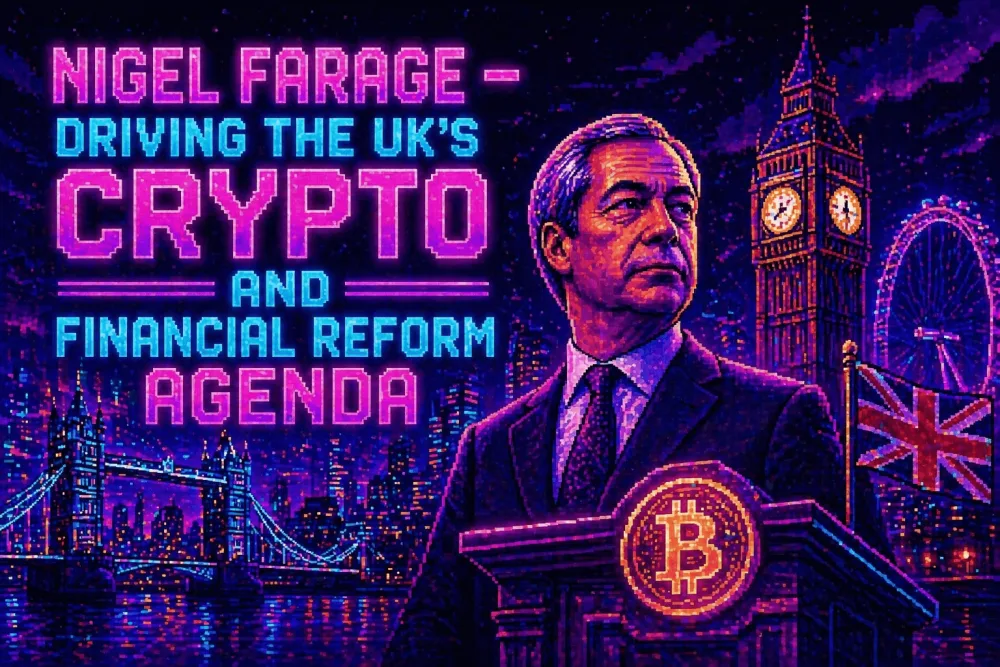
Nigel Farage – Driving the UK’s Crypto and Financial Reform Agenda
Advocacy for Pro-Crypto Regulation in the UK
Nigel Farage is regarded by many as the UK’s leading voice promoting less stringent cryptocurrency regulation, strengthening his broader Nigel Farage cryptocurrency stance.
His platform is reflective of the desire of crypto-friendly politicians in the USA and Europe to entice investment and retain talented individuals who would otherwise be forced to move to areas that are subject to tougher regulations.
In contrast, however, there are those calling for tighter controls over cryptocurrency use in the UK, specifically through an increase in rules governing the donation of crypto-assets, along with a closer eye being kept on money laundering activity.
This difference emphasizes the ongoing tension within crypto regulation in the USA vs Europe, where policy direction remains fragmented.
Plans for Bitcoin Integration in National Finance Strategy
As for his ambitions to develop Bitcoin as a legal tender currency within the U.K., Farage is comparable to other Bitcoin legal tender countries’ politicians in terms of their level regarding ambition; however, no country that has developed legal tender currencies based on cryptocurrency has done so as of yet.
Farage’s own involvement in Bitcoin further strengthens his views. Farage was the first member of Parliament still serving when he purchased Bitcoin publicly. The amount he invested in Bitcoin was about £2 million.
London as a Competing Global Crypto Hub
His strategy includes establishing London as a major crypto hub, mirroring wider Nigel Farage crypto plans for the UK aimed at drawing investment and innovation.
He has pursued this goal through deregulation and through greater integration with the existing fintech ecosystem.
Still, this vision faces resistance from regulators prioritizing compliance and risk control. The UK’s evolving stance on global crypto regulation will depend on how it balances competitiveness with regulatory supervision.
French Hill – The Legislative Architect of the U.S. Crypto Policy
Leadership in Financial Services and Crypto Legislation
Representative French Hill is a major figure in French Hill crypto regulation, shaping United States crypto legislation through his role as chairman of the House Financial Services Committee.
French Hill has repeatedly pointed out the importance of forming clear regulatory structures for digital assets.
“This is the pivotal moment for American innovation and a critical step forward in protecting consumers and investors alike.”— French Hill.
In this capacity, he was able to pass through the House the Digital Asset Market Clarity Act, which would give clarity on how digital assets are to be categorized and regulated by both the SEC and CFTC.
His leadership exemplifies a greater movement towards formalizing market structures; it places him in a group with other politicians who have molded bitcoin regulation and will determine how the U.S. will incorporate digital assets into the country’s financial system.
Support for Digital Asset Innovation in Congress
Hill has continually shown support regarding policies encouraging the development of blockchain technology while still monitoring. The legislative action by way of his committee is clearly focused on the economic impact of digital assets and creates a regulatory atmosphere wherein innovation is encouraged instead of being restricted.
His capacity as a leader in blockchain policy will continue to grow based on this type of approach. His continued support for a regulatory framework permitting clarity on the part of blockchain developers and investors, in addition to the competitive aspect of jurisdictions across the globe, provides him a strong platform moving forward.
Relationship With Crypto Industry Leaders and Lobby Groups
Hill’s crypto regulatory influence has been enhanced through direct interaction with crypto advocacy groups that are also engaged with federal lobbying efforts regarding the legislative agenda for crypto.
This funding in U.S. elections and in agreement with pro-crypto policy makers demonstrates an increasing collaboration between the Federal Government and the cryptocurrency space and represents a shift from pure private involvement in the creation of crypto regulatory 2026 frameworks toward increased governmental support.
Nayib Bukele – Bitcoin Pioneer and State-Level Crypto Experimenter

Bitcoin Adoption as Legal Tender in El Salvador
In 2021, Nayib Bukele brought El Salvador to the vanguard of global crypto policy when he implemented Bitcoin as legal tender in El Salvador. As of 2026, both US dollars and Bitcoin continue to function as currency within El Salvador; however, this is due to the support of the state-backed digital infrastructure and incentives that are offered to encourage crypto business development.
El Salvador has become an exemplary model among those countries with pro-crypto governments; however, its overall adoption has been inconsistent and uneven.
The Bitcoin usage appears to be much more prevalent in the areas of tourism, or where there is a focus on cryptocurrency, rather than being used for daily transactional purposes.
Government Bitcoin Reserves and “Bitcoin City” Vision
Bukele took this strategy further by establishing a national Bitcoin reserve in excess of 7,500 BTC by 2026. This represents an attempt at long-term commitment to deploying Bitcoin as a sovereign asset, even with continued price volatility and external pressure.
Bukele’s “Bitcoin City” is also intended to draw investment to El Salvador using tax benefits, along with the development of infrastructure for cryptocurrency. There are still many questions about whether it will be successful economically or how well it will be implemented.
Global Influence on Sovereign Crypto Adoption Models
Bukele’s approaches have influenced how governments consider national crypto strategies — especially among Bitcoin legal tender countries politicians considering similar mechanisms. The model has clearly shown both the possibility of sovereign adoption as well as the associated risks.
The wider El Salvador Bitcoin adoption Nayib Bukele impact keeps influencing emerging markets exploring alternatives to traditional financial systems.
EU Leadership (MiCA Regulators) – The Regulatory Power Bloc of Europe
Implementation of MiCA (Markets in Crypto-Assets Regulation)
The European Union has introduced an integrated framework for global crypto regulation through MiCA, fully applicable since 2024, delivering a clear example of EU MiCA regulation explained in practice.
This system replaces fragmented national rules with a single legal regime, positioning the EU as a reference point in crypto regulation in the USA vs Europe discussion.
Focus on Investor Protection and AML Compliance
One of the primary objectives of MiCA is to improve investor protection and decrease systemic risks. MiCA includes stringent disclosure obligations, regulatory requirements for operations, and particular guidelines concerning all stakeholders, including token issuers and service providers, in order to reduce the potential for fraud or abuse and increase transparency in the marketplace.
MiCA will also be incorporated into larger European Union financial regulations. As a result, MiCA will enhance anti-money laundering (AML) and regulatory compliance standards throughout Europe.
As a direct result of this incorporation, MiCA has established the European Union as one of the first regions for who regulates cryptocurrency globally in terms of customer protection and cross-border control.
Balancing Innovation With Strict Financial Oversight
The MiCA has given legal transparency; however, at the same time, it has imposed on companies the significant cost burden associated with complying with new regulations for licensing, reporting, and governance.
The adoption of the European Union MiCA regulation is seen by many in the industry as a limitation or restriction due to the control certainty. This represents the general strategy of the EU regarding its approach to regulating innovation as well as providing sufficient oversight.
How Crypto Politicians Influence Global Financial Markets
Impact on Bitcoin Price Cycles and Market Volatility
Political decisions are acting as immediate catalysts of Bitcoin volatility. The regulatory enforcement and signal actions by agencies create a significant reaction from the marketplace as investors re-price legal risk and compliance risk within their investment process.
Read Also: Stablecoin Regulations 2026: What Crypto Traders Need to Know Before Using
This includes actions taken by government agencies such as the SEC, highlighting the growing role of SEC cryptocurrency regulation in molding investor outlook, especially during high-profile rulings or investigations.
In 2026, ongoing uncertainty around legislation has reinforced that how governments affect Bitcoin price is closely tied to policy direction instead of purely technical factors.
Institutional Adoption Driven by Policy Decisions
Regulatory clarity is becoming one of the leading drivers for institutional Adoption. Larger investors are increasingly putting their money into Digital Assets as regulatory structures become clearer, and there seems to be an increased level of coordination between the government and the cryptocurrency sphere of influence.
The trend highlighted above illustrates how clear cryptocurrency regulation is allowing traditional financial institutions to participate at scale while being compliant.
Regulatory Signals That Shape Investor Behavior
Investor actions in crypto markets is extremely sensitive to policy announcements. The sudden release of information regarding taxation, enforcement, or compliance can rapidly cause a change among investor attitudes toward an asset as well as rapid shifts in investment flow.
With the development of crypto regulation by 2026, the amount of uncertainty will decrease; simultaneously, it will define a new level of assessment for the definition of risks and opportunities for investments into digital assets.
Controversies and Political Risks in Crypto Regulation
Conflicts Between Innovation and Government Control
A major contradiction in crypto regulatory schemes is the conflict between decentralized systems and state regulations.
Regulators want to increase enforcement of regulations to limit systemic risk; however, these actions have limited the ability for the decentralized community to continue building an open, permissionless system.
Influence of Lobbying Groups and Crypto Billionaires
Crypto’s political influence has grown exponentially to the point that lobbying spending for the 2026 election cycle exceeds $271 million. The level of money spent by the crypto industry has positioned it at an equal level to other major lobbying sectors and is creating new pathways for how regulatory priorities are determined.
Transparency and Ethical Concerns in Policy Making
As both financial and political interests become increasingly intertwined, concerns regarding the lack of transparency in this space have grown. These increased concerns arise from high-profile cases that involve political figures tied to crypto ventures. These situations raise serious questions concerning the potential for a conflict of interest and also how accountable each individual is for their actions.
The increased scrutiny has been compounded by an ongoing global debate concerning which entity or entities will be responsible for regulating cryptocurrency, as well as when the boundaries between public policymaking and the pursuit of personal monetary gain become unclear.
Who Really Controls the Future of Crypto?
Politicians vs Decentralized Finance Ideology
A new form of competition exists as governments continue to gain authority over decentralized systems through increasing levels of tax enforcement, regulatory requirements for “compliance,” and inter-governmental cooperation on international standards.
Read Also: Trump Shifts Stance on Prediction Markets: “The US Shouldn’t Stay on the Sidelines”
Meanwhile, DeFi is continuing to function using decentralized autonomous organizations (DAOs) and blockchain-based smart contracts that limit the centralized government’s ability to regulate or exert control.
As such, most predictions point towards a hybrid model where regulation will be extended further into decentralized finance, but allow some level of decentralized infrastructure to exist with global cooperation and much stricter governmental oversight as standard. This balance is central to the evolving future of cryptocurrency regulation 2030.
Key Takeaways for Investors, Traders, and Builders
The evolving regulatory environment has changed how market participants view policy risk. Clarity in regulations could attract institutional investors; however, uncertainty in policies will negatively impact liquidity and increase price volatility.
Therefore, it has never been more important to understand the trends of cryptocurrency regulation that exist across various countries, as this understanding will be key to effectively navigating international markets.
FAQ
What is the main goal of crypto regulation today?
The primary goal is to protect investors and ensure financial stability while allowing innovation to continue. Regulators focus on preventing fraud, enforcing compliance, and reducing risks like money laundering.
Is cryptocurrency legal in most countries in 2026?
Yes, in most major economies, crypto is legal but regulated. Countries require licensing for exchanges and impose rules on taxation, reporting, and consumer protection.
Why do governments want to control crypto markets?
Governments aim to maintain control over financial systems, prevent illegal activities, and protect monetary sovereignty. Crypto’s global and decentralized nature challenges traditional regulatory frameworks.
Can regulation slow down crypto innovation?
Regulation can slow certain developments, especially in highly restrictive environments, but it also enables broader adoption by creating trust and legal clarity for institutions and users.