Robinhood Chain is one of the hottest new blockchains, but the PONS Launchpad claims to be the fastest way to launch a token on it. The fixed-supply model, wallet-based trading, and graduated liquidity lock make it the easiest option so far.
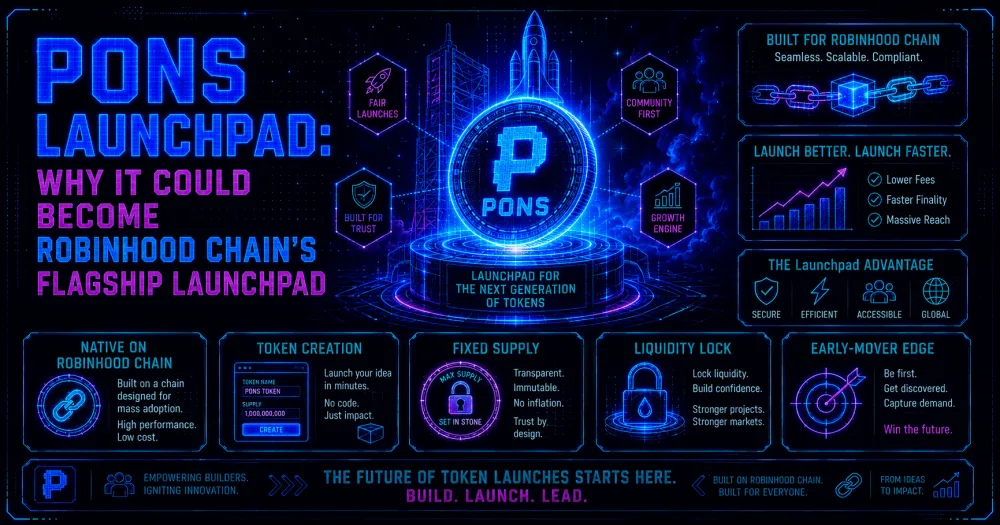
While PONS is not an official product from Robinhood, the launchpad was built exclusively for the new network. Additionally, developers seeking to raise capital on Robinhood Chain may find PONS a much faster alternative to manually deploying contracts.
The success of this launchpad product ultimately depends on the number of graduate tokens able to gain long-term value and liquidity after launch.
Related: Best Robinhood Chain Launchpads in 2026: Top Platforms to Launch Your Token Before Everyone Else
Contents
- What Is PONS Launchpad?
- How PONS Launchpad Works
- Why PONS Could Become Robinhood Chain's Flagship Launchpad
- What Makes Robinhood Chain Attractive for Builders?
- PONS vs Other Robinhood Chain Launchpads
- Advantages of Launching a Token on PONS
- How to Launch a Token on PONS
- Risks and Limitations
- Is PONS Launchpad Worth Watching?
- FAQ
What Is PONS Launchpad?
PONS Ecosystem Overview
The PONS Launchpad on Robinhood Chain is a non-custodial launchpad for utility or equity tokens with a fixed supply. The PONS crypto product also includes an explorer, creator dashboard, wallet analytics, and on-chain data. Pons Labs, LLC owns the interface at pons.sc, while users must connect their own wallets to make transactions. The PONS token itself should not be confused with user-created tokens, which are deployed separately using Robinhood Chain.
Why PONS Was Built for Robinhood Chain
PONS was built to serve Robinhood Chain rather than the other way around. The launchpad’s creation flow and liquidity-graduation mechanism are tailored to meet the needs of a single blockchain ecosystem.
Key Features of the Platform
The public-facing interface lets launch contributors customize token names, tickers, descriptions, images, socials, a creator wallet, and an optional developer buy. It also displays launch fees in ETH▲$1,761.17, liquidity-graduation thresholds in ETH, and current locked liquidity.
How PONS Launchpad Works
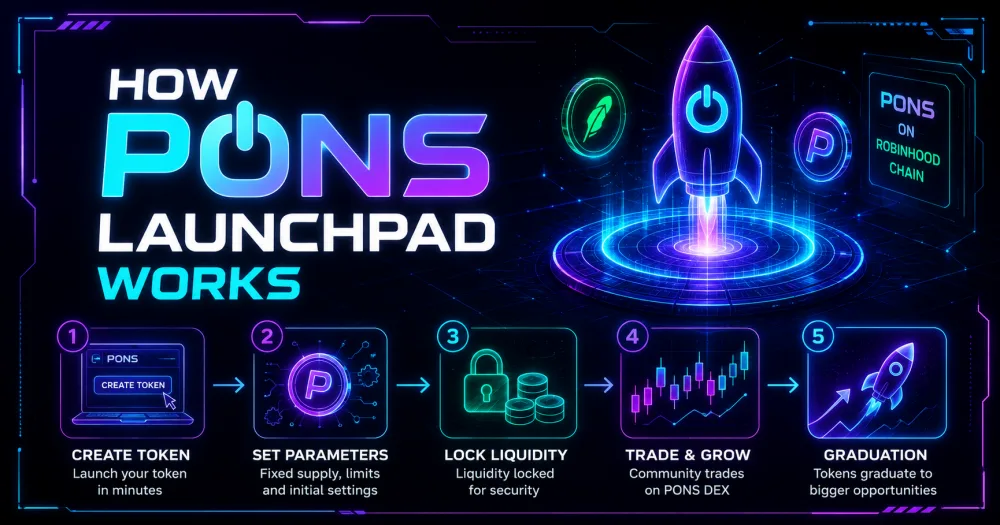
Creating a Token in Minutes
The creator connects their wallet, inputs information, and signs the deployment transaction. PONS Launchpad Robinhood Chain removes the complexity of contract creation by replacing it with a form and a wallet signature, enabling non-developers to launch tokens on Robinhood Chain without Solidity, Hardhat, or Foundry.
Fixed-Supply Token Model
PONS Launchpad Robinhood Chain adheres to the fixed-supply token model, which is standard for most memecoin projects. The public-facing creation form does not include a supply customization field. While this model typically involves less complexity than a supply contract, it does not inherently promote supply scarcity or liquidity.
Related: Best Robinhood Chain Projects: 9 Early Crypto Picks Before Everyone Else Finds Them
Liquidity Locking and Token Graduation
As trade volume increases, so do liquidity thresholds. The interface displays the graduation target at 4.2 ETH and liquidity supply at 0 ETH (locked). This feature decreases the risk of liquidity withdrawal but cannot prevent price manipulation or concentrated ownership from draining supply.
Non-Custodial Trading and Wallet Integration
Every contributor must approve each transaction through their connected wallet. PONS does not have custody of user funds or keys and cannot reverse transactions. Before signing, users must carefully review the network, transaction, approvals, and slippage.
Why PONS Could Become Robinhood Chain’s Flagship Launchpad
Native Integration With Robinhood Chain
PONS Launchpad Robinhood Chain is “native” to Robinhood Chain in that it was purpose-built for the network. However, it should not be mistaken for an official product from Robinhood, which remains separate from Pons Labs, LLC at all levels of operations. In its current state, launchpad users should not expect any special treatment from the Robinhood ecosystem.
Built for Permissionless Token Launches
Robinhood Chain allows permissionless smart-contract deployments, which PONS Launchpad Robinhood Chain turns into a permissionless token launchpad for the creation of fixed-supply, community-driven assets without custom logic. In addition to memecoins, this design could facilitate the emergence of a Robinhood Chain-specific launchpad market for token sales, bonding curves, and NFTs.
Simple UX Compared With Traditional Token Deployment
Deploying a smart contract normally requires extensive programming knowledge, testing, and network configuration. PONS Launchpad Robinhood Chain drastically simplifies the process for non-developers who only want a fast way to deploy a token to Robinhood Chain.
Early-Mover Advantage in a Young Ecosystem
In the early days of Robinhood Chain, the first launchpad to attract active users will generate habits and expectations that subsequent platforms will struggle to overcome. If PONS manages to maintain consistency and quality, then it has the potential to dominate the Robinhood launchpad market for years to come.
What Makes Robinhood Chain Attractive for Builders?
Ethereum Layer-2 Powered by Arbitrum
Robinhood Chain is an Ethereum Layer-2 blockchain using Arbitrum’s optimistic rollup protocol. It consumes ETH as gas and has a chain ID of 4663, making it fully compatible with existing Ethereum development tools like Solidity, Vyper, Hardhat, and Foundry. Developers can deploy existing contracts to Robinhood Chain without further modifications.
Growing Developer Ecosystem
The official Robinhood Chain ecosystem provides infrastructure, RPC nodes, bridges, oracles, custody, analytics, DEXes, lending, and perpetual futures. Third-party providers include Alchemy, LayerZero, Chainlink, Uniswap, Morpho, BitGo, and Fireblocks.
Institutional Infrastructure and DeFi Vision
The Robinhood token platform aims to become a bridge between traditional finance, crypto assets, and DeFi services. The mainnet launch of Robinhood Chain features the introduction of Stock Tokens, wallet infrastructure, and DeFi products. While PONS focuses on speculative assets, its underlying infrastructure benefits from the same liquidity, analytics, and wallet solutions.
Why New Projects Are Choosing Robinhood Chain
New projects want to benefit from familiar EVM-compatible smart contracts while being deployed on a rising blockchain network backed by a famous financial brand. Account abstraction enables sponsored gas, batching, and programmable wallets, but actual liquidity and user habits still need to develop.
Read more: What Is CashCat Crypto? Why Robinhood’s Memecoin Is Exploding
PONS vs Other Robinhood Chain Launchpads
PONS vs RobinPad
RobinPad is another launchpad for Robinhood Chain that uses Uniswap v3 to create markets. Its website notes that token sales on Uniswap v3 use the 1% pool fee tier, with 70% of LP fees going to the token fee recipient and 30% to the RobinPad deployer. In contrast, PONS Launchpad Robinhood Chain enables fixed-supply token launches with liquidity graduation and lock.
PONS vs RobinLaunchpad
RobinLaunchpad is a multi-chain launchpad that also supports Robinhood Chain. Unlike PONS or RobinPad, it enables the creation of tokens, NFTs, inscriptions, auctions, and liquidity. Its token sales use a bonding curve and have a 1B supply, 6.9% trading fee, and liquidity graduation after reaching 80% of the supply. Overall, PONS Launchpad Robinhood Chain offers a much more focused set of tools for token launches.
Which Platform Fits Different Types of Projects?
PONS Launchpad Robinhood Chain is appropriate for any project that wants to have a fast and simple launch with a reasonable liquidity graduation target. In comparison, RobinPad provides greater flexibility by utilizing Uniswap v3 and its creator LP fee, while RobinLaunchpad is better for projects that want to tokenize NFTs, inscriptions, and tokens alongside a marketplace. Ultimately, the choice depends on fees, contracts, and audience.
PONS vs Other Robinhood Chain Launchpads
| Platform | Main Focus | Token Launch Model | Liquidity Approach | Key Advantage | Best Suited For |
|---|---|---|---|---|---|
| PONS Launchpad | Fast fixed-supply token creation | Standardized launch with a graduation threshold | Liquidity is locked after graduation | Simple interface and low entry barrier | Meme coins, community tokens and experimental projects |
| RobinPad | Token launches connected to Uniswap v3 | Tokens move directly into Uniswap-based markets | Uses Uniswap v3 liquidity pools | Creator access to a share of liquidity-provider fees | Projects focused on decentralized exchange liquidity |
| RobinLaunchpad | Tokens, NFTs, inscriptions and auctions | Bonding-curve model with broader launch tools | Liquidity is added after the required token allocation is sold | Wider range of asset creation features | Projects that need tokens, NFTs and marketplace functions |
Advantages of Launching a Token on PONS
Low Launch Costs
The creation page displays a 0.0005 ETH launch fee and does not appear to have any additional costs beyond gas and an optional developer buy. This removes many barriers to experimentation but does not eliminate the creator’s responsibility to analyze the final wallet transaction and related costs.
Instant Market Access
The new asset is immediately available on the PONS discovery page and trading interface after launch. Instead of negotiating a listing on a separate exchange or developing a set of smart contracts for a token sale, the creator can instantly benefit from the PONS discovery and trading infrastructure.
Transparent On-Chain Liquidity
On-chain trading activity is visible to everyone on the blockchain, but PONS also provides analytics based on indexed on-chain data. At the same time, dashboards and third-party indexing services may experience delays or downtime.
Fair Launch Mechanics
The use of standard long-tail token launches facilitates faster comparisons between similar projects, but it also creates opportunities for bots, address farming, and liquidity dumps. A large supply, low launch price, and concentrated ownership always carry the risks of rug pulls or market corners.
How to Launch a Token on PONS
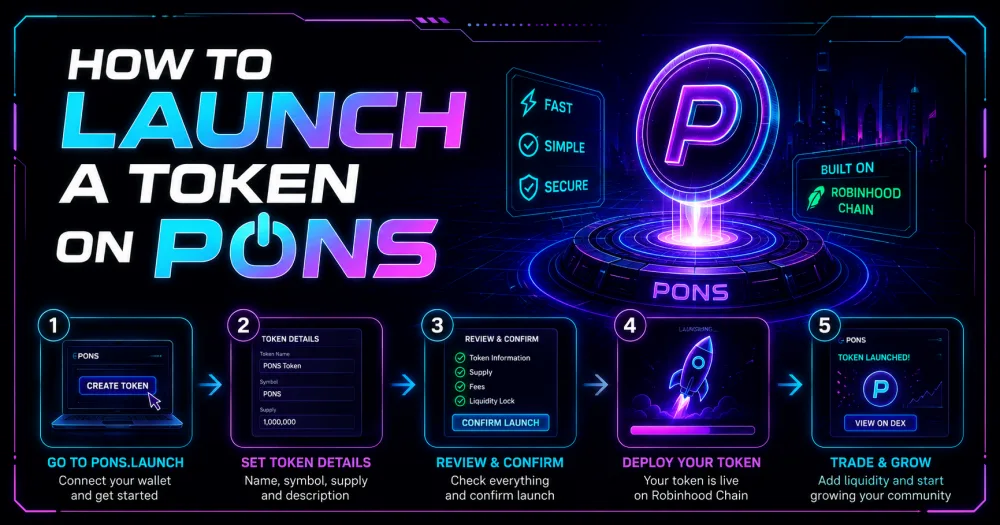
Connect Your Wallet
Install Robinhood Chain on a compatible EVM wallet and fund it with ETH to pay for gas fees. Make sure to select the mainnet chain ID 4663 and connect exclusively through the official PONS interface.
Configure Token Details
Supply a name (up to 32 characters), ticker (up to 10 characters), and a brief description of your token. Check the launch fee, graduation target, creator’s wallet, and optional developer buy before signing.
Add Social Links and Metadata
The creator can add links to their website, X account, and Telegram channel to the presale page and attach them to the social media posts. The image uploaded will be publicly available on the IPFS network, so any private or copyrighted content should be avoided. The metadata stored on-chain can help differentiate the genuine contract from potential scams.
Related: How to Launch a Memecoin on Openfair: Step-by-Step Guide for Beginners
Launch and Monitor Performance
Sign the deployment transaction, save the contract address, and monitor buying activity and graduation progress. Publish the verified address across official channels because unrelated tokens can use the same name or ticker
Risks and Limitations
Early-Stage Ecosystem Risks
Robinhood’s chain and PONS are new, and their interfaces, indexers, and bridges may evolve, be unavailable, or provide outdated information. PONS may also change, limit, or discontinue any features, so the front end’s continued availability is not guaranteed.
The platform’s terms also specify that its services are inaccessible in several jurisdictions, including the United Kingdom and the European Union. Users should check whether their country or region allows them to connect their wallet and launch a token.
Market Liquidity Challenges
The platform’s low cost may lead to a proliferation of tokens beyond the demand for the product. A liquid market might also have issues with slippage, concentration, and dislocation on small markets. Additionally, PONS cannot guarantee that a token will meet its graduation threshold or have enough liquidity.
After graduation, large short-term sales by market makers and other traders could cause significant price declines. Thus, it might be hard to sell large amounts of tokens without decreasing the price.
Smart Contract and Security Considerations
The program’s decentralized trading nature means that it cannot control smart contract risks, rogue tokens, wallet security, or third-party approvals. However, note that locking liquidity usually decreases potential losses due to scams or rug pulls, but it does not make a project completely reliable. Users are advised to review addresses, contracts, and wallet approvals and only send small amounts of money from their wallets to unverified smart contracts.
Is PONS Launchpad Worth Watching?
Who Should Use PONS?
PONS may appeal to eligible creators seeking to launch community tokens, memecoins, or experimental assets – typically not requiring custom coding. It may also attract traders seeking early access to Robinhood Chain projects. It is probably not a good fit for regulated fundraising, sophisticated governance or tokens, or complex transfer and compliance rules.
Growth Catalysts for the Platform
Adoption within Robinhood Chain, wallet compatibility, deeper levels of post-graduation market access, and successful early projects. Clear transaction costs, security responsiveness, and quality control as the number of tokens increases.
Could PONS Become Robinhood Chain’s Leading Launchpad?
Possibly, due to its concentrated product focus, lower issuance listing costs, intuitive interface, and first-mover advantage. The biggest challenge will be sustaining liquidity and community quality as issuance volumes grow.
If PONS continues delivering on its value proposition while Robinhood Chain scales its offerings, it could capture the best launchpad segment for simple token launches. However, if liquidity becomes fragmented across multiple similar launchpad services, its early lead may get overtaken by later competitors.
FAQ
What Is the PONS Launchpad?
PONS is a non-custodial fixed-supply token launchpad for the Robinhood Chain network, where users contribute ETH to creator wallets in order to receive tokens. PONS Launchpad Robinhood Chain requires users to authorize each wallet transaction themselves.
Is PONS Officially Affiliated With Robinhood?
There is no official confirmation of an affiliation between PONS and Robinhood. PONS is a separate product developed by Pons Labs, LLC for the Robinhood Chain network.
How Much Does It Cost to Launch a Token?
The current creation page displays a 0.0005 ETH launch fee, but the gas and optional developer buy add up to a higher cost.
Is Liquidity Locked on PONS?
The interface displays liquidity supply and graduation thresholds, but users should always confirm the latest contract information before contributing.
Can Anyone Launch a Token on PONS?
No, the PONS Launchpad on Robinhood Chain is not available for everyone. The service has restrictions for users under age and certain jurisdictions. According to the terms of service, the PONS interface is unavailable for all users within the United Kingdom and the European Union.
Is PONS Safe to Use?
The PONS Launchpad on Robinhood Chain is a permissionless, non-custodial token launchpad, but it does not protect users from token scams, price volatility, smart contract risks, or other issues associated with blockchain technology.