Choosing the best crypto custody provider boils down to keeping your assets safe. Institutions, funds, brokers, fintech apps, and exchanges all need a crypto custody provider that can protect user private keys, support audits, and fit their legal structure.
Updated June 17, 2026, this review compares public provider data, custody models, security controls, and exchange workflows for US-focused buyers.
This is not financial or legal advice. Licenses, supported assets, pricing, insurance, and eligibility should be verified directly before publication or procurement.
Contents
- Affiliate Disclosure
- Top 10 Crypto Custody Provider Options Compared
- How to Choose the Best Crypto Custody Provider
- Provider Reviews And Institutional Use Cases
- Deep Coverage: Custody Models, Costs, And Exchange Workflows
- Providers We Would Not Recommend Without Extra Due Diligence
- Decision Tree for Custody Selection
- FAQ About Custody Selection
- Conclusion: Choosing The Best Crypto Custody Provider
- Author Bio
- References
Affiliate Disclosure
Some links may be affiliate links. That can affect monetization, but not the ranking logic. This review uses a documented method: regulation, key management, audit evidence, API fit, asset support, settlement tools, and institutional usability. A ranking is not a replacement for internal due diligence, counsel review, or an RFP.
Top 10 Crypto Custody Provider Options Compared
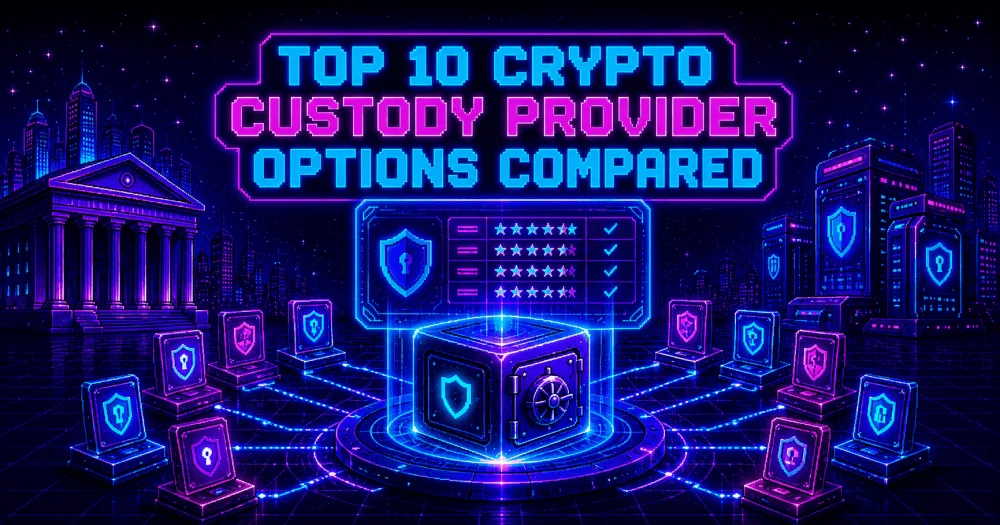
The table below compares major institutional options. “Stated” means the feature is described publicly by the provider or related official materials. The best crypto custody provider for one company may be wrong for another because funds, exchanges, treasuries, and fintech apps have different risk policies.
| Provider | Best fit | Custody model | US regulatory angle | Security model | Exchange fit | Main strength | Main limitation |
|---|---|---|---|---|---|---|---|
| Coinbase Prime | US institutions, funds, corporates | Qualified custody via Coinbase Custody Trust Company | New York fiduciary and qualified custodian | Cold storage, consensus controls, SOC reports stated | Strong | US scale and prime services | Eligibility and pricing may be custom |
| BitGo | Funds, platforms, treasury teams | Trust and wallet infrastructure | Trust entities and regulated products vary by entity | Multi-sig heritage, policy controls, cold storage | Strong | Governance and asset coverage | Jurisdiction fit needs review |
| Anchorage Digital Bank | US institutions needing federal oversight | Qualified custody through national trust bank | OCC-chartered crypto-native bank | Modern custody, governance, staking controls | Medium to strong | Federal oversight | Not always the easiest fit for smaller clients |
| Fireblocks | Exchanges, fintechs, treasury operations | Infrastructure and custody network | Not always the legal custodian itself | MPC-CMP, policy engine, network controls | Very strong | APIs, wallets, settlement workflows | Must separate tech provider from custodian role |
| Fidelity Digital Assets | Institutions seeking traditional finance brand | Custody and trading platform | Regulated institutional platform | Cold-storage custody and trading integration | Medium | TradFi trust and institutional process | Asset scope may be narrower |
| Gemini Custody | US companies and asset managers | Qualified custody | New York fiduciary and qualified custodian stated | Cold storage, SOC 2 Type 2, insurance stated | Medium | Clear US custody positioning | Product fit may be less exchange-native |
| Copper | Trading firms and off-exchange settlement users | MPC custody and ClearLoop settlement | UK/global institutional focus | MPC custody, off-exchange collateral workflows | Strong | Capital efficiency for trading | US legal fit needs extra diligence |
| Zodia Custody | Banks and global institutions | Regulated digital asset custody | Bank-backed custody business | Institutional custody controls | Medium | Bank-grade positioning | Ownership transition needs monitoring |
| Hex Trust | Asia and global institutions | Licensed institutional custody | Jurisdiction-dependent | Institutional custody, DeFi and staking tools | Medium | APAC strength | US fit may be limited |
| Komainu | Asset managers and institutions | Regulated institutional custody | Jurisdiction-dependent | Custody, collateral, governance controls | Medium | Nomura-backed institutional focus | Less US-native than some rivals |
How to Choose the Best Crypto Custody Provider
To choose the best crypto custody provider, we weighted public audit signals, qualified custody status, key-management architecture, governance controls, asset coverage, exchange integration, support maturity, and pricing transparency.
Methodology:
- Regulation: qualified custodian status, trust company status, bank charter, or local registration.
- Security: MPC, multi-sig, HSMs, cold storage, address whitelisting, role-based approvals, and withdrawal policies.
- Audit evidence: SOC 1, SOC 2, ISO 27001, penetration testing, insurance schedules, and incident disclosure.
- Operations: APIs, webhook reliability, reporting, reconciliation, and settlement tools.
- Institutional fit: funds, exchanges, fintechs, corporate treasuries, or market makers.
- Commercial fit: minimums, custody fees, withdrawal fees, setup costs, and contract limits.
The method is built for US institutional review. It does not treat a retail wallet, exchange account, and custody contract as interchangeable.
Security Controls And Key Management
The best crypto custody provider should explain how keys are generated, stored, approved, and recovered. Industry-standard security measures include MPC, multi-sig, HSMs, cold storage, withdrawal whitelists, transaction policies, approval thresholds, and role-based permissions.
A real checklist asks:
- Are private keys generated in a controlled environment?
- Are withdrawals governed by multiple approvals?
- Are address books locked, timed, or verified?
- Are high-value transfers separated from routine flows?
- Are SOC 2, ISO 27001, or equivalent reports available?
- Are red-team or penetration-test summaries available under NDA?
Avoid vague phrases like “bank-grade” or “military-grade” unless evidence follows. No public audit signal should count as a risk.
Regulation, Qualified Custody, and Audit Evidence
Regulatory status matters, but it is not magic armor. A trust company, national trust bank, registered crypto firm, and technology provider may all use the word custody while carrying different legal obligations. A buyer should confirm which legal entity signs the contract, which entity holds assets, which regulator oversees it, and which customer type is eligible.
Qualified custody is especially important for advisers, funds, and institutions with strict control requirements. Still, the exact answer depends on client type, state law, product terms, and legal review.
Crypto Custody Provider For Exchanges: API And Settlement Fit
A crypto custody provider for exchanges must do more than store coins safely. Exchanges need bulk address creation, deposit monitoring, withdrawal limits, policy engines, Travel Rule workflows, webhook reliability, reconciliation files, fast settlement paths, and incident procedures.
Exchange buyers should ask whether the provider supports:
- Production-grade API limits and clear SLA language.
- Sandbox testing that matches production behavior.
- Hot, warm, and cold wallet policy separation.
- Withdrawal approval tiers by asset, value, and user segment.
- Webhook retries and status reconciliation.
- Reporting that works for finance, compliance, and audits.
Exchange requirements are higher than ordinary treasury requirements. A demo is not proof of production capacity.
Provider Reviews And Institutional Use Cases
The following cards cover different institutional use cases. They do not replace an RFP, legal review, or direct provider call. They are a practical starting point for comparing custody, regulation, security evidence, and operating fit.
Coinbase Prime Custody — Regulated US Scale
For a US institution that wants custody connected to trading, reporting, and prime services, Coinbase Prime is a strong candidate. Coinbase Custody Trust Company is a New York fiduciary and qualified custodian, with SOC 1 Type II and SOC 2 Type II audits stated publicly.
This makes Coinbase Prime a natural shortlist option for funds, corporate treasuries, asset managers, and institutions that value US scale. It may be the best crypto custody provider for buyers who want a recognizable US platform, but not for every wallet policy or fee structure.
Strengths: regulated US custody profile, prime platform, broad institutional recognition.
Limits: costs, onboarding, minimums, and asset availability may require direct confirmation.
Read more: U.S. Crypto Tax Guide 2026: How Cryptocurrency Is Taxed and How to Stay IRS-Compliant
BitGo — Multi-Jurisdiction Wallet Governance
BitGo is known for institutional wallet governance, multi-sig roots, custody services, and broad digital asset infrastructure. It can fit funds, fintechs, platforms, and treasury teams that care about policy controls and operational separation.
BitGo may be the best crypto custody provider for teams that need strong governance across entities, assets, and jurisdictions. Still, the buyer has to check which BitGo entity provides the service, what legal status applies, and whether the product is custody, wallet infrastructure, staking, trading, or settlement.
Strengths: governance tools, institutional history, broad infrastructure.
Limits: jurisdiction and product fit need careful review.
Anchorage Digital Bank — Federal Oversight
Anchorage Digital Bank is a federally chartered crypto-native bank under OCC oversight and describes itself as a qualified custodian. That makes it highly relevant for US institutions that want a custody structure tied to federal supervision rather than only state-level trust frameworks.
Anchorage may be the best crypto custody provider for institutions that need federal oversight, governance, staking, and custody under one institutional platform. The tradeoff is access: availability, minimums, and product fit depend on the client’s profile.
Strengths: OCC charter, qualified custody positioning, institutional controls.
Limits: may not be the simplest option for smaller companies or exchange-heavy workflows.
Fireblocks And The Revolut Crypto Custody Provider Case
Fireblocks is best understood as institutional digital asset infrastructure, not always the legal custodian. Its platform supports MPC-CMP wallets, policy controls, settlement workflows, and a network used by many crypto firms, fintechs, and payment companies.
The Revolut crypto custody provider question is useful because Fireblocks has published a Revolut customer story showing how Revolut used Fireblocks to improve wallet and treasury operations. That does not mean every Revolut user has the same custody structure, or that Fireblocks is automatically the legal custodian in every context.
Strengths: wallet infrastructure, API workflows, settlement, fintech scale.
Limits: buyers must separate technology provider, custodian, sub-custodian, and contractual asset holder.
Deep Coverage: Custody Models, Costs, And Exchange Workflows
Custody selection usually fails when teams compare only brand names or monthly fees. The deeper question is which model fits the client’s regulatory, operational, and audit obligations.
| Model | Best for | Control profile | Main benefit | Main risk |
|---|---|---|---|---|
| Qualified custody | Funds, advisers, US institutions | Custodian holds assets under regulated framework | Stronger compliance fit | Higher cost and onboarding |
| Self-custody with tools | DAOs, crypto-native treasuries | Client controls keys or policies | Maximum control | Internal key-risk burden |
| MPC wallet infrastructure | Fintechs, exchanges, treasury teams | Distributed signing and policy controls | Flexible workflows | Legal custody may remain separate |
| Off-exchange settlement | Trading firms and exchanges | Assets stay with custodian while trades settle | Counterparty-risk reduction | Exchange and custodian coverage limits |
| Multi-custodian setup | Large institutions and exchanges | Assets split across providers | Reduces single-provider dependency | More reconciliation complexity |
The right model should be reviewed with counsel, auditors, finance, security, and operations together. Cheapest rarely means safest.
Related: Trump Family’s WLFI Set to Get Federal Bank Charter — Critics Cry Conflict of Interest
Exchange Integration Checklist Before Signing
Before signing with a crypto custody provider for exchanges, require proof of production readiness.
Checklist:
- API documentation covers deposits, withdrawals, status, and errors.
- Webhooks retry reliably and can be reconciled.
- Sandbox behavior reflects production.
- Withdrawal limits can be set by asset, role, time, and value.
- Address creation supports scale.
- Travel Rule processes are clear.
- Emergency freeze and incident escalation are documented.
- Reporting works for finance and compliance.
- SLA language covers realistic failure modes.
- Load limits are tested before launch.
Do not accept a polished demo as proof of production SLA.
Pricing, Minimums, And Contract Terms
Crypto custody pricing can include AUC minimums, custody fees, asset support fees, withdrawal charges, setup costs, staking fees, account fees, API access, and professional services. Many providers disclose full pricing only after a demo or RFP.
Compare:
- Monthly minimums.
- Basis-point custody fees.
- Setup and integration fees.
- Withdrawal and network fees.
- Custom reporting charges.
- Insurance exclusions.
- Support response times.
- Termination and asset transfer terms.
A cheap quote with weak reporting can become expensive once finance and audit teams get involved.
Security Models Behind Best Crypto Custody Provider Claims
Security claims need proof. The table below separates marketing language from verifiable controls.
| Claim | What to request | Why it matters |
|---|---|---|
| “Cold storage” | Description of signing flow and access controls | Cold storage varies by provider |
| “MPC security” | Architecture summary and approval policies | MPC alone does not define governance |
| “Insured assets” | Insurance schedule and exclusions | Insurance rarely covers every loss |
| “Audited controls” | SOC 1, SOC 2, ISO 27001, or equivalent evidence | Audit scope matters |
| “Qualified custodian” | Legal entity and regulator confirmation | Product and client type matter |
| “Fast withdrawals” | SLA and transaction test results | Speed can conflict with risk controls |
The best crypto custody provider claim should survive a document request, not just a sales call.
Providers We Would Not Recommend Without Extra Due Diligence
Some custody options may be usable, but not without extra work. This is not a scam list. It is a refusal-criteria list for institutions.
Related: Best Smart Wallets 2026: Safe, Argent, Coinbase Smart Wallets Ranked for Security and Ease of Use
Avoid moving forward too quickly when a provider has:
- No public audit evidence or unwillingness to share SOC summaries under NDA.
- Unclear legal entity or unclear asset holder.
- Wallet technology described as custody without legal custody terms.
- No insurance schedule or no explanation of exclusions.
- No production API documentation.
- No incident escalation process.
- No clear segregation of client assets.
- No support for reconciliation exports.
- Aggressive claims of absolute safety.
If proof is missing, write “not verified,” not “safe.”
Risk Flags In Custody RFP Responses
A custody RFP should reveal weak providers fast. Red flags include refusal to identify the contracting entity, vague answers about private-key generation, no audit summary, unclear insurance exclusions, no incident response timeline, no asset-segregation explanation, and no named support escalation.
Other warning signs:
- “We cannot disclose anything” for basic control questions.
- “Insurance covers everything” without a policy schedule.
- “Instant withdrawals” with no limit logic.
- “Qualified custody” without naming the legal entity.
- “SOC certified” without report type or scope.
- “API-ready” without sandbox testing.
Some documents are available only under NDA. That is normal. Refusing all evidence is not.
Decision Tree for Custody Selection
Use client type before brand preference.
- Registered investment adviser or fund: prioritize qualified custody, audit evidence, insurance terms, and reporting.
- Crypto exchange: prioritize API scale, wallet policy controls, settlement, Travel Rule workflows, and reconciliation.
- Corporate treasury: prioritize governance, role permissions, board reporting, and asset transfer controls.
- Fintech app: prioritize embedded wallet flows, sub-custody clarity, user terms, and incident handling.
- Trading firm: prioritize off-exchange settlement, counterparty-risk reduction, and fast collateral movement.
- Bank or broker-dealer: prioritize regulatory fit, examiner comfort, audit trail, and integration with existing controls.
No universal provider wins every branch. The final choice should match the client’s risk policy.
FAQ About Custody Selection
What Is A Crypto Custody Provider?
A crypto custody provider stores or controls digital asset private keys for clients. It differs from wallet software because custody involves legal, operational, and security responsibilities around asset safekeeping.
What Is The Best Crypto Custody Provider For A US Company?
The best crypto custody provider for a US company depends on client type. Funds may prioritize qualified custody. Exchanges may prioritize APIs. Treasuries may prioritize governance, reporting, and board-level controls.
Who Is Revolut Crypto Custody Provider?
The revolut crypto custody provider question depends on product, region, and customer terms. Fireblocks has published a Revolut customer story, but buyers should not assume one universal custody structure across all Revolut crypto services.
Can Exchanges Use Multiple Custodians?
Yes. Exchanges can use multiple custodians to reduce operational and counterparty concentration risk. The tradeoff is more complex reconciliation, liquidity routing, withdrawal policies, and internal controls.
Does Insurance Make Custody Safe?
No. Insurance helps only for covered events. It does not replace key controls, withdrawal policies, audit evidence, reconciliation, legal review, or provider due diligence.
Conclusion: Choosing The Best Crypto Custody Provider
Choosing the best crypto custody provider starts with risk policy, not a logo. US institutions should shortlist providers by regulatory status, key security, audit evidence, insurance terms, asset support, API fit, and contract clarity. Exchanges should give extra weight to settlement workflows, address scale, withdrawal controls, and reconciliation. A crypto custody provider should make risks easier to manage, not harder to explain.
Author Bio
This review was prepared by a digital asset research writer focused on crypto infrastructure, fintech products, institutional risk, and source-based provider comparison. Updated June 17, 2026.
References
https://www.coinbase.com/prime/custody
https://www.bitgo.com/
https://www.bitgo.com/resources/blog/qualified-custody-vs-self-custody/
https://www.anchorage.com/platform/custody
https://www.occ.gov/news-issuances/news-releases/2021/nr-occ-2021-6.html
https://www.fireblocks.com/customers/revolut
https://www.fireblocks.com/
https://www.fidelitydigitalassets.com/trading-custody
https://www.gemini.com/institutions/custody
https://copper.co/
https://copper.co/en/products/clearloop
https://zodia-custody.com/
https://www.sc.com/en/press-release/standard-chartered-to-acquire-zodia-custodys-custody-business/