NYSE owner says Hyperliquid’s small team built something bigger than Nasdaq, even as ICE and CME press regulators to review its market risks.
Jeffrey Sprecher, CEO of Intercontinental Exchange, the company behind the New York Stock Exchange, says Hyperliquid has become too big for traditional exchanges to ignore.
Speaking at Bernstein’s 42nd Annual Strategic Decisions Conference on May 27, Sprecher said Hyperliquid had drawn attention in energy markets since it allows trading when traditional oil markets are closed.
“The people that have built that exchange are extremely smart, and that is a true DeFi exchange,” Sprecher said, according to a transcript published by Seeking Alpha. He then compared its scale with a traditional exchange giant:
“If you haven’t heard about it, it’s bigger than Nasdaq, okay? It’s 11 people. You look at it, you’re like, wow, that’s pretty something.”
Read also: HYPE Hits All-Time High as Bitcoin Bleeds — Arthur Hayes’ “Holy Trinity” Trade Is Printing Money
Why ICE is Watching It
Hyperliquid lets users trade perpetual futures, crypto derivatives that don’t expire and can offer high leverage. Sprecher said ICE had spoken with major oil companies and now plans to narrow the weekend window when traditional oil markets are closed.
Earlier in May, Bloomberg reported that CME Group and ICE urged U.S. regulators to scrutinize Hyperliquid over concerns that its round-the-clock, largely anonymous perpetual futures markets could distort commodity benchmarks, especially in oil.
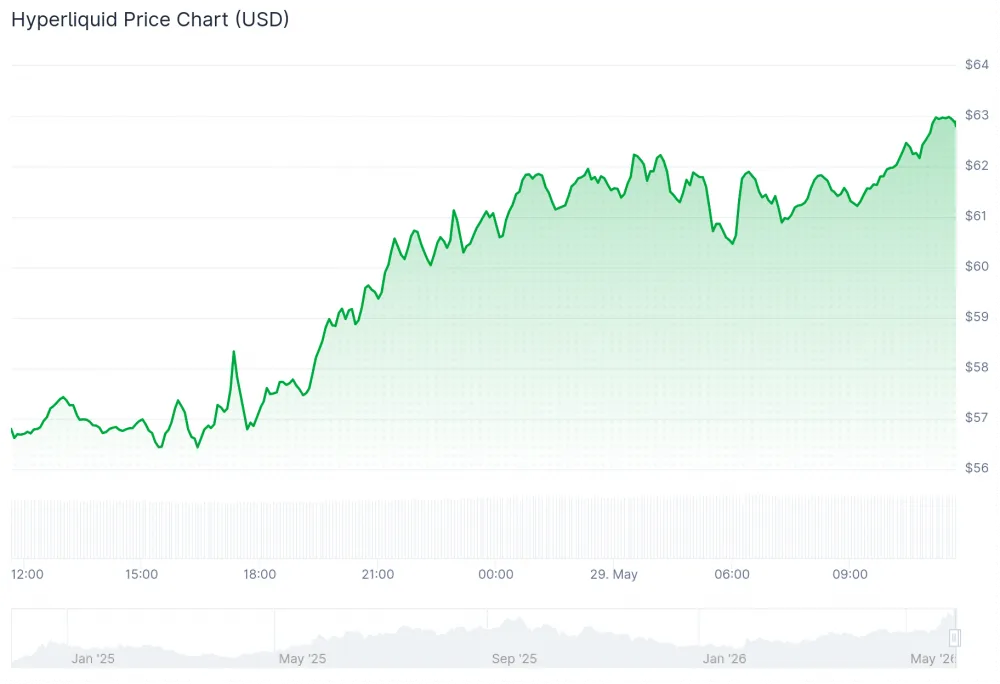
After the remarks drew attention in the crypto community, Hyperliquid’s HYPE▲$80.15 token jumped 10% to $62.80, putting it just 2.4% below its May 26 all-time high, according to CoinGecko data.
Commenting on those reports, Sprecher pushed back on the idea that ICE is trying to stop the platform, saying the company is “actually talking to these people and learning about it.” He explained:
“They’re learning what we’re doing. We’re helping them understand our world. They’re helping us understand their world.”
Sprecher said regulators may need to decide whether on-chain perpetual futures should be treated as swaps under existing rules or placed into a new regulated category.
Read more: Hyperliquid Launches Prediction Markets With Validators Instead of Oracles