As an operator, you would want to collaborate with a casino white label provider that can shorten time to market while keeping tight control over compliance and player data and enabling a future migration.
We assessed ten vendors using licensing evidence, technology depth, delivery claims, pricing transparency, and exit provisions. Holding necessary approvals in your jurisdiction remains a separate requirement: no international license substitutes for local authorization.
A white label casino can reduce implementation work only when it operates legally in the intended market. This article is not legal advice.
Contents
- White Label Casino Providers Ranked for Regulated-Market Projects
- Top 10 White Label Casino Providers
- White Label Casino Provider Reviews and Trade-Offs
- How We Compare Each Casino White Label Provider
- White Label Casino Software Explained for Operators
- White Label Casino Compliance Across Regulated Markets
- White Label Casino Cost and Revenue Share Explained
- Start White Label Casino Operations in Eight Weeks
- White Label Online Casino Software Architecture
- White Label Casino Solution vs Turnkey vs Custom Build
- Comparison Table for Control Cost and Speed
- Casino Brands That Reveal the Platform Trade-Offs
- BitStarz to Winlandia — Ten Brand Signals
- White Label Casino Risks Before You Sign
- Casino White Label Providers Outside the Final Top Ten
- Provider Evidence Gaps Before the RFP
- White Label Casino FAQ for Operators
- Choose a White Label Casino Provider with an Exit Plan
White Label Casino Providers Ranked for Regulated-Market Projects
This ranking considers whether each supplier has these:
- Verifiable product
- Credible technology stack
- Public licensing evidence
- Support infrastructure
- Sufficient commercial disclosure
- Realistic route out of the contract
White Hat provides the most extensive publicly visible licensing footprint among the white label casino providers reviewed here. Other suppliers can still be appropriate RFP candidates, but holding licenses or certifications internationally does not by itself establish access to a particular market.
The evaluation starts with the jurisdiction, the operating model permitted there, and any licensed entities that must participate. Vendor statements are treated separately from our editorial conclusions. Scores use documented assumptions and dated evidence.
Read more: Crypto Casino Research 2026: Market Analysis, Bonuses, No KYC, Games, Payments, and Player Risk
Top 10 White Label Casino Providers
The table below compares each white label casino provider using public material reviewed on August 31, 2026. “Market evidence” refers to documented regulatory credentials or operating evidence and never means automatic authorization in every jurisdiction.
| Provider | Market evidence | Model | Games | Payments | Crypto | CRM | Support | Exit |
|---|---|---|---|---|---|---|---|---|
| White Hat | Licensed | Full label | 3,000+ | Integrated | Unstated | PAM | Managed | RFP |
| SOFTSWISS | Licensed B2B technology | Turnkey/API | 40,000+ | 300+ | 20+ coins | PAM | 24/7 | Claimed |
| SkillOnNet | Licensed | Turnkey | Unstated | Integrated | Unstated | Included | Managed | RFP |
| BetConstruct | Licensed B2B technology | Dual vertical | 45,000 claimed | Integrated | Available | Included | Managed | RFP |
| Slotegrator | Vendor cites Curaçao structure; current LOK proof required | Full label | 30,000+ | 150+ | Available | Risk tools | 24/7 | RFP |
| Soft2Bet | Licensed | Turnkey | 8,500+ in 2023 | 150 in 2023 | Available | MEGA/PAM | 24/7 | RFP |
| GR8 Tech | Licensed/certified infrastructure | Modular | Aggregated | Gateway | Available | Included | Hypercare | Claimed |
| NuxGame | Market proof required | Turnkey/API | 18,500+ | Built-in | 30+ coins | CRM/KYC | 24/7 | RFP |
| SoftGamings | Licensing support | Label/turnkey | 10,000+ | Integrated | Available | Included | Technical | RFP |
| Gamingtec | Multi-jurisdiction platform claims | Label/turnkey | 10,000+ | 100+ | Available | PAM/CRM | Ongoing | RFP |
A capability that is not publicly documented is not necessarily absent. A casino white label provider can also change its licenses, game inventory, payment coverage, or contractual terms after this review date. Every figure therefore reflects the evidence available when checked.

White Label Casino Provider Reviews and Trade-Offs
The profiles below focus on practical fit rather than restating the ranking. Each review distinguishes published vendor capabilities from our interpretation and then sets out commercial questions, two principal strengths, and two principal drawbacks. Using the same evidence framework allows procurement teams to compare vendors without treating software certification as proof of operator authorization.
Pricing and implementation schedules depend on jurisdiction, traffic, integrations, service allocation, and contract design. Availability likewise depends on the intended market and the legal operating structure. Before choosing a provider, request regulatory records, a responsibility matrix, full pricing schedules, SLAs, data-control provisions, and a priced migration plan.
SOFTSWISS: Crypto-Ready Casino Stack for Regulated Growth
SOFTSWISS publishes a catalog of more than 40,000 games, 300+ integrated payment methods, support for 20+ cryptocurrencies, GLI-19 certification for its Casino Platform, ISO 27001 certification at company level, and continuous technical support.
- Its white label casino software ecosystem brings together PAM, bonuses, payment-provider management, and reporting.
- A single Game Aggregator API provides access to 300+ studios.
- Its crypto offering supports fiat conversion and more than 20 digital currencies.
| Parameter | Verified position |
|---|---|
| Model | Turnkey, API, or iFrame |
| Games | 40,000+ |
| Payments | 300+ methods |
| Crypto | 20+ currencies |
| PAM | Included |
| Security | GLI-19 and ISO 27001 |
| Support | Ongoing technical service |
| Market access | Market-specific proof required |
The main advantages are the depth of aggregation and broad payments support. The main limitations are the lack of public proof for deployment in every target market and limited disclosure of migration pricing.
A white label crypto casino provider may supply certified technology, but certification does not replace the operator authorization required by the jurisdiction. We therefore assume that the global content catalog may differ from the games legally available in a particular market. Before signing, verify the licensed operator or partner, approved games, data-export rights, and migration support.

White Hat Gaming: Multi-Market Full-Service Platform
White Hat offers everything from its proprietary PAM to a complete white label arrangement. Its platform pages list more than 3,000 games from 120 suppliers, while company-wide material separately refers to 130+ content providers.
- The online casino white label offering can include payments, CRM functionality, game content, and sportsbook access.
- Travelling Wallet lets the same player account operate across products and devices.
- White Hat publicly lists licenses from numerous gambling authorities and regulated jurisdictions.
| Parameter | Verified position |
|---|---|
| Model | PAM through full label |
| Games | 3,000+ |
| Providers | 120 in platform description; 130+ company-wide |
| Payments | Aggregated options |
| PAM | Proprietary |
| Wallet | Cross-product |
| Market evidence | Multiple licenses published |
| Exit | Must be confirmed through RFP |
Its key advantages are strong public regulatory credentials and a modular implementation model. Weaknesses are the absence of published pricing and limited public information about migration obligations.
Read More: What Is Polymarket? The Beginner’s Guide to the Prediction Market Everyone Is Talking About in 2026
A white label casino integration still requires the appropriate operator authorization or qualifying licensed operating relationship in the destination market. Every White Hat license also needs to be checked by product and role because, for example, approval involving sportsbook supply does not automatically authorize casino operations. Confirm regulatory status, product scope, third-party vendors, SLA terms, and data portability directly against the target jurisdiction.

SkillOnNet: Multi-Brand Operations and Local Licensing
SkillOnNet describes partnership structures covering licensing, turnkey deployment, and omnichannel operations, with integrated player accounts, loyalty, payments, and data across digital and physical channels.
- Its white label online casino software supports full operations and market localization.
- Public partnership examples include Genting, Slingo, and SlotStars.
- The offering can cover licensing, compliance, operations, support, marketing, and analytics.
| Parameter | Verified position |
|---|---|
| Model | Licensing, turnkey, joint venture |
| Omnichannel | Accounts, loyalty, and payments |
| Brands | Genting, Slingo, SlotStars |
| Metal Casino | Active SkillOnNet trading name in UKGC register |
| Winlandia | Active SkillOnNet trading name in UKGC register |
| Licensing | Shared-market claims |
| Market access | Must still be established for the chosen jurisdiction |
| Exit | RFP confirmation required |
The strengths are multi-brand operating experience and the ability to connect physical and digital gaming. The weaknesses are incomplete public evidence for every proposed market and the absence of disclosed exit economics.
A casino white label agreement relying on permissions in Europe does not authorize betting or casino activity elsewhere. Confirm the specific local entity, licensed partner, approved content inventory, ownership of player data, and migration charges before contracting.
BetConstruct: Casino and Sportsbook Under One Platform
BetConstruct positions SpringPlatform as a unified casino and sportsbook environment. Its published materials claim access to approximately 45,000 games from more than 350 providers.
- The white label gambling platform brings wallet management, CRM, risk controls, reporting, and game content into one environment.
- Casino and sportsbook can operate from the same back office.
- Regulatory allocation and commercial responsibilities must be defined in the contractual schedules.
| Parameter | Verified position |
|---|---|
| Core | SpringPlatform |
| Verticals | Casino and sportsbook |
| Games | 45,000 claimed |
| Providers | 350+ claimed |
| CRM | Included |
| Risk tools | Included |
| Market access | Market-specific proof required |
| Exit | Must be confirmed contractually |
BetConstruct’s main advantages are multi-vertical coverage and substantial aggregation. Its main weaknesses are the lack of public proof for every market-specific deployment and unclear migration provisions.
A provider’s international licensing portfolio does not make casino white label solutions legal in every jurisdiction. We treat catalog figures as global numbers rather than locally certified inventory. The RFP should freeze the agreed scope, milestones, regulatory roles, data-export specifications, support obligations, and termination assistance.

Slotegrator: Broad Game and Payment Aggregation
Slotegrator currently advertises more than 30,000 games, 180+ providers, over 150 payment options, and round-the-clock technical and player support. Its website continues to describe the white label product as operating under Slotegrator’s business structure and a Curaçao “sublicense.”
That terminology now requires special caution. Curaçao’s former sublicense regime ended in October 2025 under the transition to the LOK framework. A 2026 procurement process therefore needs proof of the actual current CGA-licensed entity, approved domains, legal role, and operating structure rather than relying on legacy sublicense language.
- Advantage: One API can substantially reduce the number of separate game integrations.
- Advantage: The package includes platform configuration and player-support options.
- Limitation: Legacy “Curaçao sublicense” wording is not evidence of a current LOK authorization.
- Limitation: Market-specific licensing and contractual exit provisions still require documentation.
For a regulated-market white label gambling solution, the RFP must identify the correct legal entity, current licensing route, licensed operating partner where required, approved games, payment chain, and compliance controls. Product scope was reviewed on August 31, 2026, with the Curaçao licensing framework rechecked for this rewrite.
Soft2Bet: Gamification-Led Retention Infrastructure
Soft2Bet combines PAM, CRM, payments, managed operations, and its MEGA gamification system. One company release from 2023 described more than 8,500 games, 120 providers, and 150 payment methods.
- Advantage: The white label online casino stack connects segmentation, promotions, risk functions, and support.
- Advantage: MEGA supplies configurable missions and other engagement mechanics.
- Limitation: Current public pages use different inventory figures, including 6,000 games and 220+ payment methods on the homepage.
- Limitation: Public evidence does not establish deployment permission in every target jurisdiction.
Claims of higher retention or revenue need to be tied to defined cohorts, control groups, and measurement periods. Treat online white label casino software performance metrics as vendor claims until the RFP confirms local scope, integration permissions, and the methodology behind reported results.

GR8 Tech: Rapid Launch for Complex Market Entries
GR8 Tech provides modular casino, sportsbook, CRM, payments, aggregation, APIs, and configuration frameworks. Its Light White Label materials report 99.99% uptime, more than 100 brand launches, and activity across 15 markets.
- Advantage: Automation can reduce configuration work for repeatable deployments.
- Advantage: The company describes staged and incremental migration processes.
- Limitation: Its one-week go-live statement applies to ULTIM8 Sportsbook iFrame, not to a complete casino deployment.
- Limitation: Casino-specific licensing and migration rights still require supporting documents.
Operators intending to start white label casino operations should separate the technical schedule from regulatory approval in the RFP. Actual delivery depends on scope, interfaces, testing, certification, payments, and jurisdictional review.
Read More: GameFi 2.0 Explained: How Crypto Gaming Is Transforming Beyond Play-to-Earn in 2026
NuxGame: Modular Casino Software for Fast Scaling
NuxGame publishes product pages showing more than 18,500 games, 140+ game providers, support for 180+ currencies, built-in payments, CRM and KYC tooling, and 24/7 technical support. Its white label casino platform can be delivered as a ready-made product or through API-based integrations.
- Advantage: Modular components allow implementation to happen in stages.
- Advantage: Integrated wallet, back office, payments, and compliance tooling can reduce the number of separate vendors.
- Limitation: Public product pages do not by themselves establish supplier approval in a chosen regulated jurisdiction.
- Limitation: White label and turnkey responsibilities must be clearly divided contractually.
A mobile casino white label project still requires locally permitted games and suitable payment routes. Procurement should determine who owns merchant accounts, personal data, consent logs, domains, backups, identifiers, and export processes.

SoftGamings: Flexible White Label Casino Integration
SoftGamings has operated since 2007. Its dedicated white label materials advertise 10,000+ games, licensing assistance, integrated payments, cryptocurrency support, CRM, and a technical launch target of around six weeks. Separate current platform pages advertise a broader 16,000+ game ecosystem, so catalog scope should be tied to the actual contracted product.
- Advantage: A white label casino app can use responsive delivery and a large game portfolio.
- Advantage: Packages can combine branding, games, payments, and compliance-related functionality.
- Limitation: The reviewed material does not prove local regulated-market access in every target jurisdiction.
- Limitation: Hosting and support responsibilities must be reconciled across product documentation and contract schedules.
Resolve responsibility questions through the SLA and RACI. Specify who handles hosting, maintenance, incidents, customer support, licensing work, data exports, and termination tasks. A six-week technical target should not be treated as including regulator approval.

Gamingtec: Unified Casino and Sportsbook Back Office
Gamingtec, established in 2013, combines PAM, CRM, bonuses, payments, casino, and sportsbook products through one platform environment. Its current white label page advertises more than 10,000 games, 100+ payment methods, and a six-to-eight-week go-live target.
- Advantage: A white label gambling site can operate multiple verticals from a shared wallet and control environment.
- Advantage: Gamingtec states a technical white label launch range of six to eight weeks.
- Limitation: General jurisdiction claims do not establish that the operator itself is approved for the reader’s intended market.
- Limitation: Export specifications and migration assistance remain contractual RFP items.
A white label casino software provider should substantiate its delivery timetable. Separate the provider’s implementation target from licensing and approval time, then verify certification, merchant-account ownership, support coverage, and exit pricing.
How We Compare Each Casino White Label Provider
The scoring method uses regulator registers, supplier pages, certifications, and contract-related evidence reviewed through August 31, 2026. International scale alone does not earn a high score for the best white label gambling solution.
- Market authorization and operating structure: 25%.
- Technology and reliability evidence: 20%.
- Games, payments, and API coverage: 15%.
- Commercial terms and pricing transparency: 15%.
- Data control, portability, and exit arrangements: 15%.
- Support availability and incident management: 10%.
The overall score is calculated by multiplying each criterion score by its assigned weight and adding the results. Vendors lose points for undated claims, missing jurisdictional scope, unverifiable metrics, or terms available only after an RFP. Editorial scoring does not replace legal due diligence.
Licensing Evidence and Market Access
Market entry begins with official registry records. A white label gambling assessment should confirm the platform’s status, operator arrangement, geolocation requirements, and applicable testing certificates.
- Search official records maintained by the regulator in the intended market.
- Match the operating company with all authorized platform and supplier entities.
- Verify games, payment pathways, location controls, and player-protection obligations.
Approval of a casino white label in another jurisdiction does not establish a legal pathway in the target market. Regulatory roles vary significantly, so current local requirements must be confirmed before launch.
Platform Reliability and Player Account Management
Reliable white label casino software depends on PAM stability, wallet accounting, capacity, redundancy, event logging, and clearly assigned incident responsibility. Request both an SLA and evidence showing historical performance.
- Define how uptime is calculated, including exclusions and service-credit rules.
- Test deposits, bets, payouts, withdrawals, and ledger reconciliation.
- Review failover processes, recovery objectives, alerts, escalation, and communications.
A claim such as 99.9% uptime means little unless the measurement period, environment, exclusions, and evidence are specified.
Read More: Best Web3 Games 2026 Ranked for U.S. Players
Games Payments and White Label Casino Integration
A large aggregated catalog matters only when its individual titles can legally be supplied in the destination market. Review casino white label solutions through a jurisdiction-specific approval matrix.
| Check | Required evidence | Failure risk |
|---|---|---|
| Games | Local certificates | Catalog blocked |
| PSP | Acquiring terms | Deposits fail |
| Fraud | Chargeback process | Margin erosion |
| KYC | Exception procedure | Onboarding breach |
| API | Limits and logs | Delayed launch |
Worldwide integration totals should remain secondary. Actual availability depends on supplier contracts, banking approval, local certification, payment underwriting, and regulatory permissions.
Commercial Terms, Data Ownership and Exit Rights
The advertised white label casino cost rarely captures the complete economic exposure. Model setup fees, monthly minimums, GGR or NGR percentages, reserves, PSP charges, regulatory work, and support together.
- Establish who acts as controller and processor for every relevant data set.
- Require exports for balances, KYC, consent, CRM, and transaction histories.
- Put prices on migration work, deletion obligations, and post-termination access.
Model the economics of leaving after 24 months before accepting the white label casino price. Until a proposal defines scope, revenue calculations, export rights, and exit responsibilities, the numbers are only scenarios.
White Label Casino Software Explained for Operators
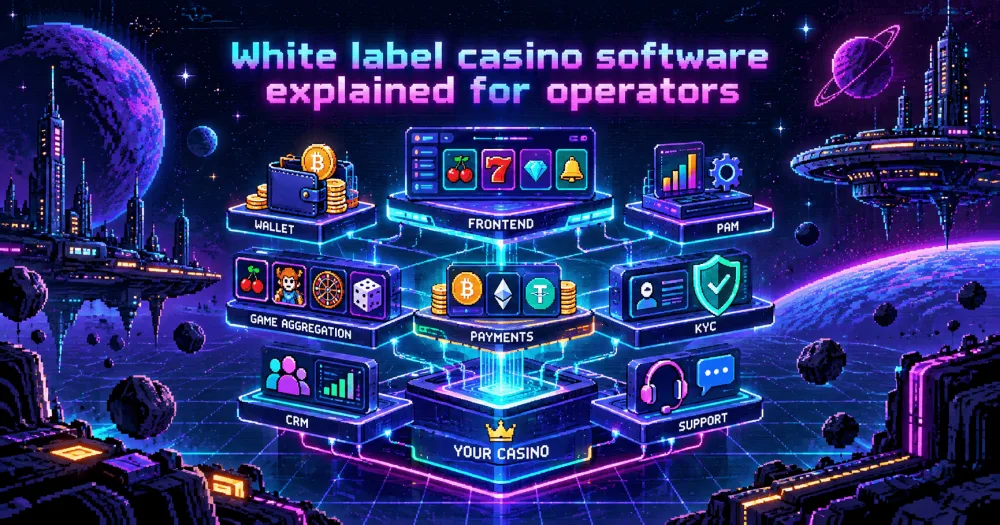
Under a typical model, the provider supplies a hosted gambling platform, frontend, games, payment integrations, and selected operating functions within one commercial arrangement. The brand normally remains responsible for acquisition, marketing budgets, content decisions, and whatever player-facing duties are allocated to it. A white label gambling solution can also include KYC workflows, customer service, CRM, reporting, and compliance operations.
Technology certification only shows that specified software was assessed against a standard. It does not authorize real-money gambling everywhere. Contracts must name the licensed operator, the platform provider’s role, all required partners, the data controller, and the party accountable for each operational control. The exact allocation depends on local regulation and negotiated scope.
White Label Casino Compliance Across Regulated Markets
Real-money iGaming regulation is jurisdiction-specific. Each market defines who may operate, what supplier roles exist, which products must be tested, and how access is granted. There is no global white label gambling license that overrides these rules.
- Pick the specific market and verify that online casino gambling is permitted.
- Identify the qualifying licensed operator and any required local partner.
- Confirm operator, platform, and supplier entities in official public registers.
- Map responsibilities for geolocation, KYC, AML, game approval, payments, and responsible gambling.
- Submit contracts, systems, ownership information, and testing material where approval is required.
Regulatory regimes may distinguish operators, platform suppliers, game suppliers, and testing laboratories. Requirements should be checked before any launch decision.
Real Money iGaming and Sweepstakes Models Compared
A white label sweepstakes casino is structurally different from a licensed real-money casino. Payment mechanisms, prize structures, and legal frameworks differ.
| Model | Currency | Prizes | Licensing | Geography | Closure risk |
|---|---|---|---|---|---|
| Real-money casino | Cash deposits | Cash winnings | Market gaming approval | Permitted markets | High if unlicensed |
| Social casino | Virtual credits | No cash redemption | Consumer-law framework | Terms-based | Lower, fact-specific |
| Sweepstakes | Usually dual currencies | Redeemable prizes | Contested and changing treatment | Rapidly changing | High in restricted markets |
Some jurisdictions have prohibited or restricted particular sweepstakes structures. A white label gambling platform should therefore keep sweepstakes, social casino, and real-money operations operationally and legally distinct. The rules are changing quickly and need launch-day verification.
Market Licensing, Geolocation and Responsible Gaming
Compliance requires identifiable entities and auditable controls. An online casino white label proposal should pass a market-specific gate covering:
- Verification of operator, platform, supplier, and casino-partner permissions.
- Tested geofencing that blocks gambling outside authorized locations.
- KYC, sanctions checks, AML monitoring, and source-of-funds procedures.
- Enforcement of local age requirements and responsible-gambling rules.
- Self-exclusion, deposit limits, account restrictions, and required notices.
- Logging of registrations, location checks, financial activity, interventions, and administrator actions.
Many authorities publish public records for licensed companies. White label gambling software may provide the controls, but the regulator’s records determine the legal role of each entity.
Read More: What Is Crypto Slang? Most Popular Crypto Terms Every Trader Should Know in 2026
White Label Casino Cost and Revenue Share Explained
The headline setup charge is only one component of the commercial structure. A complete white label casino price assessment should separate fixed charges, variable fees, and jurisdiction-specific costs.
| Cost item | Public scenario | Billing basis |
|---|---|---|
| Setup and integration | $15,000–$60,000 | One time |
| Platform fee | $3,000–$15,000 | Monthly |
| Revenue share | 10%–30% | Usually NGR or GGR |
| Rolling reserve | Contract-specific | Restricted cash |
| Games and PSPs | Contract-specific | Pass-through or markup |
| Compliance and support | Scope-specific | Fixed or usage-based |
| Marketing | Operator budget | Separate |
These figures are planning assumptions rather than provider quotes. Taxes, legal work, licensing, testing, and partner economics need separate budgets.

White Label Casino Price Stack from Setup to GGR
The following editorial model illustrates three USD scenarios. A white label solution online casino budget will vary according to integrations, regulatory scope, and monthly GGR.
| Scenario | Setup | Monthly fixed | Revenue share | Reserve | Modeled monthly GGR | First-year platform cost |
|---|---|---|---|---|---|---|
| Lean test | $20,000 | $5,000 | 10% | 5% held | $100,000 | $200,000 |
| Regulated launch | $60,000 | $15,000 | 15% | 10% held | $500,000 | $1,140,000 |
| Scale case | $120,000 | $30,000 | 20% | 15% held | $1,000,000 | $2,880,000 |
The formula is setup cost plus twelve monthly fees plus twelve months of revenue share. The reserve is not counted as a platform expense because it remains restricted cash. Taxes, legal expenses, licenses, marketing, payment costs, and game charges are excluded. Every assumption should ultimately be replaced with a vendor quote and a market-specific financial plan.
Five-year TCO for a White Label Gambling Platform
The five-year illustration compares white label and turnkey economics at three levels of monthly GGR.
For white label, the model uses $800,000 + 9.05 × monthly GGR. This incorporates setup, 60 monthly platform payments, a 15% revenue share, $150,000 of migration costs, and a 10% annual capital cost applied to a reserve equal to 10% of monthly GGR.
The turnkey calculation is $2.2 million + 1.8 × monthly GGR. It assumes a $500,000 setup, $30,000 of monthly operating expense, variable charges of 3%, and $100,000 of residual data value.
| Monthly GGR | White-label TCO | Turnkey TCO | Lower modeled TCO |
|---|---|---|---|
| $100,000 | $1.71M | $2.38M | White label |
| $500,000 | $5.33M | $3.10M | Turnkey |
| $1,000,000 | $9.85M | $4.00M | Turnkey |
The modeled break-even point is roughly $193,000 of monthly GGR. Moving the assumed revenue share by five percentage points changes the economics significantly. This is an illustrative model, excludes taxes, and should not be treated as a forecast.
Start White Label Casino Operations in Eight Weeks
Eight weeks should be understood as a project scenario, not a guaranteed timetable. A regulated-market white label casino solution requires technical, contractual, and regulatory work to line up.
- Week 1: Set the market, legal operator structure, and RFP scope.
- Week 2: Choose the supplier and negotiate data, commercial, and termination rights.
- Weeks 3–4: Configure the brand, PAM, wallet, KYC, payments, and game catalog.
- Weeks 5–6: Finish integrations, gather certification material, test systems, and train personnel.
- Week 7: Complete QA, reconciliation, geolocation, and incident-response drills.
- Week 8: Run a controlled launch and obtain any remaining required approvals.
Regulatory queues, banking, certification, supplier contracts, and technical problems can extend this schedule.
White Label Casino Launch Checklist by Workstream
Each workstream needs a named owner and an objective readiness gate. White-label online casino software should not move into production while a critical stream remains unresolved.
| Workstream | Owner | Required input | Readiness test | Blocking risk |
|---|---|---|---|---|
| Legal | Counsel | Market scope | Approved route | Wrong entity |
| Product | Product | Requirements | Configuration accepted | Scope drift |
| Payments | Finance | PSP contracts | Cash-flow test | Bank rejection |
| Games | Casino | Approved catalog | Titles load | Missing approval |
| Data | Privacy | Data map | Export test | Unclear ownership |
| Support | Operations | SLA/scripts | Drill passes | Coverage gap |
| Marketing | Compliance | Creatives | Claims approved | Prohibited promotion |
Finish testing with a complete player journey: deposit, game round, bonus, withdrawal, reconciliation, and complaint. The agreed RACI should remain part of the operating contract rather than disappearing after implementation.
White Label Online Casino Software Architecture
A white label architecture can contain roughly ten operating layers, but contractual ownership varies. Casino white label solutions typically place much of the core infrastructure under provider control.
| Layer | Usual controller | Exit deliverable |
|---|---|---|
| Frontend and CMS | Shared | Code or content export |
| PAM and wallet | Provider | Accounts and balances |
| Bonus engine | Provider | Rules and history |
| Game aggregator | Provider | Catalog mapping |
| Payments | Shared | Transaction ledger |
| KYC and AML | Shared | Records and cases |
| CRM | Shared | Segments and events |
| Reporting | Provider | Reconciled data |
| Hosting | Provider | Configuration documents |
| Support | Shared | Tickets and knowledge base |
API documentation should specify exactly which identifiers, data sets, configurations, and histories can be moved after termination.

Game Aggregation and White Label Casino Integration
One integration can simplify game distribution, but it cannot make every title legal in every jurisdiction. White label casino game deployment still depends on local certification.
| Test | SOFTSWISS | Slotegrator | BetConstruct |
|---|---|---|---|
| Reported global games | 40,000+ | 30,000+ | 45,000 claimed |
| Reported providers | 300+ | 180+ | 350+ claimed |
| Local catalog | RFP proof | RFP proof | RFP proof |
| Update control | API terms | API terms | Platform terms |
Reconcile approved game versions, suppliers, certificates, and releases for each market. A large worldwide inventory indicates sourcing breadth, not regulatory permission.
Payments KYC and AML for an Online Casino White Label
Payments in regulated markets depend on local acquiring, merchant-account ownership, anti-fraud procedures, and compliant onboarding. Ask any white label online casino solution:
- Who legally owns merchant accounts and player balances?
- Which card, bank-transfer, e-wallet, and crypto routes are actually available?
- What reserves, settlement periods, and chargeback procedures apply?
- Who investigates KYC, sanctions, AML, and source-of-funds cases?
- How are freezes, disputes, and escalations documented?
PSP availability in one jurisdiction does not demonstrate availability elsewhere. Banking partners, licenses, underwriting, and local rules determine the usable payment set.
CRM Bonuses and Retention in White Label Gambling
Retention technology should be evaluated through measured outcomes rather than the number of features displayed in a sales deck. A white label gambling solution may combine:
| Function | Required proof | Measurement |
|---|---|---|
| Segmentation | Rule logic | Eligibility |
| Journeys | Logs | Conversion rate |
| Bonuses | Cost ledger | Incremental NGR |
| Missions | Control-group design | Participation lift |
| Tournaments | Prize accounting | Net margin |
| Affiliates | Attribution | Value |
Soft2Bet MEGA and SOFTSWISS engagement tools are examples of such functionality, not guarantees of commercial performance. Any claimed uplift should state the control group, measurement period, cost of implementation, and calculation method.
Crypto Wallets for a White Label Crypto Casino Platform
A credible white label crypto casino requires considerably more diligence than checking how many digital currencies appear on a product page. Procurement should establish:
- Custody structure, key management, segregation, and recovery procedures.
- Supported assets and networks, confirmation rules, charges, and conversion mechanics.
- Blockchain analytics, sanctions controls, source-of-funds checks, and alert management.
- Liquidity sources, pricing, spreads, settlement, and reconciliation.
- Banking, counterparty, jurisdictional, and cross-border restrictions.
SOFTSWISS and NuxGame publicly advertise international cryptocurrency functionality. Those features do not establish that crypto gambling or particular custody arrangements are lawful in the intended market.
White Label Casino Solution vs Turnkey vs Custom Build
Every delivery model exchanges speed for control. A white label casino can be suitable for testing a market when an approved operator structure already exists. Turnkey is more appropriate for operators that hold their own licenses and want greater command over data, integrations, payments, and product development. A custom build suits companies able to maintain engineering, security, compliance, and implementation teams.
The business stage is more important than the label attached to the product. Early-stage operators may accept greater provider dependence. Growing companies usually need direct supplier relationships and portable data. Multi-market operations benefit from owning more of their regulatory relationships and technical architecture.
Industry terminology is inconsistent, so every proposal should explicitly define ownership of licenses, operating responsibilities, software rights, and migration obligations.
Read More: Find New Crypto Coins Before They Explode in 2026: Signals, Tools & On-Chain
Comparison Table for Control Cost and Speed
The table below combines vendor ranges and editorial assumptions. Any casino white label quote still needs a defined scope.
| Model | Launch | Upfront | Ongoing | License | Control | Data | Integrations | Staff | Exit |
|---|---|---|---|---|---|---|---|---|---|
| White label | 2–8 weeks technical | $15K–$60K | 10%–30% share | Provider framework | Low | Contract-dependent | Restricted | Lean | Migration required |
| Turnkey | 8–16 weeks plus approval | $75K–$250K+ | Fixed plus supplier fees | Operator | High | Operator-negotiated | Broad | Medium | Planned transfer |
| Custom | 6–18+ months | $250K–$1M+ | Engineering and hosting | Operator | Highest | Operator | Bespoke | Large | Internally controlled |
A white label casino software provider may use these labels differently. These figures are planning ranges, not commercial offers, and licensing can take longer than the technical implementation.
Casino Brands That Reveal the Platform Trade-Offs
The ten B2C brands below illustrate what platform architecture, licensing, and distribution can look like in practice. They are examples, not B2B provider candidates.
BitStarz and PlayAmo currently publish identifiable operating entities and licensing information. Genting, Slingo, Metal Casino, SlotStars, and Winlandia are listed as active Skill On Net Limited trading names by the UK Gambling Commission.
Other platform associations remain subject to verification. A bitcoin casino white label signal can demonstrate payment or wallet capability, but it does not prove legal access to a particular jurisdiction. Relationships also change when brands migrate, are acquired, or move licenses, so the current operator, domain, and agreement should always be checked.

BitStarz to Winlandia — Ten Brand Signals
The table reflects evidence reviewed around August 31, 2026, with material licensing corrections rechecked for this rewrite. A white label bitcoin casino association describes product positioning, not blanket authorization.
| Brand | Operator | License | Market | Crypto | Platform | Market access | Evidence |
|---|---|---|---|---|---|---|---|
| BitStarz | Gareton B.V. | Curaçao CGA OGL/2024/165/0185 | International | Yes | Undisclosed | Jurisdiction-specific | Terms/CGA |
| King Billy | Dama N.V. | Curaçao OGL/2023/174/0082 | International | Yes | Undisclosed | Jurisdiction-specific | Brand site |
| PlayAmo | Novatrix SRL | Tobique | International | Yes | Undisclosed | Restricted by jurisdiction | Terms |
| N1 Casino | N1 Interactive Ltd / regional structures | Local/regional | Europe | Varies | Historical SOFTSWISS association | Jurisdiction-specific | Terms |
| Oshi Casino | Domain/operator varies by version | Offshore/local structure varies | International | Yes | Historical crypto association | Unverified by target market | Terms required |
| Genting Casino | SkillOnNet | UKGC relationship | Britain | Limited | SkillOnNet | Britain subject to current permissions | Register |
| Slingo | SkillOnNet | UKGC/MGA relationships | Europe | Limited | SkillOnNet | Jurisdiction-specific | Terms/register |
| Metal Casino | SkillOnNet | UKGC relationship | Britain | Varies | SkillOnNet | Britain subject to current permissions | Register |
| SlotStars | SkillOnNet | UKGC relationship | Britain | Varies | SkillOnNet | Britain subject to current permissions | Register |
| Winlandia | SkillOnNet | UKGC relationship | Britain | Varies | SkillOnNet | Britain subject to current permissions | Register |
None of these brand relationships establishes access to every regulated market. UKGC records support the SkillOnNet links for the five listed trading names, while other operators publish their own entity and licensing information. Older platform associations should remain treated as signals until a current contract, operator statement, or regulator record confirms them.
A crypto casino white label relationship can change without notice. Verify the operator, domain, regulator, license number, restricted countries, platform relationship, and payment structure before relying on any brand example.
White Label Casino Risks Before You Sign
The greatest commercial risks usually concern regulatory dependency, portability, and declining margin. A white label gambling software contract should pair every trigger with a defined control and a usable exit mechanism.
| Risk group | Trigger | Likely consequence | Contract control | Exit plan |
|---|---|---|---|---|
| License and markets | Approval changes | Operations stop | Notice warranties | Pause and migrate |
| Data and migration | Export limits | Records stranded | Formats and tests | Rehearse quarterly exports |
| Economics and reserves | Share or reserve rises | Cash flow and margin compress | Defined base and caps | Model turnkey threshold |
Probability varies by market, business model, supplier, and contract. Legal and technical teams should test these safeguards before execution.
Provider License Dependency and Market Restrictions
A provider’s license defines only the activities and jurisdictions covered by that authorization. A white label casino provider still needs the correct local permissions and, where applicable, an eligible licensed operator relationship. Regulatory terminology and responsibilities vary from one market to another.
Under Curaçao’s current LOK regime, for example, the former sublicense system is no longer a valid basis for describing current authorization. The relevant CGA license and approved domains must be checked directly.
The contract should:
- Identify each entity, jurisdiction, license, product, role, and renewal responsibility.
- Require notice and create suspension or termination rights when authorization changes.
- Provide for migration if an approval is rejected, restricted, suspended, or withdrawn.
Player Data Portability and White Label Casino Migration
Ownership, access, and export obligations should be agreed before the first player registers. A white label casino app migration may need to preserve balances, KYC records, transaction histories, consent logs, exclusions, and unresolved disputes.
- Require documented CSV, JSON, or API export formats.
- Schedule backups and restoration exercises.
- Include CRM segments, suppression lists, and campaign history.
- Set migration rates, response times, and acceptance standards in advance.
- Preserve identifiers, domains, reconciliations, and audit trails.
Moving from white label to turnkey usually requires parallel accounting and controlled downtime. Personal information can only be transferred under an appropriate legal basis and secure process.
Revenue Share Reserves and Margin Compression
The illustration below assumes a 15% provider share and a reserve equal to 10% of GGR. White label casino cost affects liquidity before bonuses, taxes, PSP fees, and player payouts.
| Monthly GGR | Provider share | Reserve held | Immediate cash impact |
|---|---|---|---|
| $100,000 | $15,000 | $10,000 | $25,000 |
| $500,000 | $75,000 | $50,000 | $125,000 |
| $1,000,000 | $150,000 | $100,000 | $250,000 |
Fee definitions matter as much as percentages. The white label casino provider must state whether its share is calculated from GGR or NGR. Settlement delays and reserve-release terms can also create working-capital pressure. This example is not a financial forecast.
Casino White Label Providers Outside the Final Top Ten
ProgressPlay, TrueLabel, and GBL Factory remain potential RFP candidates but did not qualify for this evidence-led top ten. Their public information confirms products or market positioning, yet under this methodology it does not provide enough comparable evidence for deployment in the target regulated market.
ProgressPlay publishes UK, Malta, and Irish licensing information. TrueLabel presents proprietary technology and operating support. GBL Factory has comparatively limited accessible primary documentation.
Their omission is not a judgment that the products are poor. Any of them could move into consideration by supplying entity-level licenses, relevant client references, SLAs, export rights, and contractual migration terms.
Provider Evidence Gaps Before the RFP
The following items are gaps in public documentation, not proof that the capability or document does not exist. Providers often keep commercial or technical material confidential.
| Provider | Public signal | Missing document | Why it matters | RFP answer required | Reconsider when |
|---|---|---|---|---|---|
| ProgressPlay | White label, turnkey, UKGC/MGA/Irish licensing | Target-market license and deployment evidence | International permissions do not establish local scope | Entity, license, role, partner, reference | Registry and reference match |
| TrueLabel | Proprietary platform and operational support | Market license, deployment, export clause, SLA | Product claims do not establish market access or exit terms | Market scope, architecture, uptime history, export format, migration fees | Legal and technical documents pass review |
| GBL Factory | White-label positioning | Primary product file, market license, SLA, data clause | Limited primary evidence prevents consistent scoring | Entity, platform scope, certifications, references, support and exit schedules | Complete RFP supports each criterion |
A missing public file does not mean it cannot be supplied privately. A casino white label provider should move up the shortlist once a dated, entity-specific RFP response establishes jurisdictional access, commercial scope, ownership of data, economics, and termination support.
White Label Casino FAQ for Operators
The questions below cover price, delivery time, jurisdictional availability, cryptocurrency, package scope, data control, migration, and sweepstakes. An online casino white label project still requires jurisdiction-specific regulatory, commercial, technical, and legal review. Public figures are planning benchmarks rather than quotations.
How much does a white label casino cost?
Planning ranges often place setup at approximately $15,000–$60,000, followed by monthly charges and a revenue share of roughly 10%–30%. The full white label casino price can additionally include games, payments, support, compliance, reserves, and custom integrations. Only a provider proposal based on an agreed scope gives an exact commercial figure.
Can a white label casino operate in every market?
No. Real-money white label gambling follows the rules of each jurisdiction. There is no universal casino authorization. Regulated markets may separately license operators, platforms, suppliers, or required partners. Current regulator records should be checked before marketing or accepting wagers.
How fast can I launch a white label online casino?
Provider materials commonly advertise technical implementation windows in the range of several weeks, often three to eight. Teams that start white label casino projects must still complete contracts, licensing work, design, games, payments, testing, and QA. Regulatory approval can take much longer than platform configuration.
Which white label crypto casino provider supports crypto?
SOFTSWISS, Soft2Bet, NuxGame, and several other suppliers publicly describe cryptocurrency support. A white label crypto casino still needs acceptable custody, blockchain-screening, sanctions, liquidity, banking, accounting, and regulatory arrangements. Supporting a coin technically does not prove that it can lawfully be offered in a specific jurisdiction.
What is included in white label casino software?
Vendor packages frequently include PAM, frontend, games, payments, KYC/AML tooling, CRM, reporting, hosting, and technical support. White label gambling software may treat some items—such as custom design, player support, fraud operations, or third-party integrations—as optional services. The contract schedule should identify every included component and responsible party.
Who owns player data in a white label arrangement?
The answer depends on the contract and applicable privacy law. An online casino white label RFP should identify controller and processor roles, access rights, export formats, retention, deletion, backups, consent records, and migration obligations. A white label casino solution cannot promise commercial ownership of data in a way that overrides privacy-law responsibilities.
Can I migrate from white label to turnkey later?
Yes, if the original agreement protects the required data, KYC files, balances, domain rights, and migration assistance. A white label casino solution should provide a rehearsed export process before notice is served. Moving to casino white label solutions with greater operator control may also require integration work, recertification, parallel ledgers, and planned downtime.
Is a sweepstakes casino the same as real-money iGaming?
No. A white label sweepstakes casino normally uses a promotional or dual-currency structure instead of ordinary cash wagering. That distinction does not remove regulatory exposure. Multiple jurisdictions have restricted sweepstakes models, and a white label gambling platform should never treat them as a shortcut around gambling law.
Choose a White Label Casino Provider with an Exit Plan
Start with one target jurisdiction, a legally eligible operating entity, and a confirmed licensed relationship where one is required. Only then compare regulatory evidence, certified game content, payment infrastructure, PAM stability, five-year TCO, data rights, and migration support.
White Hat is a strong RFP candidate where broad, publicly visible multi-jurisdiction licensing evidence is important. SOFTSWISS may fit aggregation-heavy and cryptocurrency-oriented projects when a valid local operating structure has been independently established. The remaining suppliers are more dependent on the specific market, contract, and technical scope.
The best white label gambling solution is not necessarily the vendor with the largest catalog. It is the arrangement that solves one verified market need while preserving access to data and cash and providing a realistic route to leave.
Request a Market-Specific White Label Casino Proposal
Build the RFP around a single market and specify projected volume, expected launch period, integrations, budget, regulatory responsibilities, data exports, and termination requirements. A commercial offer cannot substitute for authorization from the relevant regulator.
About the Review Team
Author: Daniel Mercer. Role: B2B iGaming Platform Reviewer. Updated: August 31, 2026.
Daniel Mercer has 9 years of experience reviewing B2B iGaming infrastructure, including PAM, casino aggregation, sportsbook technology, payments, CRM, and compliance. He has evaluated platform integrations for licensed operators across Europe.
Sources and Testing Date
The platform testing date: August 31, 2026. Material licensing facts were rechecked for this publication on September 10, 2026. While all cited evidence was accurate for that date, it is subject to change over time.
Reviewed sources:
- BetConstruct https://www.betconstruct.com/white-label-igaming-solution
- BitStarz https://www.bitstarz.com/
- Curaçao Gaming Authority https://www.gamingcontrolcuracao.org/
- Curaçao Gaming Authority Licensing Portal https://portal.gamingcontrolcuracao.org/
- Gamingtec https://gamingtec.com/gt-white-label
- GR8 Tech https://gr8.tech/white-label/
- JeetCity https://jeetcity.rodeo/about-the-author/
- King Billy Casino https://www.kingbillycasino.com/
- Malta Gaming Authority https://www.mga.org.mt/
- MGA Licensee Register https://authorisation.mga.org.mt/verification.aspx
- NuxGame https://nuxgame.com/
- PlayAmo https://www.playamo.com/
- ProgressPlay https://progressplay.com/
- SkillOnNet Partnerships https://www.skillonnet.com/partnerships/
- Slotegrator https://slotegrator.pro/white_label_casino.html
- Soft2Bet https://www.soft2bet.com/
- SoftGamings https://www.softgamings.com/igaming-solutions-and-platforms/white-label-casino-software/
- SOFTSWISS https://www.softswiss.com/
- SOFTSWISS Game Aggregator https://www.softswiss.com/game-aggregator/
- TrueLabel https://truelabel.io/
- UK Gambling Commission https://www.gamblingcommission.gov.uk/
- UKGC Public Register https://www.gamblingcommission.gov.uk/public-register/businesses
- UKGC Skill On Net Limited Register Entry https://www.gamblingcommission.gov.uk/public-register/business/detail/trading-names/39326
- White Hat Gaming https://www.whitehatgaming.com/
- White Hat Gaming Licenses https://www.whitehatgaming.com/licences/