The Wisconsin Department of Justice filed three lawsuits against five companies. The state seeks to ban sports event contracts under local gambling laws.
The Wisconsin Department of Justice has filed three lawsuits in Dane County against five companies: Kalshi, Robinhood, Coinbase, Polymarket, and Crypto.com. State authorities want the court to declare sports event contracts a violation of local gambling laws and prohibit offering them to Wisconsin residents.
Hot topic: Bitcoin on April 24—BTC Price Stuck in $77,500–$78,500 Range
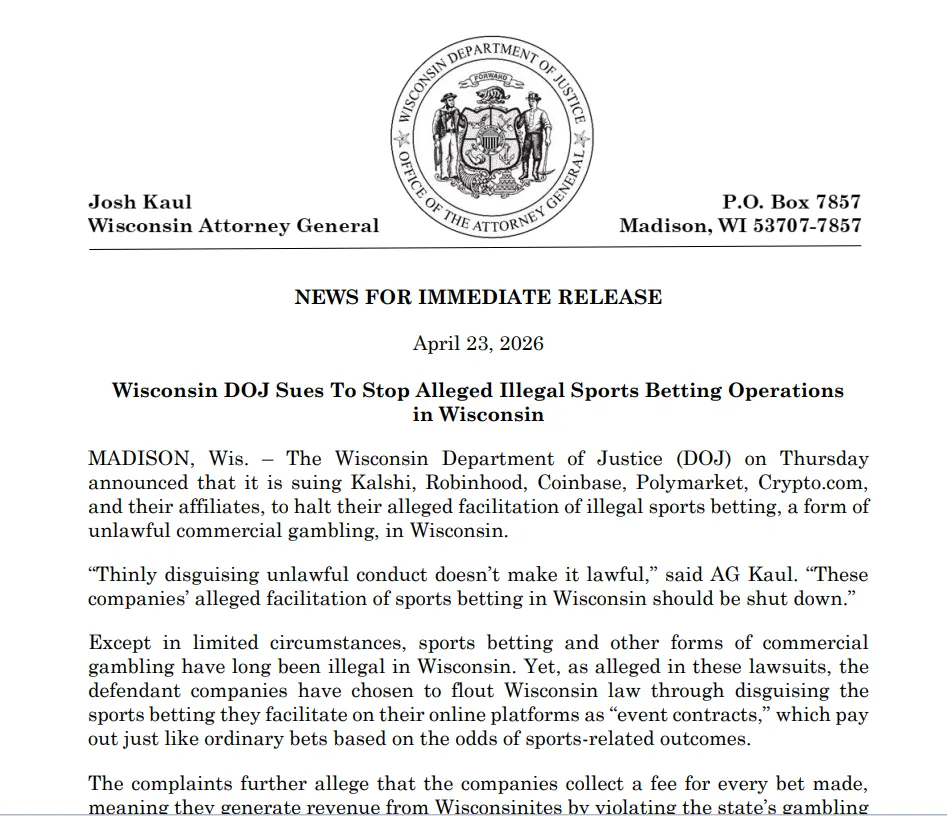
Attorney General Josh Kaul stated:
“Thinly disguising unlawful conduct doesn’t make it lawful. These companies’ alleged facilitation of sports betting in Wisconsin should be shut down.”
Contents
What Claims Wisconsin Has Made Against the Platforms
According to the complaints, companies offer contracts on sports event outcomes—from NCAA tournaments to totals and spreads. Users pay money, take a position, and receive a fixed payout if their prediction is correct. Platforms charge a fee for each transaction.
The attorney general’s office cites Kalshi’s Instagram ad:
“The first nationwide legal platform for sports betting.”
It also cites Polymarket’s description of itself as “a platform where people can bet on the outcome of future events.“
According to state estimates, sports contracts generate approximately 90% of Kalshi’s annual revenue—over $1B.
Read also: US Soldier Charged Over $400K Bet on Polymarket in Maduro Capture
All three lawsuits seek the same relief: a declaratory judgment that the contracts violate state law, along with preliminary and permanent injunctions barring future offerings to Wisconsin customers. The state is not seeking to void existing contracts—only to prohibit future ones.
Federal vs. State: Who Will Win?
Wisconsin joins a growing list of states attacking prediction markets. On Tuesday, New York filed lawsuits against Coinbase and Gemini, seeking at least $2.2B and $1.2B, respectively. Nevada, Tennessee, Arizona, Connecticut, and Illinois have also taken similar actions.
At the federal level, the position is opposite. On April 3, the CFTC filed lawsuits against Arizona, Connecticut, and Illinois, challenging their attempts to regulate prediction market operators.
CFTC Chairman Michael Selig stated the commission “will protect its exclusive jurisdiction” and that Congress “rejected a fragmented patchwork of state-level regulation.”
Read also: “I Wanted to Get Caught”—Kalshi Fines Three Politicians for Betting on Themselves
The Battle Will Reach the Supreme Court
The question of whether event contracts are financial instruments under CFTC jurisdiction or bets under state jurisdiction will almost certainly reach the US Supreme Court. Until then, the industry will exist in a state of legal uncertainty. Some courts side with platforms, others with states.
For users, this means the risk of sudden service blocks. For companies, it means rising legal costs and potential multibillion-dollar fines.
Read also: Prediction Market Limitless Hits $1B Monthly Volume Record on Base