Well into 2026, Bitcoin’s course felt pressure from Federal Reserve policy. This shift emerged not from any dependence on centralized control, but from pricing links to worldwide investment flows. Those flows evolved under U.S. rate trends, Treasury yields, dollar strength, and market willingness to take risk.
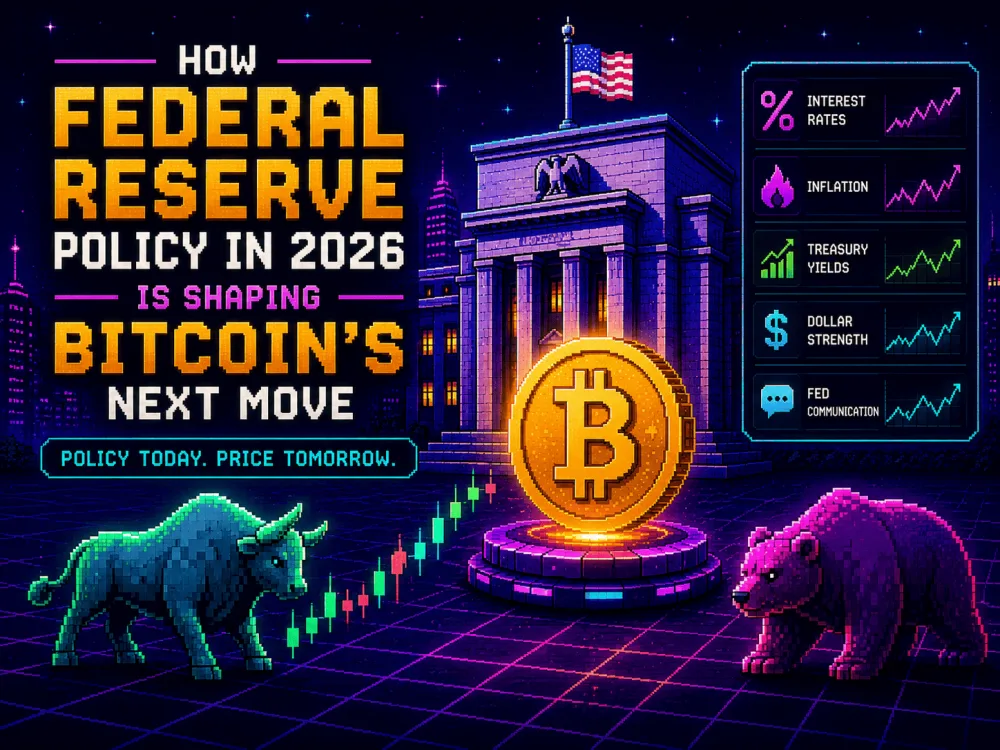
Despite appearances, movement in Bitcoin rarely ties only to the Fed. Forces such as ETF flows shape direction too. Regulatory changes do likewise. Mining expenses matter, as do decisions by large investors. Global tensions exert quiet pressure. So does liquidity across public ledgers. Yet pauses following rallies, or sharp turns after data releases, often trace back to one source: how central bank strategy evolves through 2026.
Well into spring 2026, the central bank held its benchmark interest rate steady at 3.50% to 3.75%, citing uneven economic signals and ongoing challenges in weighing price growth against employment trends. Such restraint weighed on Bitcoin. Forward-looking bets on looser policy contrasted sharply with skepticism over prolonged tight monetary settings. Despite appearances, neither scenario offered clear momentum.
Contents
- How Federal Reserve Policy Affects Bitcoin
- The 2026 Fed Plan: Rates Stay Higher Without a Full Hawkish Shift
- Federal Reserve Policy and Bitcoin Price Links
- Why Bitcoin Shifts Before Fed Meetings
- Inflation at Work
- The Balance Sheet Question
- What Bitcoin Advocates Want From the Federal Reserve Policy
- What Bitcoin Skeptics Want From the Fed
- Is Bitcoin Still a Hedge Today?
- Bitcoin Price Paths Ahead
- What Traders Should Watch Now
- The Fed Does Not Hold Bitcoin but Affects How It Operates
- FAQ
How Federal Reserve Policy Affects Bitcoin
Bitcoin’s value moves alongside wider financial trends, even when it seems apart from them. When money flows easily, speculative assets gain appeal. With tighter conditions, activity declines, shifting preference toward safer holdings or quicker payoffs.
Bitcoin links closely to monetary policy. When the Federal Reserve changes course, shifts in Bitcoin pricing tend to follow. Though built apart from traditional systems, its market behavior responds to broader economic environments. Movement in interest rates finds echoes in how Bitcoin trades across markets.
Related: Who Is Kevin Warsh? Trump’s New Pick Could Replace Jerome Powell As Fed Chair
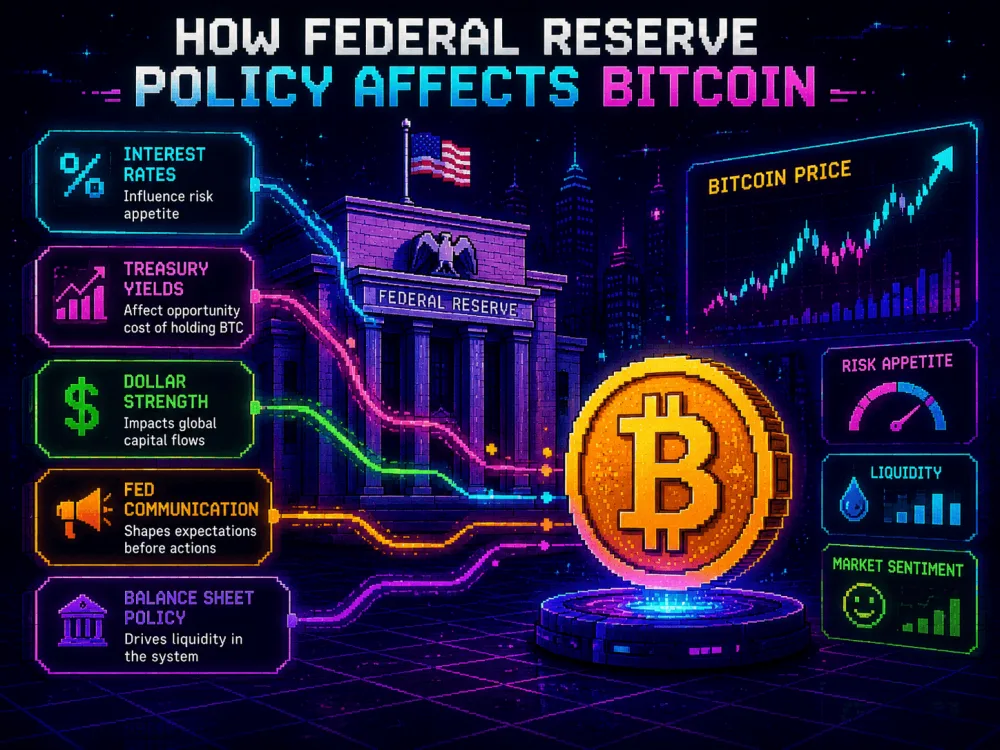
Federal Reserve policy in 2026 affects Bitcoin through several channels:
- Interest rates shift investor behavior toward either riskier assets or steadier returns.
- Treasury yields shape the appeal of non-income-generating assets like Bitcoin.
- Dollar strength affects global capital flows and digital asset demand.
- Fed communication changes trader expectations before official policy shifts.
- Balance sheet policy influences liquidity across financial markets.
Even if the Federal Reserve holds firm, gains in Bitcoin frequently stall. Still, expansion can happen without official endorsement.
The 2026 Fed Plan: Rates Stay Higher Without a Full Hawkish Shift
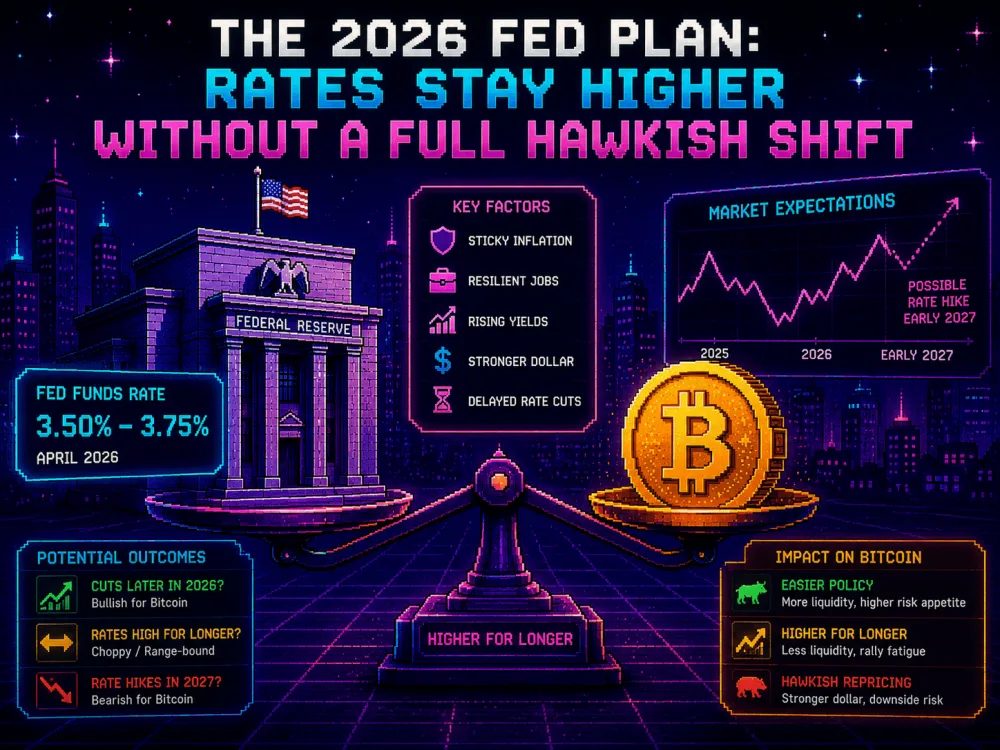
One way to view the Federal Reserve’s stance through 2026 is clear: rate reductions will not happen soon. Though sharp increases seem unlikely, loose financial settings still do not appear on the horizon for risk-prone markets like digital currency. Despite calm expectations, elevated policy tightness holds steady.
Where clarity fades in policy, doubt takes hold. Should rate reductions appear certain, liquidity outlooks generally rise, and Bitcoin might gain. Clear tightening phases typically steer investors into defensive positions, which tends to weigh on Bitcoin. At present, conditions lack clean edges: inflation stays resilient, holding back changes in direction, while softer economic cues keep the Fed from leaning too strongly on the brake.
Markets now show deeper splits. By May 2026, assumptions pointed to unchanged interest rates through December. Later views shifted as inflation pressures began building, hinting at higher rates near the start of 2027.
Should the Federal Reserve act, Bitcoin often responds. Yet anticipation of those steps matters just as much. Actual decisions shape its path, but forecasts held by traders play a strong role too. What people expect can move prices sharply even before any official change occurs.
Read more: Jerome Powell’s Most Controversial Statements as Ex-Fed Chair: How His Words Shaped Markets
Federal Reserve Policy and Bitcoin Price Links
What happens next with Bitcoin depends more on market anticipation than today’s Federal Reserve actions. Reactions form ahead of actual policy changes because forecasts shape behavior earlier.
When rate reductions appear in projections, focus often turns to Bitcoin. As returns from conventional assets are expected to drop, movement into supply-constrained options could follow. In cases where outlooks favor steady or higher rates, appetite for digital scarcity usually weakens.
| Fed Signal | Market Reaction | Likely Bitcoin Impact |
|---|---|---|
| Rate cuts become more likely | Liquidity expectations rise | Bullish for Bitcoin |
| Rates stay high | Investor caution spreads | Bearish or range-bound |
| Inflation rises again | Yields and dollar may climb | Negative for Bitcoin |
| Employment weakens sharply | Rate-cut hopes rise, but recession risk grows | Mixed |
| Balance sheet reduction continues | Available funds remain constrained | Negative for risk assets |
| Fed turns clearly dovish | Investor focus shifts toward risk assets | Positive for Bitcoin |
Not only poor economic figures support Bitcoin. That view lacks precision. When inflation softens enough, room opens for Federal Reserve support even as expansion continues without collapse. Such equilibrium quietly enables digital currency gains. Growth steadiness paired with policy flexibility becomes key under these conditions.
If inflation continues without retreat while economic activity holds firm, forecasts of lower interest rates tend to fade. When this balance persists, public securities retain favor because their yields stay predictable. In contrast, digital assets like Bitcoin face headwinds because traditional investments offer tangible earnings.
Why Bitcoin Shifts Before Fed Meetings
First come expectations. Only later do prices follow. Before any official word appears, trading has already begun.
Expectations move Bitcoin before interest rates change, driven by employment data, inflation reports, or slight shifts in how central banks speak. As sentiment changes, value begins shifting, first barely noticed, then obvious across markets. What is believed tomorrow shapes today’s price until it does not.
Well into 2026, trading shaped by expectation grew in importance, given rising ambiguity about the Federal Reserve’s direction. If forecasts of lower rates gain traction, Bitcoin could climb even without a shift in official stance. When belief in those cuts fades, however, gains might stall nearly at once.
Bitcoin lately hovered close to $78,000 as market sentiment adjusted alongside revised forecasts for interest rates. Shifts in perception about central bank paths contributed heavily, though not exclusively. Attention turns slowly toward potential endpoints of tighter policy instead. This realignment subtly influences how participants structure exposure within cryptocurrency markets.
Related: Best Crypto Exchange Platforms in the US 2026 — Picks for Fees, Liquidity, and App Access
Inflation at Work
With inflation shaping conditions, Bitcoin’s next phase takes form. Its direction follows larger financial currents instead of standing apart.
If inflation keeps moving closer to the Fed’s 2% goal, Bitcoin could benefit from how the central bank adjusts its approach by 2026. Because lower rates are expected, financial conditions may loosen while appetite for riskier investments grows. When these factors align, gains for Bitcoin become more likely, assuming demand through ETFs and ownership by large investors does not weaken.
Should inflation climb once more, challenges grow for Bitcoin. While elevated prices may feed ideas of limited supply, central banks commonly react by adjusting policy direction. With expenses increasing, tighter money conditions typically emerge. These changes tend to boost interest returns, strengthen the dollar, and leave speculative assets less appealing over time.
Now comes a hard test for those who back Bitcoin: inflation alone cannot secure higher Bitcoin value. If inflation leads the central bank to hold firm on tightening, downward forces could emerge in the near term.
The Balance Sheet Question
Even when attention focuses on interest rates, the scale of a central bank’s assets holds weight. As that balance sheet declines month by month, liquidity drains gradually from financial sectors. When lending expenses climb at the same time, risk-heavy assets often face strain. Speculative positions tend to weaken under such combined influence.
Should the central bank’s balance sheet shrink further? That question now draws attention to composition rather than size alone. With shifts in monetary understanding, focus turns toward arrangement and clarity of messaging. Past approaches are re-examined, revealing new emphasis on design instead of dimension. Structure gains weight when policy adapts across economic phases.
With less cash flowing through markets, Bitcoin often struggles. If the Fed keeps shrinking holdings, stress could spread to crypto. Yet signs of a slower pace might calm conditions. Much depends on how freely money moves across financial systems.
Higher prices for Bitcoin are not tied directly to central bank asset purchases. Still, Bitcoin often performs better when liquidity expands instead of contracts. Surprising insight: markets like money. Economists may need several expert gatherings before this revelation fully settles.
What Bitcoin Advocates Want From the Federal Reserve Policy
For Bitcoin supporters, conditions must remain carefully balanced. More important than upheaval is steadiness. When prices rise too fast, relief does not follow. If markets shrink rapidly, broad pullbacks can emerge instead.
They want:
- Inflation cooling convincingly.
- The Fed preparing rate cuts without panic.
- Treasury yields moving lower.
- The dollar weakening or stabilizing.
- Balance sheet policy becoming less restrictive.
- ETF inflows staying positive.
- Risk appetite improving across equities and crypto.
Because of this, decisions by the Federal Reserve in 2026 matter greatly. If prices stabilize without crisis, a gentler approach to rates becomes possible. This creates the best environment for Bitcoin. When relief follows turmoil, the entire basis shifts.
What Bitcoin Skeptics Want From the Fed
Opposite circumstances favor those doubtful of Bitcoin: persistent price increases, unchanged interest rates, growing bond returns, and strained monetary environments. Conditions like these create a backdrop where skepticism finds support through economic pressure.
A downward move takes shape like this:
- Inflation stays above the intended level.
- Consumer spending remains resilient.
- The labor market does not weaken enough to justify rate cuts.
- Treasury yields rise.
- The dollar strengthens.
- ETF interest slows or stalls.
- Bitcoin fails to reclaim key technical levels.
Still, a climb could happen if rare triggers appear. However, sustained growth stalls whenever larger financial pressures interfere.
Is Bitcoin Still a Hedge Today?
Depending on how far ahead one looks, the outcome may differ.
Over long stretches of time, Bitcoin tends to be viewed as a shield when currencies lose value due to excessive government spending or flawed financial decisions. That notion continues to hold ground. Concerns about rising debt, persistent price increases, and doubts about central banks keep it meaningful.
Occasionally, Bitcoin acts more like a gauge of market liquidity than a pure hedge. When that happens, value drops can appear even as trust in its limited supply remains firm, especially if borrowing costs climb at the same time.
This distinction holds weight. Should the Federal Reserve move one way in 2026, short-run headwinds might meet Bitcoin despite its growing appeal as a scarce asset outside government reach. Such paths can coexist. That is simply how markets behave: messy, yet consistent in their contradictions.
Related: Bitcoin Hashrate Hits All-Time Highs in 2026: Why Price Is Disconnecting From Fundamentals
Bitcoin Price Paths Ahead
Dovish Shift in Fed Stance
If inflation falls while the Fed hints at lower rates, a rise in Bitcoin could follow. As bonds yield less, alternative holdings gain subtle appeal. Rising liquidity sometimes brings renewed focus on ETFs, along with broader participation in digital currency markets.
This continues to present the clearest scenario supporting a rise. Yet direction depends on consistent signals aligning over time.
Interest Rates Stay Higher
If inflation continues, extended high interest rates might restrict how much Bitcoin can rise. Without strong ETF inflows, clearer regulations, or major purchases by large investors, gains could fade gradually. When broader market conditions offer little support, price shifts tend to flatten over time.
This route progresses irregularly along the middle.
Hawkish Repricing Scenario
If inflation reaches levels where rate hikes seem likely, Bitcoin could face increased selling. Rising real yields, combined with a stronger greenback, often weigh on crypto values, particularly when leverage is involved. A shift in monetary policy expectations might amplify declines across speculative holdings.
This route shows the most transparent downward direction.
What Traders Should Watch Now
Should Federal Reserve policy draw attention in 2026, hints regarding Bitcoin’s direction emerge at the intersection of economic shifts and investor behavior.
Watch these:
- Core PCE inflation
The indicator favored by policymakers shapes outlooks and guides decisions. - CPI and energy prices
A sudden shift in energy prices may rapidly alter inflation expectations. - Nonfarm payrolls and unemployment
A weaker pace in job growth could lead markets to anticipate lower interest rates. - Treasury yields
Rising yields usually create headwinds for Bitcoin. - Dollar index movement
Global liquidity may tighten when the dollar strengthens. - FOMC language
Small wording changes can shift market expectations. - ETF flows
If institutions show firm interest, some economic strain may soften. When ETFs lose appeal, underlying strength can fade. - Funding rates and leverage
Excess leverage can turn macro disappointments into fast liquidations.
Now and then, coordination among various metrics proves less crucial than believed. Yet when numerous signs adjust together, Bitcoin often moves accordingly.
The Fed Does Not Hold Bitcoin but Affects How It Operates
While the Federal Reserve’s position through 2026 affects economic settings, Bitcoin reacts to more than policy changes. Growing adoption patterns shape its course, alongside adjustments in oversight rules. Entry of funds via exchange-traded products matters, as does activity from large-scale investors. Pressure from mining output also plays a role.
Underlying all these elements is a monetary environment guided by officials in Washington. Liquidity becomes the stage on which every other influence unfolds.
If inflation declines, Bitcoin could rise under a gentler approach from the Fed. Yet when the central bank remains hesitant, gains in Bitcoin typically slow. Rate concerns reemerging may pull support from further advances. With policy direction unclear, price shifts grow wider across sessions. Every new economic report alters what traders anticipate next.
Most noticeable: Bitcoin’s path does not hinge on any one Fed choice. Shifting outlooks hold greater weight. Come 2026, focus moves past charts glowing on monitors. Instead, eyes turn toward how central banks act, along with movements in Treasury yields, consumer prices, dollar strength, and market liquidity.
Still designed to operate independently, Bitcoin finds its value swayed by shifts in global currencies. Though intended to differ, monetary trends quietly steer its course.
FAQ
How does Federal Reserve policy affect Bitcoin?
Federal Reserve policy affects Bitcoin through interest rates, Treasury yields, dollar strength, liquidity expectations, and investor sentiment. Easier policy often supports digital assets, while stricter conditions usually slow progress.
Are Fed rate cuts bullish for Bitcoin?
Most of the time, rate cuts support Bitcoin if they follow easing inflation and healthier financial trends. If cuts happen because the economy is breaking, the outcome may be mixed.
Why can Bitcoin fall when inflation rises?
When inflation rises too quickly, the central bank may hold rates high or tighten policy. Safer investments then offer stronger returns, pulling attention away from riskier assets like Bitcoin.
Which Fed signal matters most for Bitcoin in 2026?
The key signal is whether inflation eases enough for the Fed to move toward rate cuts. Treasury yields, dollar strength, FOMC wording, and balance sheet policy also matter.
Can Bitcoin rise under sustained Fed restriction?
Yes, but it becomes more difficult. Strong ETF inflows, regulatory progress, supply scarcity, or institutional buying may support Bitcoin despite tight monetary conditions. Broader economic pressure still matters.