StarkWare Chief Product Officer Avihu Levi presented a scheme called Quantum Safe Bitcoin (QSB).
The proposal makes Bitcoin (BTC) transactions resistant to quantum computer attacks without requiring a soft fork.
Related: Bitcoin Breaches $73,000 as US Inflation Data Misses Expectations
According to Levi, Bitcoin’s standard ECDSA signature is vulnerable to Shor’s algorithm. As an alternative, he proposed a mechanism called Binohash — a one-time signature fully embedded within Bitcoin’s existing Script language.
How QSB Works
The new scheme replaces elliptic curve cryptography with a hash-to-signature mechanism. The sender must solve a puzzle based solely on hashing (RIPEMD-160), not on the mathematical properties of elliptic curves.
According to Levi, even the most powerful quantum computer would be powerless against this approach.
Related: Bitcoin vs Gold—Which Is the Better Store of Value?
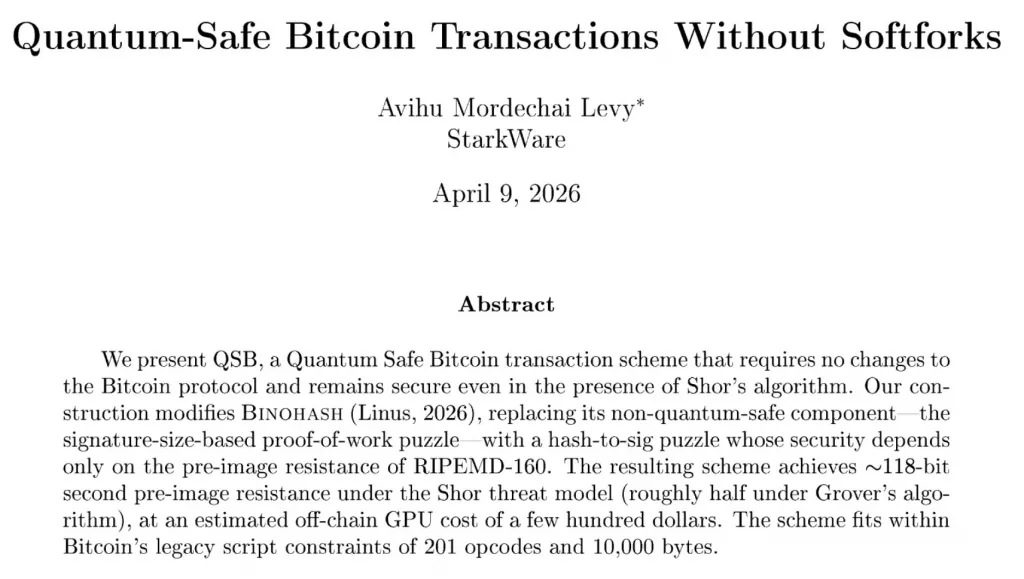
“Because this puzzle relies only on RIPEMD-160’s preimage resistance and not on any elliptic curve assumptions, it is fully shielded from Shor’s algorithm,” Levi explained.
Practical Applicability
Levi estimates that one such transaction would cost approximately $75 to $150 at current cloud computing prices. That is significantly higher than Bitcoin’s average fee of roughly $0.30. Due to the high cost and technical complexity, the author called QSB a “last resort measure.”
Key limitations include code and script size limits in Bitcoin, as well as incompatibility with some features like Lightning Network micropayments.
However, QSB is fully compatible with current network rules and requires no protocol changes, unlike proposals such as BIP-360.
Levi emphasized that in the event of a real quantum threat, the community would still need to find a long-term protocol-level solution. But QSB could serve as temporary protection for critical transactions.
Related: Bitcoin Mining Hashrate Falls 5.8% as Older Rigs Shut Down