The tech giant says the keys behind Bitcoin and Ethereum are closer to breakable than many thought.
Google says quantum computers are getting closer to breaking the core security used by the largest cryptocurrencies, adding that it plans to complete its own post-quantum migration by 2029, ahead of broader timelines such as the U.S. government’s 2035 target for full migration.
In a paper published Tuesday, March 31, Google’s research team said the job could be done with about 1,200 to 1,450 logical qubits, or around 20 times fewer than older estimates. It also said the attack could run “in minutes using fewer than half a million physical qubits.”
The paper reads:
“This rapidly closing window forces the Bitcoin community to face urgent and difficult decisions regarding legacy assets, such as the 1.7 million bitcoin locked in P2PK scripts and an even greater amount of assets vulnerable due to address reuse.”
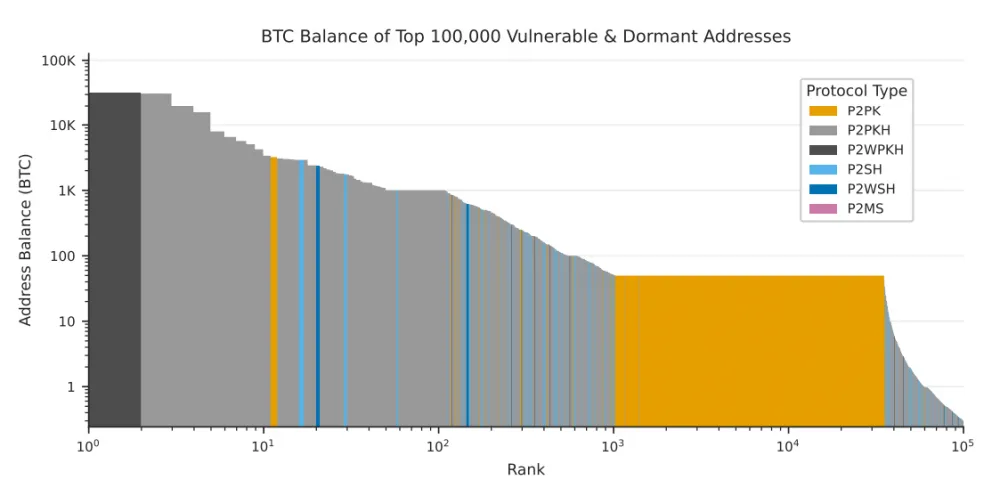
BTC▲$62,630.00 balance of the top 100,000 vulnerable and dormant addresses. Source: Google
At the center of this are secp256k1 ECDSA signatures, which prove that a wallet owner has authorized a transaction. These signatures convert a private key into a public proof, allowing the network to verify a transfer without exposing the secret key.
Google says a quantum method called Shor’s algorithm — which is designed to solve certain math tasks pretty fast — can break these signatures, implying it could reverse a public key back into a private key, which would let someone take control of a wallet.
Crypto Quantum Threat
The paper says there are two main types of quantum computers. Faster ones, like superconducting machines, could crack keys in minutes, while slower ones could take days. It also says attacks could happen even during live transactions, especially on networks like Bitcoin, where transactions sit in a public waiting area before being confirmed.
Ethereum, which was meant to handle the quantum threat better, appears more exposed in the study because it has smart contracts, stablecoins like Tether USDT▲$0.9991 and USDC▲$0.9999, and Layer-2 networks, all of which can widen the attack surface.
The study estimates that tens of millions of ETH▲$1,761.17 and about $200 billion in tokenized assets could be affected, while also warning that the “true value at risk very hard to calculate using standard asset-balance models.”
Solana, XRP Ledger Lead Quantum-Safe Push
Google claims the only solution so far is to move to post-quantum cryptography, which is designed to resist quantum attacks, pointing to early work on networks like Algorand, Solana and XRP▲$1.13 Ledger, though admitting that most of the industry still has a long way to go.
Justin Drake, a Bitcoin security researcher, wrote in an X post today that the findings mark “a monumentous day for quantum computing and cryptography.” He added, “The results are shocking. I expect a narrative shift and a further R&D boost toward post-quantum cryptography.”
Despite the news, Bitcoin and the broader crypto market appear largely unfazed, down about 0.6% over the past 24 hours, according to data from CoinGecko.