Many people enter crypto through the same door. They want one asset that holds value, or one network that does real work. Bitcoin and Ethereum answer different needs, even when their price charts move in the same week. In any bitcoin vs ethereum comparison, the first useful step is to stop treating them as twins. One was built to move and store scarce digital money. The other was built to run code, assets, and onchain services.
Disclaimer: This article is for educational purposes only. It does not provide investment, legal, tax, or accounting advice. Crypto assets are volatile, and any decision on Bitcoin or Ethereum should follow your own research, risk limits, and custody plan.

Contents
What Is Better in 2026 and for Which Goals
In 2026, the better choice still depends on the job. Bitcoin keeps its fixed supply path and slow governance style, while Ethereum keeps expanding its app layer and rollup path. For most readers, ethereum vs bitcoin becomes clearer after one question: do you want reserve-like exposure, or do you want exposure to a live software economy. That split matters more than short price noise.
Cathie Wood, Founder, CEO and CIO at ARK Invest, has long separated Bitcoin from smart-contract networks. Her framework treats Bitcoin as a monetary network, while Ethereum is better read as programmable infrastructure tied to software, tokenization, and onchain activity.

If You Need Digital Capital Defense – Bitcoin
Bitcoin fits people who want a simple monetary story. Its supply path is capped at 21 million, issuance falls over time, and the network has a long habit of resisting fast change. In that setting, ethereum vs bitcoin usually stops being a technology debate and becomes a policy debate. Bitcoin offers scarcity, rule stability, and a settlement model that many holders understand in one sitting.
Lyn Alden, Investment Strategist, often frames Bitcoin as a system that gives up speed and programmability to maximize security, decentralization, and auditability. That view helps readers see why Bitcoin can fit savings use, while Ethereum fits broader application use.
If You Need Web3 Infrastructure and Smart Contracts – Ethereum
Ethereum fits people who need a network that does more than move value. It runs smart contracts, tokens, stablecoins, lending tools, games, and rollups. A lesser-known point is that rollup data once drove over 90% of many rollup costs, which is why blob upgrades mattered so much. In practice, ethereum vs bitcoin here is a choice between a monetary network and a programmable settlement layer.
That role shows up in daily use:
- Apps can execute rules without a central operator
- Tokens can represent cash, debt, art, or game items
- Rollups can cut user costs far below mainnet fees
- ETH▲$1,761.17 can secure the base chain and pay for execution
If your goal is activity inside Web3, Ethereum gives you more surface area. That brings more opportunity, but also more moving parts, more dependencies, and more ways for user error to matter.
Vitalik Buterin, Ethereum inventor and co-founder, has argued that Ethereum’s base layer should stay robust and decentralized, while much of scaling moves to layer 2. That supports the idea of ETH as infrastructure for apps, not only as a speculative asset.
If You Do Not Want to Choose – A Basic BTC and ETH Split Logic
Some investors do not need a winner. They need a simple portfolio logic that maps to two different roles. Bitcoin can anchor the monetary side, while Ethereum can cover application and infrastructure risk. That is why many portfolios avoid a binary bet. They build exposure to two distinct crypto functions, then adjust size as conviction grows.
A basic split can start like this:
- 70/30 – for holders who care more about scarcity and policy
- 50/50 – for balanced exposure to money and onchain utility
- 30/70 – for users who believe app demand will compound faster
This is not a formula. It is a starting frame. Rebalancing matters more than finding a perfect first number, because both assets can move hard and then rewrite your original ratio.
Bitcoin: What It Is and Why It Matters
Bitcoin is a peer-to-peer monetary network with a public ledger, fixed issuance path, and proof-of-work security. Full nodes validate blocks and transactions, so miners do not set truth alone. That detail gets missed often, yet it matters whenever ethereum vs bitcoin is framed as miners versus validators. Bitcoin is money first, and most of its design choices still point back to that role.

Role: Money and Savings
Bitcoin works best when the goal is ownership of a scarce bearer asset. It can be used for payments, but its strongest story remains savings and settlement. Six confirmations are still a common high-value rule of thumb, which shows how the network treats finality with patience. That habit supports a reserve-like use case more than a high-speed app economy.
How It Works: Basic Network and Transaction Principles
Bitcoin records transactions in blocks that arrive about every ten minutes on average. Nodes verify signatures, script conditions, and spending history before they accept a block. One uncommon but useful fact is simple: an invalid block gets rejected even if a miner spent real energy making it. That rule keeps validation power broad, not just hash-based.
The basic flow looks like this:
- A wallet signs a transaction
- The transaction reaches nodes and mempools
- A miner includes it in a block
- Full nodes verify the block and relay it
- More blocks increase confidence against reversal
This design is slow by app standards, yet it is clear. When people hold Bitcoin for years, that clarity often matters more than speed in a single afternoon.
Ethereum: What It Is and Why It Matters
Ethereum is a blockchain for programmable state. It can transfer value, but it can also run contracts, issue tokens, and support whole application stacks. Since the 2022 Merge, the chain uses proof of stake, not mining. That shift changed security mechanics, issuance flow, and energy use, which is why ethereum vs bitcoin cannot be reduced to price alone in 2026.

Role: A Platform for Apps and Smart Contracts
Ethereum is closer to a settlement computer than a single-purpose coin. A smart contract is an account that runs code as written once called by a transaction. That lets teams build exchanges, lending markets, stablecoins, treasuries, and games without a central server deciding every rule. The result is a broader network economy, not just a payment rail.
ETH as Fuel and an Asset
ETH pays for computation on the network. It also secures the chain through staking and can be held as a liquid reserve inside crypto markets. Since EIP-1559, Ethereum burns the base fee, which means heavy network use can offset part of new issuance. That makes ETH a utility asset and a monetary asset at the same time.
That dual role shapes behavior:
- Users spend ETH for gas
- Validators stake ETH to help secure consensus
- Protocols use ETH as collateral
- Fees can be burned during demand spikes
This is one reason ETH is harder to classify in one sentence. It is not only a coin, and it is not only fuel, which can help or confuse investors.
Bitcoin vs Ethereum Differences
Both networks are public, open, and built around consensus. After that, they diverge fast. A clean bitcoin vs ethereum chart helps more than slogans, because the gap is structural, not cosmetic. Bitcoin targets scarce digital money with simple base-layer logic. Ethereum targets programmable coordination with a larger design surface, more dependencies, and a faster upgrade path.
| Parameter | Bitcoin | Ethereum |
|---|---|---|
| Launch year | 2009 | 2015 |
| Native asset | BTC▲$62,630.00 | ETH |
| Main role | Money and settlement | Apps and smart contracts |
| Consensus | PoW | PoS |
| Block or slot tempo | ~10 min | 12 sec |
| Common settlement rule | 6 confs, about 60 min | 2 epochs, about 12.8 min |
| Supply cap | 21,000,000 BTC | No hard cap |
| Solo security entry | Mining hardware | 32 ETH validator deposit |
These figures describe protocol design, not expected returns. They explain why the two chains attract different users, developers, and risk models.

Purpose: Money vs Platform
Bitcoin keeps its promise narrow on purpose. It aims to preserve and transfer value under stable rules. Ethereum aims wider, so its base asset also supports apps, contracts, and tokenized systems. That wider role creates more demand vectors, but it also creates more failure paths when one application layer breaks.
A simple way to frame the split is this:
- Bitcoin centers on scarcity and settlement
- Ethereum centers on execution and coordination
- Bitcoin limits base-layer complexity
- Ethereum accepts more complexity to unlock more use cases
This is why beginners often feel calm with Bitcoin first. The story is shorter, while Ethereum usually rewards readers who are willing to learn one layer deeper.
Consensus: PoW vs PoS
Bitcoin uses proof of work, where miners spend energy and hardware effort to produce blocks. Ethereum uses proof of stake, where validators lock ETH and follow slot and epoch rules. In security terms, ethereum vs bitcoin here is not old versus new. It is external cost through electricity and ASICs versus internal cost through staked capital and slashing risk.
Issuance and Supply: Cap vs Policy
Bitcoin has the cleaner issuance story. New supply falls on a preset schedule until the network reaches 21 million coins. Ethereum has no hard cap, and its net supply depends on issuance, staking, and fee burning. In a practical view, bitcoin vs ethereum differences on supply are about hard scarcity versus flexible monetary policy shaped by network activity.
Fees and Speed: Blocks, Finality, Load
Bitcoin blocks come about every ten minutes, so base-layer throughput is limited by design. Ethereum produces slots every twelve seconds, but gas prices can rise fast when onchain demand surges. For everyday users, ethereum vs bitcoin often feels like a trade-off between slower base settlement and faster execution with more variable fees. Neither chain is cheap under all conditions at layer one.
Programmability: BTC Limits vs EVM Smart Contracts
Bitcoin supports contracts, but they are narrow and finance-oriented. Ethereum supports general smart contracts through the EVM, which is why developers can build reusable application logic onchain. When teams discuss app design, ethereum vs bitcoin differences become sharp very fast. Bitcoin can express useful constraints, while Ethereum can host whole systems with state, permissions, and composable functions.
Technical Comparison by Key Parameters
A protocol-level view strips out emotion. It also stops the habit of treating both assets as one trade with two tickers. In any bitcoin vs ethereum comparison, the technical layer explains more than social media does. Security, finality, upgrade speed, and scaling choices decide what each chain can do well, and what each chain should avoid.

Security and Network Resilience
Bitcoin security comes from global proof of work and strict node validation. Ethereum security comes from validators, attestations, checkpoints, and slashable stake. A hidden point is that both systems use social coordination during rare edge cases, but the mechanics differ. In the core security debate, ethereum vs bitcoin is about which cost model you trust to resist attack and recover cleanly.
| Security Point | Bitcoin | Ethereum |
|---|---|---|
| Block or slot interval | ~10 min | 12 sec |
| Common high-value settlement | 6 blocks | 2 epochs |
| High-value wait time | ~60 min | ~12.8 min |
| Solo participation threshold | Full node, no minimum BTC | 32 ETH to validate |
| Fault response cost | Energy and hardware spend | Stake penalties and slashing |
| Finality threshold | Probabilistic | Supermajority checkpoint logic |
No table can settle the debate on its own. It does show that each chain buys safety with a different mix of time, cost, and operator behavior.
Decentralization: Nodes, Validators, Miners, Concentration
Decentralization is harder to score than people think. Bitcoin spreads validation through full nodes and block production through miners. Ethereum splits roles across validators and two client layers after the Merge. When people compare home operation, client diversity, and stake concentration, ethereum vs bitcoin differences often matter more than headline node counts, because the architecture is not the same.
Scaling: L1 and L2 for Ethereum
Bitcoin scaling often moves toward payment channels and side systems. Ethereum scaling now leans hard on rollups, which batch activity and post results to mainnet. Ethereum.org notes that rollups can already be several times cheaper than mainnet, and future changes target much larger gains. This is one reason Ethereum feels layered in daily use, while Bitcoin feels more base-layer centered.
Energy Use and Environmental Trade-Offs
Bitcoin still relies on ongoing electricity use, and Cambridge models that consumption with a best-guess range because the real value cannot be observed directly. Ethereum cut its energy use by about 99.95% after the Merge. That does not end the debate, but it changes it. Today the environmental discussion is less about whether the systems differ, and more about whether Bitcoin’s trade-off is worth it.
The trade-off can be read in simple terms:
- Bitcoin pays security costs through energy and hardware
- Ethereum pays more through locked capital and validator rules
- Bitcoin energy estimates are modeled, not directly measured
- Ethereum changed the debate after moving away from mining
That is why energy arguments now miss the mark if they treat both chains as if nothing changed after 2022. The design split is real, and it shows up in policy discussions.
Protocol Upgrades and Development Speed
Bitcoin changes slowly and tends to preserve a narrow base role. Ethereum changes faster and publishes a visible roadmap tied to scaling and rollup support. Recent roadmap items include Fusaka, PeerDAS, and flexible blob changes after Dencun. That pace can unlock utility faster, but it also means users must track more moving parts and upgrade narratives.
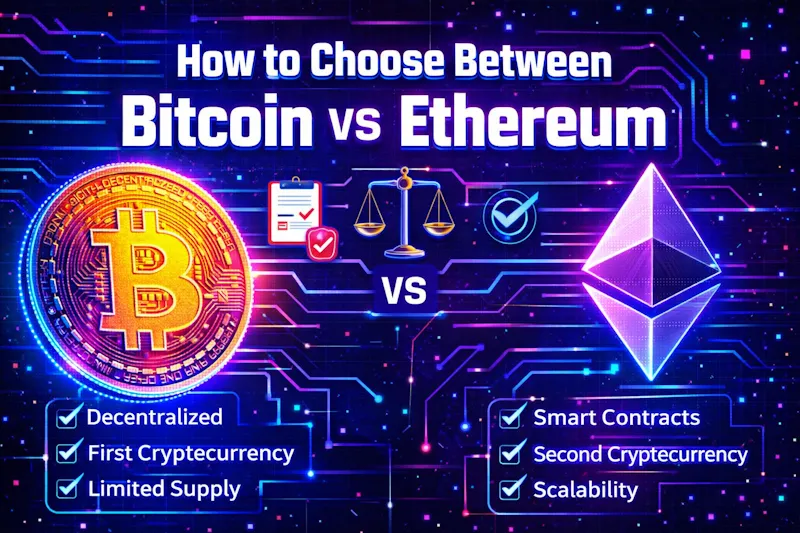
How to Choose Between Bitcoin vs Ethereum
A useful choice framework is boring on purpose. It starts with time horizon, goal, and risk tolerance before it touches narrative. In a clean bitcoin vs ethereum comparison, the best pick is usually the one whose failure mode you understand. If you cannot explain why you own an asset during a 40% drop, the allocation is probably too large.
| Investor Need | Bitcoin Lean | Ethereum Lean | Sample Split |
|---|---|---|---|
| Capital defense first | High | Low | 70/30 |
| Balanced crypto exposure | Medium | Medium | 50/50 |
| App and token economy exposure | Low | High | 30/70 |
| Low monitoring time | High | Low | 80/20 |
| High Web3 usage | Low | High | 25/75 |
This table is an illustrative framework, not a forecast. It works best when paired with a clear rule for rebalancing and custody.
Time Horizon: 1-3 Years vs 5+ Years
A shorter horizon usually increases the importance of liquidity, narrative, and entry price. A longer horizon gives more room for protocol design to matter. Bitcoin often suits investors who want a longer savings frame. Ethereum can suit investors who expect application demand, rollup growth, and fee activity to matter more over time.
A simple reading can help:
- 1-3 years – focus on drawdown tolerance and entry discipline
- 5+ years – focus on policy, utility, and adoption path
- Short horizons magnify noise
- Long horizons magnify design choices
Time horizon does not remove risk. It only changes which risks dominate your decision and which temporary moves you can ignore without stress.
Goal: Preservation vs Growth and Technology Exposure
If preservation is the main goal, Bitcoin often fits more cleanly. If growth linked to blockchain usage is the main goal, Ethereum can fit better. For many investors, ethereum vs bitcoin comes down to whether they want a monetary thesis or a technology thesis. The first is easier to hold through silence. The second may pay more attention to builders, rollups, and app demand.
Risk Tolerance
Ethereum usually brings more surface risk because contracts, bridges, rollups, and token layers can fail in different ways. Bitcoin risk is not low, but it is concentrated in price, custody, and market structure more than app logic. If complexity makes you uneasy, a higher Bitcoin weight may fit better. If you can monitor systems and accept more variables, Ethereum may be easier to justify.
Do You Need Diversification with BTC and ETH
Holding both can make sense because the two assets respond to different drivers. Bitcoin leans toward scarcity, reserve demand, and macro narratives. Ethereum leans toward usage, fees, staking, and app growth. The mix will not protect you from every crypto drawdown, but it can reduce single-thesis risk inside the asset class.
Robert Mitchnick, Head of Digital Assets at BlackRock, argues that Bitcoin does not fit standard risk-on or risk-off buckets. For allocation logic, that supports using BTC for distinct portfolio exposure, while Ethereum can serve a different technology and usage thesis.
Risks You Should Not Ignore
Every crypto thesis looks neat until execution begins. Custody can fail. Leverage can erase patience. Bridges can break at the exact moment users need them. That is where ethereum vs bitcoin stops being a clean content topic and becomes a discipline topic. The winner in a cycle often matters less than whether your setup survives a bad month without forced selling.
Disclaimer: Markets can move against both assets fast, and losses may come from leverage, custody errors, smart-contract failures, bridge exploits, or policy changes. Never rely on one scenario, and never invest funds you may need in the near term.

Market Drawdowns and Liquidations
Both assets can fall hard in short periods. If leverage is involved, a normal correction can trigger forced selling long before your thesis plays out. Liquidation risk is not a protocol feature. It is a position management problem. Many losses blamed on the asset are really caused by borrowed exposure, bad collateral choices, or no exit plan.
Technical Risks: Bugs, Smart Contracts, Bridges
Bitcoin has technical risk too, but its base-layer use is narrower. Ethereum users often interact with contracts, bridges, rollups, and token standards, so dependency risk grows with each extra step. A small bitcoin vs ethereum chart of practical hazards makes this clear faster than long debate. The question is not whether code fails. The question is how many layers you touch before settlement is final.
| Risk Source | Bitcoin Exposure | Ethereum Exposure | Practical Score 1-5 |
|---|---|---|---|
| Wallet mistake | Yes | Yes | 5 |
| Smart-contract bug | Low | High | 5 |
| Bridge failure | Low | High | 4 |
| Rollup dependency | Low | Medium to high | 3 |
| Miner or validator outage | Medium | Medium | 2 |
The score is illustrative. It reflects user-facing complexity, not a formal probability model. Keeping funds on simpler paths often removes more risk than chasing one more feature.
Regulatory and Operational Risks
Rules can change at the exchange, tax, custody, or token level. Access risk also matters. A frozen account, lost seed phrase, or fake wallet app can hurt more than market volatility. In plain terms, bitcoin vs ethereum differences do not remove the shared operational rule: self-custody, backups, and slow verification still matter more than hot takes.
Final Take
Bitcoin and Ethereum are not rivals in every sense. They are different answers to different digital problems. One answer centers on scarcity and settlement. The other centers on execution and network utility. That is why choosing well often means defining your job first, then choosing the asset.
- BTC fits people who want a clean monetary thesis and less protocol sprawl
- ETH fits people who want exposure to apps, smart contracts, and onchain services
- Both fit when you want scarcity on one side and utility on the other
- BTC often suits lower monitoring needs inside crypto
- ETH often suits higher conviction in Web3 infrastructure
The practical ending is simple. Choose Bitcoin for reserve logic, choose Ethereum for network usage, and choose both when you want crypto exposure that is not trapped in one story.
FAQ
Can Ethereum replace Bitcoin over the next full market cycle?
Probably not in the clean sense people mean. Bitcoin and Ethereum solve different problems. Bitcoin is still centered on scarce digital money, while Ethereum is centered on programmable execution. One can outperform in price or utility without making the other obsolete.
What makes Ethereum cheaper or faster to use for many users?
It is usually the execution model and the rollup layer. Ethereum slots arrive every 12 seconds, and rollups batch activity offchain before settling back to mainnet. That can cut user costs a lot, though fees still rise when demand spikes or bridge paths add friction.
Which network is safer, and what really drives that answer?
Safety depends on what you are defending against. Bitcoin has a narrow base layer and deep node validation. Ethereum has stake-based security, checkpoint finality, and more application risk above the base chain. The safer choice is often the one with fewer layers in your actual workflow.
Does it make sense to hold both BTC and ETH at the same time?
Yes, if you want two different crypto roles. BTC can cover scarcity and reserve logic. ETH can cover usage, staking, and app-layer growth. The pair will still be volatile together, but it can reduce the risk of betting your whole thesis on one network function.
Do the main Ethereum vs Bitcoin differences shrink over time?
Some edges narrow, but the core split stays. Bitcoin still prioritizes money and settlement. Ethereum still prioritizes programmable coordination. Even if both improve speed, custody, and tooling, their design goals keep pulling them in different directions.
How should a Bitcoin vs Ethereum chart be read over one week?
Use it only for market mood, not for deep judgment. A one-week chart shows flows and noise faster than fundamentals. For real decisions, pair price with supply rules, finality, fee behavior, upgrade path, and your own use case. Otherwise the picture is too thin to guide size.