AI tokens led the altcoin cycle, but crypto narratives have long histories of fading out. With values rising, investors are now chasing the next big thing in crypto with more practical usage, clearer revenue channels, and fresh catalysts for price increases.
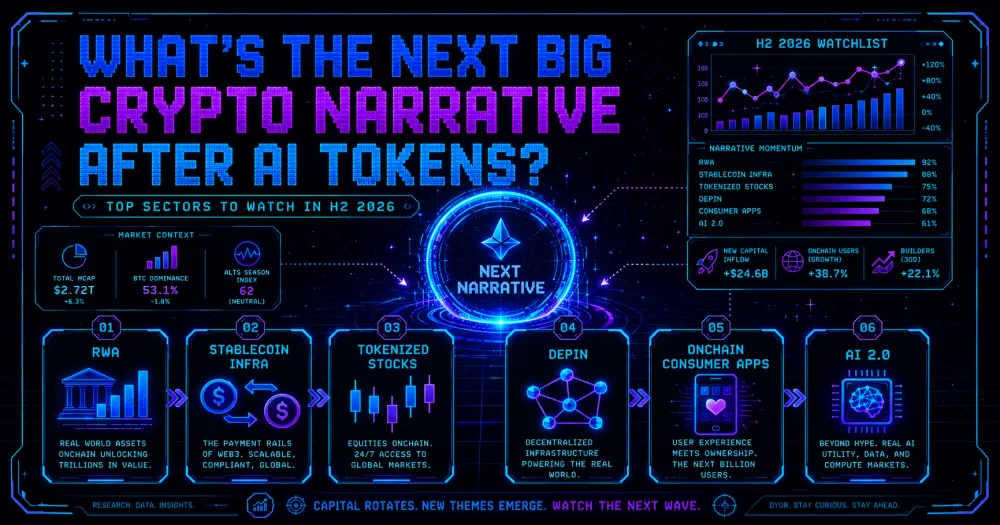
In H2 2026, the spotlight is on real-world assets, stablecoin infrastructure, tokenized stocks, prediction markets, DePIN, consumer apps, and the Robinhood Chain ecosystem. All these crypto trends intersect with adopting blockchain technologies outside of speculative trading. The most successful one will be able to combine a deep storyline, audience adoption, ongoing revenues, ease of usage for average users, and reliable liquidity.
Contents
- Why AI Tokens Became the Dominant Crypto Narrative
- What Makes a Crypto Narrative Take Off?
- Top Crypto Sectors to Watch in H2 2026
- Which Crypto Narratives Could Deliver the Highest Returns?
- Tokens That Could Benefit From These Emerging Narratives
- Risks That Could Prevent a New Crypto Narrative From Taking Off
- How to Identify the Next Crypto Narrative Before the Crowd
- FAQ
Why AI Tokens Became the Dominant Crypto Narrative
What Drove the AI Token Boom?
The confluence of enthusiasm around AI investment and demand for crypto-native computing, data, and autonomous agents drove the bull run. Tokens represented exposure to GPU-pooling, machine learning marketplaces, and coordination layers.
Protocols that distributed rewards to data producers, GPUs or nodes, models, and agents dominated the narrative.
Which AI Tokens Outperformed the Market?
Bittensor, Render, NEAR▲$2.04 Protocol, and the Artificial Superintelligence Alliance were the top performers at different stages. Render Network’s rise was driven by demand for distributed GPUs, while Bittensor had a strong reputation in the space for its work in incentivizing machine intelligence.
The crowdedness of the category also made it challenging to differentiate between narratives.
Related: AI Trading Firm Drops Deal for Trump-Linked Crypto Business
Why the AI Narrative May Be Losing Momentum
AI is far from disappearing, but investors were quick to realize that many tokens simply lacked the unit economics to justify lofty valuations. The dominance of AI in the market meant that any project without critical on-chain activity or an obvious revenue stream faced liquidation pressures.
The next big thing will see the separation of quality networks and hype-driven assets.
What Makes a Crypto Narrative Take Off?
Capital Rotation and Market Cycles
A rising narrative typically occurs when capital ditches a mature market for an emerging one. It often follows the rotation from spot trading to leveraged products or DeFi. Bitcoin typically benefits first, followed by large-cap altcoins and then the smaller ones.
The next phase will also depend critically on favorable macro conditions for crypto and the availability of stablecoins and liquidity.
Retail vs Institutional Demand
Retail traders are typically more interested in something that has a story, community, and tradability, whereas institutional investors think of custody, regulation, market structure, and cash flow.
The best narratives of 2026 will be those that manage to deliver on both fronts. Stablecoins and tokenized assets have institutional appeal, while prediction markets and consumer apps can offer retail volume.
Key Indicators That Signal a New Narrative
Active addresses, fees, inflows, stablecoin balances, developer activity, and user engagement are all leading indicators. A rising number of projects within a particular category typically signals strength, rather than one dominating the market. Similarly, growth in value from reduced user acquisition costs and revenues from network fees is more important than transaction volume driven by discounts.
Top Crypto Sectors to Watch in H2 2026
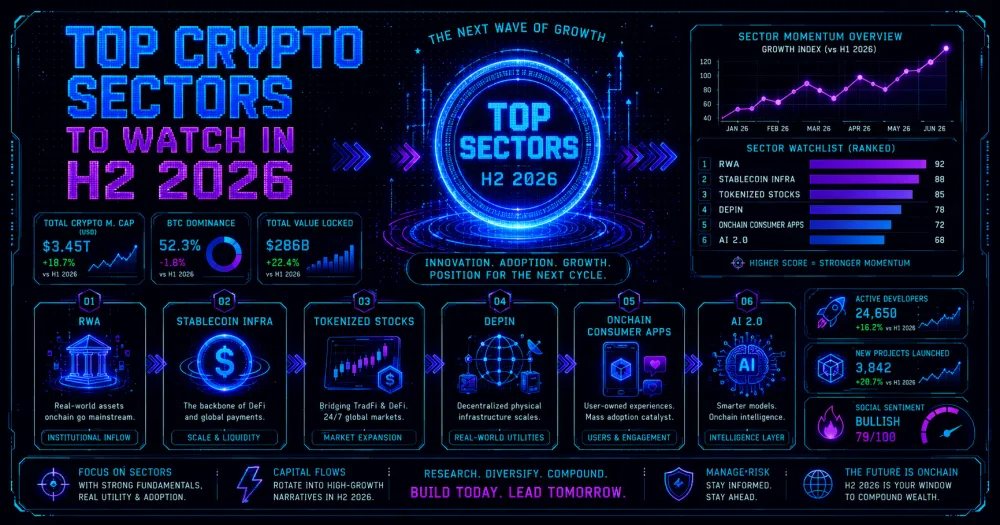
Real-World Assets (RWA)
RWA crypto is a catch-all phrase for on-chain issuance of Treasuries, private credit, commodities, and fund assets. Settlement, collateralization, and distribution can be automated via smart contracts, whereas the yields or shares can be apportioned to asset owners, oracles, compliance companies, and lenders.
Custody, liquidation risks, and legal protection of issued assets are important considerations.
Read more: Robinhood Chain Memecoin Season: Top 10 Coins to Watch in Summer 2026
Stablecoin Infrastructure
Stablecoin infrastructure is set to benefit from the shift from settlement vehicles to payment instruments. In April 2026, Visa announced that its stablecoin settlement pilot was processing $7 billion in annualized payments already.
Wallets, processors, point-of-sale spigots, and cross-border remittance tools can all capitalize on the stablecoin boom. The narrative has the potential to dominate 2026 due to the need for faster payments rails and real-time settlement.
Tokenized Stocks and On-chain Equities
Tokenized stocks crypto products enable equity ownership via blockchain platforms. RWA.xyz listed over $1 billion in tokenized public equities and ETFs on its platform in July 2026.
Trading venues benefit from extended hours, 24/7 accessibility, and DeFi composability, while investors gain from programmable markets. Different trust assumptions should be made for direct token ownership versus receipts, custodied assets, and synthetic alternatives.
Robinhood Chain Ecosystem
Robinhood launched its Layer-2 mainnet in July 2026 and announced multiple ecosystem initiatives designed to let users interact with both traditional finance and DeFi. The Robinhood Chain narrative has the potential to dominate 2026 if apps continue to be built on top of the L2 blockchain. Developers, launchpad platforms, exchanges, and lending protocols can benefit from the infrastructure layer, while consumer apps will drive broader adoption. The user base of Robinhood itself will be critical to the growth of the chain, but it will need independent developers and transaction volume.
Prediction Markets
Prediction markets crypto platforms facilitate speculation on macro, political, sporting, and financial events, as well as news and social sentiment. Prediction markets have seen a rise in regulatory scrutiny in 2026, with Reuters reporting in June that several protocols were under investigation for facilitating suspicious trades. Meanwhile, regulators are debating whether prediction markets are inherently gambling instruments.
This narrative will be defined by surveillance and the response from the community.
DePIN and AI Infrastructure
DePIN crypto platforms have been utilizing token incentives to secure coverage, storage, mapping, sensing, and computing. DePIN intersects with the AI infrastructure narrative, as decentralized GPU-pooling and data networks can provide an alternative to centralized counterparts.
The key differentiating factor will be the presence of paying users. Revenue, utilization rates, and service quality will be more important than network effects.
Consumer Crypto and Social Apps
Consumer crypto has an incredibly large potential market but has proven exceptionally challenging to date. Passkeys, embedded wallets, and account abstraction are set to reduce the barriers posed by seed phrases and gas fees.
Social apps, games, and creator platforms that utilize blockchain for ownership, monetization, and rewards can capitalize on the rise of consumer-friendly crypto.
| Crypto Sector | Main Growth Driver | Potential Beneficiaries | Risk Level | Key Risk |
|---|---|---|---|---|
| Real-World Assets | Tokenization of funds, credit, bonds and commodities | Ethereum, Chainlink, Ondo, Aave | Medium | Custody, redemption and regulatory uncertainty |
| Stablecoin Infrastructure | Cross-border payments, settlement and merchant adoption | Ethereum, Solana, payment protocols and wallet providers | Medium | Regulation and limited token value capture |
| Tokenized Stocks | Onchain access to equities and exchange-traded funds | Robinhood Chain projects, Ethereum and oracle networks | Medium–High | Unclear ownership rights and securities rules |
| Robinhood Chain Ecosystem | New DeFi apps, launchpads and tokenized financial products | Early Robinhood Chain applications and infrastructure providers | High | Low liquidity and limited early-stage adoption |
| Prediction Markets | Demand for tradable event probabilities | Market platforms, oracle providers and liquidity protocols | High | Regulatory pressure and market manipulation |
| DePIN and AI Infrastructure | Demand for distributed compute, storage, wireless networks and data | Render, Akash, Helium and Bittensor | High | Weak commercial demand and excessive token emissions |
| Consumer Crypto and Social Apps | Embedded wallets, simple onboarding and blockchain-based ownership | Solana, Ethereum Layer 2 networks and early consumer apps | High | Poor user retention and difficulty achieving mass adoption |
Which Crypto Narratives Could Deliver the Highest Returns?
High-Risk, High-Reward Sectors
The earliest projects in emerging fields, as well as niche long-tail protocols, have the potential to see incredible gains due to their low starting valuations. At the same time, smaller offerings typically possess fewer safeguards and can see precipitous losses due to inadequate liquidity, auditing, unlocks, and retention.
Reward potential must be measured against risk, while the degree of hype should be tempered with an evaluation of the underlying technology.
Related: Best Robinhood Chain Launchpads in 2026: Top Platforms to Launch Your Token Before Everyone Else
Narratives With Strong Institutional Support
RWA, tokenized asset platforms, and stablecoin infrastructure will benefit significantly from institutional involvement. Clear custody and settlement advantages will accrue to banks, asset managers, and payment processors that utilize the on-chain protocols.
Institutional adoption does not always result in higher token prices, as value can be transferred to traditional finance counterparts. The actual impact depends on the degree to which token economics drives demand.
Sectors With the Largest Developer Growth
Developers and ecosystem infrastructure are paramount to emerging Layer-2 blockchains, DePIN, and consumer applications. Multiple teams building on a particular blockchain or utilizing a shared set of decentralized infrastructure components typically indicate adoption and potential scalability. Commit numbers and deployment progress are important, but production-ready code, audits, active contributions, and repeated engagement are stronger indicators of momentum.
Tokens That Could Benefit From These Emerging Narratives
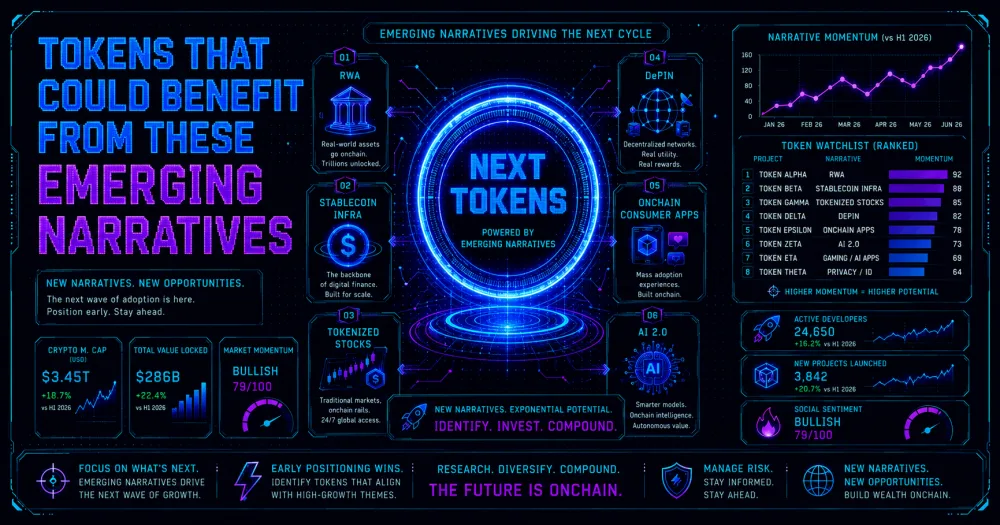
Large-Cap Leaders
Ethereum can benefit profoundly from the rise of stablecoins, RWAs, and tokenized asset markets, as much of institutional infrastructure is built on the Ethereum Virtual Machine. Solana has critical payment and consumer applications use-cases, while Chainlink has extensive oracle infrastructure and tokenized asset data partnerships.
Large-cap tokens typically possess deep liquidity and diverse utility, but their performance will be lower than more speculative alternatives.
Mid-Cap Projects With Growth Potential
Ondo Finance is a prime example of a mid-cap company that will benefit from the rise of tokenized finance. Aave and other lending platforms can see increased adoption if stablecoins dominate the market. Render, Akash, and Helium Networks offer exposure to the broader decentralized infrastructure space. Bittensor, on the other hand, could see a value discovery if the hype around AI dissipates.
Early-Stage Opportunities to Watch
Smaller capitalized tokens and emerging protocols have the potential to produce spectacular returns if the right conditions align. Robinhood Chain applications, stablecoin payment processors, prediction markets infrastructure, and embedded wallet offerings have incredible opportunity if their respective narratives develop as expected. However, many of these early projects will fail to gain traction, and some of the successful ones will not require a native token.
Risks That Could Prevent a New Crypto Narrative From Taking Off
Regulatory Pressure
Tokenized assets, stablecoins, and prediction markets are often viewed as financial instruments by regulators. Clear legislative frameworks can promote innovation by enabling banking partnerships, but prohibitions and licensing requirements can be detrimental to adoption. Particularly for prediction markets, where regulators disagree on whether the technology constitutes gambling, there may be unexpected complications.
Tokenized stocks and bonds require disclosure and liquidity, rather than familiar brand names or tickers.
Liquidity Rotation Back to Bitcoin
The rise of any altcoin narrative typically involves rotation from Bitcoin into the new space. However, during times of stress, the opposite can occur, with capital flowing from altcoins back into BTC▲$62,630.00, stablecoins, or even cash. The development of a particular market is important, but it should be measured against the overall dominance of Bitcoin, stablecoin supply, and altcoin volumes.
Related: Borrow Against Your Altcoins: Top 3 Crypto Loan Platforms in the US
Overvaluation and Hype Cycles
Valuations of assets in a particular market can often be inflated, particularly following a bullish run. Additionally, the rise of speculative projects can make it challenging to separate hype from substantive offerings. Strong fundamentals are crucial, but one must also consider the token economics, supply, demand, and realistic growth trajectories of a particular token.
How to Identify the Next Crypto Narrative Before the Crowd
On-chain Metrics to Monitor
User accounts, fees, inflows, stablecoin balances, volume, and protocol revenue are essential metrics for any narrative. For traditional finance assets, issuance and redemption data matter most, whereas for decentralized networks, utilization data is more important than raw node counts or miner revenue. Multiple years of consecutive growth is a stronger indicator than a sudden surge in active addresses following a large publicity push or supply dump.
Venture Capital and Ecosystem Funding
Venture funding and ecosystem grants can highlight potential areas of emphasis for serious developers and indicate the likelihood of competition. Similarly, such financing can give early projects breathing room before they achieve product-market fit or significant revenues. Large-volume funding can lead to increased valuations and dumping later, so one should pay attention to the token distribution and treasury management practices of any given protocol.
Developer Activity and User Adoption
The best metric for any developing protocol is the creation of products in the space and adoption by ordinary users. Code deployments, audits, and on-chain activity indicate development progress, while regular contributions and paid usage can suggest momentum.
The next big thing typically emerges when these forces intersect to create an inflection point.
FAQ
What’s Next for Crypto After AI?
The strongest candidates for the next major crypto theme are real-world assets, stablecoin infrastructure, tokenized stocks, prediction markets, DePIN, consumer apps, and Robinhood Chain.
Which Crypto Sector Has the Strongest Institutional Support?
Both real-world assets and stablecoin infrastructure have the potential to benefit critically from institutional involvement due to their applications in traditional finance.
Which Crypto Narratives Have the Highest Return Potential?
Niche markets, consumer applications, and smaller DePIN protocols have the potential to experience substantial increases in value. At the same time, they also possess significantly higher risks.
How Can One Identify a Proto-Narrative?
On-chain user accounts, fees, inflows, stablecoin balances, activity, and protocol revenues are essential indicators of potential demand. Issuance data is more important than mere token supply increases for traditional finance assets, while utilization data is more relevant than miner revenues for decentralized networks. Multiple years of consecutive growth is preferable to a sudden publicity-fueled bull run or supply dump.
Are AI Tokens a Viable Long-Term Investment?
AI tokens with substantial demand or revenues can be excellent long-term investments, while any project that only utilizes the buzz around the technology can fail to maintain value.