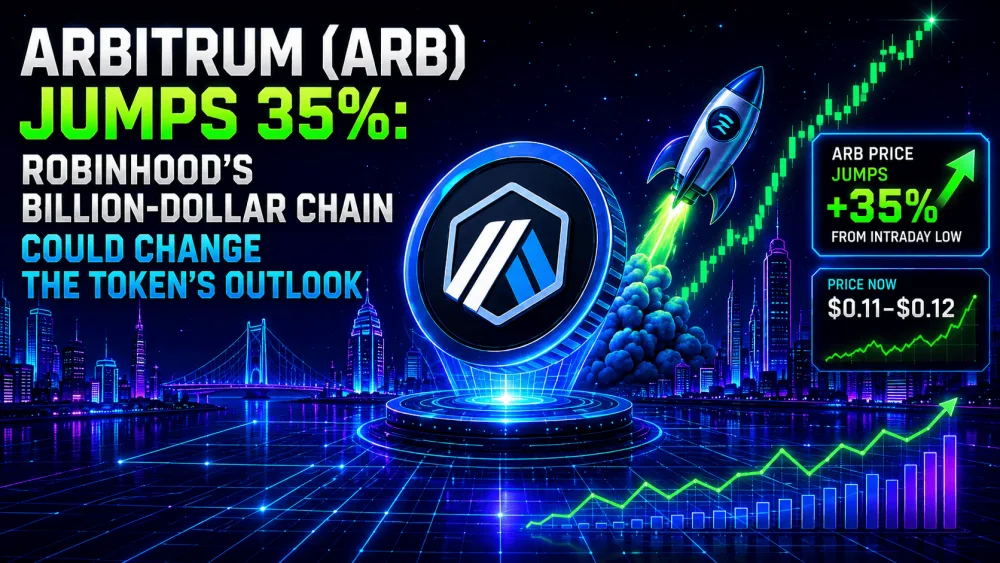
Arbitrum network is making a comeback on the cryptocurrency market as ARB▲$0.0808 jumped over 35% from its recent low. The token’s price is nearing $ 0.12, with Robinhood Chain emerging as a significant catalyst.
The exchange service built on Arbitrum technology is projected to boost trading and tokenized assets dramatically. Moreover, its revenue-sharing scheme may strengthen the outlook for the long-term prospects of Arbitrum.
Read more: Arbitrum Price Prediction 2026: Is ARB the Next 10x Crypto?
Contents
- Arbitrum (ARB) Jumps 35%: What Is Driving the Rally?
- Robinhood Chain Gives Arbitrum a New Revenue Stream
- Robinhood Chain Surpasses $1 Billion in TVL
- Arbitrum’s New Revenue Model Could Change the ARB Token Narrative
- Arbitrum’s ArbOS Elara Upgrade Adds Another Catalyst
- Arbitrum’s ZK Roadmap and Long-Term Growth Potential
- ARB Price Analysis: Can Arbitrum Sustain the Rally?
- The Biggest Risks for Arbitrum and ARB
- Arbitrum (ARB) Price Outlook: What Could Happen Next?
- Is Arbitrum (ARB) a Good Buy After the 35% Rally?
- FAQ
Arbitrum (ARB) Jumps 35%: What Is Driving the Rally?
ARB Price and Trading Volume
ARB broke out of its recent consolidation near $0.085 to roughly $0.12, rallying nearly 35% from its intraday low. Trading volume has also surged as buyers returned to the token after weeks of disappointment.
The price action indicates broad participation, and that buyers are taking advantage of the weak performance throughout most of August 2026.
Why Arbitrum Is Outperforming the Broader Crypto Market
Many who ask why Arbitrum ARB is rising are looking beyond simple altcoin momentum. The latest Arbitrum news fuels speculation that the network can generate value beyond its on-chain activity through increased revenue opportunities. Traders are turning to Arbitrum as a superior infrastructure play, and that has helped lift the price even as the broader crypto market struggles.
Robinhood Chain Gives Arbitrum a New Revenue Stream
How Robinhood Chain Is Built on Arbitrum
Robinhood Chain is an Ethereum Layer 2 blockchain built on the Arbitrum foundation. The network utilizes the Arbitrum technology for execution, but settles to Ethereum. Native ETH▲$1,761.17 is used as gas on the Robinhood Chain, rather than ARB.
The Layer 2 is focused on providing tokenized stock, trading, and lending products, and represents a significant expansion of the Arbitrum network beyond its flagship product.
Arbitrum Gets 10% of Net Protocol Revenue
The Robinhood Chain network has an agreement to provide 10% of the net protocol revenue back to the Arbitrum ecosystem, of which 8% will fund the ArbitrumDAO treasury, and 2% will go toward development.
The potential of off-chain revenue generation from networks built on Arbitrum has created a significant upgrade to the token’s outlook. Arbitrum Orbit has evolved from a technical experiment to a serious revenue-generating opportunity.
Why Robinhood’s Trading Activity Matters for ARB
Robinhood’s Chain has seen a volume explosion at the DEX, with recent days seeing multi-billion-dollar daily turnover. Such a large increase in activity will generate meaningful protocol revenue if it can be sustained.
The question is whether this can be turned into real profit and distributed to ARB holders through measures such as a dividend, or if the increased treasury will simply fund Arbitrum development.
Related: Arbitrum Warning: ARB Token Unlock Could Trigger Another Sell-Off — Is a Crash Coming?
Robinhood Chain Surpasses $1 Billion in TVL
The Robinhood Chain has seen its total value locked exceed the $1 billion mark, and while some of that value is represented by alternative assets, the network nonetheless attracted billions in just a few months of operations.
The TVL figures show the extent to which the Arbitrum blockchain can fuel a multi-chain Arbitrum enterprise ecosystem, and the value of the TVL on-chain will contribute to the protocol’s bottom line if it continues to grow at this rate.
Tokenized Stocks Become a Key Arbitrum Use Case
Robinhood initially launched its tokenized stock products on Arbitrum One, before migrating to its own chain. This integration has provided an important pipeline of users, products, and value to the Arbitrum ecosystem.
While tokenized stocks are only one component of Robinhood’s offerings, the product category overall provides a significant number of users and value, compared to many crypto-native offerings.
Can Real-World Assets Drive Arbitrum Network Activity?
Real-world assets have the potential to be a large-scale growth catalyst for the Arbitrum blockchain. Tokenized versions of stocks, funds, and credit products offer a steady-state source of value and transactions, compared to the often speculative nature of crypto-native assets.
Robinhood is just one example of a company that can provide an order of magnitude improvement in users, product depth, and value, compared to what a single Arbitrum-based crypto project could offer.
Arbitrum’s New Revenue Model Could Change the ARB Token Narrative
From Governance Token to Ecosystem Revenue Exposure
ARB has historically functioned mainly as a governance token for the Arbitrum network. Holders can vote on proposals, treasury decisions, and ecosystem changes. However, the token does not currently provide a direct yield from network activity.
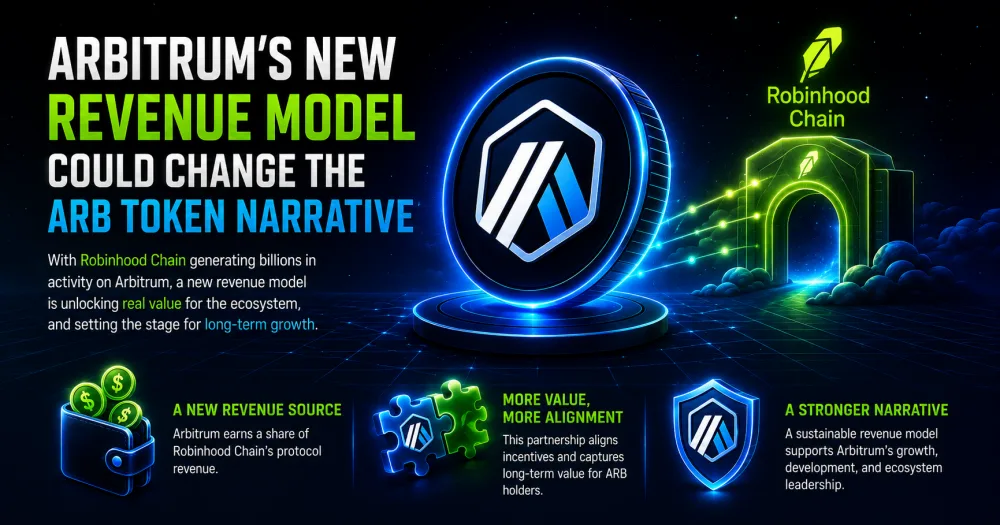
Under the new revenue model, chains built on Arbitrum can contribute part of their income to the ecosystem. These funds can support development, incentives, and future governance initiatives. Growing revenue from networks such as Robinhood Chain could therefore strengthen the broader ARB investment narrative.
Where Does Revenue From Orbit Chains Go?
Chains that qualify for the Arbitrum incentive program will fund 10% of their net protocol revenue to the Arbitrum Foundation, with 8% going to the ArbitrumDAO and 2% allocated to development.
This would apply to any qualifying Arbitrum-based chain, not just Robinhood. If multiple Arbitrum-based blockchains participate and generate significant revenue, it could create a meaningful yearly budget for the foundation to fund development and potentially distribute to token holders.
Why Revenue Growth Could Matter for ARB Holders
Revenue growth does not currently create a direct yield for ARB holders. Investors should therefore avoid treating ARB as a dividend-paying token.
Instead, higher Arbitrum revenue can strengthen the ecosystem treasury and finance further development. Greater financial resources may support incentives, infrastructure, or future governance proposals. A direct distribution to holders remains possible only if governance approves such a mechanism.
Related: Top Staking Coins for Passive Crypto Income in 2026
Arbitrum’s ArbOS Elara Upgrade Adds Another Catalyst
Compliance Tools for Dedicated Arbitrum Chains
ArbOS Elara introduces optional compliance filtering at the protocol level for dedicated Arbitrum blockchains. This allows operators of these chains to define filters and execute transactions against them. The feature is not available on Arbitrum One, and is designed for regulated markets.
Priority Fees and Higher Smart Contract Capacity
Elara introduces priority fee support for dedicated Arbitrum chains. Operators can use these fees to prioritize certain transactions when the feature is enabled. Arbitrum One would require separate changes before adopting a similar system.
Another improvement increases the Stylus contract size limit from 24KB to 96KB. Developers can deploy larger and more complex applications without splitting code across several contracts. As a result, some projects could reduce complexity and lower associated gas costs.
Why Elara Could Attract More Businesses to Arbitrum
Companies often have requirements such as regulatory compliance, cost predictability, and customization. These are addressed by the new features in the Arbitrum Elara upgrade and will likely increase institutional adoption of the blockchain.
Robinhood Chain demonstrates the potential value of the feature, as it applies to financial products. Companies will now be able to utilize Arbitrum’s technology, while still retaining sufficient control and oversight of their operations.
Arbitrum’s ZK Roadmap and Long-Term Growth Potential
Arbitrum’s Move Toward Production-Grade ZK Proving
Arbitrum research is continuing to advance the capabilities of zero knowledge proving. The team has outlined a roadmap that would allow proofs of Arbitrum blocks to be generated using the same state transition logic as the optimistic Arbitrum code. These proofs would then be added to the main Nitro codebase, rather than being a separate development.
Could ZK Technology Improve Arbitrum’s Scalability?
ZK proving has the potential to improve Arbitrum performance and infrastructure by reducing settlement times and improving capital efficiency. At present, optimistic procedures still require the challenge period to be in place for certain types of withdrawals.
A multi-prover architecture that utilizes fraud proofs, along with zk-proofs and third-party attestation, might be able to deliver faster settlement times than are currently possible. This would be valuable for bridges, exchanges, and institutional financial applications.
ARB Price Analysis: Can Arbitrum Sustain the Rally?
ARB Breaks Out From Its 2026 Lows
ARB dropped to $0.07 during 2026 before recovering. The latest rally has pushed Arbitrum price action back toward the $0.10-$0.12 region earlier this month.
While this looks like an opportunity for traders, it is important to remember that a single-day rally is not enough to reverse a downtrend.
Key ARB Resistance Levels to Watch
The first key level is $0.12. ARB already tested that region during the latest surge. A sustained break could shift attention toward $0.15.
If the price can move convincingly above this level, the next target would be the $0.19-$0.23 region. A rally that breaks above this level would indicate broad-based buying interest.
What Would Confirm a Larger ARB Reversal?
The price action of late looks like a promising setup for traders, but it is still not enough to signal a trend change. To continue higher, ARB will need to post follow-through buying and close out its weekly time frame above the $0.12 and then $0.15 level.
This will be significantly more compelling if the underlying business fundamentals continue to improve, particularly if Robinhood is delivering higher revenues.
The Biggest Risks for Arbitrum and ARB
Token Unlocks Could Increase Selling Pressure
One of the biggest risks for Arbitrum and the ARB token is the ongoing token unlock schedule. More tokens will come on the market before the program ends in 2027.
It is important to note that a token unlock does not necessarily indicate that selling pressure will increase, but it does take away potential buying power if the market is weak at the time of a large weekly unlock.
Robinhood Chain Growth Does Not Automatically Increase ARB Demand
As mentioned previously, Robinhood Chain utilizes ETH rather than ARB for its gas, and therefore increased activity on this chain does not directly contribute to additional demand for the token.
While the Robinhood business model still favors the Arbitrum network, investors should view the two assets as separate.
ARB Still Faces a Long Recovery From Its 2026 Low
Despite the recent rally, ARB is still a long way from its peak. The token has struggled throughout most of 2026, and there is still a very long road back to previous levels. This means strong follow-through buying will be needed before investors consider initiating long positions.
Arbitrum (ARB) Price Outlook: What Could Happen Next?
Bull Case: Robinhood Drives a New Growth Cycle
The bullish Arbitrum price scenario would see the Robinhood business continue to drive adoption and revenue for the network. This would provide a significant boost to the token price, which could trade near $0.12 and challenge $0.15 in the near term. A stronger Arbitrum price scenario would see the token climb toward the $0.19-$0.23 region.
Base Case: ARB Consolidates After the Rally
The base case assumes that trading interest will fade after the recent Arbitrum price movement, and the token will consolidate near its recent low of $0.09 and $0.12. This would be a prudent move for traders, as it would allow the bulls to continue to build conviction ahead of the next potential move higher.
Bear Case: Supply Pressure Limits the Upside
The bear case assumes that price momentum will fade, and the price will fall toward $0.12 could send ARB back toward $0.09. If this level is rejected, it would open up the door for another test of the $0.07 region.
| Scenario | Key Driver | ARB Price Zone | What Could Confirm It |
|---|---|---|---|
| Bull Case | Robinhood Chain growth and rising Arbitrum revenue | $0.15–$0.23 | ARB holds above $0.12 and breaks $0.15 with strong volume |
| Base Case | Rally cools while fundamentals remain stable | $0.09–$0.12 | Price consolidates without returning to 2026 lows |
| Bear Case | Token unlocks and weaker buying pressure | $0.07–$0.09 | ARB loses $0.09 and fails to reclaim resistance |
| Long-Term Catalyst | Robinhood adoption, Elara and ZK development | Above $0.23 possible | Sustained revenue growth and stronger ARB value capture |
Is Arbitrum (ARB) a Good Buy After the 35% Rally?
Arbitrum now has a compelling value proposition that has attracted strong buying interest. Robinhood’s blockchain provides increased value for the network and the token, along with a large user base and significant daily trading volumes. Arbitrum’s strong product development road map, including Elara, also provides ample opportunity for continued price growth.
That said, ARB still represents a risky investment, as the increased revenues from Robinhood do not directly fund token purchases, the chain utilizes ETH rather than ARB for its gas, and large unlocks can put downward pressure on the price. Despite the improved outlook, patience will likely be a virtue for most ARB buyers, with aggressive investors poised to benefit from the next Arbitrum rally.
FAQ
Why Is Arbitrum ARB Rising?
ARB is rising as a result of renewed interest in the network. Robinhood’s blockchain has increased revenues and utilization for Arbitrum, while the Elara upgrade and zero knowledge proving roadmap provide ample opportunity for further growth.
Why Is ARB Crypto Up So Sharply?
The sharp increase in the price of ARB reflects both technical and fundamental catalysts. The token also appears to be cheap on a relative basis, which has fueled its recent price performance.
What Is Robinhood Chain on Arbitrum?
Robinhood Chain is a Layer 2 blockchain built on the Arbitrum infrastructure. It utilizes this technology to provide tokenized asset products and financial services.
Does Robinhood Chain Revenue Go to ARB Holders?
Not directly – the Arbitrum ecosystem receives 10% of the net revenue from Robinhood’s chain, but this does not go directly to ARB token holders.
What Is the ARB Price Prediction 2026?
A bullish Arbitrum price prediction would assume the price continues higher after breaking out from its recent lows. This would put pressure on the $0.085 to roughly $0.15 level, with a follow-through buying opportunity likely to propel the price toward the $0.085 to roughly $0.23 region. A bearish scenario would assume the price fails to hold above $0.09, which would threaten to lower the price toward $0.07.
What Is the Main Risk to the Arbitrum Price?
The main risk to Arbitrum’s price is weak conviction from buyers. There are a number of potential catalysts that could drive continued growth, but it is likely that most investors will wait for the price to show strength before buying. Another risk factor for the price is the token’s large supply, as weekly unlocks can put downward pressure on the price.