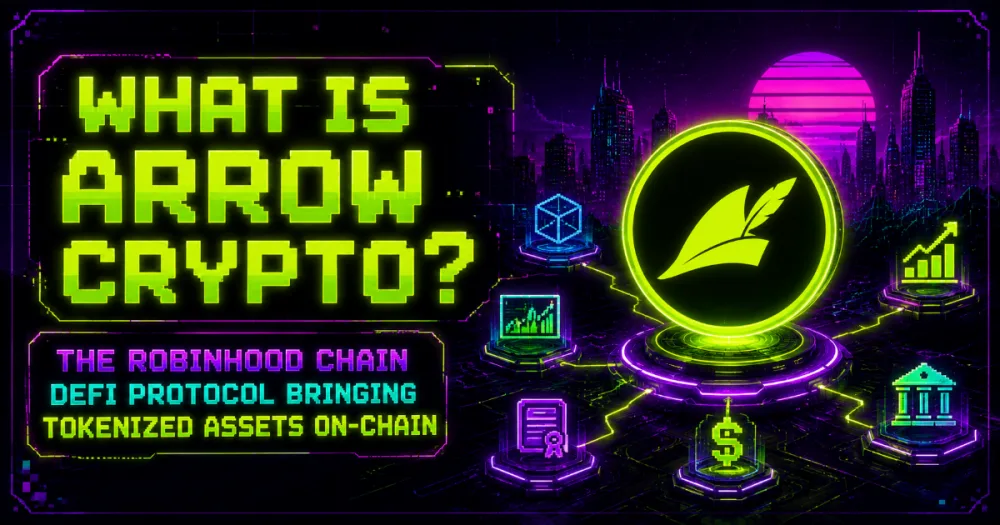
Users searching for what is Arrow crypto will find that Arrow Finance is a DeFi project under development on Robinhood Chain that offers borrowing, trading, and liquidity provisioning of tokenized financial products.
Contents
What Is Arrow Crypto?
Overview of Arrow Finance (ARROW)
The project seeks to serve as an entry point for users to manage their on-chain financial portfolios beyond just cryptocurrencies.
For users wondering what is Arrow Finance, the protocol is designed to support tokenized securities and other real-world assets alongside traditional crypto collateral.
Why Arrow Was Built on Robinhood Chain
Robinhood Chain is an Ethereum Layer 2 Blockchain supporting tokenized stocks, ETFs, and real-world assets on the Ethereum network, using Arbitrum’s infrastructure to replicate the Ethereum security model while benefiting from reduced fees and faster transaction times.
Read More: What Is Arcium Crypto? A Deep Dive Into the Next Big Privacy Blockchain
That leads to a network ideal for Arrow, allowing protocol developers to build lending and liquidity solutions around tokenized financial instruments rather than cryptocurrencies.
How Arrow Fits Into the Tokenized RWA Ecosystem
With the growth of RWA crypto, DeFi protocols needed a way to use tokenized assets as productive collateral. Robinhood Chain simplifies the adoption of tokenized stocks and tokenized ETFs within decentralized finance.
For anyone asking what is ARROW crypto, it represents the governance asset of a lending ecosystem where users can unlock liquidity from tokenized assets instead of simply holding them.
| Feature | Arrow Finance |
| Blockchain | Robinhood Chain |
| Network Type | Ethereum Layer 2 built on Arbitrum |
| Category | DeFi lending and liquidity protocol |
| Governance Token | ARROW |
| Native Stablecoin | aUSD |
| Collateral Types | Crypto, tokenized stocks, tokenized ETFs, stablecoins |
| Lending Model | Overcollateralized CDP |
| Primary Focus | Tokenized real-world assets (RWAs) |
| Smart Contract Compatibility | EVM |
| Main Use Case | Borrowing against tokenized assets without selling them |
How Arrow Finance Works
The Overcollateralized CDP Model Explained
How Arrow Finance works centers on an overcollateralized collateralized debt position (CDP) model. Users lock approved collateral in an individual vault and mint aUSD against it, while every position maintains collateral worth more than the outstanding debt.
Vaults all run independently from one another, allowing risk to be assessed on a position level.
The protocol also defines an LTV ratio as well as a liquidation threshold for each supported asset, allowing a vault to be liquidated if the collateral’s value drops below the specified ratio.
Minting aUSD Using Crypto and Tokenized Assets
Via Arrow Finance protocol, aUSD can be minted by depositing permissioned crypto assets, stablecoins, or tokenized equities and ETFs supported on Robinhood Chain. Risk parameters unique to each market determine the mintable amount of aUSD per collateral type.
Once the principal and accrued fees are paid off, the collateral can immediately be withdrawn again. This means holders can achieve liquidity without selling the underlying collateral.
Redemption Mechanism and Price Stability
However, project documentation claims each aUSD is backed by overcollateralized vaults, so liquidations ensure that collateral value always exceeds the stablecoin supply value.
A market-based redemption mechanism, designed to strengthen the peg, has been proposed, but has yet to be deployed in the current testnet.
Thus, the current phase of protocol development relies on conservative collateralization requirements and risk controls to ensure price stability.
Stability Pool, Liquidations, and Protocol Solvency
The protocol’s Stability Pool automatically repays undercollateralized vaults to reduce bad debt and receives the underlying collateral at a discount. As a result, liquidity providers are provided incentives to maintain the protocol’s solvency and the value of underlying collateral.
To avoid insolvency, Arrow imposes debt ceilings, market-specific risk parameters, oracle pricing, and a Surplus Buffer, which absorbs losses before users are affected, funded through protocol fees.
What Makes Arrow Different From Other DeFi Lending Protocols?
Supporting Tokenized Stocks, ETFs, and RWAs as Collateral
One Arrow Finance feature is support for non-crypto collateral. According to the documentation, users can pledge crypto-assets, stablecoins, tokenized equities, and tokenized exchange-traded funds on Robinhood Chain to mint aUSD through overcollateralized vaults.
Read More: Best Blockchain API Providers for Fast Web3 Data in 2026
The model also highlights Robinhood Chain’s focus on tokenized assets, allowing DeFi applications to leverage real world financial instruments alongside cryptocurrencies.
Comparison with MakerDAO, Liquity, and Morpho
Arrow, like MakerDAO, issues a stablecoin through an overcollateralized CDP model, the main difference being support for tokenized stocks and ETFs on Robinhood Chain. Unlike Arrow, Liquity only allows for ETH▲$1,761.17-collateralized lending, and Morpho has decentralized lending markets.
Why Robinhood Chain Changes the DeFi Lending Model
Robinhood Chain DeFi allows developers to use Ethereum-compatible infrastructure to build lending and trading applications for real-world assets.
The ecosystem has also discussed Arrow Finance review in the context of how tokenized securities can serve as productive collateral, expanding DeFi lending beyond purely crypto collateral.
| Feature | Arrow Finance | MakerDAO | Liquity | Morpho |
| Primary Focus | Lending against tokenized assets | Decentralized stablecoin | ETH-backed borrowing | Decentralized lending markets |
| Stablecoin | aUSD | DAI▲$0.9998 | LUSD | No native stablecoin |
| Main Collateral | Crypto, tokenized stocks, ETFs, RWAs | Crypto and selected RWAs | ETH | Crypto assets |
| Lending Model | Overcollateralized CDP | Overcollateralized CDP | Overcollateralized CDP | Peer-to-peer lending markets |
| Native Blockchain | Robinhood Chain | Ethereum | Ethereum | Ethereum and L2 networks |
| Governance Token | ARROW | MKR | LQTY | MORPHO▼$1.95 |
ARROW Tokenomics
ARROW Token Utility
For readers looking for Arrow Finance tokenomics explained, the ARROW token utility is centered on protocol governance.
In Arrow Finance’s documentation, it states that ARROW holders may lock ARROW in order to receive veARROW, a governance token that has a greater voting power when locked for a longer time period. The model seeks to encourage governance participation in the long term rather than short-term speculation.
Due to the ability to customize aspects such as collateral onboarding, loan-to-value, liquidation, fee parameters, and other protocol parameters through veARROW, ARROW is expected to be the main asset that will act as a source of protocol coordination.
Governance and Protocol Parameter Voting
Arrow Finance governance is designed to give the community more control over protocol parameters, including risk settings, collateral eligibility, fees, and treasury decisions.
Voting power is based on veARROW rather than unlocked token balances, incentivizing long-term participation in governance.
Token Supply, Distribution, and Emissions
While ARROW token price is determined by market supply and demand, the circulating supply is about 9 million ARROW out of a fixed total and maximum supply of 10 million tokens.
Supply numbers are public, but Arrow Finance has not disclosed token distribution, vesting schedules, and emissions in its documentation.
Is ARROW an Inflationary or Fixed-Supply Token?
As of market data’s publication date, ARROW tokenomics adheres to a design with a fixed supply, with its maximum supply identical to its total supply: 10 million tokens. An inflationary approach of token issuance or minting is not currently described in available official documents.
Although ARROW token price prediction is a common search topic, no official roadmap or governance proposal currently provides guidance on the token’s future valuation.
Robinhood Chain and Why It Matters for Arrow
Robinhood Chain’s Focus on Tokenized Real-World Assets
Robinhood Chain is an Ethereum Layer 2 permissionless blockchain, which is intended to provide blockchain based financial services such as tokenization of real world assets. According to the company, the network is for tokenized equities, ETFs, private assets, and other financial instruments in dApps.
Tsaritsa also is involved in real world assets crypto, building infrastructure that connects customary finance with blockchain-based markets.
EVM Compatibility, Ethereum Security, and Arbitrum Infrastructure
Robinhood Chain is fully EVM-compatible and a Layer-2 network built on Arbitrum capable of deploying Ethereum-compatible smart contracts at a fraction of the cost, while retaining Ethereum-based security.
Read More: The Next Solana? Emerging Blockchain Projects Gaining Massive Attention
It also supports standard wallets and developer tools, lowering the barrier to entry for projects within the Robinhood Chain ecosystem.
How Arrow Benefits from Robinhood Chain’s Growing Ecosystem
For Arrow Finance, the new network infrastructure allows for the lending and liquidity of their tokenized financial assets. Robinhood Chain supports service providers such as Chainlink, LayerZero, Alchemy, Uniswap and Morpho.
With Robinhood Chain projects growth, Arrow is positioned to provide liquidity and allow loans against tokenized financial assets within this ecosystem.
Arrow Finance Use Cases
Borrowing Without Selling Tokenized Assets
Among the main ARROW token use cases is participation in protocol governance, while Arrow Finance enables users to borrow aUSD against existing positions without selling their collateral.
Users may also deposit cryptocurrencies, stablecoins, or tokenized equities as collateral to mint aUSD, while still maintaining exposure to their underlying asset and on-chain liquidity.
The importance of this model is that, for tokenized stocks, liquidity can be realized without selling their ownership of the stock or transferring networks.
Unlocking Liquidity From Stock Tokens and Crypto
The protocol supports cryptocurrencies, stablecoins, tokenized stocks, and exchange-traded funds (ETFs), which are issued on Robinhood Chain, the protocol’s proprietary blockchain. Borrowing limits are separate by asset class, and loan-to-value (LTV) ratios are defined by the protocol’s risk framework.
This model of coupling customary digital assets with tokenized securities within a unified lending marketplace has underscored the potential of tokenized assets within DeFi.
Leveraging DeFi Strategies With aUSD
Once minted, borrowers can put aUSD to use in supported DeFi applications without needing to unlock their collateral. This implementation was proposed with the intention that people could put the assets to work while maintaining upside exposure to the performance of the underlying collateral.
In the future, as Robinhood Chain DeFi ecosystem develops, aUSD will support more lending, trading, and liquidity opportunities involving tokenized financial assets.
Governance Participation Through ARROW
ARROW holders are expected to participate in controlling the protocol through a veARROW vote-escrow model, which will launch after the testnet phase. Once in use, tokens may be deposited to grant voting power, which grows in proportion to a token’s balance and lock duration.
In addition, the community will directly vote on all items related to the protocol’s future and risk management, including the onboarding of new collateral types, adjustment of risk parameters, fee curves, and Surplus Buffer.
| Use Case | How Arrow Finance Supports It |
| Borrow Against Collateral | Mint aUSD without selling crypto or tokenized assets |
| Unlock Liquidity | Use tokenized stocks, ETFs, stablecoins, and crypto as collateral |
| Retain Market Exposure | Keep ownership of collateral while accessing liquidity |
| DeFi Participation | Use aUSD in supported lending, trading, and liquidity protocols |
| Portfolio Capital Efficiency | Put idle assets to work without liquidating long-term holdings |
| Protocol Governance | Lock ARROW for veARROW to vote on protocol parameters and risk management |
Is Arrow Crypto a Good Investment?
Growth Opportunities
The success of is Arrow crypto a good investment story will depend on Robinhood Chain adoption and its tokenized asset ecosystem.
Robinhood also promoted the network as an infrastructure for tokenized stocks, ETFs, and other real-world assets, and as the basis for DeFi protocols around those assets.
Arrow is designed to be the main DeFi application of Robinhood Chain, including features such as borrowing, trading, liquidity aggregation, and portfolio management. This use is expected to expand if tokenized assets are used on the network.
Key Risks Investors Should Understand
As an emerging protocol, Arrow Finance has governance and other ecosystem features in development, but also carries the risks typically associated with DeFi protocols that support tokenized financial assets, including smart contract, liquidity, and regulatory risks.
Notably, for Arrow to achieve long-term sustainable success as a protocol, Robinhood Chain must attract developers, liquidity, and users, and adoption of the larger ecosystem should not be discounted in this regard.
Competition Within the Robinhood Chain Ecosystem
Infrastructure providers and DeFi projects that use Robinhood Chain include Chainlink, LayerZero, Alchemy, Morpho, and Uniswap, making it an increasingly competitive network to create new projects.
When searching for Arrow Finance review, it is frequently highlighted that the protocol’s focus is on the lending/borrowing and liquidity markets for tokenized financial assets instead of competing across every segment of the DeFi market. Long-term success will depend on execution, ecosystem, and user adoption on Robinhood Chain.
| Potential Opportunities | Key Risks |
| Growth of Robinhood Chain ecosystem | Early-stage protocol under active development |
| Rising adoption of tokenized stocks and RWAs | Smart contract vulnerabilities |
| Increasing demand for DeFi lending | Liquidity constraints in a new ecosystem |
| Expansion of tokenized asset markets | Regulatory uncertainty around tokenized securities |
| Growing utility of ARROW governance | Competition from established DeFi protocols |
| New ecosystem integrations and partnerships | Success depends on Robinhood Chain adoption |
How to Buy ARROW Crypto
Where ARROW Is Available
Users wondering how to buy ARROW token can currently find it on several centralized and decentralized exchanges. CoinGecko lists it on the centralized exchange CoinW and the decentralized exchanges Uniswap V2, V3, and V4 on Robinhood Chain, a layer-2 network on Ethereum.
Before trading, investors should verify that they are interacting with Arrow Finance’s official token contract address via Arrow Finance’s official channels or reputable market aggregators.
Setting Up a Robinhood Chain-Compatible Wallet
Robinhood Chain is EVM-compatible, meaning supported Ethereum wallets such as MetaMask, Rabby, or Robinhood Wallet can be used after the network is added. Robinhood chain uses ETH as gas and standard Ethereum tooling.
Once the wallet is set up and loaded with ETH, users can interact with decentralized apps and swap Robinhood Chain tokens.
Swapping and Storing ARROW Securely
A user can acquire ARROW by swapping for it on Robinhood Chain decentralized exchanges once their wallet has been connected, or by purchasing it on centralized exchanges that support it and withdrawing it to their self-custody wallet.
For the long-term storage of ARROW, users should use non-custodial wallets and ensure they have their wallet recovery phrase securely saved, and check transaction details before signing any transaction.
Arrow Finance Roadmap and Future Outlook
Ecosystem Expansion Plans
According to the latest Arrow Finance roadmap, the goal is for the protocol to become the go-to DeFi product suite on Robinhood Chain. The product suite includes a crypto liquidity aggregator, a yield marketplace, a CDP lending product, a professional trading terminal, and a token launchpad.
The vision for Robinhood Chain ecosystem is that it should serve as the main hub for trading, borrowing, earning, launching, and managing on-chain assets.
Expected Integrations Across Robinhood Chain
Future development is likely to build on top of the wider Robinhood Chain ecosystem. Chainlink, Alchemy, LayerZero, BitGo, Fireblocks, Uniswap, Morpho, and Paxos are all integrated with the chain and provide infrastructure for lending, trading, cross-chain interoperability, price oracles, and liquidity.
With the launch of additional applications on Robinhood Chain, Arrow intends to aggregate liquidity and lending opportunities across the chain, rather than operate as a standalone entity.
Long-Term Adoption Catalysts
The long-term Arrow Finance crypto potential depends mainly on Robinhood’s plans to bring tokenized stocks, ETFs, and other physical assets on-chain for trading, borrowing, and lending, and other DeFi use cases on their Layer-2 network.
If the adoption of tokenized financial assets continues to grow, Arrow may benefit from increased user activity and demand for specialized lending and liquidity services in the market.
FAQ
What Is ARROW Used For?
Users asking what is ARROW token is should know that ARROW is the native governance token of the Arrow Finance protocol. Locked ARROW tokens for veARROW are utilized by holders to vote on protocol parameters, including collateral onboarding, risk parameters, and fees.
What Is aUSD?
The protocol’s overcollateralized stablecoin, aUSD, is minted when someone deposits eligible collateral into a vault, and it can be redeemed after paying outstanding debt and fees.
Can Tokenized Stocks Be Used as Collateral?
Yes. Arrow Finance supports tokenized stocks, ETFs and other tokenized real-world assets as well as cryptocurrencies and stablecoins for collateral, subject to risk parameters set by the protocol.
Is Arrow Finance the Official Lending Protocol on Robinhood Chain?
Arrow Finance writes that although the native lending and CDP protocol is still being built for the chain, Robinhood Chain is compatible with many other decentralized finance (DeFi) products and services, meaning many lending and loan products are available on the chain.
What Makes Arrow Different From MakerDAO and Liquity?
Unlike MakerDAO and Liquity, which are based on crypto-native collateralization, Arrow relies on Robinhood Chain’s tokenized asset infrastructure, which allows Arrow to accept a variety of tokenized equities, ETFs, and real-world asset (RWA) collateral, in addition to standard crypto-collateralized loans.